
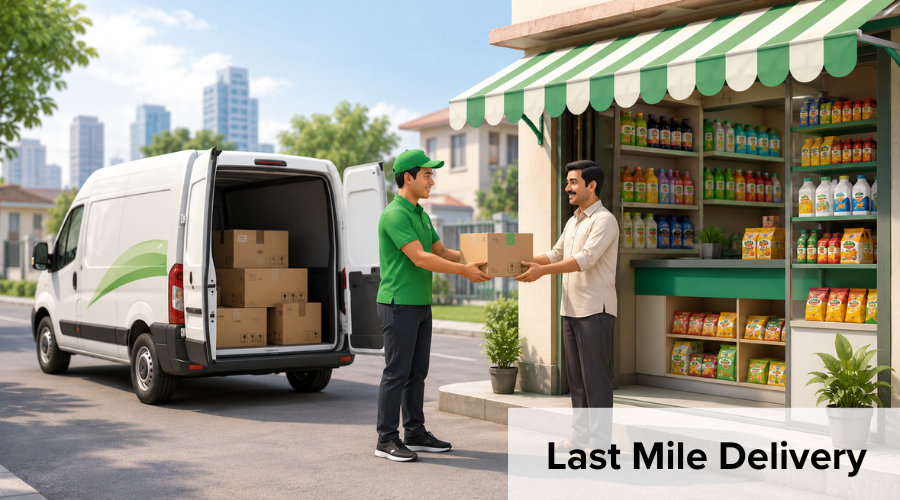
Last Mile Delivery
Last Mile Delivery is the final stage of the supply chain in which a product moves from a local distribution hub, warehouse, or retail center to the end customer’s doorstep or retail outlet. It is the most critical step because it represents the final touchpoint between the business and the customer.
This stage is also the most complex and expensive part of logistics, often accounting for over 50% of total shipping costs, making last mile logistics management a key focus area for modern supply chains.
Why Last Mile Delivery is the Most Critical Stage
The importance of last mile delivery goes beyond transportation, it directly impacts customer experience, brand perception, and operational profitability.
Key reasons include:
-
High operational cost: Inefficiencies such as urban traffic congestion, multiple delivery stops, failed attempts, and route deviations significantly increase expenses
-
Direct customer interaction: It is the only supply chain stage where customers interact directly with a delivery person, making it a direct reflection of the brand
-
Speed expectations: Customers increasingly expect fast fulfillment, including same-day or next-day delivery
-
Service reliability impact: Delays or failed deliveries directly affect customer satisfaction and loyalty
A strong last mile delivery optimization strategy is essential to balance cost, speed, and service quality.
Core Elements of Efficient Last Mile Delivery
Effective last mile delivery systems rely on structured execution and technology integration:
Route Optimization:
Designing efficient delivery routes to minimize time, fuel usage, and cost.
Real-Time Tracking:
Monitoring delivery agents and vehicles using GPS for better visibility.
Delivery Scheduling:
Assigning time slots to improve delivery success rates.
Proof of Delivery (POD):
Digital confirmation through OTP, signature, or image capture to validate successful delivery.
Exception Handling:
Managing failed deliveries, rescheduling, and customer communication efficiently.
How to Improve Last Mile Delivery Performance
Organizations can improve efficiency and customer experience by adopting modern logistics practices:
-
Implementing AI-based route optimization systems
-
Using GPS-enabled real-time delivery tracking
-
Reducing failed deliveries through better scheduling
-
Digitizing proof of delivery workflows
-
Improving coordination between warehouse and delivery teams
-
Training delivery personnel for customer interaction and efficiency
Strategic Importance in Modern Supply Chains
Last mile delivery is no longer just a logistics function, it is a customer experience driver and a major cost center in the supply chain. Companies that optimize this stage gain a significant advantage in speed, efficiency, and brand trust.
It is also the stage where operational execution meets customer expectations, making it a key differentiator in competitive markets.
Last mile delivery defines how customers perceive a brand in real time. Efficient execution ensures faster deliveries, lower costs, and stronger customer relationships, making it one of the most important pillars of modern logistics and distribution systems.