
Sales Pipeline Management
Sales pipeline management is the systematic process of tracking, organizing, and guiding prospective buyers through the stages of your sales cycle. It empowers sales teams to remove bottlenecks, reliably forecast revenue, and ensure that deals progress efficiently from initial contact to successful closure.
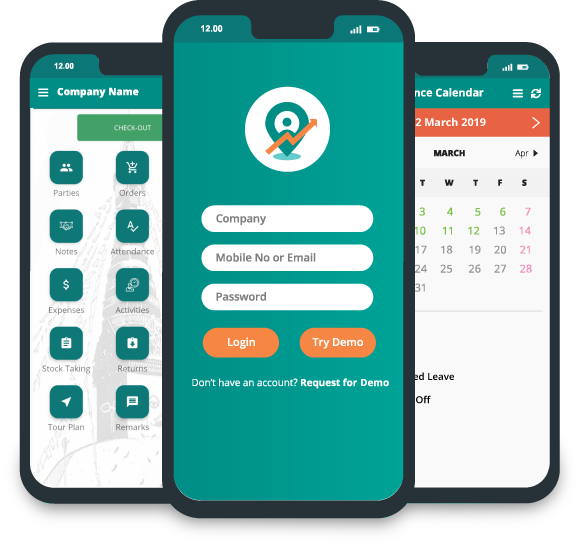
In modern organizations, pipeline management software is widely used to improve forecasting accuracy and sales execution efficiency.
Stages of a Sales Pipeline
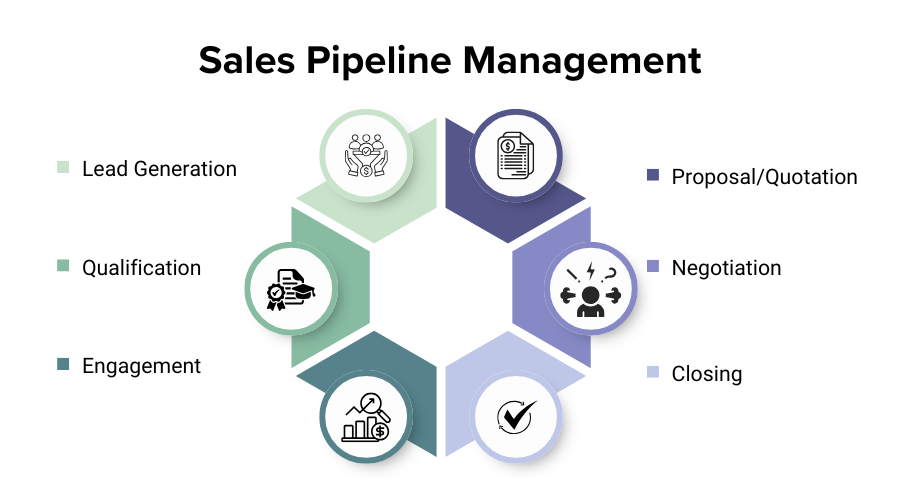
A typical sales pipeline consists of multiple sequential stages that represent the customer journey:
Lead Generation:
Identifying and capturing potential customers through marketing campaigns, field visits, or referrals.
Qualification:
Assessing whether leads match the ideal customer profile and have real purchase intent.
Engagement:
Building relationships through communication, product demonstrations, and follow-ups.
Proposal/Quotation:
Sharing pricing, offers, or proposals based on customer requirements.
Negotiation:
Discussing terms, resolving objections, and finalizing deal conditions.
Closing:
Converting the lead into a paying customer and completing the transaction.
Why Sales Pipeline Management is Important
Effective pipeline management helps businesses maintain control over their sales process and improve revenue predictability.
Key benefits include:
-
Better visibility into deal progression
-
Improved sales forecasting accuracy
-
Higher conversion rates across stages
-
Reduced leakage of potential opportunities
-
Improved sales team productivity and focus
-
Faster decision-making based on pipeline data
A strong sales pipeline management strategy ensures consistent movement of deals through every stage.
Key Components of Sales Pipeline Management
Sales pipeline management relies on structured tracking and analysis:
Lead Tracking:
Monitoring all incoming prospects and their source.
Deal Staging:
Categorizing opportunities based on where they are in the sales cycle.
Conversion Analysis:
Measuring how many leads move from one stage to the next.
Follow-up Management:
Ensuring timely communication to avoid losing opportunities.
Performance Monitoring:
Tracking individual and team-level sales performance.
How Sales Pipeline Management Works
Sales pipeline management operates through a continuous cycle:
-
Leads are captured from multiple sources
-
Each lead is assigned a pipeline stage
-
Sales teams nurture and engage prospects
-
Deals are updated as they progress through stages
-
Managers monitor pipeline health through dashboards
-
Forecasts are generated based on pipeline data
Modern CRM-based sales pipeline management systems help automate tracking and improve visibility across the entire sales process.
How to Improve Sales Pipeline Management
Businesses can improve pipeline effectiveness by adopting structured practices:
-
Using CRM and automation tools for tracking
-
Standardizing pipeline stages across teams
-
Improving lead qualification processes
-
Ensuring timely follow-ups and reminders
-
Monitoring conversion rates at each stage
-
Using data analytics for forecasting improvements
Sales pipeline management is not just tracking leads, it is a structured approach to managing opportunities, improving sales efficiency, and ensuring that every potential deal moves smoothly toward conversion.