
Sell-In vs Sell-Out
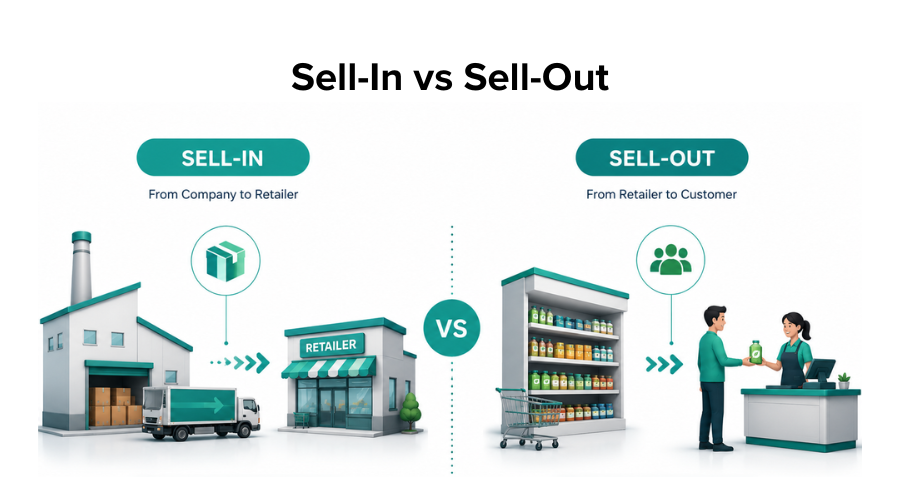
Sell-In and Sell-Out are two important sales metrics used in FMCG, retail, and distribution businesses to measure product movement across the supply chain.
Sell-In refers to the sales made by a manufacturer or brand to distributors, wholesalers, or retailers. It measures how much inventory is pushed into the distribution channel.
Sell-Out refers to the sales made by retailers or distributors to end consumers. It measures actual customer demand and product consumption in the market.
Understanding sell-in vs sell-out in FMCG distribution helps businesses evaluate channel performance, optimize inventory levels, and make informed sales and production decisions.
Sell-In vs Sell-Out: Key Differences
|
Sell-In |
Sell-Out |
|---|---|
|
Sales from manufacturer to distributor or retailer |
Sales from retailer to end customer |
|
Measures channel inventory movement |
Measures actual consumer demand |
|
Focuses on product placement |
Focuses on product consumption |
|
Used for production and distribution planning |
Used for demand forecasting and market analysis |
|
Can increase inventory in the channel |
Reduces inventory from retail shelves |
Why is Sell-In Important?
Sell-In helps manufacturers understand how much stock is entering the market through distributors and retailers.
Benefits of Sell-In
-
Supports production planning.
-
Improves distributor stock availability.
-
Expands market coverage.
-
Helps achieve primary sales targets.
-
Measures channel distribution performance.
Tracking sell-in sales performance enables companies to ensure products are available across their distribution network.
Why is Sell-Out Important?
Sell-Out provides visibility into actual consumer purchases and market demand.
Benefits of Sell-Out
-
Measures real customer demand.
-
Improves demand forecasting accuracy.
-
Reduces excess inventory.
-
Identifies fast-moving and slow-moving products.
-
Supports better inventory and replenishment decisions.
Monitoring sell-out sales data in FMCG companies helps businesses align supply with consumer demand and improve retail execution.
Why Should Businesses Track Both Sell-In and Sell-Out?
Focusing only on Sell-In can create a false impression of market performance because products may be sitting in distributor or retailer inventory without being sold to consumers.
A healthy business maintains a balance between sell-in and sell-out sales management. When Sell-Out consistently matches or exceeds Sell-In, it indicates strong market demand and efficient inventory movement.
Large gaps between Sell-In and Sell-Out may signal:
-
Overstocking in the channel.
-
Slow product movement.
-
Demand forecasting issues.
-
Distribution inefficiencies.
-
Retail execution challenges.
Sell-In vs Sell-Out in FMCG Companies
In FMCG businesses, both metrics play a critical role in managing distribution networks and ensuring product availability.
By analyzing sell-in vs sell-out in FMCG distribution, companies can:
-
Improve inventory planning.
-
Optimize stock replenishment.
-
Monitor distributor performance.
-
Increase retail availability.
-
Reduce stockouts and excess inventory.
-
Enhance overall supply chain efficiency.
Sell-In and Sell-Out are essential metrics for measuring sales performance across the distribution channel. While Sell-In tracks inventory movement from manufacturers to distributors or retailers, Sell-Out measures actual consumer purchases. Understanding the difference between sell-in and sell-out sales helps businesses improve demand forecasting, optimize inventory management, and drive sustainable growth through better distribution and retail execution.