
Effective Strategies for Boosting Profit Margins in FMCG Companies

Fast-Moving Consumer Goods industry is one of the most competitive sectors globally, where profit margins are often tight, and growth opportunities can be limited. FMCG companies, whether large multinational brands or small emerging companies, are constantly exploring ways to increase their profit margins. This is crucial not only for staying competitive in the market but also for ensuring long-term business sustainability.
Many FMCG companies focus heavily on expanding their customer base but often overlook the operational inefficiencies that silently reduce profitability. High logistics costs, excess inventory, poor retail execution, ineffective pricing strategies, and limited visibility into field sales operations can significantly impact the bottom line.
In this comprehensive guide, we'll explore the factors affecting FMCG profitability, practical strategies to improve margins, the role of technology, and best practices that help businesses achieve long-term, sustainable growth.
Understanding Profit Margins in the FMCG Industry
Profit margins represent one of the key financial parameters for any FMCG company. This metric reveals the amount of profit made by a company after all the costs for production, logistics, and sale of their products.
As opposed to luxury or specialty products, the margin for FMCG products is generally low due to strong market competition and price sensitivity. As such, any minor changes in operational efficiencies have a huge impact on profitability.
These are the main three profit indicators that must be tracked by all FMCG companies:
- Gross Profit Margin
- Operating Profit Margin
- Net Profit Margin
All these metrics provide important information about different performance aspects of the business. The companies with high profit margins will have more resources to innovate, market, expand their logistics and acquire customers.
Here are some operational factors affecting the business profitability:
- Product pricing
- Procurement costs
- Manufacturing expenses
- Warehouse management
- Distribution efficiency
- Retail execution
- Sales productivity
- Customer retention
Organizations that continuously improve these areas are more likely to achieve consistent business growth while maintaining healthy margins.
Why Profit Margins Are Shrinking in FMCG Companies
Many FMCG companies experience declining profit margins despite increasing sales volumes. Operational costs often rise faster than revenue, making it difficult to sustain profitability. Understanding these challenges helps businesses implement effective strategies before margins decline further.
Rising Raw Material Costs
Fluctuating raw material prices increase manufacturing expenses. Without timely pricing adjustments or cost optimization, businesses absorb higher costs, directly reducing overall profit margins.
Increasing Distribution Expenses
Higher transportation, fuel, warehousing, and delivery costs significantly impact profitability. Efficient supply chain optimization helps reduce logistics expenses while ensuring timely product distribution.
Inefficient Inventory Management
Poor inventory management causes overstocking, stockouts, and excess storage costs. Maintaining optimal inventory levels improves cash flow, minimizes waste, and prevents lost sales opportunities.
Poor Retail Execution
Weak retail execution leads to empty shelves, poor product visibility, and ineffective promotions. Consistent merchandising and product availability help maximize sales and customer satisfaction.
Low Field Sales Productivity
Inefficient field sales management reduces customer visits and selling time. Automating routine tasks enables sales representatives to improve productivity and generate higher revenue.
Pricing Pressure
Intense market competition often forces businesses to reduce prices. Without strategic pricing decisions, frequent discounts can lower profit margins despite increasing overall sales volumes.
Lack of Business Visibility
Limited real-time reporting restricts decision-making and performance monitoring. Better business visibility enables managers to identify inefficiencies quickly and take corrective actions to improve profitability.
Key Factors That Impact FMCG Profitability
Several interconnected factors influence whether an FMCG business can maintain healthy profit margins. By optimizing these areas, companies can reduce costs, improve operational performance, and achieve sustainable business growth.
Cost Control
Controlling operational expenses is essential for improving profitability. Regular cost analysis across manufacturing, procurement, logistics, and distribution helps eliminate inefficiencies without compromising product quality or customer satisfaction.
Sales Performance
Strong sales performance depends on more than higher sales volumes. Improving conversion rates, increasing average order value, and using sales analytics help businesses maximize revenue and improve profit margins.
Distribution Network
An efficient distribution network reduces transportation costs and ensures timely product availability. Effective distributor management improves order fulfillment, inventory movement, and retailer satisfaction, supporting long-term profitability.
Operational Efficiency
Manual processes often increase costs, delays, and human errors. Enhancing operational efficiency through automation streamlines workflows, improves productivity, reduces administrative work, and boosts overall business performance.
Customer Retention
Retaining existing customers costs less than acquiring new ones. Strengthening retailer relationships and improving customer retention encourages repeat purchases, increases customer loyalty, and generates consistent long-term revenue.
Market Demand
Understanding market demand enables businesses to forecast sales accurately and optimize production planning. Effective demand forecasting minimizes inventory waste while ensuring products remain available to meet customer needs.
Technology Adoption
Modern digital solutions provide visibility into sales, inventory, distribution, and field operations. Investing in FMCG sales automation improves decision-making, enhances productivity, and gives businesses a competitive advantage.
Effective Strategies for Boosting Profit Margins in FMCG Companies
Improving profit margins requires more than increasing sales. FMCG companies need to focus on optimizing operations, reducing costs, improving productivity, and leveraging technology to maximize every sales opportunity. The following strategies can help businesses increase profitability while building a strong foundation for sustainable growth.
1. Conduct a Comprehensive Cost Analysis
The first step toward improving profitability is understanding where your money is being spent. Many FMCG companies unknowingly incur unnecessary expenses in procurement, warehousing, transportation, and administrative processes.
A detailed cost analysis helps identify areas where expenses can be reduced without affecting product quality or customer satisfaction.
Consider evaluating:
- Manufacturing costs
- Transportation expenses
- Warehouse operations
- Packaging costs
- Sales and marketing expenses
- Administrative overhead
Regular financial reviews enable businesses to eliminate inefficiencies and allocate resources more effectively.
2. Optimize Pricing Strategies
Pricing has a direct impact on profit margins. Setting prices too low can reduce profitability, while pricing products too high may result in lower sales volumes.
An effective pricing strategy should consider:
- Market demand
- Competitor pricing
- Customer purchasing behavior
- Product value
- Distribution costs
Businesses should also periodically review their pricing models based on market trends and production costs. Dynamic pricing strategies and promotional planning help maximize revenue without sacrificing customer loyalty.
3. Improve Supply Chain and Logistics Efficiency
An inefficient supply chain often leads to delayed deliveries, increased transportation costs, and excess inventory.
Improving supply chain optimization helps businesses streamline procurement, warehousing, and product distribution while reducing operational expenses.
Best practices include:
- Optimizing delivery routes
- Reducing transportation delays
- Improving warehouse management
- Forecasting product demand accurately
- Working closely with suppliers
A streamlined supply chain not only reduces costs but also improves customer satisfaction through timely product availability.
4. Reduce Inventory Waste and Stockouts
Inventory is one of the largest investments for FMCG businesses. Poor inventory planning results in overstocking, expired products, and unnecessary storage costs.
On the other hand, stock shortages lead to missed sales opportunities and dissatisfied retailers.
Implementing efficient inventory management practices helps maintain optimal stock levels while minimizing waste.
Some effective inventory management techniques include:
- Real-time stock monitoring
- Automated stock replenishment
- Demand forecasting
- ABC inventory analysis
- Expiry date tracking
Maintaining the right inventory balance improves cash flow and overall profitability.
5. Strengthen Distributor and Retailer Relationships
Distributors and retailers play a vital role in the success of every FMCG company.
Poor communication, delayed deliveries, or inconsistent product availability can negatively impact sales and customer loyalty.
Building stronger distributor management processes helps improve order accuracy, inventory visibility, and retailer satisfaction.
Businesses can strengthen channel relationships by:
- Providing faster order processing
- Offering timely promotional support
- Ensuring product availability
- Monitoring distributor performance
- Sharing real-time sales insights
Strong distribution partnerships create a more reliable and efficient supply chain while driving consistent revenue growth.
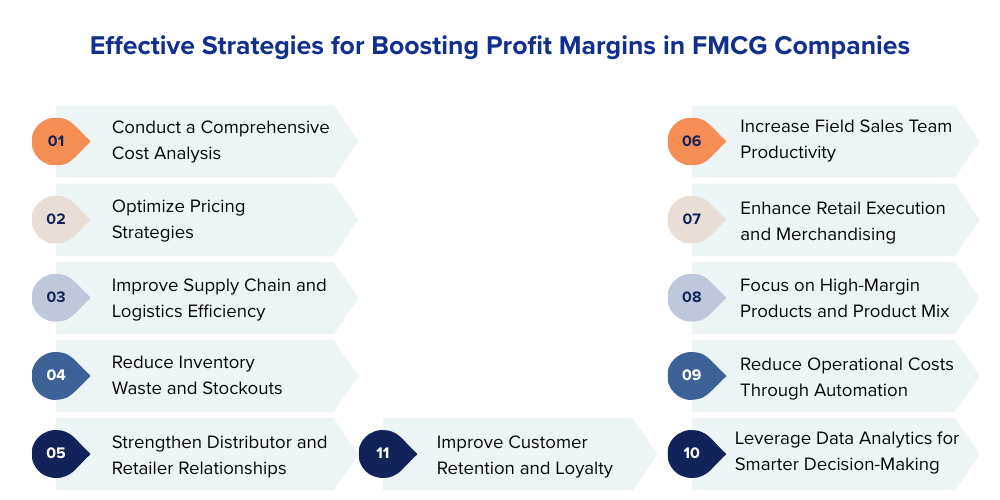
6. Increase Field Sales Team Productivity
Field sales representatives directly influence revenue generation. However, many sales teams spend valuable time on administrative tasks instead of meeting customers.
Improving field sales management enables representatives to focus more on selling and building customer relationships.
Businesses can improve productivity by:
- Automating attendance and reporting
- Planning optimized daily routes
- Tracking customer visits
- Managing sales activities through mobile apps
- Reducing manual paperwork
Implementing route optimization allows sales representatives to visit more customers in less time while reducing travel expenses.
Higher productivity translates into increased sales without significantly increasing operational costs.
7. Enhance Retail Execution and Merchandising
Even high-quality products may underperform if they are not properly displayed at retail outlets.
Effective retail execution ensures products remain visible, well-stocked, and promoted according to company standards.
Businesses should regularly monitor:
- Shelf availability
- Product placement
- Promotional displays
- Planogram compliance
- Competitor activities
Improving retail visibility increases customer engagement, strengthens brand recognition, and ultimately boosts sales.
8. Focus on High-Margin Products and Product Mix
Not every product contributes equally to overall profitability.
Analyzing product performance helps businesses identify high-margin products that generate the greatest returns.
Consider:
- Product profitability
- Customer demand
- Sales trends
- Seasonal performance
- Product lifecycle
Prioritizing high-performing products while phasing out low-margin offerings helps improve overall profit margins without increasing operational complexity.
9. Reduce Operational Costs Through Automation
Manual processes often lead to delays, human errors, and higher administrative costs.
Automating routine business operations enables employees to focus on strategic tasks while improving overall operational efficiency.
Automation can streamline:
- Attendance tracking
- Order processing
- Sales reporting
- Expense management
- Customer data management
- Inventory updates
Businesses that invest in automation reduce repetitive work, improve accuracy, and accelerate decision-making.
10. Leverage Data Analytics for Smarter Decision-Making
Modern FMCG businesses generate vast amounts of sales and operational data every day.
However, data only becomes valuable when transformed into actionable insights.
Using sales analytics allows businesses to:
- Identify top-performing products
- Measure sales representative performance
- Forecast future demand
- Analyze customer buying behavior
- Monitor regional sales trends
Data-driven decision-making minimizes guesswork and enables management to respond quickly to market changes.
11. Improve Customer Retention and Loyalty
Retaining existing customers is more cost-effective than constantly acquiring new ones.
Building long-term relationships with retailers and distributors leads to repeat purchases, increased order values, and consistent revenue streams.
Businesses can improve customer retention by:
- Delivering products on time
- Offering personalized service
- Resolving issues quickly
- Providing attractive loyalty programs
- Maintaining consistent product quality
Satisfied customers are more likely to recommend your products, creating additional growth opportunities while lowering customer acquisition costs.
By implementing these strategies, FMCG companies can significantly improve operational performance, reduce unnecessary expenses, and create a more profitable business model. Rather than relying solely on higher sales volumes, businesses that optimize processes, embrace automation, and leverage data-driven insights are better positioned to achieve sustainable profit growth in an increasingly competitive market.
Key Performance Indicators (KPIs) to Track Profit Margins
Improving profit margins requires continuous monitoring of business performance. Tracking the right KPIs helps FMCG companies measure profitability, identify inefficiencies, optimize operations, and make data-driven decisions that support long-term business growth.
Gross Profit Margin
Gross Profit Margin measures the percentage of revenue remaining after deducting the Cost of Goods Sold (COGS). A higher margin indicates effective pricing strategies, efficient production processes, and better cost management.
Formula:
Gross Profit Margin = (Revenue – Cost of Goods Sold) ÷ Revenue × 100
Net Profit Margin
Net Profit Margin reflects the actual profit earned after deducting all operating expenses, taxes, and other business costs. It provides a complete picture of a company's financial health and overall profitability.
Sales Growth Rate
The Sales Growth Rate measures how consistently business revenue is increasing over time. Analyzing sales growth alongside profit margins ensures revenue growth contributes to higher profitability rather than increased operational costs.
Inventory Turnover Ratio
The Inventory Turnover Ratio indicates how efficiently products are sold and replenished. Effective inventory management reduces storage costs, minimizes obsolete stock, improves cash flow, and enhances overall business profitability.
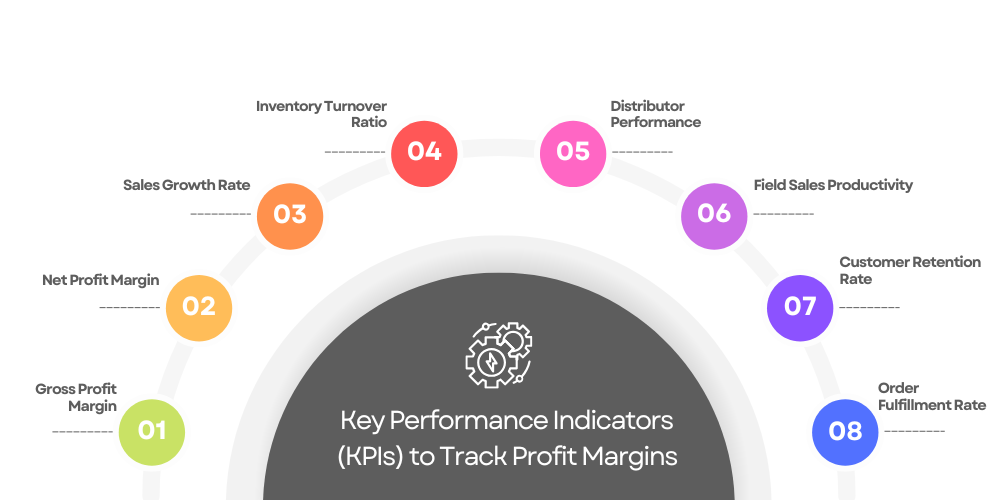
Distributor Performance
Monitoring distributor performance helps businesses evaluate supply chain efficiency and strengthen channel partnerships. Key metrics include order fulfillment rate, sales volume, product availability, retail coverage, and delivery efficiency to improve distributor management.
Field Sales Productivity
Measuring sales team productivity helps identify performance gaps and improve operational efficiency. Track metrics such as customer visits, orders collected, average order value, sales conversion rate, and revenue generated per representative to optimize field sales management.
Customer Retention Rate
Customer Retention Rate measures how effectively a business retains existing customers over time. Strong customer retention increases repeat purchases, strengthens retailer relationships, and reduces customer acquisition costs, leading to sustainable profitability.
Order Fulfillment Rate
Order Fulfillment Rate measures how efficiently customer orders are processed and delivered. Effective order management improves delivery accuracy, enhances retailer satisfaction, reduces missed sales opportunities, and supports long-term business growth.
How Sales Automation Technology Improves FMCG Profitability
Digital transformation has become a necessity rather than a competitive advantage in the FMCG industry. Companies relying on manual processes often struggle with delayed reporting, limited visibility, and operational inefficiencies that directly impact profit margins.
Modern sales force automation solutions help businesses streamline operations, reduce costs, and improve decision-making through real-time data.
Automates Routine Sales Processes
Sales representatives spend a significant amount of time on administrative work such as reporting, attendance, and order processing.
Automation eliminates repetitive tasks, allowing teams to spend more time engaging with customers and generating revenue.
Improves Route Planning
Poor travel planning increases fuel expenses and reduces the number of customer visits completed each day.
Using route optimization, businesses can create efficient travel plans that minimize travel time while maximizing customer coverage.
This improves productivity and lowers operational costs.
Provides Real-Time Business Visibility
Managers need accurate and timely information to make informed business decisions.
With real-time reporting, businesses can monitor:
- Daily sales
- Order status
- Inventory availability
- Employee attendance
- Customer visits
- Sales performance
Instant access to business data enables faster decision-making and quicker responses to market changes.
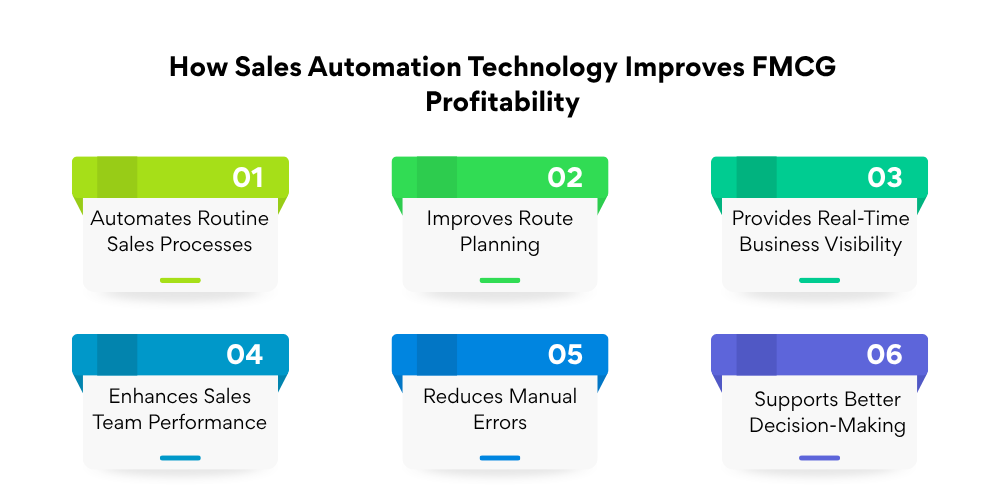
Enhances Sales Team Performance
Automation provides complete visibility into sales activities, allowing managers to monitor productivity and identify performance gaps.
Managers can evaluate:
- Sales targets
- Customer visit frequency
- Revenue per representative
- Territory performance
- Sales trends
This improves accountability and encourages higher performance across the sales team.
Reduces Manual Errors
Manual order processing and reporting often lead to mistakes that increase operational costs.
Automated systems improve data accuracy while reducing duplicate entries and reporting errors.
Supports Better Decision-Making
Technology consolidates data from multiple departments into a single dashboard, enabling management to analyze business performance quickly.
Using profitability analysis, companies can identify high-performing products, profitable territories, and opportunities for cost reduction.
Common Mistakes That Reduce Profit Margins
Even companies with strong sales can experience declining profitability if they fail to address operational inefficiencies. Avoiding these common mistakes can help protect your margins and support long-term growth.
Focusing Only on Sales Volume
Higher sales do not always lead to higher profits.
Selling low-margin products or offering excessive discounts can increase revenue while reducing overall profitability.
Businesses should focus on profitable growth rather than sales volume alone.
Ignoring Operational Costs
Small inefficiencies in logistics, inventory, transportation, and administration can accumulate over time.
Regular cost analysis helps identify hidden expenses before they significantly impact profitability.
Poor Inventory Planning
Maintaining excess inventory increases storage costs, while insufficient inventory results in lost sales.
Accurate forecasting and effective inventory management help maintain the right stock levels.
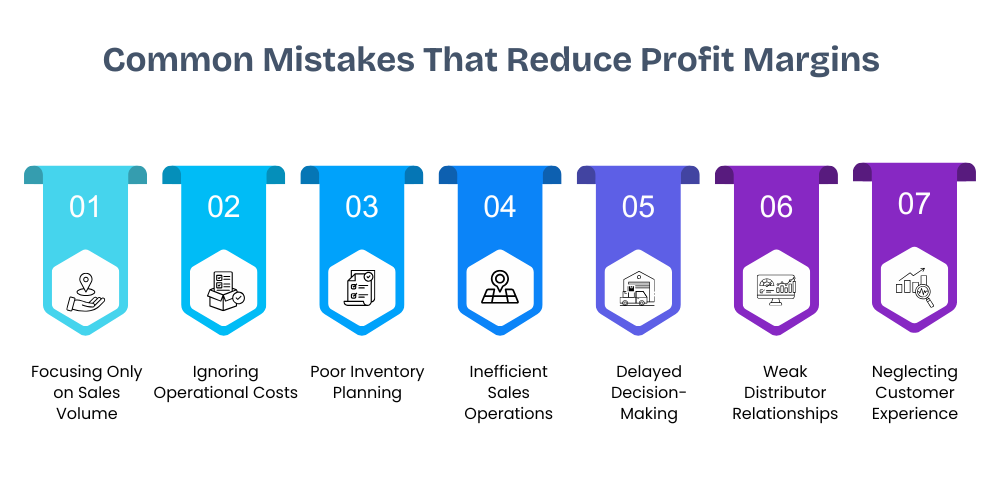
Inefficient Sales Operations
Sales representatives spending too much time on travel, paperwork, or manual reporting reduces overall productivity.
Investing in FMCG sales automation enables sales teams to focus on revenue-generating activities.
Delayed Decision-Making
Businesses relying on outdated reports often react too slowly to changing market conditions.
Access to real-time reporting enables managers to identify problems early and implement corrective actions quickly.
Weak Distributor Relationships
Poor communication with distributors can lead to delayed deliveries, inventory shortages, and reduced retailer satisfaction.
Strong distributor management improves collaboration and ensures smooth product movement across the distribution network.
Neglecting Customer Experience
Poor service, delayed deliveries, and inconsistent product availability can reduce customer loyalty.
Investing in customer retention initiatives helps build long-term relationships while increasing repeat business.
By tracking meaningful KPIs, adopting modern sales force automation solutions, and avoiding common operational mistakes, FMCG companies can significantly improve efficiency and profitability. Technology-driven businesses are better equipped to optimize costs, empower sales teams, and respond quickly to changing market demands, creating a strong foundation for sustainable growth.
Best Practices for Sustainable Profit Growth
Boosting profit margins is not a one-time initiative, it requires continuous improvement, strategic planning, and the ability to adapt to changing market conditions. FMCG companies that consistently review their operations, embrace innovation, and focus on customer satisfaction are better positioned to achieve long-term profitability.
Here are some best practices to help sustain profit growth over time.
Continuously Monitor Business Performance
Successful FMCG companies rely on data rather than assumptions. Regularly reviewing sales performance, operational costs, inventory levels, and customer demand enables businesses to identify opportunities for improvement before they affect profitability.
By using real-time dashboards and business reports, managers can quickly respond to market changes and make informed decisions.
Invest in Digital Transformation
Technology has become a key driver of business success in the FMCG industry. Investing in modern sales and distribution solutions helps streamline workflows, improve collaboration, and eliminate manual processes.
Digital tools provide greater visibility into field operations, inventory movement, distributor performance, and sales activities, allowing businesses to operate more efficiently while reducing costs.
Optimize Sales and Distribution Processes
Efficient sales and distribution networks ensure products reach retailers on time while minimizing transportation and operational expenses.
Businesses should regularly evaluate their distribution strategies, optimize delivery routes, improve order processing, and strengthen retailer relationships to maximize market coverage and profitability.

Empower Your Field Sales Team
Field sales representatives are the face of your business. Providing them with mobile tools, real-time information, and automated workflows enables them to work more efficiently and focus on selling instead of administrative tasks.
A well-equipped sales team can improve customer engagement, increase order values, and strengthen retailer relationships.
Build Strong Relationships Across the Distribution Network
Long-term partnerships with distributors and retailers contribute significantly to sustainable business growth. Open communication, timely deliveries, consistent product availability, and responsive support help build trust and encourage repeat business.
Collaborating closely with channel partners also provides valuable market insights that can improve business planning and forecasting.
Regularly Review Product Performance
Not every product contributes equally to profitability. Periodically analyzing product performance allows businesses to identify high-performing products, discontinue low-margin items, and optimize their product portfolio.
Focusing resources on products with higher demand and better margins helps improve overall business performance.
Stay Agile and Adapt to Market Trends
Consumer preferences, market conditions, and competitive landscapes are constantly evolving. Businesses that monitor industry trends and adapt their strategies accordingly are better prepared to seize new opportunities and overcome challenges.
Maintaining flexibility in pricing, inventory planning, and promotional strategies enables FMCG companies to remain competitive in a rapidly changing market.
Conclusion
Increasing profit margins in the FMCG industry requires more than simply boosting sales, it demands a balanced approach that focuses on operational efficiency, strategic planning, and continuous optimization. From improving pricing strategies and streamlining supply chain operations to enhancing sales productivity and strengthening distributor relationships, every aspect of the business plays a role in improving profitability.
By implementing the strategies discussed in this guide, businesses can reduce unnecessary costs, improve resource utilization, enhance customer satisfaction, and build a more resilient organization. Leveraging modern technologies such as sales force automation, field sales management, sales analytics, and real-time reporting further empowers businesses to make data-driven decisions and respond quickly to changing market demands.
Book a free demo today to discover how Delta Sales App can help your FMCG business reduce operational costs, improve field sales performance, strengthen distribution, and achieve sustainable profit growth.