
The Impact of Effective Distributor and Consumer Management Strategies
Effective Distributor and Consumer Management is the backbone of modern supply chain success. In today’s competitive market, businesses rely heavily on distribution network optimization, retail execution systems, and consumer engagement strategies to ensure products move efficiently from manufacturers to end customers.
This blog explains the complete ecosystem of distribution management systems (DMS) and consumer management systems (CMS), their importance, challenges, and how modern tools like Delta Sales App help streamline operations.
What is Distributor and Consumer Management?
Distributor and Consumer Management refers to an integrated business approach that manages distribution channels and end consumers together for seamless supply chain flow, improved visibility, and higher sales efficiency.
It ensures coordination between manufacturers, distributors, retailers, and consumers using structured systems like distribution management systems (DMS) and consumer management platforms (CMS).
Distributor Management
Distributor Management focuses on controlling and optimizing channel partner operations across the supply chain.
- Manages stock allocation efficiently to prevent shortages and overstock situations in different regions and warehouses
- Handles order processing workflows ensuring faster approvals, accurate billing, and smooth coordination between distributors and manufacturers
- Tracks secondary sales data to monitor actual product movement from distributors to retailers in real time
- Coordinates channel partners to improve communication, performance tracking, and overall distribution network efficiency across territories
Consumer Management
Consumer Management focuses on understanding, tracking, and improving relationships with end customers.
- Maintains detailed customer data including demographics, purchase patterns, and behavioral insights for better marketing targeting
- Tracks purchase behavior to understand product preferences, frequency, and seasonal buying trends for demand forecasting
- Improves customer engagement through personalized communication, offers, and loyalty-driven marketing strategies
- Manages loyalty tracking systems to increase repeat purchases and long-term customer retention across multiple channels
Together, they form a unified system for demand-driven supply chain management and omnichannel distribution strategy.
Importance of Distribution in Modern Business
In today’s digital-first economy, efficient distribution is not optional, it is critical for business growth, competitiveness, and customer satisfaction.
Key reasons include:
- Ensures last-mile delivery optimization by improving routing efficiency, reducing delays, and enabling faster product delivery to end customers
- Reduces stockouts and overstocking issues through better inventory planning, demand forecasting, and real-time stock visibility across channels
- Improves channel partner performance tracking with data-driven insights, sales monitoring, and transparent distributor accountability systems
- Enhances market penetration strategies by optimizing distribution reach, expanding retail presence, and targeting high-potential geographic markets effectively
- Strengthens supply chain visibility and control using real-time tracking systems, centralized dashboards, and end-to-end operational transparency
Without proper distribution planning and execution, even strong products fail to reach the right customers at the right time, reducing revenue potential.
Distributor Management System (DMS) Overview
A Distributor Management System (DMS) is an advanced digital platform designed to streamline and control the entire distribution network ecosystem. It helps businesses automate distributor-related operations, improve visibility, and ensure efficient product flow across the supply chain using real-time distribution tracking systems and sales automation tools.
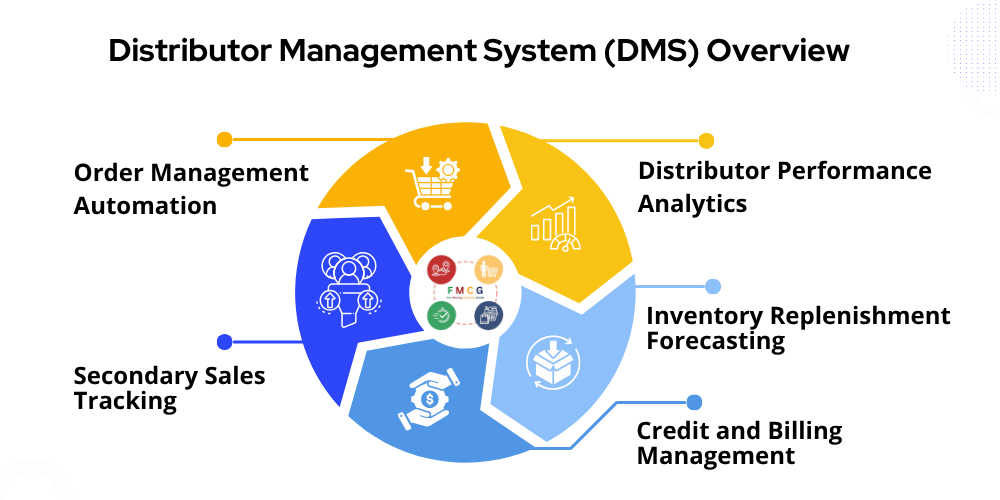
Order Management Automation
- Automates order creation, approval, and processing to reduce manual errors and improve transaction speed significantly
- Ensures faster order fulfillment cycles through integrated workflows between distributors, warehouses, and sales teams
- Improves accuracy in billing and order validation using centralized order management systems.
- Enhances operational efficiency by reducing dependency on manual order entry and paperwork processes
Secondary Sales Tracking
- Tracks product movement from distributors to retailers for accurate market demand analysis and reporting
- Provides real-time visibility into secondary sales performance across multiple regions and distribution channels
- Helps identify fast-moving and slow-moving products to improve inventory planning and forecasting
- Strengthens sales tracking analytics systems for better decision-making and demand understanding
Distributor Performance Analytics
- Measures distributor efficiency using KPIs such as order frequency, sales volume, and delivery performance
- Provides actionable insights through dashboards and business intelligence reporting tools
- Helps businesses identify top-performing and underperforming distributors for strategic support and improvement
- Improves overall channel performance through data-driven evaluation and optimization strategies
Inventory Replenishment Forecasting
- Predicts future inventory requirements using historical sales data and demand forecasting models
- Prevents stockouts and overstock situations through automated replenishment alerts and planning systems
- Optimizes warehouse inventory levels across multiple locations for better supply chain balance
- Enhances inventory optimization strategies for smoother and more efficient distribution operations
Credit and Billing Management
- Manages distributor credit limits, outstanding payments, and billing cycles in a centralized system
- Reduces financial risks through automated credit control and approval workflows
- Ensures transparency in financial transactions between businesses and channel partners
- Improves cash flow management using structured billing automation systems and payment tracking tools
Modern DMS software solutions enable organizations to shift from manual, error-prone tracking methods to real-time digital distribution monitoring systems, resulting in higher accuracy, improved efficiency, and stronger supply chain control.
Consumer Management System Explained
A Consumer Management System (CMS) is a structured digital platform designed to manage end-user data, track buying behavior, and improve customer engagement through data-driven insights and customer relationship management strategies. It helps businesses understand consumer needs and deliver personalized experiences that increase satisfaction and retention.
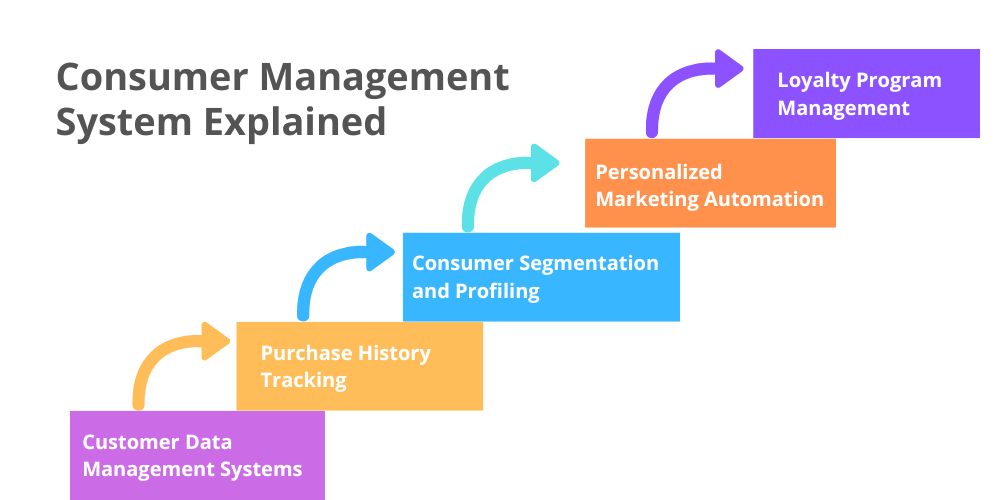
Customer Data Management Systems
- Stores and organizes complete customer profiles including demographics, preferences, and contact information securely
- Enables centralized access to customer records for sales, marketing, and support teams across departments
- Improves data accuracy and reduces duplication through structured customer data management platforms
- Supports better decision-making by providing unified and reliable consumer information
Purchase History Tracking
- Tracks complete buying history of customers across products, channels, and time periods effectively
- Helps identify repeat purchase patterns and seasonal buying trends for better forecasting
- Enables businesses to recommend relevant products based on previous purchase behavior
- Strengthens customer analytics systems for improved marketing and sales strategies
Consumer Segmentation and Profiling
- Divides customers into groups based on behavior, preferences, and purchasing power for targeted marketing
- Improves campaign effectiveness by delivering tailored messages to specific consumer segments
- Enhances product positioning strategies through detailed consumer profiling and analysis
- Supports data-driven customer segmentation models for better engagement and conversion rates
Loyalty Program Management
- Designs and manages reward programs to encourage repeat purchases and long-term customer relationships
- Tracks customer reward points, redemption history, and engagement levels efficiently
- Increases brand loyalty by offering personalized incentives and exclusive benefits
- Strengthens customer retention strategies through structured loyalty management systems
Personalized Marketing Automation
- Automates targeted marketing campaigns based on customer behavior, interests, and purchase history
- Delivers personalized messages through email, SMS, and digital channels for higher engagement
- Improves conversion rates by showing relevant offers to the right audience at the right time
- Enhances marketing automation systems with AI-driven personalization and segmentation
With strong consumer behavior analytics, businesses can significantly improve customer retention strategies, increase engagement levels, and enhance overall lifetime value (LTV) through smarter and more personalized interactions.
Role of Retail Distribution and Execution
Retail distribution execution ensures products are available at the right retail outlets at the right time.
Key components include:
- Retailer Onboarding and Management: Streamlines onboarding process for new retailers, ensuring faster activation, proper documentation, and seamless integration into distribution network systems
- Field Force Automation Tools: Enables sales representatives to capture orders, report activities, and track performance using mobile-based field force automation systems
- Store-Level Inventory Tracking: Monitors stock availability at each retail outlet in real time, preventing shortages, overstocking, and improving inventory accuracy across stores
- Planogram Compliance Monitoring: Ensures retail shelves follow brand-approved layouts and product placement standards to maximize visibility, customer engagement, and sales performance effectiveness
- Retail Visibility Management: Provides insights into product display, shelf presence, and brand visibility across stores, improving in-store merchandising and execution strategies
Strong retail execution systems help businesses improve in-store performance tracking and ensure channel efficiency optimization.
Benefits of Distributor and Consumer Management
Implementing a strong system for distribution and consumer management delivers several benefits:
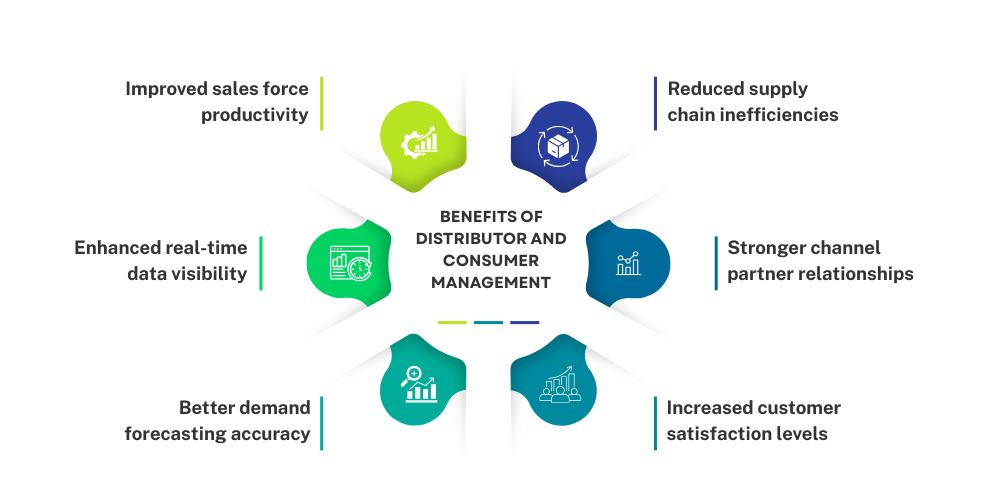
- Improved sales force productivity: Enhances field team efficiency by automating order capture, reducing manual work, and enabling faster execution of daily sales activities
- Enhanced real-time data visibility: Provides live insights into sales, inventory, and consumer behavior, enabling faster and more accurate business decision-making processes
- Better demand forecasting accuracy: Uses historical sales and consumer data analytics to predict demand trends and optimize inventory planning across distribution channels
- Reduced supply chain inefficiencies: Minimizes delays, wastage, and operational gaps by streamlining coordination between manufacturers, distributors, and retail networks
- Stronger channel partner relationships: Improves communication, transparency, and trust between businesses and distributors through structured performance tracking systems
- Increased customer satisfaction levels: Ensures product availability, faster delivery, and personalized engagement, resulting in improved customer experience and long-term loyalty
Overall, it leads to a more data-driven sales strategy and optimized business operations.
Key Components of an Effective Distribution Strategy
An effective distribution strategy framework is built on structured planning, optimized channel networks, and data-driven execution. It ensures seamless product flow, better supply chain optimization, and improved market coverage efficiency across all regions.
Channel Partner Segmentation: Divides distributors and retailers based on performance, geography, and capability to improve targeted distribution planning and resource allocation efficiency
Route-to-Market Optimization: Designs efficient product movement paths from manufacturing units to end customers, reducing delivery time and improving distribution cost efficiency
Demand Forecasting and Planning: Uses historical sales data and market trends to predict future demand and optimize production and inventory planning strategies
Inventory Distribution Control: Ensures balanced stock allocation across warehouses and distributors to avoid shortages, overstocking, and improve supply chain stability
Sales Territory Management: Defines clear geographic sales boundaries for teams, improving accountability, coverage efficiency, and structured field force execution performance
Logistics and Fulfillment Coordination: Manages transportation, warehousing, and delivery operations to ensure timely order fulfillment and smooth end-to-end supply chain execution
These components ensure a smooth end-to-end supply chain workflow, improved distribution efficiency, and stronger market coverage performance across all business channels.
Challenges in Distribution and Consumer Management
Despite advancements in digital supply chain systems, businesses continue to face multiple operational and strategic challenges in distribution management systems (DMS) and consumer management platforms (CMS). These challenges often reduce efficiency, increase costs, and impact overall customer experience.
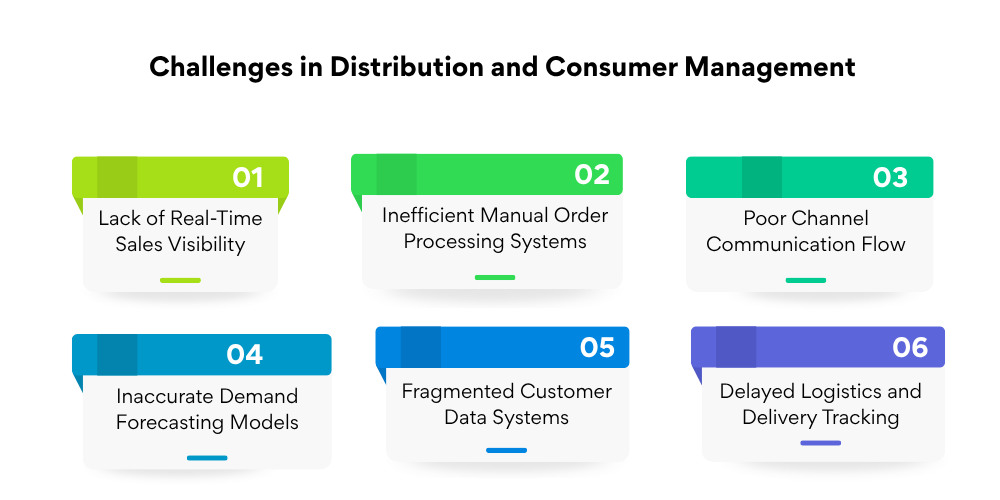
Lack of Real-Time Sales Visibility
Lack of real-time sales visibility: Prevents businesses from tracking live distributor and retail performance, leading to delayed decisions and inaccurate demand assessment across channels
Inefficient Manual Order Processing Systems
Inefficient manual order processing systems: Increases errors, slows down order fulfillment cycles, and reduces operational efficiency due to dependency on paper-based or offline workflows
Poor Channel Communication Flow
Poor channel communication flow: Creates gaps between manufacturers, distributors, and retailers, resulting in misalignment, delayed updates, and reduced coordination across supply chain networks
Inaccurate Demand Forecasting Models
Inaccurate demand forecasting models: Leads to overstocking or stockouts due to unreliable predictions based on incomplete data and weak sales analytics systems
Fragmented Customer Data Systems
Fragmented customer data systems: Results in scattered consumer information across multiple platforms, reducing visibility and limiting effective customer relationship management (CRM) insights
Delayed Logistics and Delivery Tracking
Delayed logistics and delivery tracking: Causes uncertainty in shipment status, increases lead times, and negatively impacts customer satisfaction and supply chain responsiveness
These issues often result in reduced operational efficiency, increased costs, and poor customer experience management, highlighting the need for integrated distribution and consumer management solutions powered by real-time data and automation.
How to Choose the Right Management System
Selecting the right distribution and consumer management system requires a structured evaluation approach to ensure it supports scalable sales operations, real-time analytics, and multi-channel distribution control. The right platform should align with business size, complexity, and long-term growth strategy.
Scalability of the Platform
Scalability of the platform: Ensures the system can handle increasing distributors, consumers, transactions, and data volume without performance degradation or operational limitations over time
Integration with ERP and CRM Systems
Integration with ERP and CRM systems: Enables seamless data flow between enterprise applications, improving operational efficiency, reducing duplication, and ensuring unified business process management
Real-Time Reporting Capabilities
Real-time reporting capabilities: Provides instant access to sales, inventory, and customer insights, enabling faster decision-making and improved business intelligence (BI) accuracy
Mobile Accessibility for Field Teams
Mobile accessibility for field teams: Allows sales representatives and distributors to access, update, and manage data on-the-go using mobile-based field force automation solutions
Data Security and Compliance Features
Data security and compliance features: Protects sensitive business and customer data using encryption, access controls, and compliance with industry regulations and security standards
Customization for Industry-Specific Needs
Customization for industry-specific needs: Adapts workflows, dashboards, and reporting structures according to specific industry requirements for better operational alignment and efficiency
A strong platform should support end-to-end sales automation, distribution network optimization, and multi-channel distribution control, ensuring smooth coordination between distributors, retailers, and consumers while maximizing overall business performance.

How Delta Sales App Helps Improve Distribution
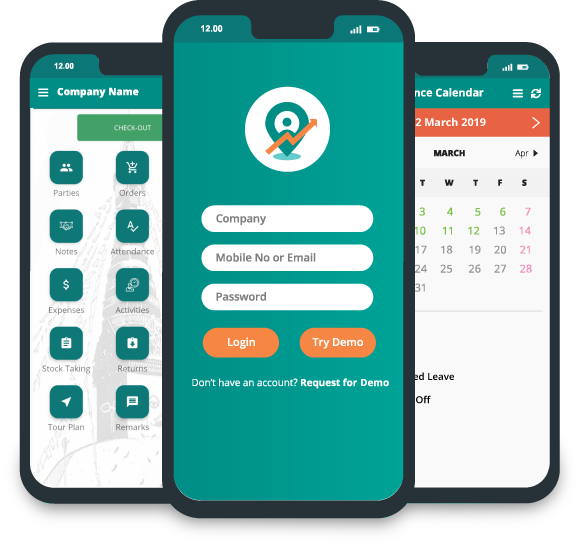
Delta Sales App is a modern field sales automation and distribution management platform designed to improve end-to-end sales operations by combining Sales Force Automation (SFA) and Distribution Management System (DMS) capabilities into a unified ecosystem.
It helps businesses strengthen distribution efficiency, retail execution, and channel performance visibility through real-time data and automation.
Real-Time Field Force Tracking
Real-Time Field Force Tracking: Enables live monitoring of sales executives’ locations and activities, improving productivity, accountability, and route adherence across field operations
Distributor Order Management Automation
Distributor Order Management Automation: Automates order capture, processing, and approval workflows, reducing manual errors and improving order fulfillment speed and accuracy
Secondary Sales Monitoring Dashboards
Secondary Sales Monitoring Dashboards: Provides real-time visibility into product movement from distributors to retailers, improving demand tracking and sales performance analysis
Retail Execution Visibility Tools
Retail Execution Visibility Tools: Enhances in-store performance tracking by monitoring product availability, shelf presence, and merchandising compliance across retail outlets
GPS-Based Route Tracking and Attendance
GPS-Based Route Tracking and Attendance: Ensures accurate field force attendance and optimized travel routes using GPS technology for better efficiency and control
Instant Reporting and Analytics
Instant Reporting and Analytics: Delivers real-time business insights through automated reports and dashboards, enabling faster and data-driven decision-making processes
By integrating SFA and DMS functionalities, Delta Sales App enables organizations to achieve improved distribution network efficiency, higher sales productivity, and stronger channel partner performance tracking.
This ultimately leads to a more structured, scalable, and data-driven distribution ecosystem management system.
Conclusion
Effective Distributor and Consumer Management is no longer a traditional operational function, it is a strategic business capability.
With rising competition and evolving customer expectations, companies must adopt advanced distribution management systems, consumer analytics platforms, and field sales automation tools to stay ahead.
Modern solutions like Delta Sales App enable organizations to unify distribution intelligence, retail execution, and consumer insights into a single ecosystem, resulting in better decision-making, improved efficiency, and sustainable business growth.
Experience how Delta Sales App can streamline your field force automation, distributor management, and retail execution with real-time insights and powerful analytics.
Book a free demo today and see how you can improve sales productivity, distribution efficiency, and channel performance in one platform.