Top 10 SPOTIO Alternatives for Field Sales Teams in 2026
Field sales management takes more than assigning territories and tracking where reps are. Businesses need to coordinate daily visits, watch customer coverage, capture orders, manage distributor relationships, and measure sales performance across regions.
SPOTIO gives outside sales teams tools to manage leads, territories, routes, and field activity. It fits best for businesses that rely on in-person prospecting and geographically spread-out reps. The requirements change once a business is running FMCG distribution, wholesale operations, retail outlets, and several distributor networks. Managers may then need to see primary and secondary sales, beat plan adherence, SKU-level orders, payment collections, and retailer visits next to location tracking.
That's why businesses look at SPOTIO alternatives that match their operations more closely. Some platforms specialize in door-to-door prospecting. Others focus on territory mapping, CRM, retail execution, or distribution management. The right pick depends on what reps actually do in the field and what managers need to monitor.
This blog compares 10 SPOTIO alternatives for 2026, with a closer look at Delta Sales App and shorter comparisons of nine other platforms.
Why Field Sales Teams Look For SPOTIO Alternatives
SPOTIO has useful tools for managing outside sales, but field sales operations don't all work the same way. A company chasing residential leads has very different needs from an FMCG manufacturer managing distributors and thousands of retail outlets. Here are some common reasons businesses consider other platforms.
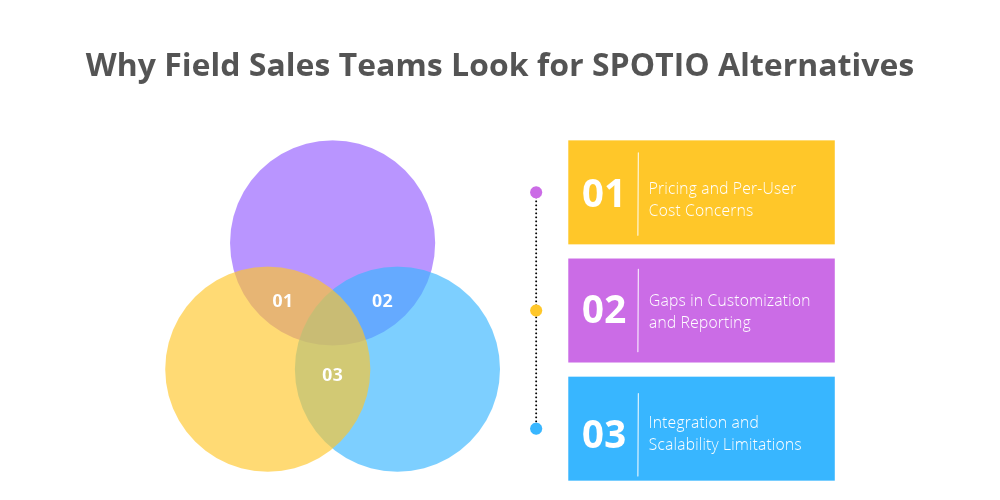
Pricing and Per-User Cost Concerns
Per-user subscription pricing can add up fast as a sales team grows. A business with 15 reps pays a very different software bill from one with 100 reps spread across several territories. The total can also include premium features, integrations, implementation, and extra modules. Compare the full subscription cost with the operational benefits you actually expect to get out of it.
Gaps in Customization and Reporting
Standard activity reports may not provide enough information for businesses with complex field sales processes. For example, an FMCG sales manager may need to monitor:
-
Daily outlet visits against assigned beat plans.
-
Orders booked by each sales representative.
-
Primary and secondary sales performance.
-
SKU-level sales and product availability.
-
Payment collections and outstanding amounts.
-
Territory-wise sales performance.
If a platform does not support these workflows directly, businesses may need additional applications or customized integrations.
Integration and Scalability Limitations
Field sales apps should connect to your existing ERP, accounting, inventory, and CRM systems wherever you need them to. Without that, reps and office staff end up typing the same information into several systems, which adds admin work and lets discrepancies creep into the sales records. Scalability matters just as much. The software should handle more reps, more distributors, more territories, and more reporting requirements as the business grows.
How to Choose the Right SPOTIO Alternative
Before comparing software, identify which parts of your field sales process need improvement. This makes it easier to distinguish between platforms designed for prospecting, customer relationship management, and distribution operations.
1. Must-Have Features: Route Planning, Territory Management, and Offline Mode
Start with the everyday responsibilities of your field representatives. Important capabilities include:
-
Route planning: Organize customer visits and reduce unnecessary travel.
-
Territory management: Assign geographical areas and customer accounts to representatives.
-
GPS tracking: Monitor field movement and verify visits.
-
Visit management: Record customer interactions and visit outcomes.
-
Offline mode: Capture orders and field activities without continuous internet connectivity.
-
Performance reporting: Compare planned visits, completed activities, and sales results.
For FMCG and distribution businesses, beat planning, order booking, payment collection, and distributor management may also be essential.
2. CRM and Integration Compatibility
Check whether the platform can connect with your existing business applications. Evaluate its ability to synchronize customer records, sales orders, inventory information, and reporting data. API availability and custom integration support are also worth considering.
3. Team Size, Industry Fit, and Pricing Model
A small B2B sales team does not need the same configuration as a manufacturer managing hundreds of representatives. Consider the number of users, industry-specific workflows, subscription structure, implementation requirements, and availability of technical support before making a decision.
SPOTIO Alternatives at a Glance
The following table summarizes the primary strengths of the 10 platforms. Pricing is indicative and should be confirmed directly with vendors before purchasing.
Comparison Table: Features, Best For, and Starting Price
|
Software |
Best For |
Key Capabilities |
|---|---|---|
|
Delta Sales App |
FMCG and distribution-led field sales |
SFA, GPS tracking, beat planning, order management |
|
SalesRabbit |
Door-to-door sales |
Canvassing, lead tracking, territory management |
|
Badger Maps |
Route optimization |
Sales mapping, route planning, CRM integration |
|
Map My Customers |
Territory mapping |
Customer mapping, visit tracking, CRM synchronization |
|
Repsly |
Retail merchandising |
Store visits, retail execution, shelf monitoring |
|
Salesforce Sales Cloud |
Enterprise sales |
CRM, forecasting, automation, reporting |
|
HubSpot Sales Hub |
Marketing-aligned sales |
Contact management, pipeline, automation |
|
Pipedrive |
Sales pipeline management |
Deal tracking, activities, reporting |
|
Zoho CRM |
Customizable CRM |
Workflow automation, custom modules, analytics |
|
Bizom |
FMCG distribution |
SFA, DMS, retail execution, analytics |
10 SPOTIO Alternatives
Not all field sales platforms serve the same purpose. Some focus on lead generation and door-to-door prospecting, while others specialize in route optimization, CRM, retail execution, or distribution management. For businesses managing FMCG sales, distributors, and field representatives, choosing a platform with the right operational capabilities is essential. Here are 10 SPOTIO alternatives to consider in 2026, starting with Delta Sales App.
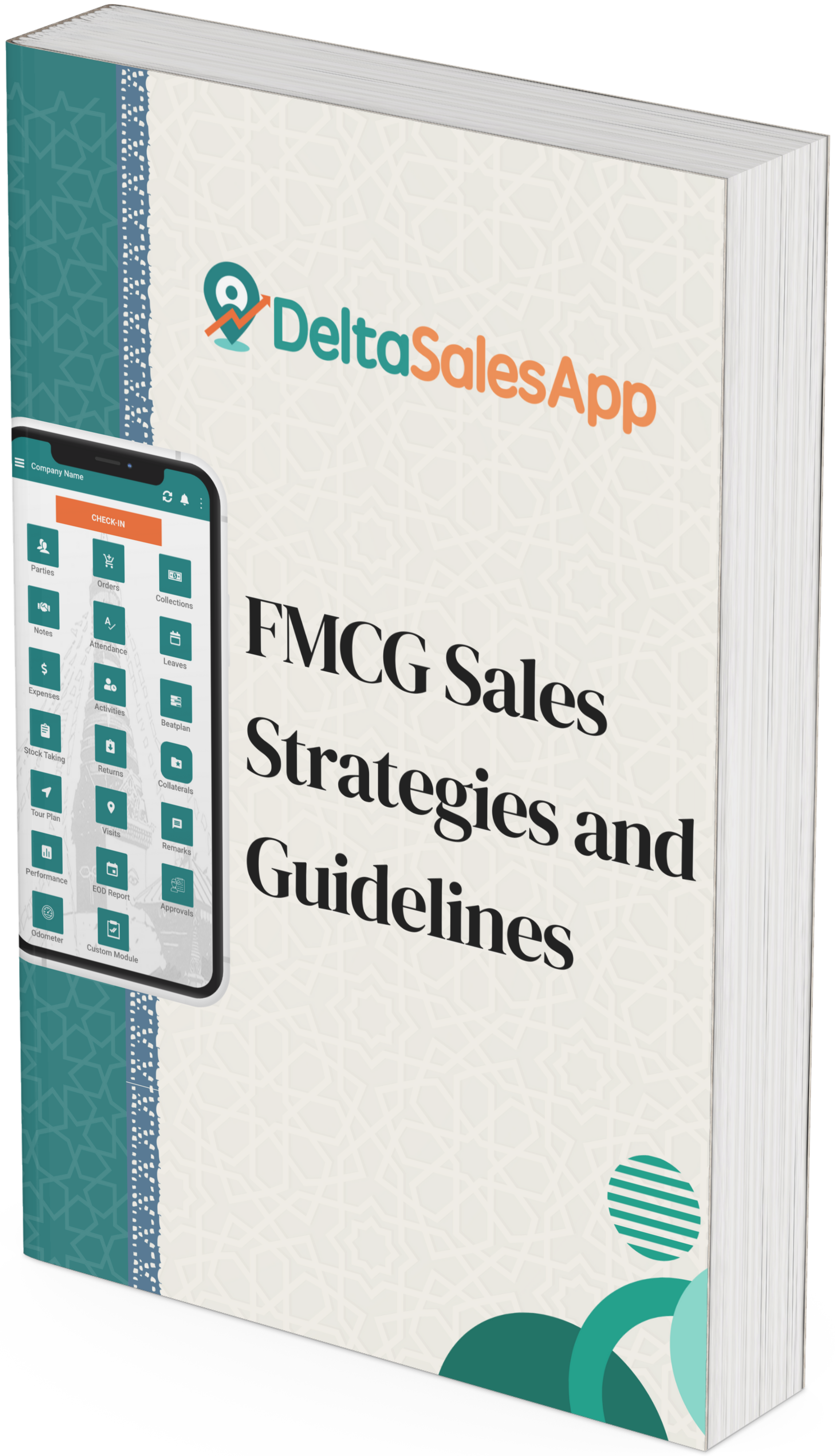
1. Delta Sales App:
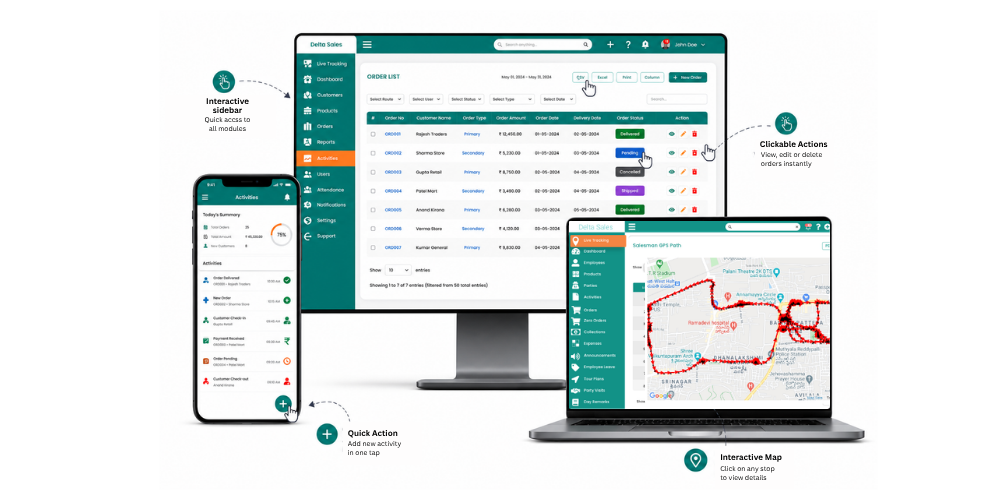
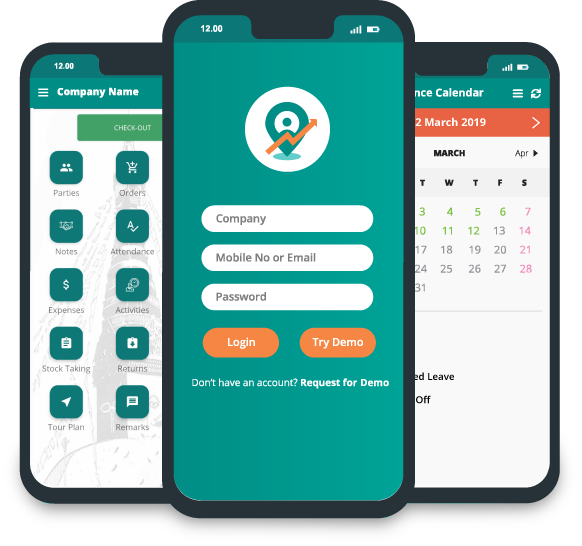
Delta Sales App is a SaaS-based field sales force automation and employee tracking platform designed for businesses that manage outside sales representatives, distributor networks, and retail operations.
Unlike platforms primarily focused on lead generation and door-to-door prospecting, Delta Sales App supports the operational activities involved in managing field sales teams. It connects representative tracking, beat planning, customer visits, order management, attendance, and sales reporting within one platform. Delta Sales App also supports businesses beyond FMCG, including building materials, electrical and hardware distribution, and other industries where sales representatives regularly visit dealers, retailers, and business customers.
Key Features:
-
GPS-Based Employee Location Tracking: Monitor representative locations and field movement to improve visibility into daily activities.
-
Beat Planning and Route Management: Assign territories, organize customer visits, and help representatives follow their planned schedules.
-
Outlet Visit Verification: Record customer visits and monitor whether assigned outlets are being covered.
-
Order Management: Allow representatives to capture customer orders directly through the mobile application.
-
Primary and Secondary Sales Tracking: Monitor sales activities across distributor and retail networks.
-
Payment and Collection Reporting: Record payments collected from customers and track collection activities.
-
Distributor and Party Management: Maintain distributor, retailer, and customer information in a centralized system.
-
Attendance and Leave Management: Manage employee attendance and leave-related activities.
-
Expense Reporting: Record field expenses and provide managers with visibility into employee-reported costs.
-
Offline-First Mobile Functionality: Allow representatives to record field activities and orders without an active internet connection, with synchronization when connectivity returns.
-
Real-Time Sales Analytics: Review sales performance, representative activities, order information, and field operations through dashboards.
Pros:
-
Combines employee tracking with field sales automation.
-
Supports beat planning, outlet visits, and order management.
-
Suitable for FMCG and distribution-led business models.
-
Provides centralized visibility into field activities and sales performance.
-
Supports offline field operations.
-
Offers features for managing representatives, distributors, and retail customers.
Cons:
- Primarily suited to businesses with field sales and distribution operations rather than teams focused exclusively on residential canvassing.
Best Fit: FMCG companies, manufacturers, wholesalers, distributors, and organizations managing outside sales representatives across multiple territories.
2. SalesRabbit: Best for Door-to-Door Sales Teams
SalesRabbit is a field sales management platform primarily designed for door-to-door sales teams. It helps representatives manage prospects, organize canvassing activities, plan routes, and monitor their daily performance. It is particularly relevant for businesses in home improvement, solar, roofing, and other industries where representatives generate leads through in-person prospecting.
Key Features: Canvassing management, lead tracking, territory mapping, route planning, rep tracking, appointment scheduling, and performance analytics.
Pros: Strong focus on field prospecting, territory organization, and representative performance.
Cons: Less suited to businesses requiring distributor management, SKU-level order capture, and secondary sales reporting.
Best Fit: Door-to-door sales teams and businesses that generate leads through in-person prospecting.
3. Badger Maps: Best for Route Optimization
Badger Maps focuses on helping outside sales representatives organize customer visits and reduce unnecessary travel. Its mapping and route optimization capabilities make it useful for teams managing large customer databases across multiple geographical areas. Instead of manually deciding which customer to visit next, representatives can use mapped accounts and optimized routes to organize their daily schedules.
Key Features: Multi-stop route planning, customer mapping, territory visualization, CRM synchronization, and activity reporting.
Pros: Strong mapping capabilities, route planning, and CRM integrations.
Cons: Primarily focused on geographical sales planning rather than complete distribution management.
Best Fit: B2B sales representatives, industrial distributors, and teams visiting multiple customers daily.
4. Map My Customers: Best for Territory Mapping
Map My Customers is a field sales execution platform that combines customer mapping, territory management, activity tracking, and CRM synchronization. It helps managers understand how representatives are covering their assigned territories while giving field employees a centralized place to manage customer information and daily activities. The platform is particularly useful for businesses where customer relationships depend on regular in-person visits.
Key Features: Customer mapping, route optimization, visit tracking, offline functionality, CRM synchronization, and territory analytics.
Pros: Useful geographical visibility, mobile field tools, and CRM connectivity.
Cons: Higher starting costs and limited built-in capabilities for complex distributor operations.
Best Fit: B2B manufacturers, industrial distributors, and field teams prioritizing customer coverage.
5. Repsly: Best for Retail and Merchandising Teams
Repsly is a retail execution platform designed for consumer packaged goods (CPG) brands and merchandising organizations. Its focus is on what happens inside retail outlets. Managers can organize store visits, monitor product availability, collect shelf information, and evaluate whether merchandising activities are being completed according to plan. For FMCG businesses, this provides better visibility into retail execution beyond simply recording whether a representative visited a store.
Key Features: Store visit management, shelf monitoring, retail audits, image recognition, product catalogs, and field reporting.
Pros: Specialized retail execution capabilities and visibility into store-level activities.
Cons: Less focused on general CRM and broader sales pipeline management.
Best Fit: FMCG brands, CPG companies, and merchandising teams.
6. Salesforce Sales Cloud: Best for Enterprise Field Sales
Salesforce Sales Cloud is an enterprise CRM platform designed to manage customer relationships, sales opportunities, and business processes across large organizations. Unlike platforms focused primarily on field representatives, Salesforce provides a broader sales management environment. Businesses can configure workflows, manage customer accounts, automate activities, and connect sales data across departments. It is particularly suitable for organizations with complex sales processes and dedicated IT or CRM administration teams.
Key Features: Lead management, account management, sales forecasting, workflow automation, custom reporting, and integrations.
Pros: Extensive customization, broad integration ecosystem, and enterprise-level CRM capabilities.
Cons: Implementation can be complex, and field-specific workflows may require additional configuration or products.
Best Fit: Large enterprises and organizations managing complex sales processes across departments.

7. HubSpot Sales Hub: Best for Marketing-Aligned Sales Teams
HubSpot Sales Hub combines CRM, sales automation, contact management, and reporting in one platform. It is particularly useful for businesses where marketing and sales teams work closely together. Marketing teams can generate leads, while sales representatives manage those contacts, schedule follow-ups, and track opportunities through the pipeline. For field sales organizations, HubSpot can provide customer relationship visibility, although its primary focus is not distribution-oriented field execution.
Key Features: Contact management, deal tracking, email automation, meeting scheduling, reporting, and workflow automation.
Pros: User-friendly CRM, useful marketing integration, and centralized customer information.
Cons: Advanced automation can become expensive, and specialized beat planning and distributor management are not its primary strengths.
Best Fit: Businesses with inbound lead generation and marketing-driven sales processes.
8. Pipedrive: Best for Pipeline Visibility
Pipedrive is a sales CRM built around visual pipeline management. It helps representatives organize leads, track opportunities, schedule activities, and understand which deals need attention. Its straightforward interface makes it suitable for smaller businesses that want better visibility into their sales process without implementing a complex enterprise CRM. For field sales teams, its mobile application provides access to contacts, activities, deals, and pipeline information while representatives are away from the office.
Key Features: Deal management, contact management, activity scheduling, sales forecasting, reporting, and integrations.
Pros: Simple interface, clear pipeline visibility, and accessible entry-level pricing.
Cons: Limited native capabilities for FMCG order management, distributor operations, and retail execution.
Best Fit: Small and medium-sized B2B sales teams focused on opportunity and pipeline management.
9. Zoho CRM: Best for Customizable CRM
Zoho CRM provides customer management, sales automation, reporting, and workflow customization for businesses of different sizes. One of its main strengths is flexibility. Organizations can customize modules, create automation rules, manage sales processes, and connect CRM data with other applications in the Zoho ecosystem. For businesses with field representatives, Zoho CRM can help centralize customer information and sales activities, although more specialized field operations may need additional configuration.
Key Features: Lead management, custom modules, workflow automation, sales forecasting, dashboards, and integrations.
Pros: Competitive pricing, flexible customization, and integration with other Zoho applications.
Cons: Advanced configuration can require technical knowledge, and specialized field operations may need additional setup.
Best Fit: Small and medium-sized businesses looking for customizable CRM capabilities.
10. Bizom: Best for FMCG and Distribution Field Forces
Bizom is a retail intelligence and route-to-market platform designed for consumer goods companies and distribution-led businesses. Unlike general CRM systems, Bizom focuses on the operational requirements of FMCG sales and distribution networks. It connects field sales activities with distributor operations and retail execution, helping businesses monitor how products move through their distribution channels. Its capabilities are relevant to manufacturers managing primary and secondary sales, distributor networks, and large retail outlet databases.
Key Features: Sales force automation, distributor management, retail execution, order management, trade promotion management, and sales analytics.
Pros: Strong FMCG focus, distributor-related capabilities, and retail intelligence.
Cons: May be extensive for smaller businesses, and pricing and implementation depend on the selected modules and requirements.
Best Fit: FMCG manufacturers, consumer goods brands, and large distribution networks.
Final Thoughts: Picking the Right Field Sales Platform
Conclusion
Choosing the right SPOTIO alternative depends on how your business manages field sales operations. While some platforms focus on prospecting, CRM, or route planning, businesses managing FMCG distribution and large field teams need broader capabilities, including employee tracking, beat planning, outlet visit verification, order management, and sales reporting. Delta Sales App brings these capabilities together in one platform, helping businesses improve field team visibility, streamline daily sales activities, and make better decisions using real-time data.
Ready to improve your field sales operations? Book your free demo of Delta Sales App today and see how it can support your sales team.