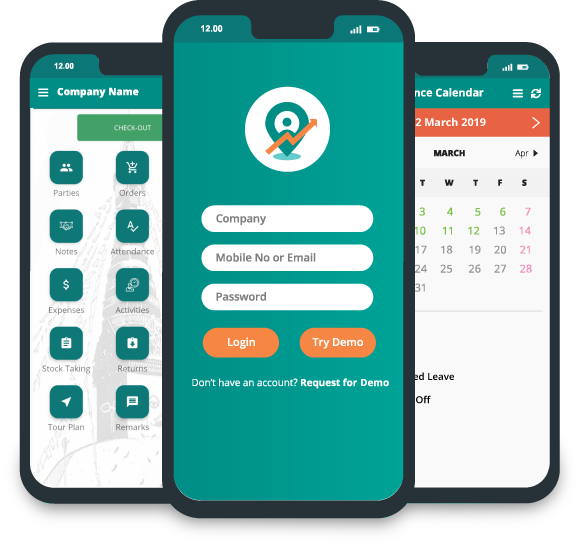

Attendance Management for Field Sales Teams: Beyond the Office Clock-In

Managing attendance for on-ground sales representatives is fundamentally different from tracking employees in a fixed office environment. Unlike desk-based roles, field sales teams operate across multiple locations, visiting clients, distributors, and retail outlets throughout the day. Traditional punch-in systems were built for static workplaces, making them ineffective for a workforce that is constantly on the move. These outdated methods fail to capture real-time activity, location accuracy, and actual productivity, often leading to gaps in visibility.
As businesses expand their market reach, these limitations become more evident. Inaccurate attendance data can result in poor decision-making, reduced accountability, and operational inefficiencies. Managers struggle to verify whether field reps are actively working or simply marking attendance without meaningful engagement.
This is where attendance and leave management for field sales teams transforms into more than just a tracking mechanism. By leveraging modern field workforce tracking tools, businesses can gain real-time insights, improve transparency, and ensure that attendance reflects actual work done in the field.
What Is Attendance Management for Field Sales Teams?
Attendance tracking in field operations refers to monitoring when, where, and how sales representatives begin and complete their workday. Unlike office setups, it includes location validation, activity tracking, and time utilization using a mobile attendance system.
It ensures that sales reps are not just “logged in” but actively engaged in productive tasks throughout their routes, supported by effective sales team monitoring.
To understand it better, field attendance management goes beyond simple check-ins and focuses on real work validation. It combines time, location, and activity data to give managers a complete view of field performance.
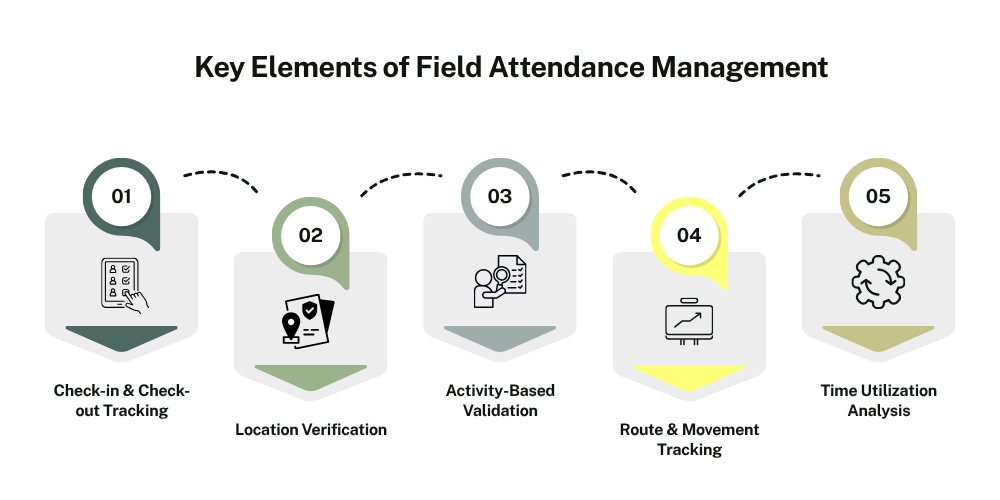
Key Elements of Field Attendance Management
- Check-in & Check-out Tracking
Captures start and end times of workday using mobile apps with accurate digital timestamps. - Location Verification
Ensures attendance is marked from the correct location using GPS, preventing fake or remote check-ins. - Activity-Based Validation
Links attendance with actual tasks, visits, or meetings completed by sales representatives during the day. - Route & Movement Tracking
Tracks sales reps’ movement to ensure adherence to planned routes and optimized travel efficiency. - Time Utilization Analysis
Measures productive and non-productive hours to improve efficiency and overall field sales performance.
Limitations of Traditional Clock-In Systems
Legacy attendance methods fail to capture real-world field scenarios, especially in dynamic environments where employees operate beyond fixed office locations. These systems were never designed for mobility, making them ineffective for modern field sales operations.
- Dependence on physical presence at a fixed location
Traditional systems require employees to mark attendance from a specific office location, making them unsuitable for field roles where employees rarely visit headquarters daily. - Vulnerability to proxy attendance
Manual or biometric systems allow buddy punching, where one employee marks attendance for another, leading to inaccurate records and reduced accountability across field teams. - No visibility into employee movement
These systems fail to track where employees go after check-in, providing zero insight into field activities, travel routes, or actual customer interactions during the day. - Zero linkage with actual sales activities
Attendance is recorded independently without connecting it to meetings, orders, or visits, making it impossible to measure whether logged time translates into productive work.
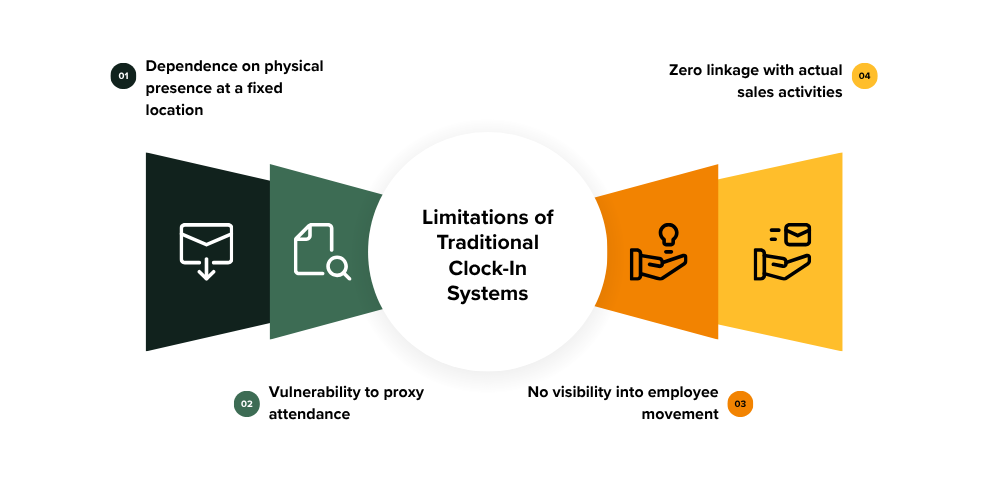
Such gaps create significant blind spots for managers trying to evaluate performance, optimize routes, and improve efficiency, especially without reliable field employee tracking systems in place.
Key Challenges in Managing Field Sales Attendance
Tracking a distributed team introduces several operational challenges, especially when employees operate across multiple locations without direct supervision. These issues make it difficult to maintain accuracy, accountability, and efficiency in attendance management for field sales teams.
- Difficulty in verifying real-time location
Managers struggle to confirm whether sales representatives are actually present at assigned locations without reliable tracking systems that provide accurate, real-time location validation data. - False check-ins without actual field visits
Employees may mark attendance without visiting assigned clients, leading to discrepancies between reported attendance and actual field activity, ultimately impacting business outcomes and trust. - Delayed or manipulated reporting
Manual reporting methods allow delays or alterations in attendance data, making it difficult for managers to rely on reports for timely decisions and performance evaluations. - Lack of clarity on time spent per client
Without proper tracking, businesses cannot determine how much time representatives spend with each client, affecting productivity analysis and overall sales performance optimization efforts. - No validation of planned vs actual routes
There is no mechanism to verify whether sales reps follow assigned routes, resulting in inefficient coverage, missed opportunities, and reduced effectiveness of field operations.
These issues directly impact productivity and decision-making, making real-time workforce visibility a necessity rather than a luxury for modern field sales organizations.
The Evolution of Attendance Management Systems
Attendance systems have transitioned significantly over time, evolving alongside changes in workplace dynamics and technological advancements. What began as simple manual tracking has now transformed into intelligent, data-driven systems tailored for mobile workforces and dynamic field environments.
- Manual registers → prone to manipulation
Early attendance systems relied on paper-based logs, making them easy to alter, difficult to verify, and highly dependent on manual supervision for accuracy. - Biometric systems → location-bound and inflexible
While biometrics improved authenticity, they restricted attendance marking to specific locations, making them unsuitable for employees working outside office premises. - Digital tools → improved accuracy but limited mobility
Software-based systems enhanced data accuracy and reporting but still lacked flexibility for employees who needed to operate across multiple locations throughout the day. - Mobile-first solutions → designed for real-time field tracking
Modern systems leverage smartphones to enable location-based attendance, real-time updates, and seamless tracking of employee activities regardless of their physical location.
Today, attendance management is no longer just about recording presence, it is about capturing meaningful work data. With the rise of automated attendance system capabilities, businesses can now integrate attendance with sales activities, route tracking, and performance metrics.
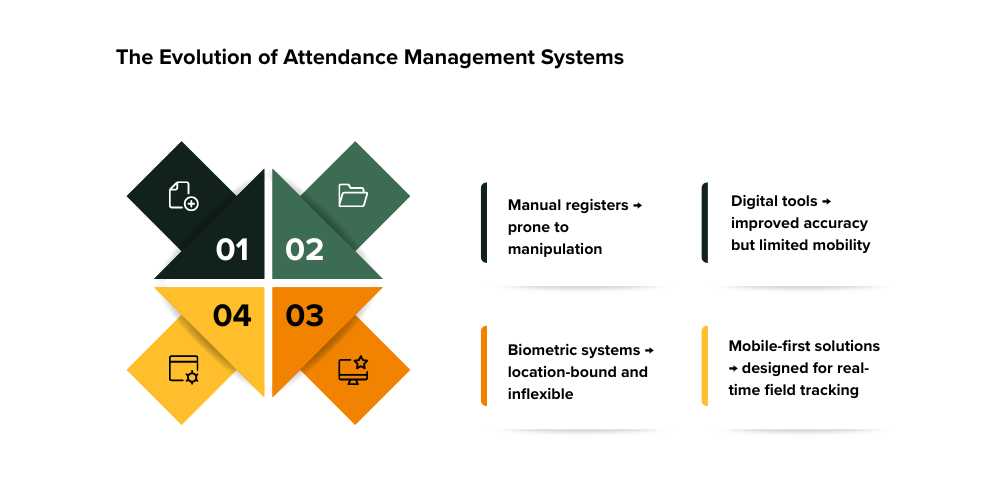
This evolution reflects a shift from static tracking to intelligent workforce management, where data is used not only for monitoring but also for improving efficiency, accountability, and decision-making across field sales teams.
Modern Attendance Tracking Methods for Field Teams
Advanced methods focus on mobility, accuracy, and real-time validation, ensuring that attendance is not just recorded but verified against actual field activities. These systems are specifically designed to support dynamic work environments where employees operate across multiple locations throughout the day.
- App-based check-in and check-out
Enables sales representatives to mark attendance directly through mobile devices, ensuring flexibility while capturing accurate timestamps without dependency on fixed office locations. - GPS-enabled tracking for accurate location capture
Uses real-time location data to verify where attendance is marked, helping managers ensure employees are present at assigned territories or client locations. - Geo-fencing attendance to restrict fake entries
Creates virtual boundaries around specific locations, allowing attendance to be marked only within approved zones, effectively preventing unauthorized or remote check-ins. - Geo-tagged visit confirmations
Records location data along with each client visit, ensuring that reported meetings actually took place and improving transparency in daily field activities. - Route-based tracking for daily plans
Monitors whether sales representatives follow assigned routes, helping optimize travel efficiency and ensuring proper coverage of territories and customer locations.
These approaches ensure attendance reflects real work activity and aligns with actual field movements, making attendance management for field sales teams more reliable, transparent, and performance-driven.
Role of Technology in Field Attendance Management
Technology acts as the backbone of modern tracking systems, transforming how businesses monitor, manage, and optimize field workforce activities. It replaces manual processes with intelligent systems that provide accuracy, transparency, and real-time control over distributed teams.
- Mobile applications enable remote access
Allow field employees to mark attendance, update activities, and access schedules from anywhere, ensuring seamless communication and tracking without dependency on office infrastructure. - Cloud platforms centralize data
Store attendance and activity data in a unified system, enabling easy access, secure storage, and real-time synchronization across teams, managers, and multiple business locations. - Dashboards provide instant insights
Offer visual reports and analytics that help managers monitor attendance patterns, track performance, and make quick, data-driven decisions without relying on delayed manual reports. - Automated logs reduce manual dependency
Automatically record attendance, location, and activity data, minimizing human errors, eliminating paperwork, and ensuring accurate and consistent reporting across the organization.
This shift eliminates guesswork and enhances operational clarity within field operations management, making attendance tracking more efficient, scalable, and aligned with real business needs.
Key Features to Look for in Field Attendance Software
An effective system should include a combination of accuracy, flexibility, and automation to support the dynamic nature of field operations. The right set of features ensures that attendance is not only recorded but also validated against real work activities.
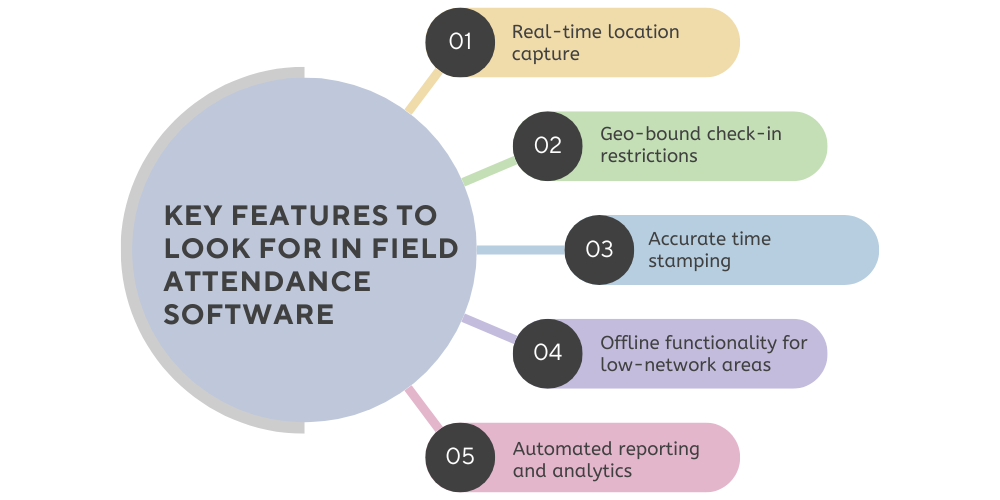
- Real-time location capture
Tracks the exact location of employees during check-in and throughout the day, ensuring attendance is marked from the correct place with high accuracy. - Geo-bound check-in restrictions
Allows attendance marking only within predefined locations, preventing fake entries and ensuring employees are physically present at assigned work sites or client locations. - Accurate time stamping
Records precise login and logout times automatically, helping businesses track working hours accurately and eliminate discrepancies caused by manual time entries. - Offline functionality for low-network areas
Enables employees to mark attendance even without internet connectivity, syncing data automatically once the network is restored, ensuring uninterrupted tracking in remote locations. - Automated reporting and analytics
Generates real-time reports and insights on attendance patterns, employee performance, and productivity trends, helping managers make informed decisions quickly and effectively.
These capabilities ensure reliability and usability in diverse field conditions, especially when using cloud-based attendance software, making attendance management more efficient, transparent, and scalable.
Data-Driven Attendance Monitoring: Metrics That Matter
Instead of just tracking login time, modern businesses focus on analyzing meaningful performance indicators that reflect actual field productivity. Data-driven attendance monitoring helps organizations move beyond basic tracking and gain actionable insights into how efficiently their field teams operate.
- Active working duration
Measures the total time employees spend actively working in the field, excluding idle periods, helping businesses understand actual effort and optimize workforce productivity. - Number of productive visits
Tracks how many meaningful client interactions or visits are completed in a day, giving a clear picture of field engagement and sales activity effectiveness. - Idle time between activities
Identifies gaps between tasks or visits, helping managers detect inefficiencies, reduce downtime, and improve scheduling for better time utilization across field teams. - Route adherence efficiency
Evaluates whether sales representatives follow planned routes, ensuring proper territory coverage, minimizing travel inefficiencies, and improving overall field execution strategies.
These metrics provide deeper insights into workforce effectiveness and strengthen field sales productivity, enabling businesses to make smarter decisions and continuously improve field performance.
Benefits of Smart Attendance Management Systems
Adopting modern attendance solutions brings measurable advantages by aligning workforce tracking with real business outcomes. Instead of simply recording presence, these systems help organizations improve efficiency, transparency, and performance across field teams.
- Higher productivity through structured tracking
Organized attendance systems ensure employees follow planned schedules, reduce idle time, and focus on productive activities, leading to better output and improved overall performance. - Improved visibility into field operations
Managers gain real-time insights into employee locations, activities, and attendance status, enabling better supervision, faster decision-making, and more effective field management strategies. - Stronger accountability across teams
Transparent tracking systems ensure every action is recorded and verified, encouraging employees to stay responsible for their tasks and reducing chances of misreporting or negligence. - Reduced revenue leakage due to inefficiencies
By identifying gaps in attendance, missed visits, and unproductive time, businesses can minimize losses and ensure maximum utilization of their field sales resources.
It also enables better planning and execution at scale while improving workforce productivity tracking, helping organizations grow efficiently without losing control over their field operations.
Hidden Costs of Poor Attendance Tracking
Ineffective attendance tracking systems can quietly impact business performance, often going unnoticed until losses begin to accumulate. Without accurate and reliable data, organizations struggle to manage field teams efficiently and make informed decisions.
- Missed sales opportunities
When field activities are not properly tracked, sales representatives may skip visits or delay follow-ups, resulting in lost opportunities and reduced chances of converting potential customers. - Inefficient territory coverage
Without proper monitoring, sales reps may not cover assigned areas effectively, leading to uneven distribution of effort and missed markets that could otherwise generate revenue. - Poor resource utilization
Lack of visibility into employee activities results in underutilized workforce potential, where time and effort are not aligned with business priorities or revenue-generating tasks. - Inaccurate reporting leading to flawed decisions
When attendance data is unreliable, managers base decisions on incorrect information, affecting planning, forecasting, and overall business strategy.
Over time, these issues compound into significant financial loss, especially without proper sales force tracking software, making it critical for businesses to adopt smarter attendance management solutions.
Best Practices for Implementing Field Attendance Systems
Successful implementation requires more than just deploying a tool, it involves aligning processes, people, and technology to ensure long-term adoption and measurable outcomes. A structured approach helps businesses maximize the value of attendance systems in dynamic field environments.
- Define clear attendance policies
Establish well-documented rules for check-in, check-out, location requirements, and reporting standards to ensure consistency, reduce confusion, and set clear expectations for all field employees. - Set expectations for field teams
Clearly communicate how attendance will be tracked, what metrics will be monitored, and how performance will be evaluated to ensure alignment and accountability across teams. - Ensure proper onboarding and training
Provide hands-on training to help employees understand system usage, features, and benefits, ensuring smooth adoption and minimizing resistance to new technology. - Monitor adoption and usage regularly
Continuously track how effectively the system is being used, identify gaps, and take corrective actions to improve compliance and overall efficiency.
Without a structured rollout strategy, even the most advanced tools fail to deliver expected results in mobile workforce management environments, making implementation planning just as important as the technology itself.
Step-by-Step Guide to Implementing a Modern Attendance Solution
A systematic, phased rollout is critical to ensure adoption, data integrity, and measurable ROI. Treat implementation as an operational change program, not just a software install.
- Identify operational gaps
Audit current workflows, attendance leakages, reporting delays, and visibility issues; define KPIs, success criteria, and baseline metrics to measure post-implementation improvements effectively. - Select a solution aligned with business needs
Evaluate vendors against use-cases, scalability, integrations, security, offline capability, and total cost; prioritize features that support real field conditions and compliance requirements. - Deploy across teams with proper training
Roll out in phases, starting with pilot teams; conduct role-based training, provide SOPs, and ensure managers actively reinforce usage standards and accountability. - Monitor usage and optimize continuously
Track adoption rates, data accuracy, and performance metrics; refine configurations, automate reports, and iterate processes based on insights and field feedback.
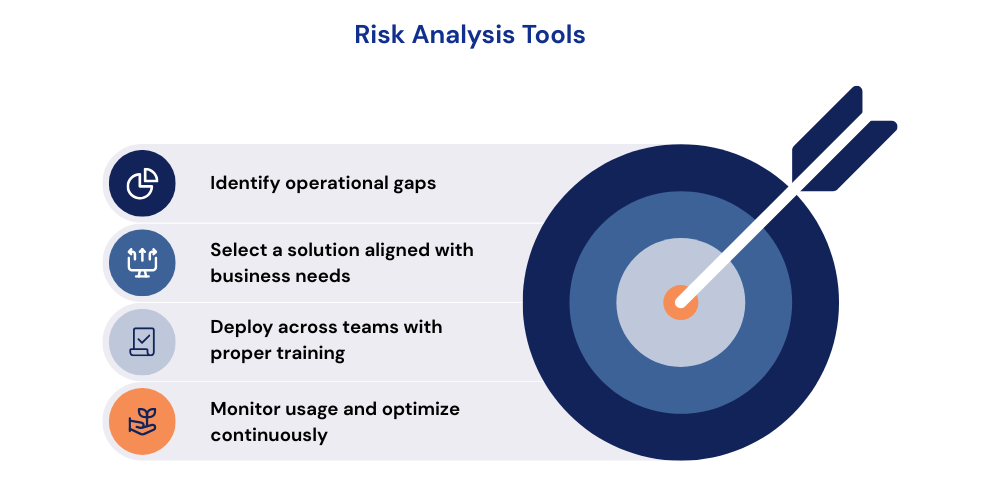
This phased implementation reduces resistance, accelerates user adoption, and improves outcomes while enabling better employee activity tracking and operational control.
Enhancing Transparency and Team Accountability
Modern attendance systems create a transparent and data-driven work environment where both managers and field employees operate with clear visibility and expectations. This transparency helps eliminate confusion, reduces disputes, and builds a culture of accountability across distributed teams.
- Managers get real-time visibility
Gain instant access to employee locations, attendance status, and daily activities, enabling better supervision, faster decision-making, and improved control over field operations. - Employees understand performance expectations
Clear tracking systems help employees know what is expected in terms of attendance, activity levels, and productivity, encouraging them to stay aligned with business goals. - Data eliminates ambiguity in reporting
Automated records ensure that attendance and activity data are accurate, reducing reliance on manual inputs and minimizing conflicts or misunderstandings between managers and teams.
This clarity strengthens trust, improves discipline, and fosters a performance-driven culture through structured use of attendance tracking software, ultimately leading to more efficient and accountable field operations.

Real Business Impact of Smart Attendance Systems
Organizations adopting advanced tracking solutions often experience measurable improvements across both operational efficiency and strategic decision-making. By aligning attendance with real field activities, businesses gain better control over workforce performance and outcomes.
- Better field coverage
Ensures sales representatives consistently cover assigned territories, reducing missed opportunities and improving market reach through structured planning and monitored execution of field activities. - Increased visit productivity
Encourages more meaningful customer interactions by tracking actual visits, helping teams focus on high-value activities that directly contribute to revenue generation and sales growth. - Improved reporting accuracy
Eliminates manual errors by capturing real-time attendance and activity data, ensuring reports are reliable, consistent, and useful for performance evaluation and planning. - Faster decision-making cycles
Provides managers with instant access to actionable insights, enabling quicker responses to field issues, better resource allocation, and more agile business strategies.
The impact is both operational and strategic, especially when powered by location-based attendance system capabilities that ensure accuracy, transparency, and real-time visibility.
Final Thoughts
Attendance management has evolved far beyond simply marking presence, it now plays a critical role in measuring productivity, driving accountability, and optimizing overall field performance. For businesses with on-ground teams, relying on outdated tracking methods can lead to inefficiencies, poor visibility, and missed growth opportunities.
On the other hand, organizations that embrace modern, technology-driven solutions gain better control over their field operations, improve team performance, and make faster, data-backed decisions. The shift is no longer optional, it’s essential for staying competitive in today’s dynamic sales environment.
If you’re looking to streamline your field operations and gain complete visibility into your team’s performance, it’s time to take the next step. Book a free demo of Delta Sales App today and see how a smart attendance and field sales management solution can transform your business.