
Best Sales Software for Food Distributors to Manage Field Operations
Food distribution looks straightforward on paper: products move from manufacturers or distributors to retailers, restaurants, wholesalers, and other outlets. Managing the actual field operation behind that movement involves dozens of daily decisions.
Which outlets should a rep visit today? Did they actually cover the planned beat? What did the retailer order? Is the requested SKU even available? Which payments are overdue? Did the rep collect cash or a cheque? How much stock is sitting with the distributor right now? Which territories are getting poor coverage? When those questions get answered through phone calls, spreadsheets, paper order books, and separate reporting systems, managers end up spending more time collecting information than actually acting on it.
That's where sales software for food distributors earns its place. The right platform ties order taking, customer management, beat planning, field tracking, collections, inventory visibility, and reporting into one operational workflow, instead of five disconnected ones.
This blog covers what food distributors should look for in sales software, how leading platforms compare, and where they actually fit into a practical field-sales operation.
Why Food Distributors Need Dedicated Sales Software for Field Operations
Food distribution runs on a different operating rhythm than most B2B sales environments. Orders come in frequently, product moves fast, SKU counts can be high, and outlet coverage directly drives secondary sales.
A rep might visit dozens of retailers in a single day. A manager might need to watch several territories at once. Distributor stock, retailer demand, pricing, schemes, collections, and route coverage all have to stay aligned, not drift apart from each other. A dedicated field sales platform is what turns those activities into one connected process, rather than a pile of separate admin tasks nobody's reconciling.
Challenges Unique to Food Distribution Field Sales
Food distributors commonly deal with several operational problems at the same time.
-
High-frequency ordering is one of the biggest. Retailers may reorder the same products every few days, while fast-moving SKUs can require frequent replenishment. Manually writing orders increases the possibility of incorrect quantities, missed items, and delayed communication with the distributor or warehouse.
-
SKU complexity adds another layer. A food distributor may handle different pack sizes, product variants, price points, schemes, and retailer-specific rates. Reps need accurate product information while standing in front of the customer.
-
Territory coverage is another challenge. A territory can contain hundreds or thousands of outlets, and simply assigning a list of customers does not create an effective beat plan. Travel time, outlet frequency, priority customers, and rep capacity all need to be considered.
Collections matter just as much. A sale isn't complete just because an order got booked. Outstanding invoices, payment commitments, cash collections, cheques, and follow-ups are what actually determine a distributor's real cash flow. Then there's management visibility. When reps are out in the market all day, managers need a reliable way to understand visits, orders, collections, attendance, routes, and daily productivity, without calling every single rep to piece it together.
Where Spreadsheets, Paper Orders, and Generic CRMs Fall Short
Spreadsheets are genuinely useful for analysis, but they weren't built to run a field operation. A spreadsheet can show a customer list, but it can't verify whether that customer actually got visited. A paper order book can record quantities, but it offers zero real-time visibility into order status. A generic CRM maintains customer records and sales pipelines fine, but most food distribution teams need something a lot closer to the actual field workflow.
The problem isn't that these tools are bad. It's that too many disconnected tools create extra work nobody asked for. A rep takes an order on paper, sends a photo through a messaging app, someone else enters it into a spreadsheet, the manager waits for an update, and the warehouse finds out later still. By the time a report finally comes together, the market's already moved on. Sales software built for field operations is what cuts out those handoffs entirely.
What Field Teams Gain from the Right Software
The biggest benefit isn't digitizing paperwork for its own sake. It's creating a continuous flow of information between the field, the sales manager, the distributor, the warehouse, and the management team.
A rep can pull up customer information, products, pricing, and order functions right from their phone. Managers see field activity and sales reports without waiting on end-of-day calls. The distributor team gets a much clearer picture of real demand and orders, instead of piecing it together after the fact.
Key Features to Look for in Sales Software for Food Distributors
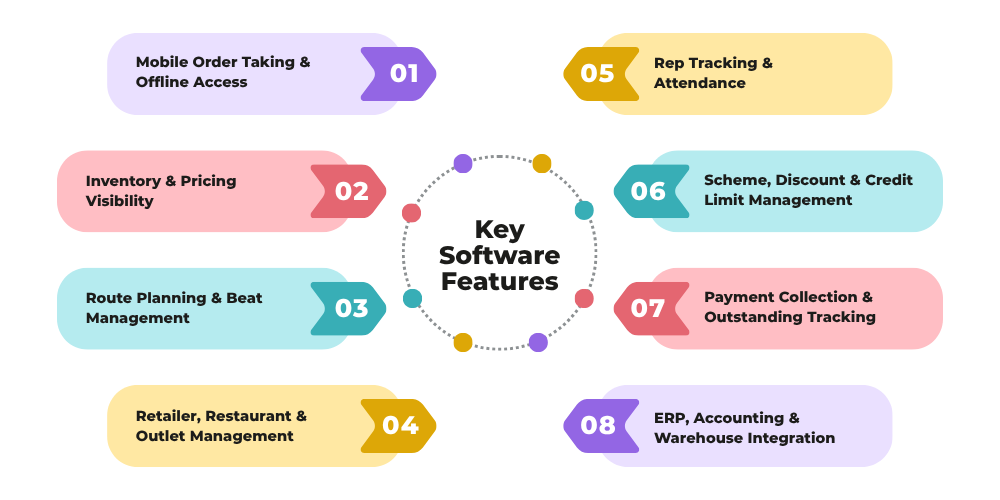
The right sales software needs to support the whole field-sales workflow: planning daily beats, visiting outlets, capturing orders, managing collections, and reviewing performance, all as one continuous process. For food distributors specifically, the features that matter most are the ones that help reps work efficiently out in the field while giving managers accurate visibility across territories, customers, inventory, and sales activity.
-
Mobile Order Taking with Offline Access
Order booking needs to happen right where the sale happens; at the retailer, restaurant, wholesaler, or wherever the customer actually is. An order management system lets reps select products, enter quantities, apply the right pricing or schemes, and submit the order on the spot, without running a separate paper process behind it.
Offline functionality matters a lot here, especially for distribution teams covering rural areas, weak-network zones, warehouses, markets, and routes where connectivity can't be counted on. For food distributors, that's a real, practical difference: the rep keeps visiting outlets instead of standing around waiting for a signal before they can record the next order.
-
Real-Time Inventory and Pricing Visibility
Food sales depend heavily on what's actually available to sell. A rep shouldn't have to call the distributor every time a retailer asks about a specific SKU. Sales software needs to put relevant product and stock information right in the rep's hands, cutting out the back-and-forth between field and office that would otherwise happen over every single question. Pricing visibility matters just as much when different customers or channels run different rates. Accurate product and party information is what keeps a rep from quoting the wrong price or logging an order incorrectly in the moment.
-
Route Planning and Beat Management
A good sales team can still lose real productivity to poor routing. If a rep spends too much time traveling between outlets, fewer productive calls get completed in a day. If beats are poorly structured, some retailers end up with frequent visits while others get neglected entirely. The goal was never just handing every rep a list of outlets. It's building a visit structure that actually matches territory size, customer frequency, and sales priorities, not one that just looks organized on paper.
-
Retailer, Restaurant, and Outlet Management
A food distributor's customer base is rarely just one type of customer. Depending on the distribution model, the field team might deal with grocery retailers, supermarkets, restaurants, cafés, wholesalers, hotels, institutional buyers, and other outlets, all at once. Sales software should keep customer details, locations, order history, products, and relevant commercial information in one place. That gives the rep real, useful information going into a visit instead of relying on a notebook or a spreadsheet nobody's updated in weeks.
-
Rep Tracking, Attendance, and Visit Verification
Managing a field team does not mean watching a map all day. It means having enough reliable information to understand whether planned field activity is actually happening. GPS-based employee tracking, attendance, geo-tagging, and visit records can help managers identify route deviations, missed visits, excessive travel, or territory coverage gaps. This is particularly useful when a sales manager is responsible for several territories and cannot physically accompany every rep.
-
Scheme, Discount, and Credit Limit Management
Food distribution often involves retailer-specific pricing, trade schemes, discounts, and credit arrangements. The sales application should make the correct commercial rules available during order entry instead of leaving reps to calculate everything manually. The practical benefit is fewer pricing mistakes and less back-and-forth between the rep, distributor, and manager.
-
Payment Collection and Outstanding Tracking
Collections should be treated as part of the field-sales workflow, not as a separate accounting exercise. A rep visiting a retailer may need to check an outstanding amount, collect a payment, record the payment method, and schedule a follow-up. For food distributors operating on credit, this creates a clearer connection between sales activity and cash recovery.
-
Integration with ERP, Accounting, and Warehouse Systems
Field sales software shouldn't end up as another isolated database bolted onto everything else. As a distributor grows, product, customer, inventory, billing, accounting, and sales information often already exist across ERP or accounting systems, and the sales platform needs to actually fit into that environment, not fight it. That's why integration requirements deserve a real conversation before purchase. Check exactly how customer data, product masters, prices, stock, orders, payments, and other required information will actually move between systems, not just assume it'll work itself out.
-
Reports and Sales Analytics
Managers shouldn't have to wait until the end of the week to find out what happened in the field. Useful reports here include daily sales and order reports, party-wise sales, rep-wise performance, zero-order alerts, attendance, expenses, payment collections, GPS paths, outlet visits, and territory and beat performance. That's what moves managers from simply collecting DSR data to actually using it to make a decision.
Best Sales Software for Food Distributors Compared
There is no single sales platform that will fit every distributor. The right choice depends on the size of the operation, distribution model, existing systems, territory structure, and field-team requirements. The following tools are worth considering when evaluating the market.
1. Delta Sales App: Best for Practical Field Sales and Distribution Management
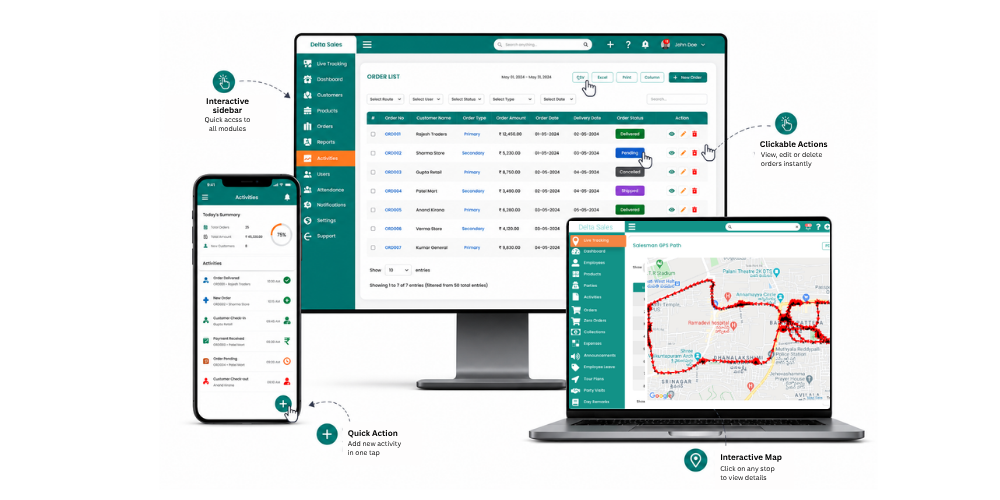
For food distributors, Delta Sales App combines Sales Force Automation (SFA) with Distribution Management System (DMS) capabilities in one platform. It connects the daily activities of field representatives and distribution teams, from beat planning and outlet visits to order capture, collections, inventory, and sales reporting.
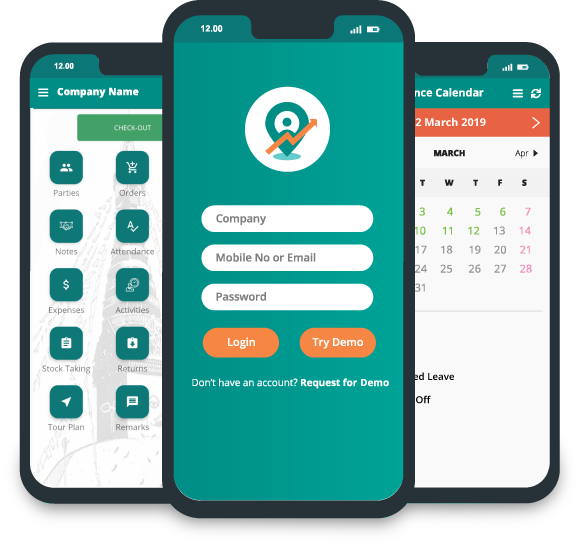
Representatives can manage customer information, follow assigned beats, track visits, capture orders, record collections, and submit daily activity from the field. The system also supports GPS employee tracking, attendance and leave management, expense reporting, distributor and party management, payment collection, inventory management, reporting, and analytics.
Offline access is particularly useful for teams working in areas with inconsistent connectivity. Representatives can continue recording orders and field activities without an active connection, with data synchronizing once connectivity is restored. The DMS capabilities help connect distributor operations with field sales, while the SFA functionality provides tools for beat planning, route management, employee tracking, visit monitoring, and automated field reporting. This makes the platform suitable for food distributors that want to manage sales and distribution operations through a connected workflow rather than relying on separate tools.
Field usability is another important consideration. Even a feature-rich system will struggle to deliver results if representatives find it difficult to use. A straightforward mobile workflow can make order entry, customer visits, collections, and daily reporting easier to adopt across the sales team.
2. Bizom
Bizom is positioned around retail intelligence and route-to-market operations for consumer brands. Its platform covers sales force automation system, distributor management, retail execution, beat plans, trade promotion, suggested ordering, and more. That can make real sense for organizations running complex CPG operations with substantial retail-intelligence needs. For a smaller or mid-sized food distributor, though, the real question is whether all that breadth actually matches the operational complexity of the business. More capabilities don't automatically translate into better adoption.
3. BeatRoute
BeatRoute combines SFA and DMS with route optimization and AI-based capabilities. Its platform covers areas such as order collection, stock reporting, retail execution, van sales, and territory management. It is particularly relevant for larger FMCG teams looking beyond basic activity tracking and toward goal-driven territory execution. For distributors evaluating it, the main consideration should be whether those advanced capabilities are necessary for the current distribution model and whether the implementation complexity fits the organization.
4. FieldAssist
FieldAssist focuses strongly on FMCG sales and distribution. Its documented platform workflows cover outlets, beats, product pricing, distributor inventory, payments, primary orders, retailer sales, schemes, and route planning. It can be suitable for organizations managing large and structured FMCG operations. The evaluation should focus on integration, implementation, usability, and the exact workflows required by the field team rather than feature volume alone.
5. SalesDiary
SalesDiary is also worth considering when comparing field sales and distribution platforms. For a food distributor, the evaluation should center on practical requirements: offline order taking, customer management, beat planning, collections, stock visibility, reporting, and integration with existing systems. The question that actually matters stays the same no matter which platform you're looking at: can reps complete their real daily workflow quickly and accurately from the field?
How to Choose the Right Sales Software for Your Distribution Business
Choosing sales software should start with the way the distribution business actually operates. The right platform should fit the sales model, team size, territory structure, field workflows, and existing systems while remaining simple enough for representatives to use consistently. Before making a decision, evaluate the software against the practical needs of the business rather than choosing based only on the number of features or the subscription price.
-
Match the Software to Your Distribution Model
Not every food distributor operates the same way. A wholesale distributor might have fewer, larger customers and a relationship-driven ordering process. A pre-sales model depends on regular retailer visits and order booking. Van sales need ready-stock visibility, route planning, order capture, and delivery coordination, all working together in real time. Before picking software, map out the actual process, from the rep's first visit all the way through to the final order, delivery, and collection, so the platform gets chosen to fit how the business really works, not the other way around.
-
Assess Team Size, Territory Coverage, and Growth Plans
A solution that works smoothly for ten reps might not hold up the same way for a hundred. Worth weighing: the number of reps, distributors, territories, outlets, SKUs, daily visits, and managers who'll actually be using the system. Expansion matters too. If new territories or distributors are likely down the road, make sure the software can grow with that structure instead of forcing another migration project a year or two from now.
-
Check Usability for Field Reps with Low Tech Experience
The rep is the one actually living inside the app all day. If placing a simple order takes several minutes, adoption falls apart fast. If the navigation's a maze, reps drift right back to WhatsApp, paper, phone calls, or whatever's faster in the moment. That's exactly why a live trial beats a feature sheet every single time. Try the basics yourself: find an outlet, check customer information, place an order, record a payment, complete a visit, check the next beat, submit the day's report. If those feel natural end-to-end, the app has a real shot at becoming part of the daily routine.
-
Evaluate Implementation Time, Training, and Support
Implementation is not finished when the software is installed. Customer and distributor data need to be prepared. Product masters need to be configured. Pricing and schemes need to be mapped. Beats need to be created. Representatives need training. Ask the vendor what implementation support looks like, how training is delivered, how issues are handled, and who owns the process after launch.

How Sales Software Improves Field Operations in Food Distribution
Sales software can improve food distribution operations by connecting field activities that are often managed separately. From order capture and route planning to payment collection and sales reporting, a connected system helps reduce manual work, improve field productivity, and give managers clearer visibility into daily operations.
-
Faster Order Capture and Fewer Order Errors
Digital order entry cuts out a lot of the manual handoffs between the rep and the back office. Instead of writing the order down and re-entering it later, the rep records it directly during the visit itself. That gets the information available sooner and cuts out most of the transcription errors that creep in when an order gets copied twice. For food distributors, faster order capture usually means faster confirmation, better planning for dispatch, and a lot fewer clarification calls chasing down what was actually ordered.
-
Better Route Efficiency and More Outlet Visits per Day
A well-structured beat plan helps representatives spend more time selling and less time travelling unnecessarily. Managers can organize outlets into beats, assign routes, and compare planned activity with actual field movement. The goal is not to force reps to visit more outlets regardless of quality. It is to make territory coverage more deliberate and reduce avoidable travel.
-
Improved Collections and Cash Flow
Sales volume alone doesn't tell the full story of distributor performance. Outstanding payments turn into a real operational problem fast when there's no consistent follow-up process behind them. With payment collection functionality, reps record collections right during customer visits, and managers can watch payment status as it happens. That's what ties sales activity to actual cash recovery, instead of leaving the two disconnected.
-
Stronger Visibility for Managers and Owners
One of the biggest changes after implementing field sales software is the quality of information available to management. Instead of asking, "How many outlets were visited today?" or "Which reps have submitted their DSR?" managers can use centralized reports and dashboards. This allows management to focus on exceptions and decisions rather than chasing updates.
Common Mistakes to Avoid When Selecting and Rolling Out Field Sales Software
Selecting field sales software is only the first step. The system also needs to fit the team's workflow and be introduced in a way that encourages consistent adoption. Avoiding common mistakes around pricing, rep involvement, integrations, and implementation can help prevent unnecessary costs and operational disruption.
-
Choosing Based on Price Alone
The cheapest application is not necessarily the lowest-cost option. If reps do not use the system consistently, if managers still maintain spreadsheets, or if the software cannot integrate with existing systems, the business ends up paying for both the software and the manual process. Evaluate total operational value, not just the subscription price.
-
Skipping Rep Input Before Purchase
Managers and owners may make the purchasing decision, but representatives determine whether the software becomes part of the daily process. Ask reps where current order taking slows them down. Find out which customer information they need most often. Observe how long it takes to complete a typical outlet visit. Those observations should influence the final software decision.
-
Ignoring Integration Requirements
A field sales app shouldn't end up as a second, competing version of the product or customer database. Before implementation, pin down which systems actually need to exchange data; that might mean ERP, accounting, inventory, billing, warehouse, or distributor systems. Document those integration requirements before signing the contract, not after rollout's already underway and something doesn't connect the way everyone assumed it would.
-
Rolling Out to the Whole Team at Once
A big-bang rollout can create unnecessary confusion. A better approach is to start with one territory, distributor, or representative group. Test order booking, beat plans, customer data, collections, reports, and synchronization. Once the workflow works in practice, expand the rollout.
Final Thoughts
For food distributors, sales software should do more than store customer information or generate a sales report. The real value comes from connecting the field operation: beat planning, outlet visits, order taking, SKU management, distributor stock, payment collection, attendance, GPS tracking, and sales reporting.
The best sales software for food distributors is therefore the platform that fits the way the sales team actually works.
Delta Sales App is particularly suited to this requirement because it brings field sales automation, distributor and party management, order management, payment collection, beat planning, employee tracking, attendance, inventory, offline functionality, and reporting into one workflow.
For a food distributor, that means less dependence on paper orders and scattered spreadsheets, clearer territory coverage, faster access to field information, and better visibility into what is happening across the sales network. The best way to evaluate the fit is to test the platform against a real distribution workflow rather than a theoretical feature checklist.
Book a free demo of Delta Sales App to see how field sales, distributor management, order taking, beat planning, collections, and reporting can work together for a food distribution business.