Top 7 Bizom Alternatives for FMCG Field Sales Teams
Managing an FMCG field sales team requires businesses to keep track of multiple activities, including retailer visits, order booking, beat coverage, distributor operations, product availability, and sales performance. With representatives working across different territories, managers need reliable tools to monitor field activities, maintain retail execution, and manage sales operations effectively.
Bizom is a retail intelligence platform that helps FMCG businesses manage field sales, distribution, and retail execution through technology-driven insights and operational tools. However, because business needs differ, a platform that works well for one company may not fit another.
Factors such as pricing, team size, ease of use, reporting capabilities, integration requirements, and the flexibility to manage different sales workflows can influence a company's software choice. Businesses may also look for alternatives when expanding into new markets, restructuring field operations, or seeking features that better match their day-to-day requirements.
Fortunately, several platforms offer capabilities for managing FMCG field sales, retail execution, and distribution activities. This guide explores seven Bizom alternatives, comparing their key features and suitability to help businesses identify a platform that aligns with their operational needs.
Why FMCG Teams Look for a Bizom Alternative
Switching sales force automation software is not simply about finding another application. It involves evaluating whether the existing system supports the company's distribution model, workforce structure, and reporting requirements. As an FMCG business grows, its operational requirements can change. Three common situations encourage companies to explore alternatives.
-
When team size or pricing stops matching the plan
Fifteen field reps and 150 reps across several territories call for different software. As the team grows, a business has to think about subscription costs, user management, reporting hierarchies, and add-on modules. A small distributor might only need employee tracking, attendance, beat planning, and order management. A larger organization is more likely to want territory-wise dashboards, distributor access, advanced reporting, and ERP integrations. A lower subscription price doesn't always mean lower running costs, either. If managers still reconcile orders in spreadsheets or build the daily sales report by hand, the business is paying for the admin time anyway.
-
When distributor and secondary sales workflows need more flexibility
Distributor management is an important part of FMCG operations. Manufacturers depend on distributors to maintain product availability, fulfill retailer orders, manage stock, and report secondary sales. However, distribution structures differ between businesses. Some manufacturers operate through super-stockists, stockists, and distributors. Others work with multiple distributors covering different territories. Their requirements for primary sales, secondary sales, inventory management, payment collection, and retailer-level ordering can vary. If the existing software does not accommodate these workflows conveniently, employees may need to maintain additional records outside the platform.
-
When reporting and onboarding slow the field team down
Field reps already have full days. They follow assigned beats, visit retailers, check product availability, book orders, collect payments, and file daily reports. If the mobile app needs too many manual entries or buries things behind complicated navigation, reps end up spending more time updating records than serving customers. Managers hit the same wall when they can't get reliable sales information without chasing reports from several people. A platform only helps when reps use it consistently, and managers can trust what comes out of it.
7 Bizom Alternatives for FMCG Field Sales
Different SFA platforms address different parts of field sales management. Some emphasize distributor management and secondary sales, while others focus on retail execution, employee tracking, or territory management. The following seven platforms are worth evaluating based on your business requirements.
1. Delta Sales App
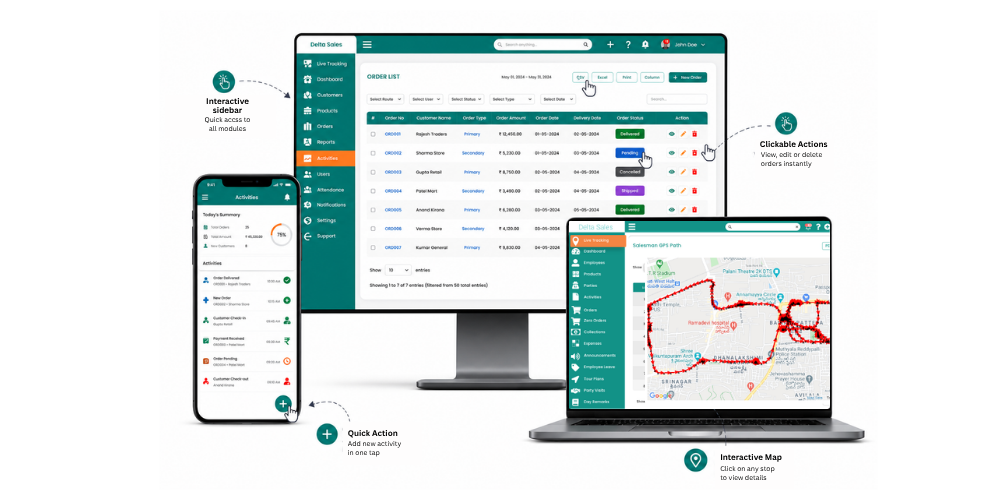
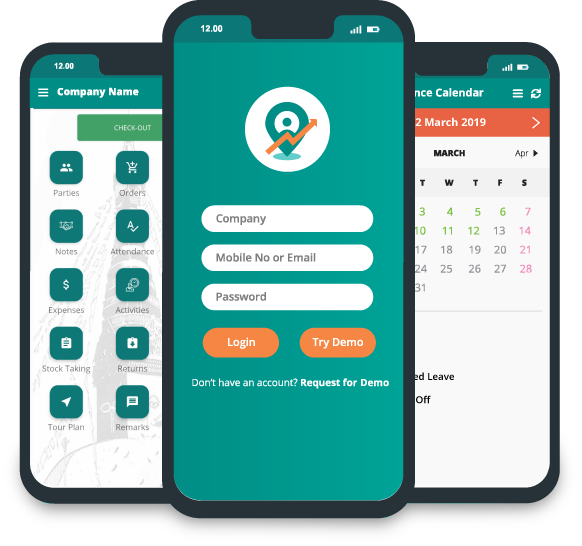
Delta Sales App is a SaaS‑based field sales force automation and employee tracking platform made for FMCG companies, manufacturers, wholesalers, and distributors who manage sales teams. It lets businesses coordinate field representatives who track sales activities, handle retailer orders, and review sales performance through a mobile app and a central management dashboard.
If a business is looking for an alternative, the Delta Sales App is worth checking out when the goal is to bring everyday field sales activities into one system instead of juggling separate applications and manual reports.
Its features cover the stages of field sales execution: assigning daily beats, verifying retailer visits, recording orders, collecting payments, and reviewing end‑of‑day performance.
Key Features of Delta Sales App
1. GPS-Based Employee Tracking and Visit Verification
Delta Sales App offers GPS‑based employee tracking, customer visit tracking, and location mapping. Delta Sales App lets managers see where representatives are, look at travel history, and review customer visit records. Delta Sales App helps managers watch field activity and check territory coverage.
2. Beat Planning and Route Management
The platform allows managers to create beat plans, assign routes, and schedule retailer visits for field representatives. It also supports tour planning, helping businesses organize daily market visits and manage outlet coverage.
3. Order Booking and Payment Collection
Field representatives can use the application to place customer orders. They can also look up product rates for each party. The application lets them use order schemes. There is a payment collection module too. This module helps them record money they get in cash. They can also record payments received by cheque. They can also record payments that come by dated cheque.
4. Attendance, Leave, and Expense Management
Delta Sales App includes features for employee attendance, leave applications, and field expense reporting. Employees can submit records through the application, while managers can review attendance and process leave and expense requests.
5. Stocktaking and Retailer Management
The stock-taking feature allows representatives to record product stock information at customer locations. The platform also maintains customer and party details, including retailer information, GPS locations, and order history.
6. Offline Order Booking and Synchronization
The application supports offline order booking and selected field activities when internet connectivity is unavailable. Recorded information is automatically synchronized once the connection is restored, allowing representatives to continue working in areas with limited network coverage.
7. Automated Reports and Sales Analytics
Managers can access reports covering sales orders, employee performance, attendance, payment collection, expenses, GPS routes, and daily field activities. These reports provide an overview of sales operations and representative performance.
8. Distributor and Retailer-Facing Capabilities
Delta Sales App includes a distributor panel for managing received orders and a retailer application that allows customers to place orders with distributors. It also supports integrations with accounting and business software, depending on the integration requirements.
Who should consider Delta Sales App?
Delta Sales App is worth considering for:
-
FMCG distributors managing field sales representatives across multiple beats.
-
Manufacturers looking to improve retailer visit verification and sales reporting.
-
Wholesalers managing customer orders and payment collections.
-
Businesses that need GPS-based employee tracking alongside sales automation.
-
Companies with field teams operating in areas with inconsistent internet connectivity.
2. FieldAssist
FieldAssist is an FMCG-focused sales and distribution automation platform that combines field sales management, distributor operations, and retail intelligence. Its capabilities include:
-
Sales force automation and order booking.
-
Geo-tagged visits and guided beat planning.
-
Distributor stock visibility.
-
Secondary sales monitoring.
-
Retail execution and promotion management.
Best suited for: FMCG and consumer goods companies looking to coordinate field sales, distributor operations, and retail execution through a connected platform.
Consideration: Evaluate implementation requirements, module availability, pricing, and the level of customization needed for your distribution structure.
3. Botree
Botree offers FMCG-focused sales force automation and distributor management solutions. Its platform is relevant to manufacturers managing extensive distributor networks and seeking better visibility into secondary sales. Its key capabilities include:
-
Distributor management and secondary sales tracking.
-
Field sales automation and outlet management.
-
Order and return management.
-
Route planning and optimization.
-
Sales analytics and retail intelligence.
Best suited for: FMCG manufacturers that need distributor-level visibility, secondary sales information, and structured field execution.
Consideration: Businesses should assess implementation complexity and integration requirements, particularly if they only need basic field sales automation.

4. SalesDiary
SalesDiary focuses on FMCG sales execution, retailer engagement, and distributor coordination. It is relevant to businesses looking to improve the way representatives manage daily retail visits. Its key capabilities include:
-
Beat planning and route management.
-
Retailer order booking.
-
Merchandising and in-store execution.
-
Trade schemes and claims management.
-
Secondary sales visibility.
Best suited for: FMCG brands that want to improve outlet-level execution and coordinate retail activities with distributor operations.
Consideration: Verify the availability of specific distributor workflows, reporting features, and ERP integrations before selecting a package.
5. Repsly
Repsly is a retail execution and field team management platform that helps consumer goods brands monitor in-store activities and merchandising performance. Its key capabilities include:
-
Retail merchandising and store audits.
-
Mobile order entry and product catalogs.
-
Photo and survey collection.
-
Promotion execution monitoring.
-
Field team reporting and analytics.
Best suited for: FMCG brands that prioritize store-level visibility, merchandising standards, product availability, and promotional execution.
Consideration: Businesses requiring extensive distributor accounting, primary sales management, and inventory reconciliation should verify these capabilities separately.
6. Salestrip SFA
Salestrip SFA offers field sales automation capabilities, with a strong focus on pharmaceutical and healthcare sales teams. It also lists FMCG and other industries among its areas of application.
Its key capabilities include:
-
GPS-based visit tracking.
-
Territory and beat planning.
-
Order and inventory management.
-
Expense reporting.
-
Field activity reporting and analytics.
Best suited for: Organizations looking for field representative management and structured sales reporting across pharmaceutical and related industries.
Consideration: FMCG businesses should confirm the suitability of their distributor management, secondary sales, and retailer-focused workflows.
7. SPOTIO
SPOTIO is an outside sales platform focused on territory organization, route planning, and representative productivity. Its key capabilities include:
-
Sales territory management.
-
Route optimization.
-
Location-verified activity tracking.
-
Lead and account management.
-
Sales performance reporting and CRM integrations.
Best suited for: Outside sales teams that prioritize territory coverage, account management, and field representative productivity.
Consideration: FMCG businesses should verify its suitability for distributor inventory, primary and secondary sales, and high-frequency retailer order management.
How to Choose the Right Bizom Alternative for Your FMCG Team
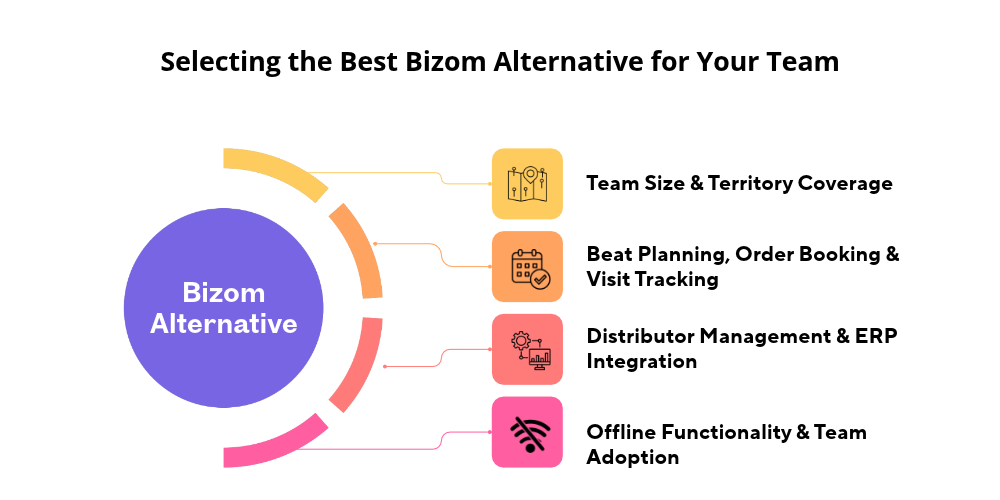
A feature list isn't enough to shortlist software. Two platforms can both claim GPS tracking, order management, and sales reports and still work very differently once a rep picks up the phone. Start the selection with your own distribution model, what field reps do all day, and what managers need to see to make decisions. Compare the platforms against that.
Match the tool to your team size and territory spread
Start by understanding how your field sales team is structured. A distributor operating in one city may have 10 representatives reporting to a single sales manager. A manufacturer operating across several regions may have representatives, territory sales officers, area sales managers, and regional managers. The software should support this structure without creating unnecessary administrative work.
Check beat planning, order booking, and visit tracking depth
These capabilities shape how field sales run day to day. A beat plan should do more than hand a rep a list of retailers. It should let managers organize outlet visits by territory, visit frequency, and business priority. When you evaluate software, check whether reps can:
-
Open their assigned daily beats
-
See retailer details and previous order history
-
Navigate to customer locations
-
Record completed and missed visits
-
Book orders directly from the outlet
-
Log zero-order visits along with the reason
-
Record payment collections
-
Submit daily activity reports
GPS tracking needs a close look too. Knowing roughly where a rep is isn't the same as verifying they actually visited an assigned retailer. Look for GPS-based visit verification, timestamps, check-in and check-out records, and route history.
Confirm distributor management and ERP integration
Distributor operations should weigh heavily when you're picking an alternative to Bizom. An FMCG manufacturer needs to see what distributors buy, what they sell on to retailers, and how much inventory they still hold. Without that, managers can look at strong primary sales and miss weak secondary sales or shrinking outlet coverage. Check whether the software supports:
-
Primary and secondary order management
-
Distributor-wise sales reporting
-
Retailer-level order tracking
-
SKU-wise stock visibility
-
Payment collection and outstanding balances
-
Product returns and delivery records
-
Promotional schemes and discounts
-
Distributor and accounting software integrations
ERP integration matters just as much. If your company already keeps product masters, customer records, inventory, and accounting data in an ERP or accounting system, and the SFA platform can't exchange the data it needs, your people will end up entering the same information twice.
Test offline use and rep adoption before you commit
Field sales teams don't always work where the internet is reliable. Reps may visit rural outlets, remote markets, or places where the mobile network comes and goes. An app that needs a stable connection the whole time will interrupt order booking and reporting. During a product demo, test whether reps can:
-
Open their assigned beats with no connection
-
View the customer and product information they need
-
Record orders and visit details offline
-
Save payment and activity information
-
Sync records automatically once connectivity returns
Also ask how many training reps they would need before they can use the app on their own. A complicated interface can lead to incomplete visit records, delayed order entries, and inaccurate reporting. Involving actual field representatives in the evaluation process can reveal usability problems that managers may overlook. Finally, evaluate the vendor's onboarding process, technical support, training resources, and response time when operational issues occur.
Final Thoughts
Choosing the right Bizom alternative depends on how well a platform supports your company's field sales operations, distribution structure, and business goals. While some tools focus on retail intelligence and execution, others offer capabilities for beat planning, employee tracking, order management, distributor operations, and sales reporting.
Before making a decision, compare each platform based on its features, pricing, ease of use, integration options, and suitability for your team's daily workflows. It is also worth evaluating how easily field representatives and managers can adopt the software.
If you are looking for a platform to manage field representatives, monitor retailer visits, organize beat plans, track orders, and review sales performance, Delta Sales App is worth considering. Explore its features and see how it can support your field sales operations.
Ready to simplify your field sales management? Get a Personalized Product Demo and explore what Delta Sales App can do for your business.