
Competitor Activity Tracking: How Field Sales Teams Can Be Your Best Market Research Tool

In today's super competitive business environment, knowing your competition isn't optional, it's essential. Whether it is FMCG, pharmaceuticals, consumer goods, electronics or manufacturing, your competitors are always coming up with new products, changing prices, running promotions and devising their retail strategies to win customers. If you don’t keep pace with these changes, your business could be losing share and missing out on major growth opportunities.
That’s where monitoring competitor activity becomes a powerful business practice. It helps organisations keep track of what competitors are doing in the market and use those insights to make informed choices regarding pricing, promotions, product placement and distribution strategies.
Companies often learn about competitors' activities through regular market surveys or reports from external researchers. These approaches are instructive, but often fail to capture real-time changes at the retail level. By the time the reports are available, the strategies of the competitors may have changed.
Your field sales teams are a much quicker and more reliable source of market intelligence. They visit retailers, distributors and outlets every day and see first hand how competitors are positioning their products, engaging customers and responding to market trends. With the right process and technology, each sales visit is an opportunity to collect actionable market knowledge to keep your business ahead of the curve.
In this guide, we’re going to talk about what competitor activity tracking is, why it’s important, the role field sales teams play in gathering valuable market intelligence, and how businesses can turn regular outlet visits into strategic decision-making opportunities.
What Is Competitor Activity Tracking?
Competitor activity tracking is the systematic process of monitoring and documenting information about your competitors’ activities in the marketplace. This includes the collection of data on pricing, availability of products, promotional campaigns, merchandising tactics, visibility on the shelf, new product introductions, retailer feedback, and other market developments.
The main goal is not to clone competitors but to grasp the competitive context and spot possibilities for enhancing your own business strategy.
For example, a field sales representative visiting a supermarket may note that a competitor has launched a “Buy One Get One Free” promotion or has acquired premium shelf space near the entrance to the store. Such observations offer important competitive intelligence that assists managers in assessing whether similar initiatives are required or if alternative strategies would be more productive.
Tracking competitor activity supports sound decision-making by providing insights into questions such as:
-
Are competitors changing their pricing strategy?
-
Which products are gaining more shelf space?
-
Are competitors launching new SKUs or product variants?
-
What promotional campaigns are retailers actively supporting?
-
How do retailers perceive competing brands?
-
Are competitors expanding into new territories or distribution channels?
When collected consistently, this information helps businesses identify market trends, anticipate competitive moves, and respond more quickly to changing customer demands.
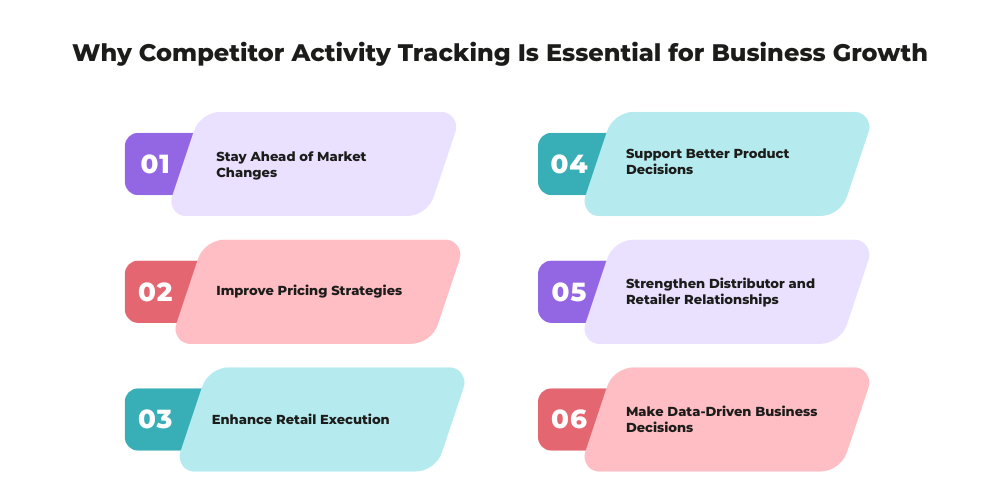
Why Competitor Activity Tracking Is Essential for Business Growth
Markets today evolve rapidly. Consumer preferences shift, retailers adapt their stocking decisions, and competitors continuously experiment with pricing, promotions, and merchandising techniques. Businesses that fail to monitor these changes often find themselves reacting too late.
Competitor activity tracking provides the visibility needed to make proactive business decisions rather than reactive ones.
Stay Ahead of Market Changes
Markets don’t sit still. A competitor could introduce a new product, or offer a seasonal promotion, or expand into a new territory with little or no warning. Companies that track these trends will be able to respond more quickly, safeguarding their customer base and competitive position.
For instance, if a number of retailers start giving a competitor’s new product more shelf space, your business can explore the reasons for this and take steps to boost the visibility of its own products.
Improve Pricing Strategies
Pricing plays a critical role in influencing purchasing decisions. If competitors reduce prices, offer bundled deals, or provide retailer incentives, these changes can directly impact your sales performance.
Regular competitor pricing monitoring helps businesses:
-
Identify pricing trends.
-
Evaluate promotional effectiveness.
-
Adjust pricing strategies based on market conditions.
-
Maintain profitability while remaining competitive.
Rather than reacting months later, businesses can make timely pricing decisions supported by real market data.
Enhance Retail Execution
Strong retail execution extends beyond ensuring product availability. It also involves monitoring how products are displayed, promoted, and positioned within stores.
Competitor activity tracking enables businesses to evaluate:
-
Shelf placement.
-
Product visibility.
-
Promotional displays.
-
Point-of-sale materials.
-
Merchandising standards.
Understanding these factors helps improve your own in-store execution strategy and strengthens brand visibility.
Support Better Product Decisions
Competitor tracking often provides valuable insight into changing consumer preferences.
For instance, if competitors are successfully launching smaller pack sizes or premium product variants, this could be an indication of changing customer demand.
These insights can be used by businesses to:
-
Expand product portfolios.
-
Modify packaging.
-
Introducing new SKUs.
-
Improve product positioning.
-
Prioritize innovation efforts.
Instead of relying solely on assumptions, companies can make product decisions backed by actual market observations.
Strengthen Distributor and Retailer Relationships
Retailers interact with multiple brands every day, making them a valuable source of market feedback.
During outlet visits, sales representatives can gather insights such as:
-
Which products sell fastest?
-
Which promotions generate the highest response?
-
Which competitors provide better retailer support?
-
What challenges do retailers experience with existing suppliers?
These conversations help businesses understand retailer expectations and improve their distribution strategies while strengthening long-term relationships.
Make Data-Driven Business Decisions
One of the greatest advantages of competitor activity tracking is the ability to replace assumptions with evidence.
Rather than asking, "We think our competitors are becoming more aggressive," businesses can confidently say:
-
Competitor A introduced five new products this quarter.
-
Competitor B increased promotional activity across 200 retail outlets.
-
Competitor C reduced pricing by 8% in key territories.
This level of market intelligence enables leadership teams to develop more effective sales, marketing, and distribution strategies.
Why Field Sales Teams Are Your Most Valuable Market Research Asset
Many organizations invest significant resources in external market research agencies, customer surveys, and industry reports. While these sources provide valuable insights, they often come with two major limitations: they are expensive and rarely provide real-time information. Your field sales representatives, on the other hand, are already visiting retailers, distributors, wholesalers, and outlets as part of their daily responsibilities. Every market visit presents an opportunity to collect valuable competitive insights without requiring a separate research initiative. Instead of viewing field sales teams solely as order takers, businesses should recognize them as their eyes and ears in the market.
-1785043936.png)
They Visit Retail Outlets Every Day
Field sales representatives visit retail outlets daily, giving them firsthand visibility into competitor pricing, product availability, shelf visibility, promotional campaigns, and customer buying behavior that traditional market research often misses.
They Build Strong Relationships with Retailers
Regular interactions with retailers help field sales teams gather valuable retailer feedback, understand market trends, identify successful competitor promotions, and uncover customer preferences that strengthen overall competitive intelligence.
They Provide Real-Time Competitive Intelligence
Because field sales teams are active in the market every day, they capture real-time market intelligence on competitor activities, enabling businesses to respond quickly to pricing changes, product launches, and evolving retail conditions.
They Turn Everyday Sales Visits into Strategic Business Insights
By consistently collecting competitor activity, retail execution data, merchandising insights, and retailer feedback during outlet visits, field sales teams help businesses make data-driven decisions and gain a lasting competitive advantage.
What Competitor Information Should Field Sales Representatives Collect?
Collecting competitor information is not about gathering every detail available in the market. Instead, field sales representatives should focus on capturing data that directly influences sales, distribution, merchandising, and customer purchasing decisions. By following a standardized approach during every outlet visit, businesses can build a reliable database of competitive intelligence that supports faster and more informed decision-making. Here are the most important types of competitor information that field sales teams should collect.
1. Competitor Product Availability
Monitoring competitor product availability helps businesses understand market demand, distribution efficiency, and retailer stocking patterns. If competitor products are consistently available while your products experience stockouts, it may indicate gaps in inventory management or supply chain performance.
Field sales representatives should record:
-
Products currently available
-
Out-of-stock competitor products
-
Fast-moving product categories
-
Newly introduced SKUs
-
Product variants (size, flavor, packaging, etc.)
Tracking product availability across multiple retail outlets provides valuable market intelligence that helps businesses forecast demand, optimize inventory, and strengthen product distribution
2. Competitor Pricing
Competitor pricing directly influences customer purchasing decisions and market competitiveness. Even minor price changes or promotional discounts can affect sales performance, especially in industries like FMCG, consumer goods, and retail.
During each outlet visit, sales representatives should capture:
-
Retail prices
-
Wholesale prices (where applicable)
-
Retailer margins
-
Bundle offers
-
Seasonal discounts
-
Limited-time promotional pricing
Regular competitor price monitoring enables businesses to evaluate pricing strategies, maintain profitability, and respond quickly to changing market conditions with data-driven decisions.
3. Promotional Campaigns and Offers
Promotional activities play a significant role in attracting customers and increasing product visibility. Tracking competitor promotions helps businesses understand which campaigns are influencing customer purchases and retailer engagement.
Sales representatives should document:
-
Buy One Get One (BOGO) offers
-
Cashback schemes
-
Consumer discounts
-
Retailer incentive programs
-
Festival or seasonal promotions
-
Loyalty rewards
-
Free samples or gift offers
Analyzing promotional campaigns across different regions provides valuable insights into competitor analysis, allowing businesses to plan more effective marketing and sales strategies.
4. Shelf Placement and Product Visibility
In modern retail, shelf visibility can significantly impact product sales. Products displayed at eye level or in high-traffic areas are more likely to attract customer attention than those placed on lower shelves.
Field sales teams should evaluate:
-
Shelf position
-
Eye-level placement
-
End-cap displays
-
Checkout counter visibility
-
Dedicated brand sections
-
Share of shelf compared to competitors
Monitoring product visibility and shelf placement helps businesses improve retail execution, strengthen merchandising strategies, and compete more effectively for customer attention.
5. Display Quality and In-Store Branding
Strong in-store merchandising enhances brand recognition and encourages impulse purchases. Well-designed displays also improve the shopping experience and reinforce brand recall.
During store visits, representatives should assess:
-
Promotional stands
-
Branded display units
-
Posters and banners
-
Product arrangement
-
Point-of-sale (POS) materials
-
Digital promotional displays
Capturing photos of merchandising activities provides visual evidence that helps marketing and sales teams evaluate display quality and improve retail execution across different outlets.
6. New Product Launches
Keeping track of new product launches helps businesses stay informed about changing market trends and evolving consumer preferences. Early awareness allows organizations to respond with better product strategies and marketing initiatives.
Field sales representatives should record:
-
Newly launched products
-
Packaging updates
-
New flavors or variants
-
Premium product introductions
-
Economy-sized products
-
Limited edition products
Monitoring competitor product launches enables businesses to identify innovation opportunities and respond proactively to market changes.
7. Retailer and Customer Feedback
Retailers interact with customers every day, making them an excellent source of retailer insights and market intelligence. Their feedback can reveal purchasing behavior, competitor strengths, and emerging consumer trends.
Sales representatives should ask questions such as:
-
Which products are selling the fastest?
-
What products do customers frequently request?
-
Which competitor promotions generate the best response?
-
Are there recurring complaints about competing products?
-
Which brands provide better retailer support?
Collecting retailer and customer feedback helps businesses understand customer expectations, improve product positioning, and make informed decisions that strengthen long-term market performance.
How Competitor Activity Tracking Improves Sales and Distribution Strategy
Collecting competitor information is only valuable if businesses use it effectively. When analyzed properly, competitor activity tracking can influence pricing decisions, sales planning, distribution strategies, and retail execution.
Let's explore how these insights translate into measurable business improvements.
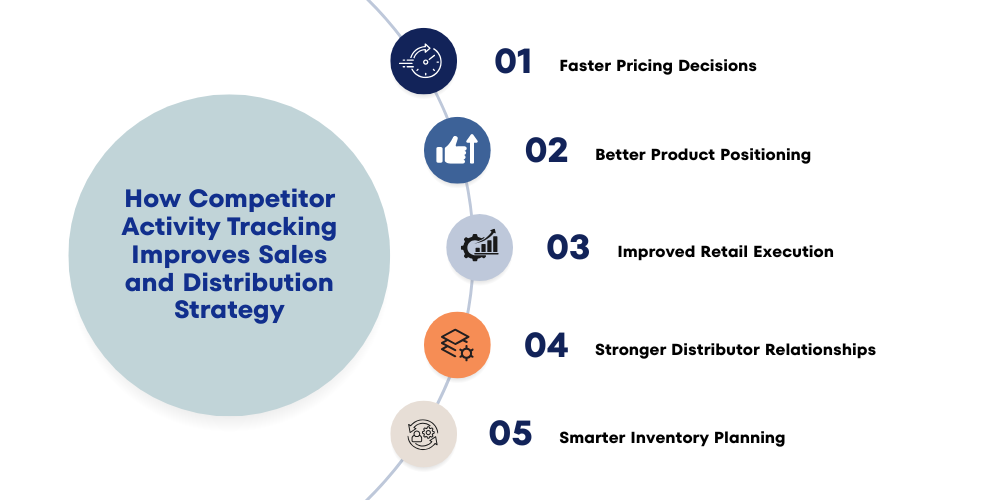
Faster Pricing Decisions
Continuous competitor activity tracking helps businesses identify pricing changes early, adjust regional pricing, launch targeted promotions, and stay competitive without sacrificing profitability or losing market share.
Better Product Positioning
Competitor analysis reveals how products are positioned in retail stores, helping businesses improve shelf visibility, strengthen merchandising strategies, enhance customer engagement, and increase product discoverability.
Improved Retail Execution
Tracking competitor activities uncovers gaps in retail execution, including poor shelf placement, missing promotional materials, and inconsistent merchandising, enabling sales teams to improve in-store performance.
Stronger Distributor Relationships
Competitor intelligence helps businesses understand product distribution, retailer preferences, and regional demand, enabling stronger distributor partnerships, improved market coverage, and a more efficient distribution network.
Smarter Inventory Planning
By monitoring product availability, competitor demand, and market trends, businesses can optimize inventory planning, reduce stockouts, improve sales forecasting, and ensure faster product replenishment across territories.
Common Challenges of Manual Competitor Tracking
Although competitor activity tracking is highly valuable, many organizations still rely on manual methods such as notebooks, spreadsheets, phone calls, or messaging apps. While these approaches may work for small teams, they often become inefficient as the business grows.
Here are some of the most common challenges businesses face.
Inconsistent Data Collection
Without standardized reporting, field sales representatives often capture different types of competitor information, resulting in inconsistent competitor analysis and unreliable data for effective decision-making.
Delayed Reporting
Manual reporting delays the sharing of competitor activities, causing businesses to miss critical pricing changes, promotions, and market trends that require immediate action.
Lack of Visual Evidence
Written reports cannot accurately capture shelf visibility, merchandising quality, or promotional displays. Photo-based reporting provides stronger retail execution insights and validates field observations.
Data Scattered Across Multiple Platforms
Competitor information stored across spreadsheets, WhatsApp, emails, phone calls, and paper forms makes competitor monitoring difficult, limiting data analysis and centralized reporting.
Limited Visibility for Managers
Without centralized dashboards and sales analytics, managers struggle to monitor competitor pricing, promotional campaigns, and regional market trends, making strategic planning and faster decision-making more challenging.
How Technology Simplifies Competitor Activity Tracking
As businesses grow across multiple territories and retail outlets, manual competitor activity tracking becomes inefficient and prone to errors. Modern field sales software streamlines data collection, provides real-time market intelligence, and helps managers monitor competitor activities from a centralized dashboard. Here's how technology simplifies the process.
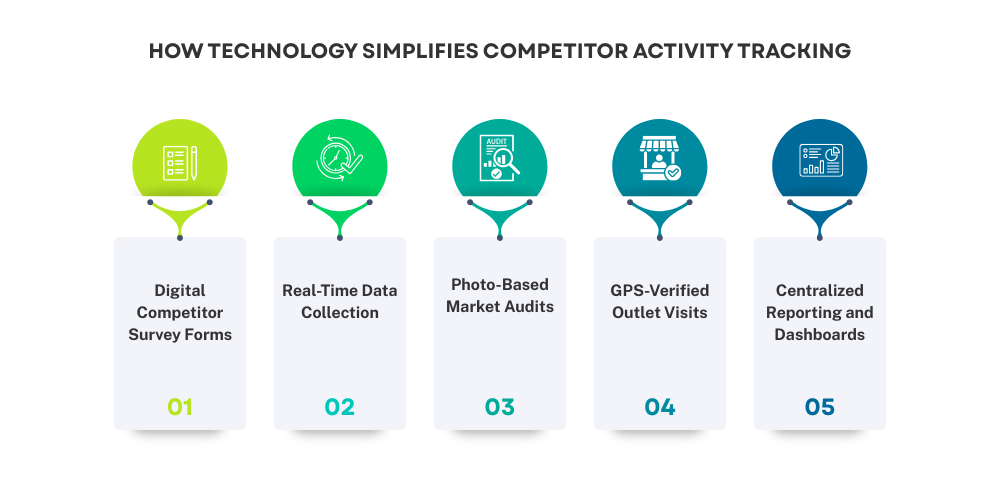
1. Digital Competitor Survey Forms
Digital survey forms standardize competitor data collection by capturing product availability, pricing, promotions, shelf placement, retailer feedback, and product photos, ensuring accurate and consistent competitor analysis across every outlet.
2. Real-Time Data Collection
With automated reports and analytics, field sales representatives instantly upload competitor pricing, promotions, and product updates from retail outlets, enabling managers to respond quickly to changing market trends.
3. Photo-Based Market Audits
Photo-based retail audits provide visual evidence of shelf visibility, promotional displays, competitor branding, and merchandising standards, helping businesses evaluate retail execution and validate field reports.
4. GPS-Verified Outlet Visits
GPS-enabled field sales tracking verifies that competitor information is collected during actual outlet visits, improving accountability, data accuracy, and the reliability of competitor intelligence.
5. Centralized Reporting and Dashboards
Centralized sales analytics dashboards consolidate competitor data across territories, helping managers identify pricing trends, promotional activities, product availability, and market opportunities for faster strategic decisions.
How Delta Sales App Helps Businesses Track Competitor Activities in the Market
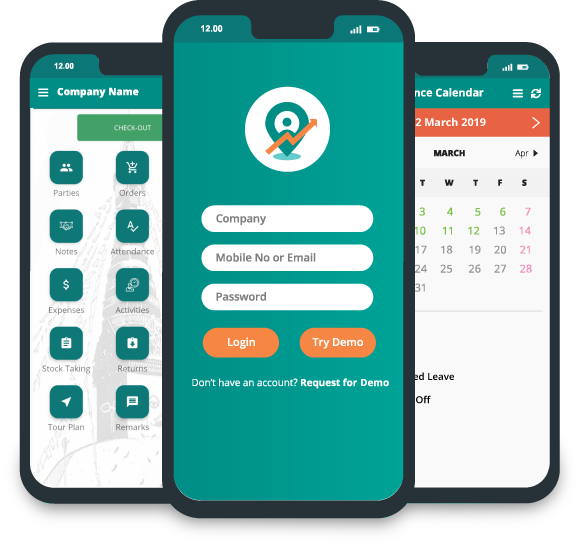
Effective competitor activity tracking requires more than occasional observations, it demands a structured process for collecting accurate, consistent, and real-time data from the field. This is where Delta Sales App helps businesses turn routine outlet visits into actionable market intelligence.
Using the mobile app, field sales representatives can capture valuable competitor information during every retail visit, including:
- Competitor product availability
- Retail and competitor pricing
- Promotional campaigns and offers
- Shelf placement and product visibility
- Product and display photographs
- Retailer feedback and observations
- Merchandising conditions
- Customer insights
Because all information is recorded digitally and submitted instantly, managers gain real-time visibility into competitor activities across multiple territories. This eliminates delays associated with manual reporting and enables faster, data-driven decision-making.
Key Benefits of Using Delta Sales App for Competitor Activity Tracking
-
Standardized data collection to ensure every sales representative captures consistent competitor information.
-
GPS-verified outlet visits for accurate and reliable field reporting.
-
Centralized dashboards that consolidate competitor insights from all territories in one place.
-
Real-time reports and analytics to monitor pricing changes, promotions, and market trends instantly.
-
Photo-based reporting to validate shelf placement, merchandising, and in-store branding.
-
Territory-wise market intelligence that helps managers identify regional opportunities and competitive threats.
Instead of managing competitor information through scattered spreadsheets, WhatsApp messages, or paper notes, businesses can build a centralized repository of competitive intelligence. This empowers sales managers, marketing teams, and business leaders to identify market trends, improve retail execution, strengthen distribution strategies, and make informed decisions that drive sustainable growth.
Common Mistakes to Avoid When Tracking Competitor Activities
Even the best competitor activity tracking strategy can fall short if businesses fail to collect, analyze, and act on competitor insights effectively. Avoiding these common mistakes will help your field sales team generate accurate market intelligence and support smarter business decisions.
Tracking Too Much Information
Collect only the competitor data that can be acted upon, such as pricing, promotions, product availability, shelf visibility, merchandising and retailer feedback. Don’t burden field sales teams with data they don’t need.
Inconsistent Reporting Standards
Without standardized reporting formats, field sales reps may capture different details about the competition, resulting in inconsistent competitor analysis that’s hard to compare across territories.

Ignoring Qualitative Insights
Don't rely solely on numbers. Retailer feedback, customer preferences, and field observations provide valuable market intelligence that helps explain why competitor strategies succeed or fail.
Failing to Analyze Collected Data
Collecting competitor information is only the first step. Regularly analyze competitor trends, share insights across teams, and use data to improve sales, marketing, and retail execution strategies.
Delayed Response to Market Changes
Timely action is essential. Businesses that quickly respond to competitor pricing, promotions, and market trends are better positioned to protect market share and maintain a competitive advantage.
Conclusion
A compelling aspect is that in competitive markets, success depends on how one tries one's own performance, but on information about what competitors do, synthesizing multiple perspectives into a tenacious framework. Moreover, analysis indicates that the monitoring of militant action renders parties with entropy on pricing strategies, product availability, promotions, trade, and customer preferences. Research suggests that need a fuller advance? Their servicing teams are uniquely set to accumulate this intelligence during their daily visits. Passing fast!
Examination reveals that instead of putting delayed accounts or scattered data on the table, fellowships can use solutions such as delta sales to standardise competing data assemblage, monitor vertical-time and provide managers with manageable knowledge. It is worth noting that by making each field.
Book a free demo today and discover how Delta Sales App can help you make faster, data-driven decisions and stay ahead of the competition.