
Your Distributor Management App Should Do More Than Tracking Orders
In today’s competitive FMCG ecosystem, distributors play a critical role in ensuring product availability, market penetration, and smooth execution of FMCG distribution strategies. However, many businesses still rely on basic tools that only focus on order tracking, ignoring deeper operational needs like visibility, forecasting, and execution control.
Modern businesses now expect smarter systems powered by sales force automation, field sales management, and real-time intelligence that go far beyond simple order booking.
This blog explores why distributor management apps must evolve and what capabilities truly define a modern solution.
What is Distributor Management App?
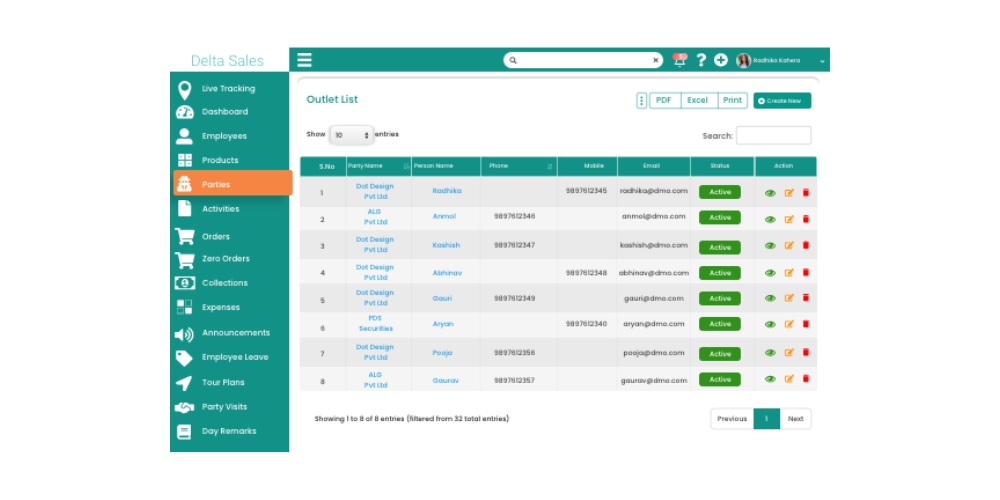
Distributor management software is a comprehensive digital solution that streamlines the complete distribution process from order placement to final delivery at retailers. It gives businesses real-time insights into inventory levels, sales performance, distributor activities, and logistics operations.
Key objectives include:
- Automating repetitive distribution tasks to save time and resources.
- Tracking orders, inventory, and field sales efficiently.
- Optimizing delivery routes and schedules for timely fulfillment.
- Maintaining accurate, consistent data across manufacturers, distributors, and retailers.
Unlike conventional methods relying on spreadsheets, phone calls, and manual updates, DMS provides data-driven accuracy and operational control, reducing errors, cutting costs, and boosting overall efficiency.
Why Order Tracking Alone Is Not Enough
Many traditional apps only focus on tracking orders placed by distributors. While this is useful, it does not provide a complete picture of business performance. Order data alone only reflects what has been purchased, not what is happening across the entire distribution ecosystem.
Without sales analytics, businesses cannot understand demand patterns, retailer behavior, or stock movement. Order tracking alone fails to support strategic decision-making, leading to inefficiencies in retail distribution and missed growth opportunities.
In reality, distributor performance depends on multiple interconnected factors that go far beyond order booking. Businesses need visibility into secondary sales, inventory levels, retailer coverage, and field execution to make informed decisions.
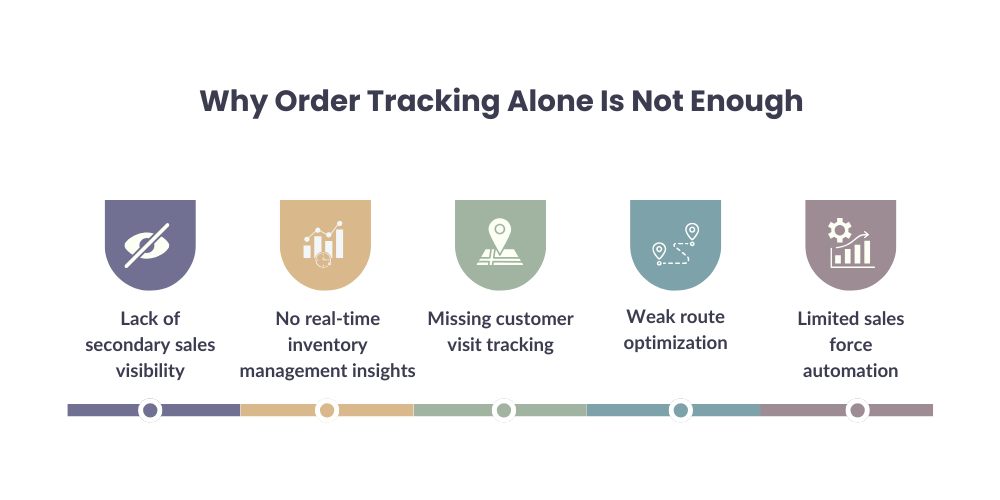
Key gaps when relying only on order tracking:
- Lack of secondary sales visibility: Businesses cannot see actual product movement at the retailer level, making demand forecasting inaccurate.
- No real-time inventory management insights: Stock availability at distributor and retailer level remains unclear, leading to frequent stockouts or overstocking.
- Missing customer visit tracking: Without field-level data, companies cannot verify retailer engagement or coverage efficiency.
- Weak route optimization: Sales reps may follow inefficient routes, reducing daily outlet coverage and productivity.
- Limited sales force automation: Manual processes still dominate reporting, slowing down decision-making and increasing errors.
Because of these gaps, businesses often end up making reactive decisions instead of proactive strategies. For example, a product may appear to have low demand based on order data, while in reality it may simply be out of stock at the retailer level.
To truly optimize FMCG distribution, companies need systems that combine order tracking with real-time analytics, distributor management, and field sales visibility. Only then can businesses move from basic operational control to intelligent, data-driven supply chain management.
Evolution of Distributor Management Systems in FMCG
Earlier, distributor management in FMCG companies was entirely manual and heavily dependent on spreadsheets, phone calls, and paper-based records. Sales teams had limited visibility into stock movement, order status, and retailer-level demand, which often led to delays, errors, and inefficient decision-making.
Over time, businesses moved toward basic digital tools that focused mainly on billing automation and order entry systems. While this shift improved operational speed, it still lacked intelligence, real-time visibility, and integration across the supply chain.
Today, distributor management has evolved into advanced field force automation and FMCG distribution systems that unify multiple business functions into a single platform. Modern solutions now include inventory management, GPS-based field tracking, sales analytics, secondary sales visibility, and real-time reporting dashboards.
Key stages in this evolution include:
- Manual Era: Paper-based reporting, phone calls, and disconnected distributor coordination with no sales force automation.
- Digital Billing Stage: Basic software for invoicing and order entry without real-time insights or analytics.
- Integrated Systems Phase: Introduction of distributor management systems (DMS) with centralized data and reporting.
- Intelligent Automation Era: Modern platforms combining field sales management, GPS tracking, and predictive analytics for smarter decision-making.
This evolution has significantly transformed how FMCG companies manage complex distribution networks, enabling better retail distribution, faster execution, and improved control over multi-channel sales operations.
Key Limitations of Basic Order Tracking Apps
Basic systems often suffer from several limitations that restrict scalability and reduce decision-making efficiency in FMCG operations.
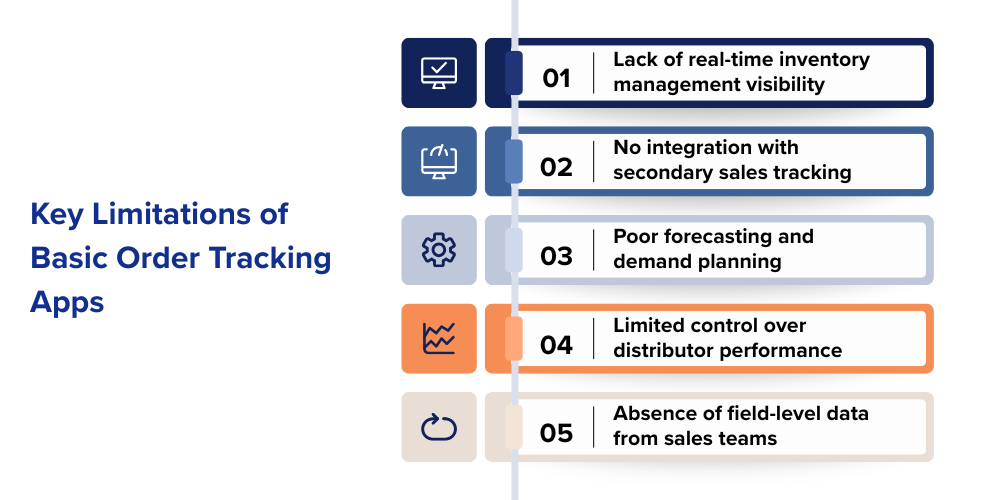
- Lack of real-time inventory management visibility: Inventory management systems are not updated instantly, leading to stock mismatches, delays, and inaccurate supply chain planning decisions.
- No integration with secondary sales tracking: Secondary sales tracking is missing, making it difficult to understand actual retail-level product movement and demand patterns.
- Poor forecasting and demand planning: Without sales analytics tools, businesses cannot accurately predict future demand or optimize production and distribution planning effectively.
- Limited control over distributor performance: Distributor management becomes reactive, with no structured KPIs or performance monitoring for sales and distribution efficiency improvement.
- Absence of field-level data from sales teams: Field sales management data is not captured, reducing visibility into customer visits, retailer engagement, and on-ground execution accuracy.
These gaps make it difficult for businesses to maintain efficiency, improve FMCG distribution systems, and scale operations effectively in competitive markets.
What Modern FMCG Businesses Expect from DMS Platforms
Modern FMCG companies require far more advanced capabilities than simple order tracking. As distribution networks become larger and more complex, businesses demand real-time visibility, automation, and intelligence-driven decision-making tools from their Distributor Management Systems (DMS).
They expect:
- Real-time sales force automation insights: Sales force automation enables instant visibility into field activities, helping managers track orders, visits, and performance without delays.
- Integrated field sales management tools: Field sales management systems unify customer visits, order booking, and reporting into a single platform for better operational control.
- Accurate distributor-level reporting: Distributor management systems must provide precise, real-time reporting on stock movement, secondary sales, and outlet-level performance.
- Mobile-based accessibility for field teams: Mobile-first design ensures sales representatives can update data, capture visits, and manage orders directly from the field.
- Unified dashboards for decision-making: Sales analytics dashboards consolidate KPIs, inventory data, and sales performance into one view for faster strategic decisions.
These expectations reflect a shift toward intelligent FMCG distribution systems where visibility, speed, and data-driven execution define success.
How Distributor Management Apps Improve Supply Chain Visibility
Advanced distributor management apps provide complete end-to-end visibility across the FMCG supply chain, connecting warehouse operations, distributor activities, and retail-level execution into a single unified system. This helps businesses move from fragmented reporting to real-time, data-driven control over distribution networks.
With sales analytics and FMCG distribution systems, companies can track stock movement accurately, monitor distributor performance, and quickly identify gaps in product availability across different territories. This ensures better coordination between supply chain stakeholders and faster response to market demand.
Key improvements include:
- Improved stock tracking across the supply chain: Real-time inventory management ensures businesses know exactly where stock is available and where replenishment is needed.
- Better distributor performance monitoring: Distributor management systems help evaluate order fulfillment speed, coverage efficiency, and compliance with sales targets.
- Enhanced secondary sales visibility: Secondary sales tracking provides accurate insights into actual product movement at the retail level, improving demand forecasting.
- Faster identification of supply gaps: Field data highlights missing or underperforming regions, enabling quicker corrective action through field sales management tools.
- Optimized replenishment cycles: Automated alerts and insights improve restocking efficiency and reduce both stockouts and overstock situations.
This improved visibility ultimately strengthens FMCG distribution efficiency, enhances retail execution, and ensures consistent product availability across markets.
Role of Real-Time Sales Data and Analytics
Real-time sales analytics plays a crucial role in understanding market demand, distributor performance, and overall channel efficiency. By capturing live data from field operations, orders, and secondary sales, businesses gain immediate visibility into what is happening across their distribution network instead of relying on delayed reports.
With these data-driven insights, FMCG companies can optimize pricing strategies, improve demand forecasting, and strengthen overall sales execution. It also enables faster corrective actions, helping organizations reduce inefficiencies, improve stock availability, and enhance decision-making accuracy across their FMCG distribution ecosystem.
Importance of Inventory and Stock Management Features
Effective inventory management systems play a critical role in ensuring smooth FMCG distribution by maintaining the right balance between supply and demand. With real-time visibility into stock levels, businesses can avoid overstocking, reduce wastage, and prevent costly stockouts across retail outlets.
These features also strengthen sales force automation by enabling field teams to check product availability instantly during customer visits. This improves order accuracy, enhances retail distribution efficiency, and ensures that popular products are always available in the market.
In addition, strong stock management features support better demand planning and forecasting by tracking product movement at distributor and retailer levels. This allows companies to optimize replenishment cycles, improve cash flow, and maintain consistent product availability across their entire supply chain network.
How Field Sales Automation Strengthens Distributor Operations
Field sales automation significantly improves how distributors manage daily operations by replacing manual, error-prone processes with real-time digital workflows. It creates seamless coordination between field teams, distributors, and retailers, ensuring faster execution, better visibility, and improved decision-making across the entire FMCG distribution network.
By integrating sales force automation, order management systems, and real-time reporting tools, businesses can track performance, monitor stock movement, and streamline communication between all stakeholders. This reduces operational delays and enhances overall efficiency in distributor-led sales operations.
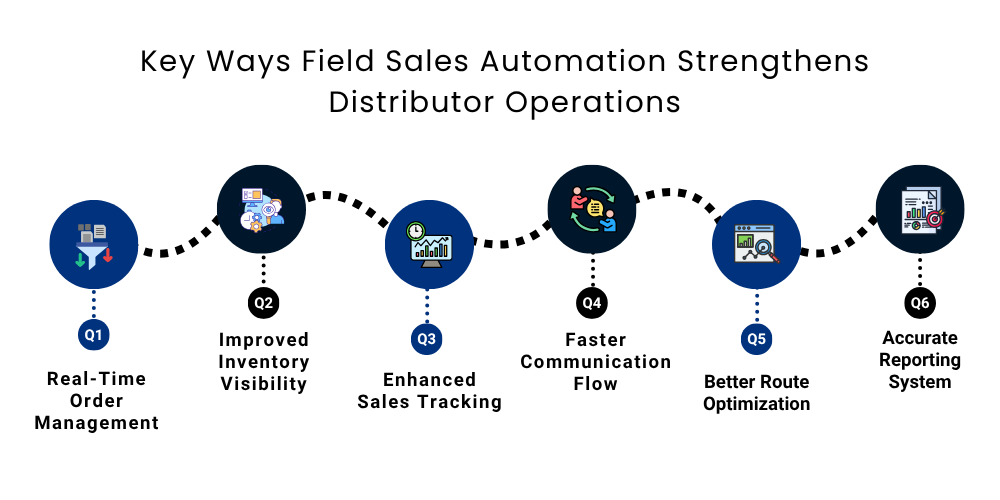
Key Ways Field Sales Automation Strengthens Distributor Operations
- Real-Time Order Management: Enables instant order booking from retailers, reducing delays and improving distributor fulfillment speed significantly.
- Improved Inventory Visibility: Provides live stock updates, helping distributors avoid shortages and maintain optimal inventory levels efficiently.
- Enhanced Sales Tracking: Tracks secondary sales accurately, ensuring better demand understanding and improved distributor performance measurement.
- Faster Communication Flow: Connects field reps and distributors instantly, reducing miscommunication and improving operational coordination daily.
- Better Route Optimization: Optimizes field visits, helping sales teams cover more retailers and increase overall productivity efficiently.
- Accurate Reporting System: Automates reporting processes, eliminating manual errors and ensuring reliable distributor performance insights consistently.
Role of Automation in Distributor Performance Management
Automation plays a crucial role in improving distributor performance by removing dependency on manual processes and enabling faster, more accurate business execution. With sales force automation software, businesses can streamline daily operations such as order processing, reporting, billing, and reconciliation, ensuring consistency and reducing operational errors across the distribution network.
It also enhances decision-making by providing real-time insights into distributor activities, sales performance, and stock movement. This allows managers to identify gaps quickly, improve accountability, and optimize overall FMCG distribution efficiency.
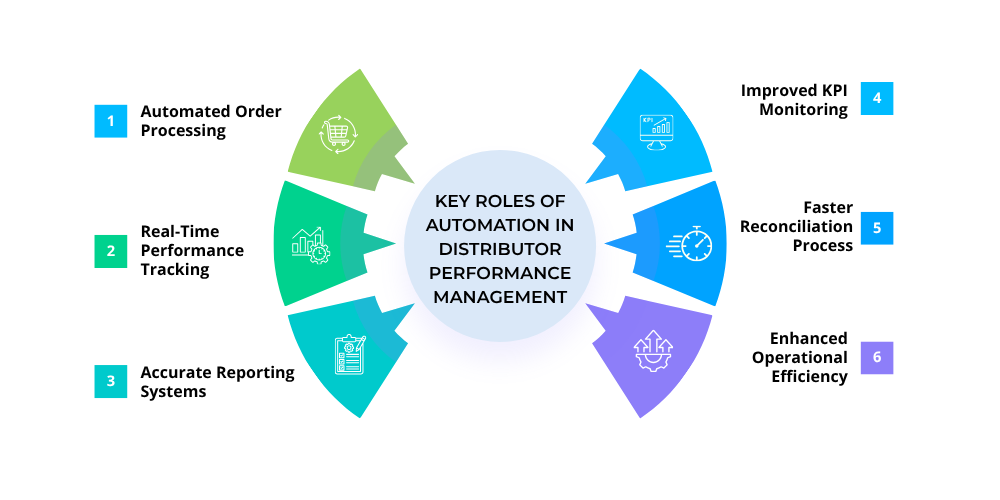
Key Roles of Automation in Distributor Performance Management
- Automated Order Processing: Eliminates manual entry errors and ensures faster order fulfillment across distributor networks.
- Real-Time Performance Tracking: Provides instant visibility into distributor sales performance and operational efficiency metrics.
- Accurate Reporting Systems: Generates error-free reports, improving decision-making and reducing dependency on manual spreadsheets.
- Improved KPI Monitoring: Tracks key performance indicators continuously to evaluate distributor productivity and efficiency.
- Faster Reconciliation Process: Automates billing and payment reconciliation, reducing delays and improving financial accuracy.
- Enhanced Operational Efficiency: Reduces manual workload, allowing distributors to focus more on sales growth and customer service.
How Delta Sales App Goes Beyond Order Tracking
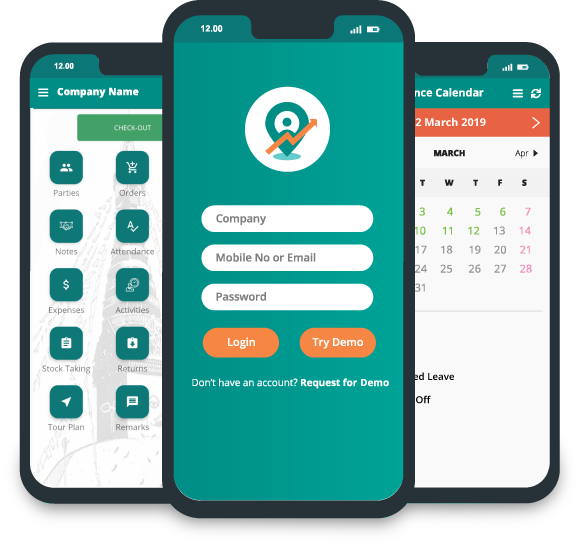
The Delta Sales App is a comprehensive field force automation platform that extends far beyond basic order tracking by delivering complete visibility, control, and intelligence across FMCG distribution networks. Instead of only capturing orders, it integrates field operations, sales analytics, and real-time execution into a single unified system.

It empowers FMCG businesses to improve sales force automation, strengthen distributor performance, and enhance decision-making through actionable insights derived from live field data.
Key Capabilities Beyond Order Tracking
- Real-Time Customer Visit Tracking: Enables instant monitoring of field activities, improving transparency and strengthening customer engagement across territories.
- Advanced Route Optimization: Helps sales teams plan efficient travel paths, reducing time and improving daily outlet coverage significantly.
- Live Secondary Sales Tracking: Provides accurate visibility into actual product movement from distributor to retailer in real time.
- Intelligent Sales Analytics Dashboards: Converts raw field data into actionable insights for better forecasting and performance evaluation.
- Full Inventory Management Visibility: Ensures complete stock transparency across distributors and retailers to prevent stockouts and improve availability.
By combining these capabilities, the Delta Sales App helps businesses move beyond simple order management toward a fully optimized FMCG distribution ecosystem, improving productivity, accuracy, and strategic decision-making.
Final Thoughts
A modern Distributor Management App should never be limited to simple order tracking. It must provide real-time insights, automation, and end-to-end visibility across the entire FMCG distribution network to truly drive business performance.
In today’s highly competitive market, companies that invest in advanced sales force automation, field sales management, and supply chain management systems are better positioned to improve efficiency, reduce operational gaps, and maximize growth opportunities.
Platforms like the Delta Sales App help businesses move beyond basic operations by enabling a smarter, data-driven, and highly efficient distribution ecosystem that strengthens decision-making and boosts overall productivity.
Ready to upgrade your distributor management process?
Book a free demo of Delta Sales App today and see how you can transform your field operations into a high-performing sales engine.