
How to Eliminate the Communication Void Between Field Reps and Distributors
In any distribution-driven business, success depends on how effectively information flows between field representatives and distributors. Field reps serve as the eyes and ears of the company in the market, while distributors ensure products reach retailers and customers on time. When communication between these two critical stakeholders breaks down, businesses often face delayed orders, stock shortages, missed opportunities, and dissatisfied customers.
Despite advances in technology, many organizations still rely on phone calls, spreadsheets, messaging apps, and manual reporting processes. These disconnected systems create information gaps that make it difficult for teams to stay aligned.
To build a high-performing distribution network, companies must establish seamless communication channels that enable real-time collaboration, visibility, and accountability. Effective field sales management plays a critical role in ensuring that information flows smoothly across the entire distribution ecosystem.
In this article, we'll explore the causes of communication gaps, their business impact, and practical strategies to eliminate them.
Understanding the Communication Gap Between Field Reps and Distributors
Field representatives interact with retailers, gather market intelligence, monitor competitor activities, and capture orders. Distributors, on the other hand, manage inventory, process orders, and coordinate deliveries. Strong distributor management practices help ensure both parties remain aligned and informed.
Ideally, information should flow effortlessly between both parties. However, in many organizations, communication is fragmented. Field reps may not have visibility into distributor inventory levels, while distributors may not receive timely updates from field teams regarding retailer demand or market conditions.
This disconnect creates delays in decision-making and prevents businesses from responding quickly to changing market needs.
Why Communication Breakdowns Occur in Distribution Networks
Several factors contribute to communication gaps between field teams and distributors:
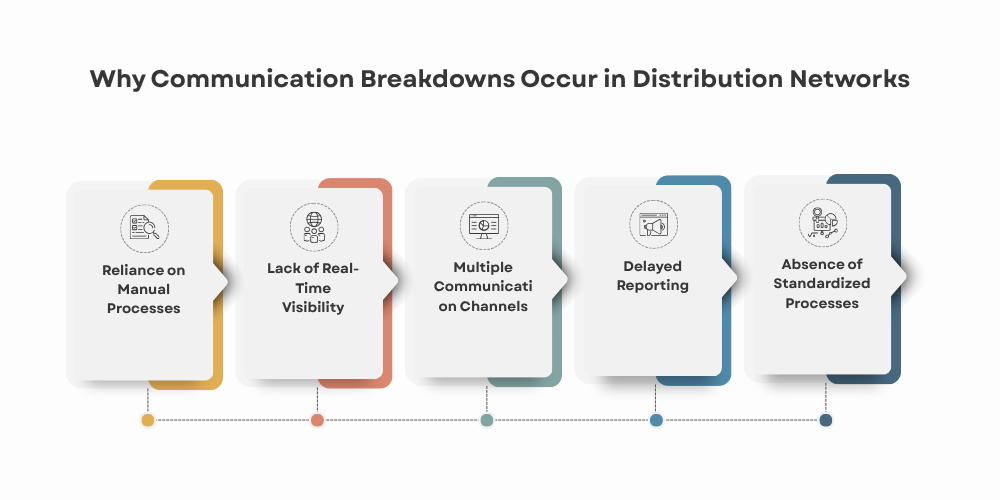
Reliance on Manual Processes
Many businesses still depend on paper-based reporting, spreadsheets, and phone calls. Information often gets delayed, lost, or miscommunicated, reducing accuracy and slowing down decision-making across distribution networks.
Lack of Real-Time Visibility
Distributors may not know what is happening in the field, while field representatives may lack access to current inventory and delivery information, leading to misalignment in supply planning and execution.
Multiple Communication Channels
When information is shared through calls, emails, messaging apps, and spreadsheets simultaneously, important updates can easily be missed, creating confusion and fragmented communication across teams and stakeholders.
Delayed Reporting
Field teams often submit reports at the end of the day or week, reducing the organization's ability to respond quickly to market developments, customer demands, and competitor activities effectively.
Absence of Standardized Processes
Without clear communication protocols, different teams may follow different methods for reporting orders, inventory issues, and retailer feedback, resulting in inconsistent data and operational inefficiencies across the system.
The Business Impact of Poor Field Rep–Distributor Communication
Communication gaps affect every aspect of distribution operations.
Delayed Order Processing
When orders are communicated late or inaccurately, distributors struggle to fulfill retailer requirements promptly. Businesses that lack a centralized order management system often experience processing delays that impact sales and customer satisfaction.
Stockouts and Inventory Issues
Without timely demand updates, distributors may fail to maintain adequate inventory levels. Limited inventory visibility further increases the risk of stock shortages and lost sales opportunities.
Missed Sales Opportunities
Field reps often identify new opportunities in the market. Poor communication can negatively affect retail execution, preventing businesses from responding quickly to retailer requirements and market demand.
Reduced Distributor Engagement
Distributors perform best when they feel connected to the company's goals and strategies. Poor communication can create frustration, reduce motivation, and weaken business relationships.
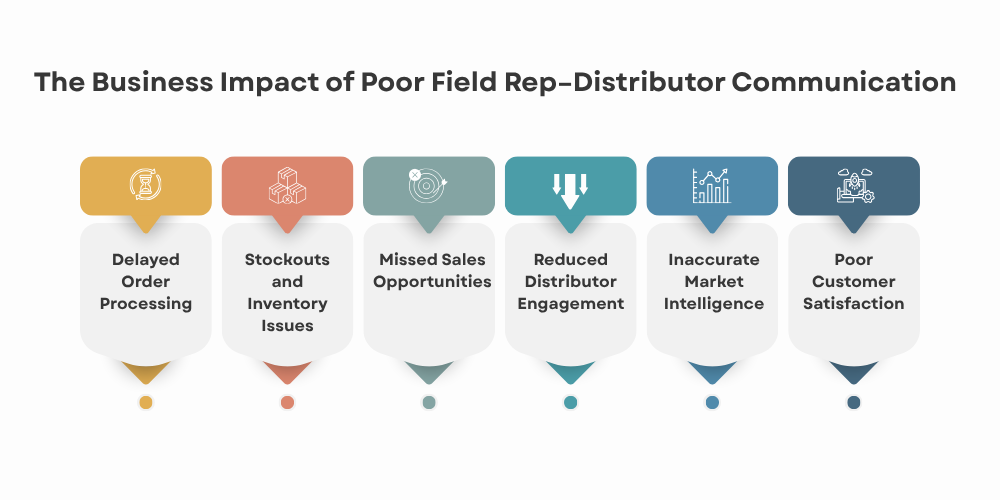
Inaccurate Market Intelligence
Field representatives gather valuable market intelligence about customer preferences, competitor activities, and market trends. Communication breakdowns often prevent this information from reaching decision-makers effectively.
Poor Customer Satisfaction
Retailers expect timely deliveries, product availability, and quick issue resolution. Communication gaps can negatively impact service quality and customer experience.
Warning Signs Your Distribution Network Has a Communication Problem
Businesses should watch for indicators that suggest communication issues may be affecting performance:
-
Frequent order discrepancies: Repeated mismatches between ordered and delivered quantities indicate poor coordination between field teams and distributors, causing operational inefficiencies and revenue leakage.
-
Repeated stock shortages: Consistent product unavailability at retail level reflects weak demand communication, leading to lost sales opportunities and reduced customer satisfaction across channels.
-
Delayed market updates: Slow sharing of field insights prevents timely decisions, making businesses less responsive to competitor actions and changing customer demand patterns.
-
Low distributor responsiveness: When distributors take longer to respond to field requests, it signals broken communication loops and weak operational alignment between stakeholders.
-
Increased customer complaints: Rising complaints often result from delayed deliveries or incorrect orders, showing that communication gaps are directly affecting service quality and trust.
-
Missed promotional opportunities: Poor coordination leads to ineffective execution of offers and campaigns, reducing overall impact of marketing efforts at the retail level.
-
Lack of visibility into field activities: Managers struggle to track what field reps are doing daily, leading to poor planning, limited control, and reduced performance optimization.
-
Conflicting information from different teams: When teams share inconsistent updates, it creates confusion, delays decisions, and reduces confidence in the reliability of operational data.
-
Slow issue resolution: Problems take longer to resolve when communication channels are unclear, resulting in operational delays and decreased efficiency across the distribution network.
If these challenges occur regularly, it may be time to reassess communication processes across the distribution network.

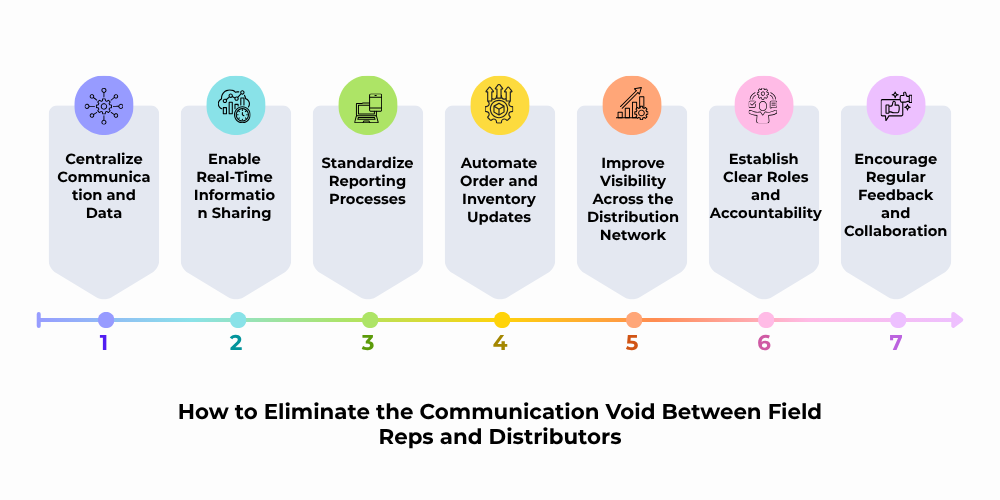
How to Eliminate the Communication Void Between Field Reps and Distributors
Centralize Communication and Data
Organizations should establish a single platform where field teams, distributors, and management can access the same information. A centralized system strengthens field force management by ensuring all stakeholders work with accurate and up-to-date data.
Enable Real-Time Information Sharing
Real-time communication allows field reps to instantly share retailer feedback, orders, market observations, and competitor updates. Implementing real-time reporting helps organizations make faster and more informed decisions.
Standardize Reporting Processes
Businesses should define clear reporting formats and procedures for all stakeholders.
Standardized reporting helps ensure consistency, improves data accuracy, and simplifies performance monitoring.
Automate Order and Inventory Updates
Automation eliminates delays associated with manual communication. A modern mobile sales tool allows field reps to capture orders instantly while keeping distributors informed about inventory and order updates.
Improve Visibility Across the Distribution Network
Visibility enables all stakeholders to understand what is happening at every stage of the sales and distribution process. Advanced route planning capabilities help optimize field activities and improve coordination between field teams and distributors.
Establish Clear Roles and Accountability
Communication improves when responsibilities are clearly defined.
Field reps should know what information they must share, distributors should understand their reporting obligations, and managers should monitor compliance regularly.
Encourage Regular Feedback and Collaboration
Strong communication requires continuous engagement. Successful organizations encourage sales team collaboration through regular meetings, feedback sessions, and shared performance goals.
How Field Sales Automation Bridges the Gap Between Field Teams and Distributors
Technology plays a crucial role in eliminating communication barriers.
Modern field sales automation solutions connect field representatives, distributors, retailers, and management on a single platform. Information becomes accessible in real time, reducing delays and improving operational efficiency.
When field reps capture orders, conduct store visits, or submit market feedback, the information becomes instantly available to relevant stakeholders.
Similarly, distributors can update inventory levels, order status, and delivery information without relying on manual communication methods.
This digital approach creates a connected ecosystem where everyone operates with the same information, leading to faster decisions and better business outcomes.
Essential Features of a Field Sales Management Solution
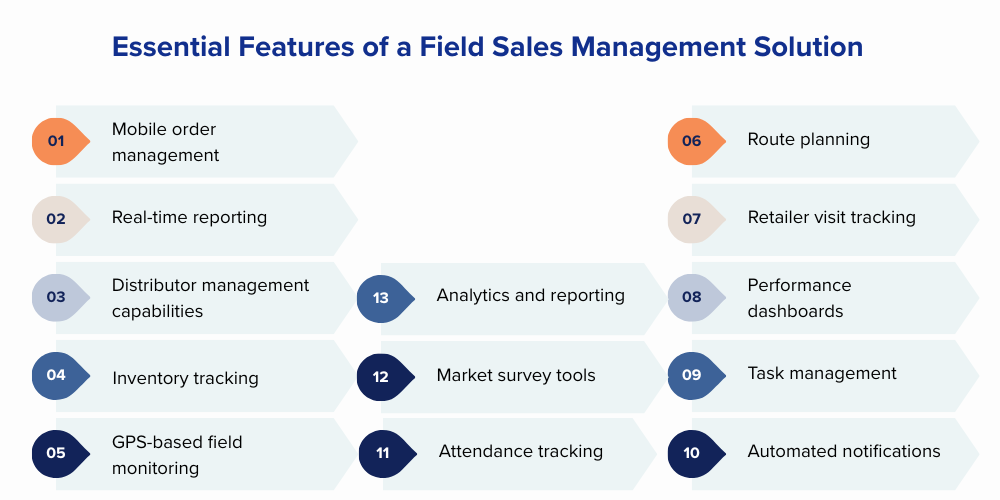
When selecting a solution to improve communication between field reps and distributors, businesses should look for features such as:
-
Mobile order management: Mobile order management enables field representatives to capture and submit orders instantly from the field, reducing manual errors and ensuring faster processing across the distribution chain.
-
Real-time reporting: Real-time reporting provides instant visibility into field activities and sales performance, allowing managers and distributors to make faster, data-driven decisions with accurate updated information.
-
Distributor management capabilities: Distributor management help organizations maintain structured distributor data, improve coordination, and ensure smoother communication between field teams and distribution partners.
-
Inventory tracking: Inventory tracking allows businesses to monitor stock levels in real time, preventing shortages and ensuring timely replenishment based on actual market demand.
-
GPS-based field monitoring: GPS-based field monitoring tracks field executive movements accurately, improving accountability, ensuring visit compliance, and enhancing overall operational transparency across territories.
-
Route planning: Route planning optimizes daily travel routes for field reps, reducing travel time, improving productivity, and ensuring maximum retailer coverage within assigned areas.
-
Retailer visit tracking: Retailer visit tracking records and monitors store visits systematically, ensuring proper coverage, better engagement, and improved visibility into field execution quality.
-
Performance dashboards: Performance dashboards provide visual insights into sales, field activities, and distributor performance, helping managers quickly identify gaps and improvement opportunities.
-
Task management: Task management helps assign, track, and complete field tasks efficiently, ensuring better coordination between teams and improved execution of daily responsibilities.
-
Automated notifications: Automated notifications send instant alerts for orders, updates, and issues, ensuring timely communication between field reps, distributors, and management teams.
-
Attendance tracking: Attendance tracking monitors field staff attendance digitally, improving discipline, workforce accountability, and ensuring accurate workforce utilization across regions.
-
Market survey tools: Market survey tools enable collection of structured market insights, helping businesses understand customer behavior, competitor activity, and demand trends effectively.
-
Analytics and reporting: Analytics and reporting transform raw field data into actionable insights, supporting better forecasting, performance evaluation, and strategic decision-making across the organization.
These features help organizations streamline communication and improve coordination across the distribution network.
Best Practices for Building Long-Term Distributor Collaboration
Effective communication is not a one-time initiative. Businesses must continuously strengthen relationships with distributors through transparency, trust, and accountability. Long-term success often depends on effective distributor management strategies that foster stronger partnerships.
Some proven best practices include:
Maintaining transparency in communication
Maintain transparency in communication by sharing accurate information consistently to build trust and reduce misunderstandings across distribution channels.
Sharing business goals and expectations
Share business goals and expectations clearly with distributors to align strategies, improve coordination, and achieve mutually beneficial performance outcomes effectively.
Providing timely updates and feedback
Provide timely updates and feedback to distributors, ensuring faster decision-making, improved responsiveness, and stronger operational alignment between teams.
Using data-driven decision-making
Use data-driven decision-making to improve accuracy, optimize sales strategies, and strengthen distributor performance through actionable insights and analytics.
Offering regular training and support
Offer regular training and support to distributors, enhancing skills, improving efficiency, and ensuring better execution of sales processes.
Recognizing distributor achievements
Recognize distributor achievements consistently to motivate performance, build loyalty, and strengthen long-term business relationships across the distribution network.
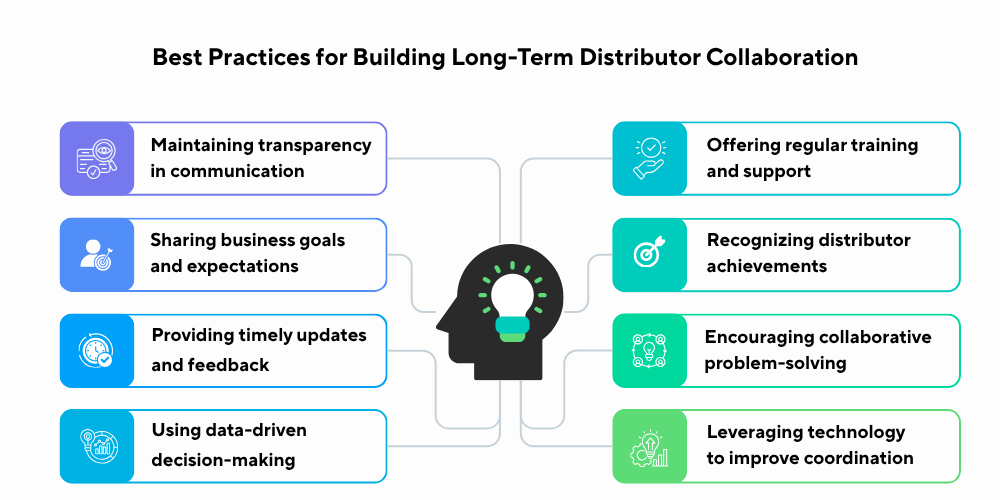
Encouraging collaborative problem-solving
Encourage collaborative problem-solving between field teams and distributors to resolve issues faster and improve operational efficiency across the supply chain.
Leveraging technology to improve coordination
Leverage technology to improve coordination by enabling real-time communication, streamlined workflows, and better visibility across all distribution activities.
Strong distributor partnerships contribute significantly to sustainable business growth.
Measuring the Success of Your Communication Strategy
Organizations should monitor key performance indicators to evaluate communication effectiveness. Metrics such as order fulfillment rates, distributor responsiveness, and sales tracker app provide valuable insights into operational performance.
Important metrics include:
Order fulfillment rate
Order fulfillment rate measures how efficiently orders are completed, reflecting communication accuracy between field teams and distributors across the supply chain.
Average order processing time
Average order processing time indicates how quickly orders move from field entry to fulfillment, highlighting efficiency of communication and workflows.
Stockout frequency
Stockout frequency tracks how often products are unavailable, revealing gaps in demand communication and inventory planning between teams.
Distributor response time
Distributor response time measures how quickly distributors respond to field updates, indicating strength of coordination and communication efficiency.

Sales growth
Sales growth reflects overall business performance influenced by strong communication, efficient execution, and alignment between field reps and distributors.
Customer satisfaction levels
Customer satisfaction levels show how well communication processes support timely deliveries, accurate orders, and consistent retail service quality.
Retailer retention rates
Retailer retention rates measure long-term engagement and loyalty, driven by reliable supply, smooth communication, and consistent service delivery.
Field productivity
Field productivity evaluates how effectively field teams perform tasks, supported by clear communication and streamlined operational processes.
Inventory accuracy
Inventory accuracy ensures stock records match actual availability, reducing errors caused by poor communication between field and distribution systems.
Regular measurement helps identify improvement opportunities and ensures communication initiatives deliver measurable results.
Conclusion
Communication gaps between field representatives and distributors can significantly impact sales performance, operational efficiency, and customer satisfaction. Delayed information, disconnected systems, and manual processes often prevent businesses from achieving their full potential.
By centralizing communication, enabling real-time information sharing, standardizing workflows, and leveraging field sales automation technology, organizations can create a more connected and collaborative distribution network.
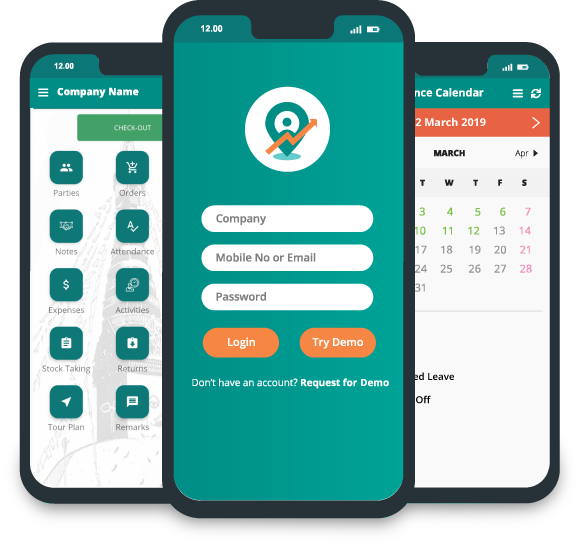
If you're looking to improve visibility, streamline distributor coordination, automate field operations, and strengthen communication across your sales ecosystem, Delta Sales App can help. Its comprehensive field sales management capabilities empower businesses to connect field teams, distributors, and management on a single platform.
Book a demo today to see how Delta Sales App can transform your distribution operations and eliminate communication gaps that hold your business back.