
What Is Modern Trade in FMCG and How Does It Work?

Consumers shop very differently now than they did ten years ago. Today, shoppers expect to go into a supermarket, scan a barcode, pay with a phone, and walk out with their groceries in a few minutes. This is enabled by a slick retail system called modern trade that delivers a frictionless shopping experience. Behind each item on the shelf is a well-thought-out supply chain consisting of manufacturers, distributors, retailers, and advanced technology working together to have the right products at the right place and at the right time.
At the same time, the explosive growth of supermarkets, hypermarkets, convenience stores, e-commerce, and quick commerce platforms has changed the distribution landscape of FMCG products. Businesses alone can no longer rely on traditional methods of distribution. Today, they need to focus on efficient inventory management, real-time sales visibility, effective execution of retail strategies, and strengthening of field sales operations to stay competitive in today’s fast-moving retail landscape.
But what is FMCG modern trade, and why is it such an integral part of the retail industry?
In this blog, you will learn what modern trade is, how it works, and the different types of modern trade channels. You will also learn about the features of modern trade, its benefits and challenges, and how tools like sales force automation software help FMCG companies optimize distribution, improve retail execution, and manage modern trade operations in a better way.
What Is Modern Trade in FMCG?
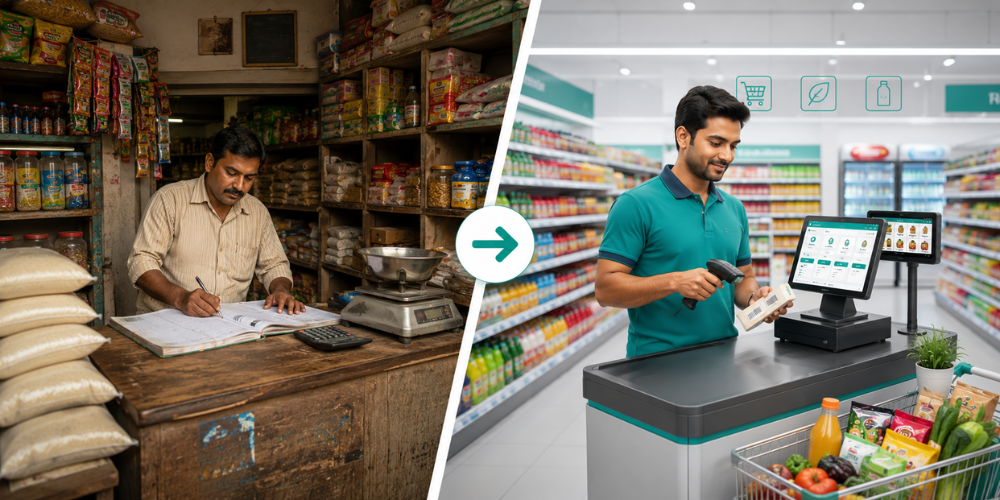
Modern trade in FMCG refers to organized retail channels that operate through structured business processes, centralized procurement, standardized pricing, technology-driven inventory management, and professional merchandising. Unlike traditional neighborhood stores, modern trade retailers rely on advanced systems to manage purchasing, inventory, promotions, customer data, and sales reporting.
Modern trade includes retail businesses such as:
-
Supermarkets
-
Hypermarkets
-
Department stores
-
Convenience stores
-
Cash & Carry wholesalers
-
Large retail chains
-
Online shopping sites
-
Insta commerce platforms
Retailers source products from manufacturers or authorized distributors and sell them through organized retail formats.
Why is it called Modern Trade?
The term ‘modern trade’ is used to differentiate organized retail from traditional trade, which includes mostly small, independent stores such as the grocery stores in the neighborhood, local convenience stores, and general retailers. Traditional commerce is based on manual procedures and decentralized purchasing. Modern commerce is based on standardized systems and technology-driven procedures that improve efficiency and consistency.
Modern trade retailers are focused on creating a seamless shopping experience, utilizing data and automation to optimize business operations. Their systematic approach to enhancing supply chain visibility, inventory accuracy, and sales performance helps retailers and FMCG manufacturers.
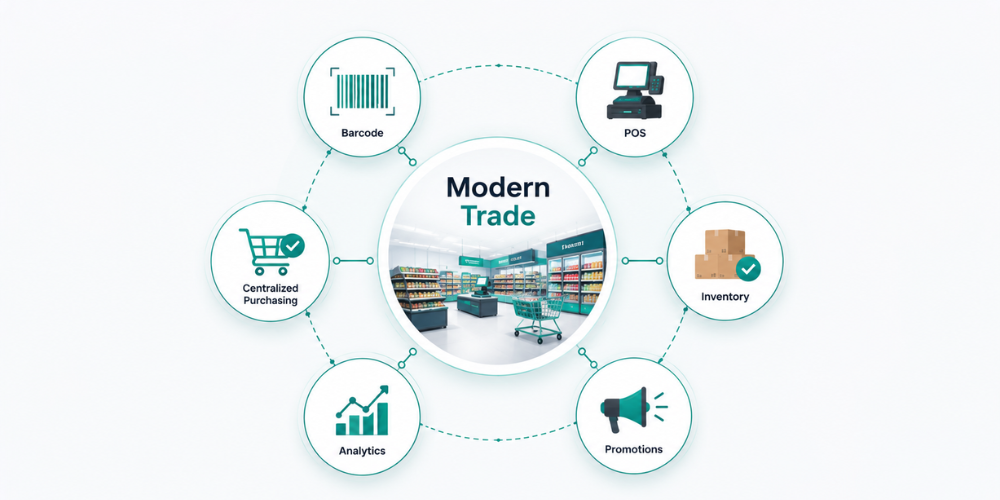
Key characteristics of modern trade include:
-
Centralized buying and purchasing
-
Retail Operations & Technology Enablement
-
POS Billing Systems and Bar Code Scanning
-
Standardised store prices
-
Merchandising and promotional campaigns scheduled
-
Forecasting demand and making decisions based on data
-
Structured supply chain and inventory management
Modern trade retailers offer FMCG manufacturers greater transparency, predictable ordering patterns, better shelf visibility, and access to valuable sales data. This makes it easier to forecast demand, plan inventory, and execute marketing campaigns more effectively across multiple retail locations.
Great examples of modern trade in retail are some of the world’s leading organized retailers. Centralized purchasing, sophisticated inventory management, and technology-driven retail operations are the cornerstones of the business models of companies such as Walmart, Carrefour, Tesco, Costco, and Metro Cash & Carry. In India, DMart, Reliance Smart, and More Retail are prominent examples of modern trade retail, while platforms like BigBasket, Blinkit, Zepto, and Swiggy Instamart have taken the modern trade concept to e-commerce and quick commerce. These modern trade channels help FMCG brands to increase their customer base, enhance the visibility of their products, and streamline retail distribution through organized retail channels.
How Does Modern Trade Work?
Modern trade operates through a well-structured supply chain that connects manufacturers, distributors, organized retail chains, and consumers. Unlike traditional trade, where products often pass through multiple intermediaries with limited visibility, modern trade follows standardized procurement, inventory management, and distribution processes. Every stage is supported by technology, making it easier to monitor product movement, maintain stock availability, and ensure a consistent shopping experience.
A typical modern trade supply chain follows this flow:
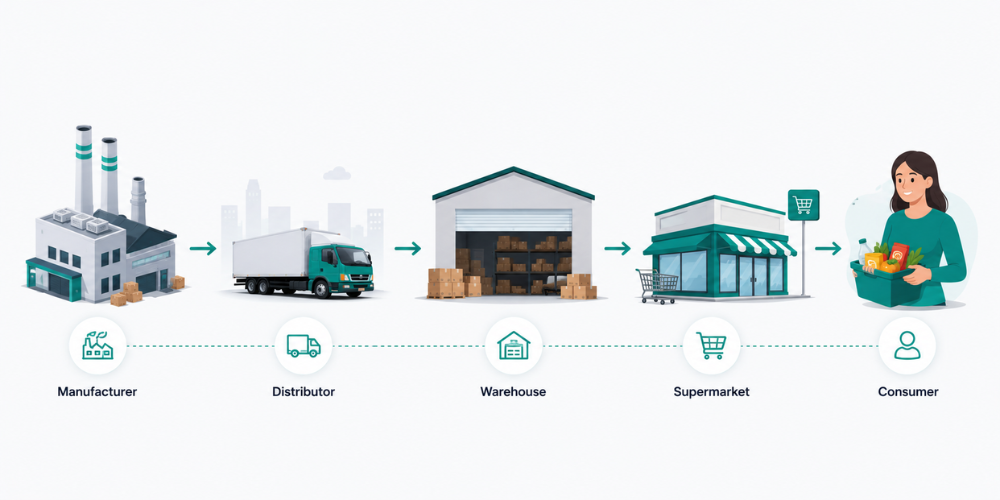
Let's take a closer look at each stage.
-
Manufacturer
The process begins with the manufacturer, who produces FMCG products and plans how they will reach organized retail stores. Manufacturers collaborate with modern retail chains or authorized distributors to establish supply agreements, pricing, promotional campaigns, and delivery schedules. They also forecast demand, plan production, and ensure products are available in sufficient quantities to meet consumer needs. Manufacturers are also responsible for developing trade promotions, launching new products, and maintaining consistent product quality across all retail locations.
-
Distributor
Distributors act as the bridge between manufacturers and modern retail stores. They buy products from manufacturers, keep them in warehouses, and supply them to supermarkets, hypermarkets, and other organized retailers as per purchase orders and replenishment schedules. To effectively manage the vast distribution networks, many organizations deploy field sales management software that helps sales representatives plan store visits, collect orders, track retailer requirements, and deliver them promptly. This means better coordination between distributors and retailers, and fewer delays and stockouts.
-
Modern Retail Chain
Modern retail chains receive inventory from distributors and handle their products through advanced retail technologies. Centralized procurement systems, barcode scanners, Point-of-Sale (POS) software, and inventory management solutions power their operations, offering real-time visibility into sales and stock levels. Retailers constantly monitor customer demand, restocking inventory, conducting promotional campaigns, optimizing shelf space, and analyzing sales performance. This data-driven approach helps to ensure popular products are in stock, while reducing excess inventory and minimizing waste.
-
Consumer
Shoppers buy their favorite products from various organized retail stores or online platforms, including e-commerce and quick commerce apps. Their shopping habits are tracked through Point-of-Sale (POS) systems, which help retailers understand what customers like, spot popular items, and predict what will be in demand next. Retailers often share this valuable sales information with manufacturers, helping them to better plan production, curate product selections, and create more impactful marketing campaigns.
Features of Modern Trade
Modern trade thrives on well-structured systems, consistent processes, and innovative technology that empower retailers and FMCG companies to operate more effectively. In contrast to traditional retail, where many tasks are performed manually, modern trade leverages data, automation, and centralized management to enhance inventory oversight, elevate customer experiences, and optimize supply chain efficiency.
Here are the essential characteristics that shape modern trade:
-
Centralized Purchasing
A key feature of modern trade is the shift towards centralized purchasing. Rather than each store placing orders on its own, decisions about what to buy are often made at a regional or corporate level. This means that retail chains can work directly with manufacturers or authorized distributors to negotiate better prices, ensure consistent quality, and maintain a reliable supply of products. By centralizing procurement, retailers can also create a more uniform selection of products across their various locations. This approach not only enhances their ability to forecast demand more accurately but also helps to lower procurement costs, making the entire process more efficient and effective.
-
Barcode and POS Systems
Modern trade retailers use barcode and point-of-sale (POS) systems to streamline daily operations. Every product is assigned a barcode that can be scanned during checkout, allowing transactions to be completed quickly and accurately. These systems automatically update inventory levels after every sale, generate sales reports, and provide real-time insights into product performance. This reduces manual errors, speeds up billing, and helps retailers make informed stocking decisions.
-
Promotions and Merchandising
Promotions and merchandising are vital in encouraging customers to make purchases in today's retail landscape. Retailers collaborate closely with FMCG brands to create engaging seasonal campaigns, offer discounts, launch new products, and organize in-store promotions that enhance product visibility and drive sales. To ensure these initiatives are carried out uniformly across all locations, many businesses adopt retail execution software. These tools help monitor shelf displays, ensure promotional compliance, manage product placement, and keep an eye on competitor activities. This approach allows brands to maintain a strong presence in stores while making the most of their marketing investments.
-
Inventory Management
Effective inventory management plays a crucial role in today’s retail landscape. Retailers keep a close eye on stock levels in both warehouses and stores, ensuring that products are readily available for customers while avoiding the pitfalls of overstocking. With the help of inventory management software, businesses can monitor their inventory in real time, streamline the replenishment process, minimize stockouts, and enhance the efficiency of their warehouses. Having clear visibility into inventory not only benefits retailers but also aids manufacturers and distributors in planning their production schedules and deliveries more effectively.
-
Data-Driven Decision Making
One of the most significant benefits of modern trade lies in its capacity to provide meaningful insights through data. Each transaction, customer purchase, inventory shift, and marketing effort generates valuable information that can be examined to enhance overall performance. Retailers and FMCG companies harness this data to pinpoint popular products, anticipate customer demand, assess the effectiveness of promotions, fine-tune pricing strategies, and refine their distribution planning. By utilizing automated analytics, businesses can make quicker, more informed choices that boost both profitability and customer satisfaction, ultimately creating a more engaging shopping experience for everyone involved.
Benefits of Modern Trade for FMCG Companies
The landscape of FMCG distribution and sales has evolved significantly with the rise of modern trade. By collaborating with organized retail chains, companies can connect with a broader audience, streamline their operations, and leverage sales and inventory insights more effectively. Unlike traditional retail, modern trade provides enhanced visibility into how products perform and opens doors for sustainable growth.
Let’s explore some of the key advantages that modern trade brings to FMCG companies.
-
Wider Market Reach
One of the biggest advantages of modern trade is access to a larger customer base. Supermarkets, hypermarkets, convenience stores, and e-commerce platforms attract thousands of shoppers every day, allowing FMCG brands to expand their presence across multiple cities and regions. Instead of relying solely on local retailers, manufacturers can distribute their products through organized retail networks, increasing product availability and reaching new market segments more efficiently.
-
Better Product Visibility
Effective shelf placement is crucial in shaping how consumers make purchasing choices. Today’s retail environments are designed with thoughtful product displays, special promotional sections, and eye-catching branded shelves that allow products to shine amidst the competition. When FMCG companies execute their retail strategies well, they can guarantee that products are showcased properly, promotional materials are utilized effectively, and shelves are consistently replenished. This enhanced visibility not only boosts brand awareness but also heightens the chances of spontaneous purchases.
-
Higher Sales Volume
Modern trade retailers attract a significant number of customers daily, leading to a steady demand for FMCG products. This dynamic enables manufacturers to boost their sales volumes beyond what traditional retail channels can offer. Additionally, organized retailers frequently make bulk purchase orders, which helps businesses enjoy more reliable sales patterns and enhances their production planning efforts.

-
Data-Driven Planning
In contrast to traditional trade, modern trade offers a wealth of valuable data throughout the sales journey. Retailers have the ability to monitor product sales, understand customer preferences, track inventory flow, and assess promotional effectiveness using integrated point-of-sale and inventory systems. These insights empower FMCG companies to predict demand with greater accuracy, tailor product assortments to meet consumer needs, design impactful promotional campaigns, and make well-informed business choices. When paired with sales force automation, businesses gain enhanced visibility into field operations and retailer performance, facilitating quicker and more strategic decision-making.
-
Stronger Brand Presence
Having products in popular retail chains boosts a brand's trustworthiness and visibility. Shoppers frequently link established retail stores with quality, reliability, and trust, which increases their likelihood of buying items from familiar brands found on the shelves. Additionally, a solid presence across various modern trade channels strengthens brand recognition, aids in launching new products, and fosters customer loyalty as time goes on.
-
Improved Supply Chain Efficiency
Modern trade fosters stronger collaboration among manufacturers, distributors, and retailers by implementing standardized procurement and inventory practices. With scheduled deliveries, centralized purchasing, and digital inventory tracking, it minimizes delays and enhances product availability in retail stores. By unifying order management, inventory management, and field sales management systems, FMCG companies can simplify distribution, prevent stockouts, and guarantee that retailers receive their products promptly.
-
Better Performance Monitoring
Modern trade offers valuable insights that enable businesses to assess their sales and distribution strategies effectively. Companies can track essential metrics such as sales performance by store, individual product performance, stock levels, promotion success, and retailer productivity. With real-time reporting and analytics, managers can quickly identify opportunities, resolve operational issues, and continuously improve sales performance across their retail network.
How Technology Helps Manage Modern Trade
As modern trade continues to expand, managing operations across multiple retail chains, distributors, warehouses, and field sales teams has become increasingly complex. FMCG companies are expected to maintain consistent stock availability, execute promotions accurately, fulfill orders on time, and respond quickly to changing consumer demand. Relying on spreadsheets or manual processes is no longer sufficient to meet these expectations.
Technology has become the backbone of modern trade, enabling businesses to automate routine tasks, improve visibility across the supply chain, and make faster, data-driven decisions. From sales planning to retail execution, digital solutions help streamline every stage of the distribution process while reducing operational inefficiencies.
-
Sales Force Automation (SFA)
A Sales Force Automation (SFA) solution transforms the everyday experiences of field sales teams by streamlining essential tasks like visiting outlets, tracking attendance, collecting orders, generating reports, and engaging with customers. This automation allows sales representatives to spend less time on administrative duties and more time nurturing relationships with retailers and boosting sales.
For managers, Sales Force Automation Software offers a clear view of field activities in real-time, enabling them to support their teams effectively, monitor coverage across outlets, and ensure that sales goals are achieved. It fosters better communication between the field and the head office, facilitating quicker decision-making and enhancing overall operational control.
-
Digital Order Management
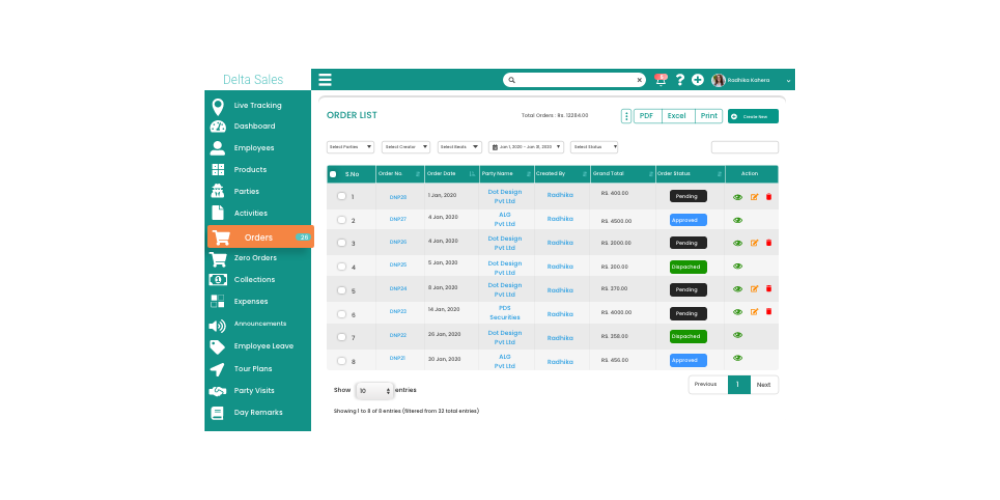
Manually collecting orders can lead to frustrating delays, costly errors, and missed sales opportunities. By using a digital order management system, sales representatives can effortlessly capture retailer orders on the spot with their mobile devices, cutting down on paperwork and reducing the chance of mistakes.
With real-time order processing, businesses can accelerate order fulfillment, enhance accuracy, and guarantee that retailers receive their products promptly. This digital approach also offers full transparency into order status, making it simple to monitor pending, completed, and delivered orders.
-
Route Planning and Beat Management
Effective route planning plays a crucial role in enhancing the productivity of field sales teams. By strategically visiting the right outlets in a logical order, sales representatives can minimize travel time, cut down on fuel expenses, and engage with more retailers throughout the day. With the help of beat planning software, businesses can craft personalized visit schedules, allocate territories thoughtfully, and ensure that each retailer receives attention according to a well-defined plan. This approach not only boosts outlet coverage but also empowers managers to keep track of how closely their teams are following the planned routes.
-
Real-Time Stock Visibility
Keeping inventory at the right levels is a significant hurdle in today’s retail landscape. When stock runs low, businesses risk missing out on sales, while having too much inventory can lead to higher storage costs and the potential for products to expire. By adopting inventory management software that works seamlessly with sales and distribution, companies can see their stock levels in real-time across warehouses, distributors, and stores. This visibility allows for quicker restocking decisions, enhances the accuracy of inventory records, and helps prevent both shortages and excess stock.
-
Retail Execution
In today's competitive retail landscape, success hinges not just on having products available, but also on how they are showcased in stores. Sales teams need to ensure that products are displayed attractively, promotional materials are effectively positioned, and merchandising standards are adhered to. By utilizing Retail Execution Software, businesses can easily take photos of shelf displays, perform thorough store audits, check compliance with promotional activities, and keep track of competitor actions during each visit. This approach guarantees that marketing initiatives are consistently implemented across all retail outlets, allowing brands to enhance their visibility and connect more meaningfully with customers.
-
Sales Analytics and Real-Time Reporting
In today's fast-paced retail environment, businesses are inundated with a wealth of information daily, ranging from customer orders and sales figures to inventory shifts and the effectiveness of promotions. Transforming this data into meaningful insights is crucial for enhancing overall business success. By utilizing intuitive dashboards and insightful sales analytics, managers can easily track key performance indicators like sales patterns, retailer efficiency, store coverage, stock levels, and team effectiveness, all from one user-friendly platform. These valuable insights empower better forecasting, more strategic inventory management, and quicker decision-making processes.
How Delta Sales App Helps Manage Modern Trade Operations
Managing modern trade successfully requires seamless coordination between manufacturers, distributors, field sales teams, and organized retail chains. As the number of retail outlets and product SKUs grows, businesses need a centralized system to manage orders, monitor inventory, track sales activities, and ensure consistent retail execution. Manual processes often make it difficult to maintain visibility across the supply chain, leading to delayed orders, stock shortages, missed store visits, and inefficient field operations.
This is where the Delta Sales App steps in. Tailored specifically for FMCG manufacturers, distributors, and sales teams, the Delta Sales App offers a comprehensive Sales Force Automation (SFA) solution that streamlines modern trade operations, ultimately boosting productivity and enhancing decision-making.
-1785304095.png)
-
Simplified Sales Force Automation
Overseeing a large field sales team spread across various retail locations can be quite a task, especially without the right resources. The Delta Sales App simplifies daily sales routines, handling everything from tracking attendance and outlet visits to managing retailer interactions, order collection, and reporting. This means sales representatives can focus more on what they do best: selling rather than getting bogged down by administrative duties.
Thanks to its integrated Salesforce automation features, managers can keep an eye on field activities in real time, assess team performance, and make sure that every scheduled retail visit happens as planned.
-
Faster and More Accurate Order Management
Collecting orders manually can hinder the sales process and lead to mistakes. The Delta Sales App empowers sales representatives to effortlessly capture retailer orders using a user-friendly mobile application, ensuring that orders are processed in real-time.
With its seamless order management features, the app minimizes paperwork, enhances order accuracy, and enables distributors to fulfill orders more swiftly, guaranteeing that products are available on retail shelves without unnecessary hold-ups.
-
Better Retail Execution
Ensuring that products are consistently available and promotions are followed is crucial in today's retail landscape. The Delta Sales App empowers businesses to enhance their retail execution by enabling field representatives to conduct store audits, take shelf photos, observe product displays, confirm promotional efforts, and track competitor activities during each store visit.
This approach provides managers with a clear view of how products are showcased across various retail sites, helping to uphold merchandising standards and create a better shopping experience for customers.
-
Smarter Beat Planning and Field Sales Management
Smart route planning allows sales representatives to connect with more retailers, all while cutting down on travel time and costs. The Delta Sales App offers intuitive beat planning tools that empower businesses to create daily visit schedules, allocate territories, and streamline sales routes.
With its robust field sales management features, managers can easily track outlet coverage, confirm completed visits through GPS tracking, and support their field teams in sticking to their planned schedules effectively.
-
Improved Inventory Visibility
Keeping the right amount of inventory is essential to prevent running out of stock or having too much on hand. The Delta Sales App supports businesses by enhancing their visibility into inventory, offering up-to-the-minute details on stock levels at distributors and retail locations.
By utilizing integrated inventory management, companies can quickly decide when to restock, plan their inventory more effectively, and guarantee that products are accessible to customers when they need them.
-
Real-Time Reporting and Sales Analytics
Modern trade generates valuable business data every day. Delta Sales App transforms this information into actionable insights through real-time dashboards and detailed reports.
With this tool, managers can easily keep track of essential performance indicators like sales trends, retailer productivity, order statuses, outlet coverage, and team performance: all from one convenient platform. These insights empower businesses to spot opportunities, swiftly address operational challenges, and make informed, data-driven decisions that enhance overall sales effectiveness.
Conclusion
Modern trade has transformed the FMCG industry by creating organized retail ecosystems that rely The evolution of modern trade has significantly reshaped the FMCG industry, fostering organized retail environments that leverage technology, centralized purchasing, and data-informed decision-making. As supermarkets, hypermarkets, convenience stores, and online shopping platforms expand, manufacturers and distributors face the challenge of navigating increasingly intricate retail landscapes.
Effectively managing inventory, ensuring consistent execution at retail points, optimizing field sales efforts, and keeping stock levels steady across various locations can be daunting without the right tools. By embracing solutions like sales force automation, field sales management, order management, and retail execution, businesses can simplify their operations, enhance visibility, and respond more swiftly to consumer demands. For FMCG companies aiming to bolster their modern trade approach, investing in digital sales and distribution technology has become essential, it's a crucial factor in achieving operational efficiency, nurturing stronger relationships with retailers, and fostering sustainable growth.
If you're eager to enhance your FMCG distribution network and streamline your modern trade processes, consider how Delta Sales App can assist you.
Schedule a free demo today and see how our sales force automation solution can make your field operations more manageable, strengthen your connections with retailers, and propel your business growth.