
Field Sales App vs Excel Spreadsheet: An Honest Comparison for Distributors

For years, distributors have relied on Excel spreadsheets to manage their sales operations. While spreadsheets offer flexibility and familiarity, they fall short when it comes to handling modern, fast-moving field sales environments.
Today, businesses need real-time insights, seamless coordination, and accurate reporting, something Excel struggles to deliver at scale. This is where a field sales app becomes a game-changer.
In this blog, we’ll provide an honest comparison between a field sales app and Excel spreadsheets, helping distributors understand which solution is better suited for improving field sales tracking app, boosting productivity, and driving growth.
What is a Field Sales App?
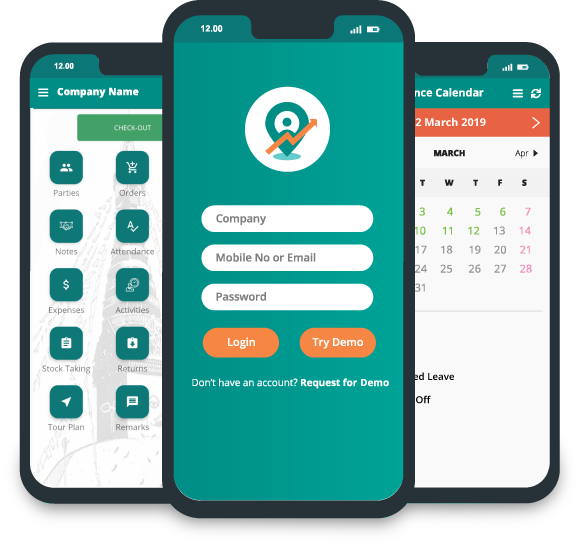
A field sales app is a digital solution designed to automate and streamline on-ground sales operations. It helps businesses manage their mobile workforce efficiently by enabling real-time data capture and seamless coordination between field teams and managers. With increasing competition and the need for faster decision-making, relying on manual tools is no longer effective.
Using a mobile sales app, sales representatives can:
- Log visits with geo-tagging
- Capture orders instantly
- Update customer data
- Track performance through dashboards
These features ensure that every field activity is recorded accurately and instantly, improving transparency and accountability. Managers can monitor operations without delays and make data-driven decisions.
Unlike spreadsheets, a field force automation tool provides structured data, real-time reporting, and seamless integration with CRM and order management systems. This eliminates manual errors, reduces reporting delays, and enhances overall field sales tracking and productivity, making it an essential tool for modern distributors.
How Distributors Use Excel for Sales Management
Excel spreadsheets are commonly used by distributors to manage basic sales operations, especially in the early stages of business. They provide a simple and flexible way to store and organize data without requiring specialized software. However, as operations grow, limitations begin to surface.
Excel spreadsheets are commonly used by distributors to:
- Maintain customer lists
- Track sales data manually
- Record orders and inventory
- Generate basic reports
These functions help in maintaining a basic level of control over sales activities. However, since everything is managed manually, it requires continuous effort and accuracy from the team.
While Excel is easy to use initially, it becomes inefficient as teams grow. Manual updates, version control issues, and lack of real-time reporting make it difficult to manage field operations effectively. This often leads to data inconsistencies, delayed insights, and reduced sales team efficiency, limiting overall business growth.
Field Sales App vs Excel Spreadsheet: Key Differences
A field sales app and Excel spreadsheet differ significantly in how they manage and optimize sales operations. While Excel is a traditional tool used for basic data handling, it lacks the capabilities required for modern, fast-paced field sales environments.
A field sales app offers automated reports and analytics, ensuring that data is updated instantly as field activities happen. In contrast, Excel relies on manual updates, which often lead to delays and outdated information. When it comes to data accuracy, field sales apps provide automated and error-free data capture, whereas Excel is prone to human errors and inconsistencies.
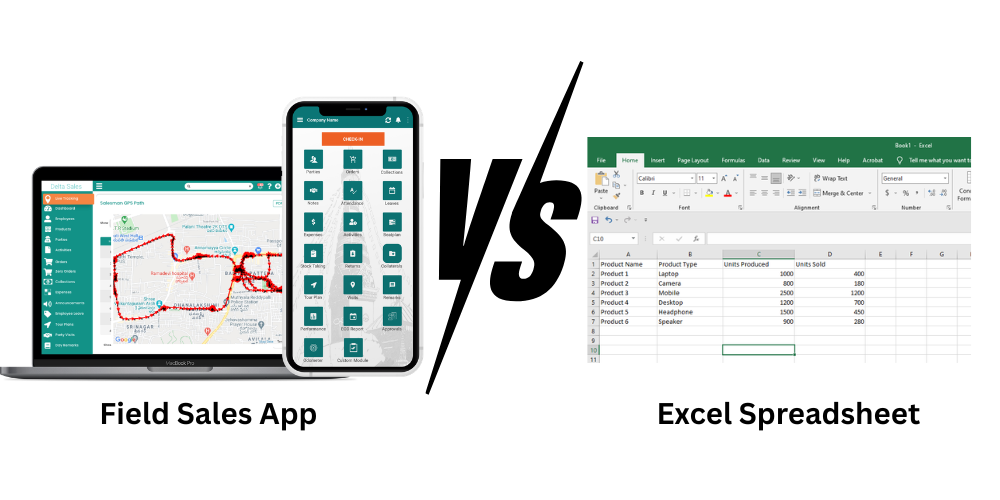
In terms of accessibility, a field sales app is mobile-based, allowing sales teams to work from anywhere, while Excel offers limited access and is not optimized for on-ground teams. Collaboration is also seamless in a field sales app, enabling teams to stay aligned in real time, whereas Excel makes collaboration difficult due to version control issues.
Additionally, field sales apps support integration with CRM, order management, and inventory management software, creating a connected workflow. Excel lacks such integrations, resulting in disconnected processes.
Overall, a field sales app delivers automation, efficiency, and real-time visibility, while Excel remains a static and manual tool unsuitable for scalable sales operations.
Limitations of Using Excel for Field Sales Management
Using Excel for field operations creates several bottlenecks, especially as business complexity increases. While it may work for basic data handling, it lacks the capabilities required for efficient field sales tracking and real-time decision-making.
- No real-time field sales tracking
Managers cannot monitor field activities instantly, leading to delayed decisions and reduced operational control. This lack of real-time visibility affects responsiveness in fast-moving markets. - High dependency on manual data entry
Manual input increases the chances of errors, duplication, and data inconsistencies, ultimately reducing data reliability and accuracy in sales reporting. - Lack of visibility
There is no centralized dashboard for sales performance tracking, making it difficult to analyze team productivity and identify gaps. - Poor scalability
As teams grow, Excel becomes harder to manage, leading to inefficiencies, version control issues, and operational delays.
These limitations make Excel unsuitable for modern, scalable field sales operations.
Benefits of Using a Field Sales App for Distributors
Switching to a field sales app offers multiple advantages for distributors looking to streamline operations and improve overall performance. Unlike manual tools, it enables automation, real-time visibility, and better control over field activities.
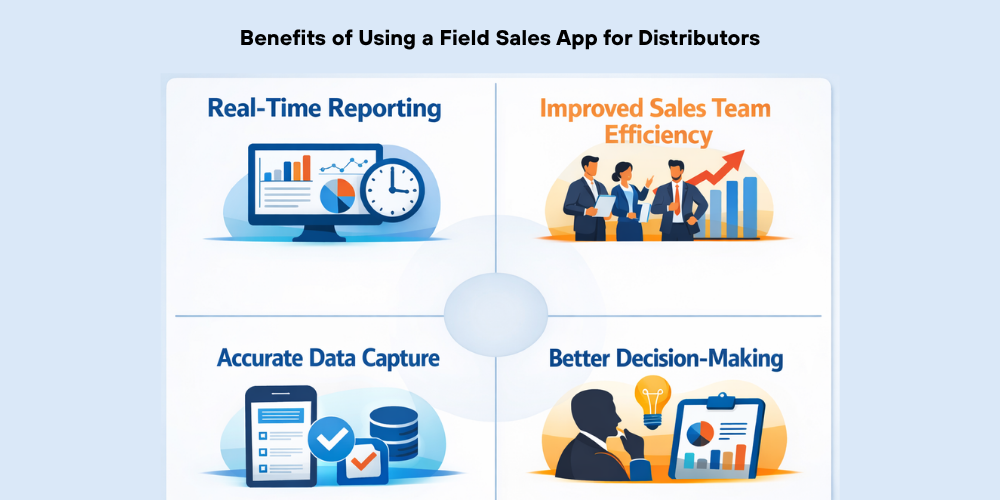
- Real-time reporting
Managers receive instant updates on field activities, enabling faster decision-making and improved field sales tracking without delays. - Improved sales team efficiency
Automation reduces repetitive administrative tasks, allowing sales representatives to focus more on selling and customer engagement. - Accurate data capture
Eliminates manual errors by capturing data digitally, ensuring reliable and consistent sales reporting across the organization. - Better decision-making
With access to real-time data and insights, businesses can make informed, data-driven strategies to improve performance and revenue.
Real-Time Field Sales Tracking: App vs Spreadsheet
A field sales app enables real-time visibility into on-ground activities, helping managers track and manage their teams more effectively. With live data updates, businesses can ensure better control, faster decisions, and improved field sales tracking.
A field sales app enables live tracking of sales reps, including:
- Location tracking
- Visit verification
- Task completion
These features ensure that every activity performed by the sales team is recorded instantly, improving transparency and accountability. Managers can monitor performance in real time and take immediate action when required.
In contrast, Excel relies on delayed and manual updates, making field sales tracking unreliable and inefficient. The lack of real-time insights often leads to poor visibility, slower decision-making, and reduced overall productivity, making it unsuitable for modern field sales operations.
Sales Reporting & Data Accuracy Comparison
Accurate and timely reporting is critical for effective decision-making in field sales operations. A field sales app significantly improves the quality and reliability of data by automating the entire reporting process.
With a field sales app, reports are:
- Automatically generated
- Standardized
- Error-free
These automated reports ensure consistency across teams and eliminate the risk of human error. Managers get real-time insights into performance, enabling faster and more informed decisions.
Excel-based reporting, on the other hand, is:
- Manual
- Inconsistent
- Time-consuming
Since data is entered manually, there are higher chances of errors, duplication, and delays. Reports may vary in format, making analysis difficult and unreliable.
This clear difference makes automation essential for accurate sales reporting, improved data consistency, and better overall business analysis.
Impact on Sales Team Efficiency and Productivity
A field sales app plays a crucial role in enhancing sales team efficiency and overall productivity by minimizing manual workload and streamlining daily operations. It allows sales representatives to focus on high-value activities instead of administrative tasks.
A field sales app significantly improves productivity by:
- Reducing admin work
- Optimizing daily schedules
- Enabling faster reporting
By automating routine processes like data entry and report generation, it saves valuable time for field teams. Features like route planning and task management help reps cover more ground efficiently.
As a result, sales reps can focus more on selling and customer engagement rather than managing spreadsheets. This leads to improved performance, better field sales tracking, and higher overall productivity across the organization.
Automation vs Manual Processes in Field Sales
In traditional setups, Excel represents manual processes that slow down operations and increase dependency on human effort. As field sales operations grow, these manual methods become inefficient and difficult to manage.
Excel represents manual processes:
- Data entry
- Report creation
- Follow-ups
These tasks require continuous input, are time-consuming, and are prone to errors, ultimately affecting the accuracy of sales reporting and overall efficiency.
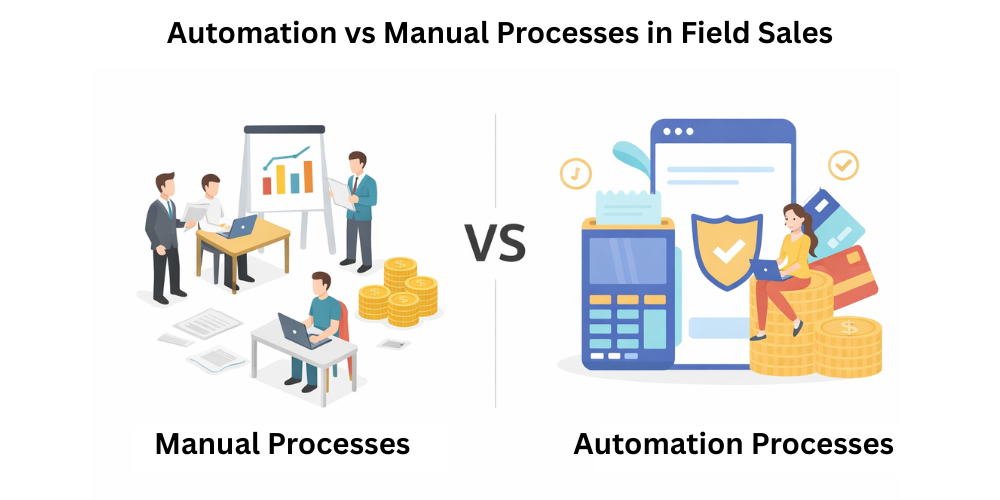
A field sales app, on the other hand, automates:
- Data capture
- Reporting
- Workflow management
Automation ensures that data is recorded instantly, reports are generated in real time, and workflows are streamlined without manual intervention.
This shift from manual processes to field force automation leads to faster operations, improved accuracy, better field sales tracking, and significantly higher productivity for growing businesses.
Integration with CRM, Order & Inventory Management
A key advantage of using a field sales app is its ability to integrate seamlessly with essential business systems, creating a unified and efficient workflow. This integration ensures that all sales data flows smoothly across departments, improving coordination and decision-making.
A field sales app enables integration with:
- CRM systems for centralized customer data management
- Order management for faster and more accurate order processing
- Inventory management software for real-time stock visibility
These integrations eliminate data silos and ensure that field teams, managers, and backend operations are always aligned. Sales representatives can access up-to-date customer and product information, improving both efficiency and customer experience.
In contrast, Excel lacks these integrations, resulting in disconnected workflows, manual data transfers, and higher chances of errors. This makes it difficult to maintain consistency and efficiency in growing field sales operations.
Cost Comparison: Field Sales App vs Excel
At first glance, Excel may appear to be a cost-effective solution for managing field sales operations. However, when you look beyond the surface, the hidden costs associated with manual processes can significantly impact overall efficiency and profitability.
Hidden costs of Excel:
- Time spent on manual work
- Errors and data loss
- Delayed decisions
These factors lead to reduced productivity, inaccurate sales reporting, and missed business opportunities, which can cost more in the long run.
A field sales app, on the other hand, delivers a much stronger return on investment by streamlining operations and improving performance.
A field sales app offers better ROI through:
- Increased productivity
- Faster reporting
- Improved sales performance
By automating workflows and enabling real-time field sales tracking, businesses can save time, reduce errors, and make faster decisions, ultimately driving higher revenue and sustainable growth.
Common Challenges Faced by Distributors Using Excel
Distributors relying on Excel for managing field sales operations often face multiple challenges that hinder efficiency and growth. While spreadsheets may work for basic tasks, they lack the capabilities required for dynamic and scalable sales environments.
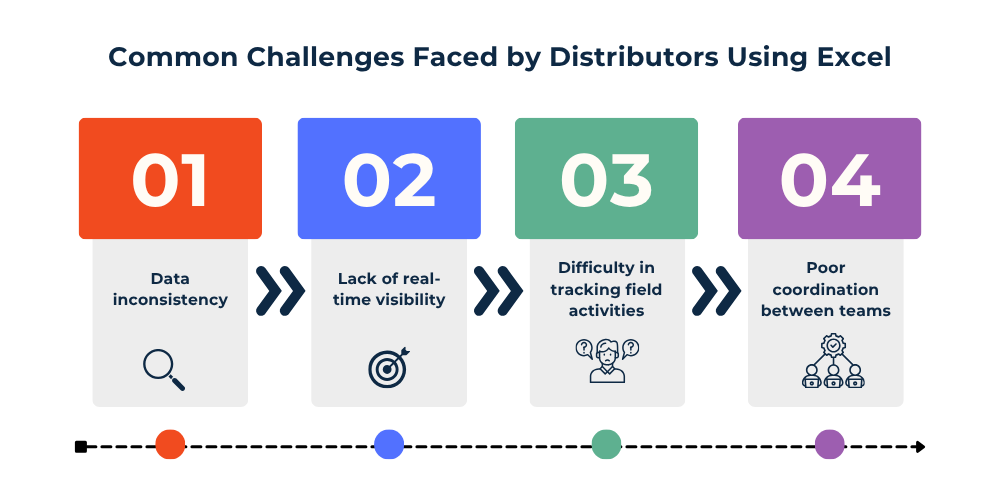
Common challenges include:
- Data inconsistency
Manual data entry often leads to errors, duplication, and unreliable sales reporting. - Lack of real-time visibility
Managers cannot access live updates, making field sales tracking slow and ineffective. - Difficulty in tracking field activities
Monitoring sales reps, visits, and tasks becomes challenging without automation. - Poor coordination between teams
Disconnected workflows lead to communication gaps and operational inefficiencies.
These challenges limit business growth, reduce productivity, and highlight the need for a field sales app that offers automation, real-time insights, and better control over field operations.
When Should You Switch to a Field Sales App?
You should consider switching to a field sales app when your current processes start limiting efficiency and visibility. While Excel may work in the early stages, growing operations demand smarter tools.

Key signs include:
- Your team is growing rapidly
Managing multiple sales reps becomes complex without a centralized field force automation system. - Reporting is becoming chaotic
Manual updates lead to inconsistent and delayed sales reporting. - You lack real-time insights
Without live data, decision-making becomes reactive instead of strategic. - Manual processes are slowing operations
Tasks like data entry, report creation, and follow-ups consume valuable time.
How Field Sales Apps Drive Faster Business Growth
A modern field sales app plays a critical role in accelerating business growth by improving efficiency, visibility, and decision-making across sales operations. By replacing manual processes, businesses can scale faster and respond more effectively to market demands.
With a field sales app, businesses can:
Track field activities in real time
Monitor on-ground operations with live updates on sales rep locations, visits, and task progress, ensuring complete visibility and control.
Automate sales reporting
Generate structured, real-time reports without manual effort, enabling faster analysis and reducing reporting errors.
Streamline order management
Capture and process orders instantly, minimizing delays and improving overall order accuracy and fulfillment speed.
Improve performance tracking
Access data-driven insights and KPIs to evaluate team performance and identify areas for improvement.
Boost team productivity
Reduce administrative workload and empower sales teams to focus more on selling and customer engagement.
By leveraging automation, real-time data, and intelligent workflows, field sales apps help businesses improve execution, make faster decisions, and achieve sustainable growth in competitive markets.
Future of Field Sales Management for Distributors
The future of field sales is being reshaped by advanced technologies that enable faster decision-making, deeper insights, and higher operational efficiency. Distributors who embrace these innovations will gain a strong competitive advantage in an increasingly data-driven market.
Key trends driving this transformation include:
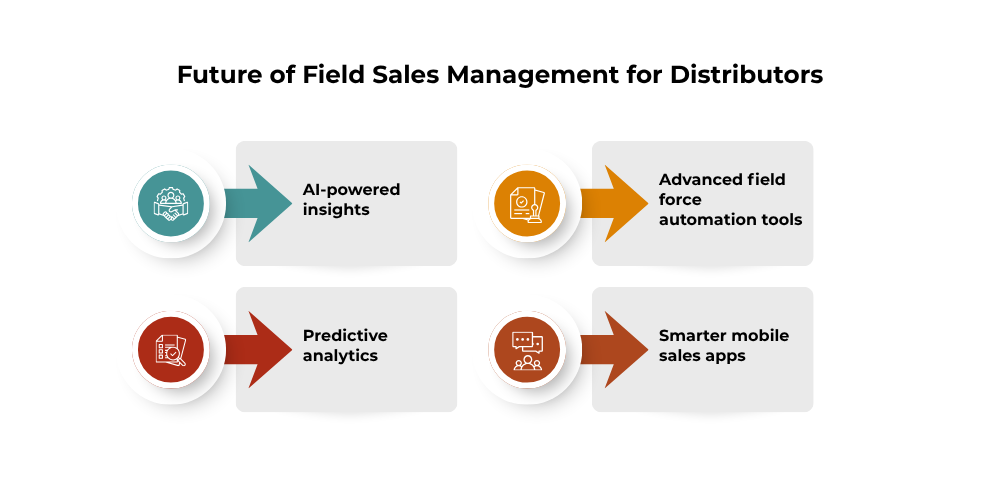
- AI-powered insights
Artificial intelligence enables smarter decision-making by analyzing large volumes of sales and customer data in real time. - Predictive analytics
Distributors can forecast demand, optimize inventory, and plan sales strategies proactively instead of reacting to past data. - Advanced field force automation tools
Automation will continue to streamline workflows, reduce manual effort, and improve overall execution efficiency. - Smarter mobile sales apps
Next-generation field sales apps will offer enhanced usability, real-time collaboration, and intelligent recommendations for sales teams.
Distributors adopting these technologies will not only improve productivity but also stay agile, responsive, and competitive in a rapidly evolving sales landscape.
Conclusion
While spreadsheets like Excel have long supported traditional distribution workflows, they fall short in meeting the demands of modern sales operations. Today’s competitive landscape requires real-time visibility, streamlined processes, and scalable systems, capabilities that a field sales app delivers effectively.
To enhance field tracking, increase team productivity, and enable data-driven decision-making, businesses must move beyond manual tools and adopt smarter, technology-driven solutions.
Book a demo of Delta Sales App today and transform your field sales operations.