
The Hidden Costs of Inefficient Field Sales Operations

Inefficiencies in sales execution are often invisible at first, but over time they significantly impact profitability, customer satisfaction, and overall business growth. In most organizations, these issues are not caused by a lack of effort from sales teams, but by weak processes, disconnected systems, and poor visibility across operations.
Modern businesses depend heavily on Field Sales Operations to drive revenue from the ground level. However, when these operations are not optimized, hidden inefficiencies accumulate and slowly reduce overall business performance.
These gaps often come from small but repeated issues like manual order handling, delayed reporting, and lack of real-time visibility, which together create a major operational drag. Over time, they affect sales performance tracking and make it difficult to make accurate, data-driven decisions.
Ultimately, without proper systems and process control, scaling Field Sales Operations becomes difficult, leading to continuous hidden costs that impact both profitability and customer experience.
Understanding Inefficiencies in Field Sales
Inefficiencies in Field Sales Operations occur when sales teams are unable to execute tasks smoothly due to manual processes, lack of real-time data, or poor coordination between departments. These inefficiencies often remain unnoticed until they start affecting revenue, customer satisfaction, and operational cost structures.
Common sources of inefficiency include:
-
Manual order entry and paper-based reporting
- Lack of real-time inventory and pricing visibility
- Weak communication between field teams and backend systems
In many organizations, issues such as delayed order processing, inaccurate reporting, and weak sales performance tracking directly impact execution quality. Over time, these small gaps lead to major financial losses.
What Causes Inefficiencies in Field Sales Operations?
Several factors contribute to inefficiencies in Field Sales Operations, including outdated systems, manual workflows, and lack of integration between tools. These gaps reduce execution speed, accuracy, and overall visibility across teams.
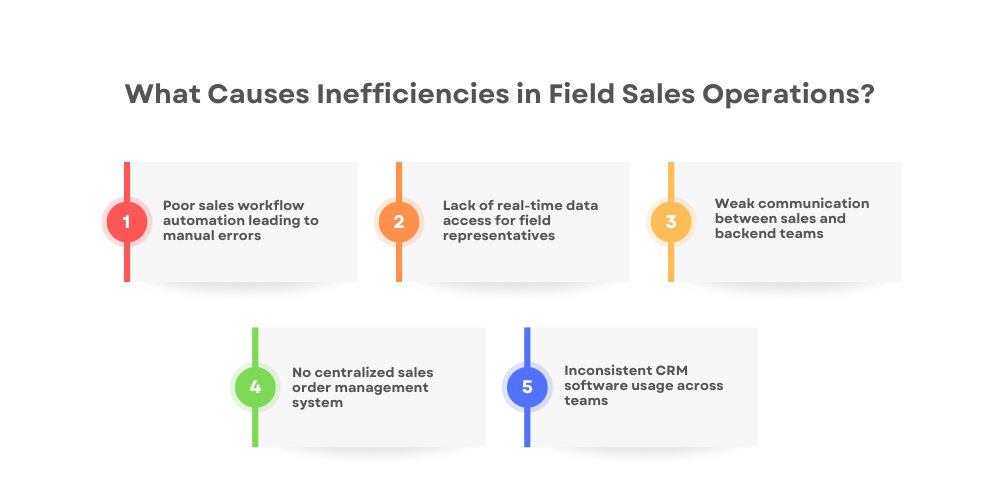
- Poor sales workflow automation leading to manual errors
Manual processes increase mistakes, delay execution, and reduce consistency in daily Field Sales Operations across teams. This also leads to repeated corrections and higher operational effort. - Lack of real-time data access for field representatives
Without live data, sales teams make incorrect decisions during order processing and customer interactions in the field. It directly impacts order accuracy and customer satisfaction levels. - Weak communication between sales and backend teams
Poor coordination causes delays, duplicate work, and misalignment between field execution and backend order fulfillment processes. This slows down the entire sales cycle. - No centralized sales order management system
Disconnected systems create fragmented data, leading to inaccurate reporting and inefficient handling of sales orders. It also increases dependency on manual reconciliation. - Inconsistent CRM software usage across teams
Uneven adoption of CRM tools results in data gaps, reducing visibility and weakening overall sales performance tracking accuracy. Managers struggle to get a unified view of performance.
Hidden Cost #1: Revenue Leakage from Missed Opportunities
One of the biggest hidden costs is revenue loss due to missed orders and delayed follow-ups. When sales teams rely on manual tracking or outdated tools, opportunities are often lost.
Poor order processing and weak pricing validation also contribute to revenue leakage, directly impacting profitability. In many cases, even small delays in approvals or confirmations result in lost conversions and reduced deal closure rates.
Additionally, lack of real-time data access prevents sales reps from acting quickly on customer demand, further increasing missed revenue opportunities.-
Hidden Cost #2: Increased Operational and Logistics Expenses
Inefficient systems lead to repeated deliveries, incorrect orders, and higher return rates. This increases logistics costs and operational burden.
Lack of proper inventory management and weak coordination between teams results in unnecessary transportation and warehousing expenses. Over time, these inefficiencies significantly increase cost per order and reduce margin efficiency.
Poor sales order management also leads to rework cycles, which further inflate operational expenses.
Hidden Cost #3: Reduced Sales Team Productivity
Sales representatives spend more time fixing errors than selling. This reduces overall efficiency in Field Sales Operations.
Without proper sales analytics tools, managers cannot identify productivity gaps, leading to underperformance across teams. Time lost in manual corrections directly reduces customer coverage and daily visit efficiency.
Inefficient sales workflow automation also forces teams to perform repetitive administrative tasks instead of focusing on revenue generation.
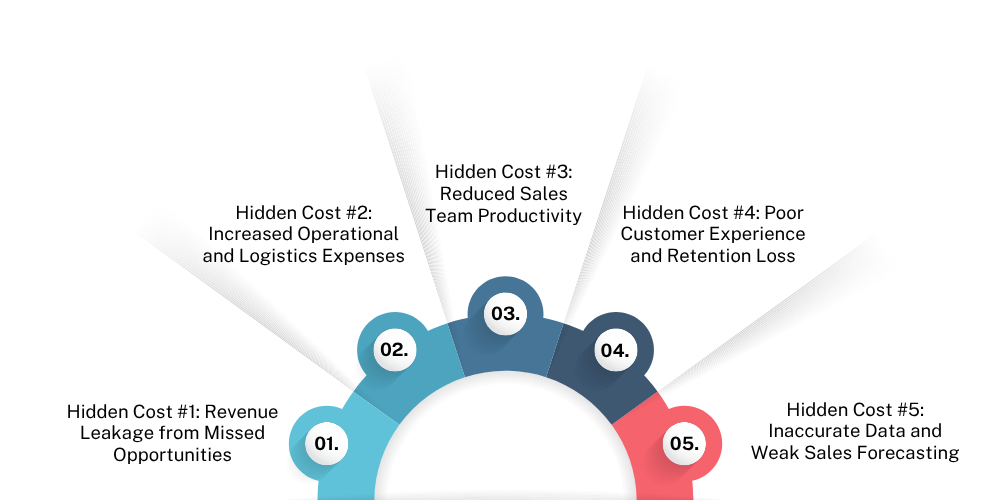
Hidden Cost #4: Poor Customer Experience and Retention Loss
Customers expect accurate orders and timely deliveries. Errors in order fulfillment and communication damage trust.
Weak customer relationship management systems lead to dissatisfaction, reducing repeat purchases and long-term loyalty. Over time, this results in increased churn and lower customer lifetime value.
Frequent mistakes also weaken brand reliability in competitive markets, making it harder to retain key accounts.
Hidden Cost #5: Inaccurate Data and Weak Sales Forecasting
Inaccurate reporting is a major challenge in inefficient systems. Without proper reports & analytics, forecasting becomes unreliable.
Poor data quality affects demand planning, inventory decisions, and strategic growth planning. This leads to overstocking, stockouts, and poor resource allocation.
Lack of integration in sales order management systems further distorts reporting accuracy, making it difficult for leadership to make data-driven decisions.
Impact on Sales Performance and Business Growth
Overall inefficiencies in Field Sales Operations reduce scalability and slow down business growth. Companies struggle with inconsistent reporting, weak execution, and poor visibility.
This directly impacts sales performance tracking, making it difficult to identify top-performing teams or regions.
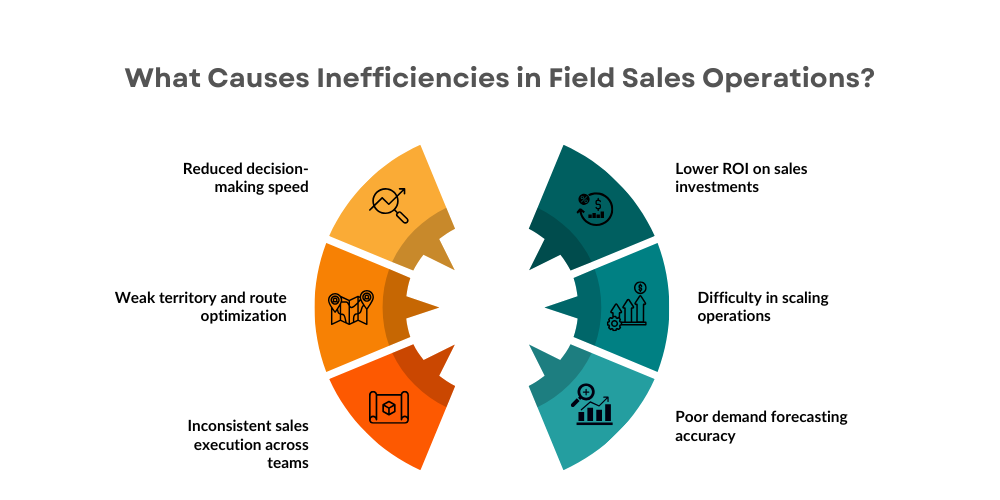
Key Impacts on Business Growth:
-
Reduced decision-making speed
Lack of real-time insights delays strategic decisions, affecting responsiveness in competitive market conditions. - Weak territory and route optimization
Poor planning leads to inefficient coverage, missed outlets, and lower productivity in field execution. - Inconsistent sales execution across teams
Variations in process adoption reduce standardization, affecting overall performance in Field Sales Operations. - Lower ROI on sales investments
Inefficiencies in sales workflow automation and manual processes increase cost per sale and reduce profitability. - Difficulty in scaling operations
Without structured systems, expanding into new regions becomes challenging due to lack of control and visibility. - Poor demand forecasting accuracy
Weak sales analytics tools and unreliable data lead to incorrect inventory planning and missed growth opportunities.
Role of Technology in Eliminating Field Sales Inefficiencies
Technology plays a key role in improving efficiency. Modern CRM software, mobile apps, and automation platforms help streamline operations.
These tools enable better sales workflow automation, improved data accuracy, and faster decision-making.
With the help of integrated systems, businesses can achieve real-time visibility across Field Sales Operations, ensuring that every order, visit, and customer interaction is tracked accurately. This reduces dependency on manual reporting and improves overall execution control.
Technology also enhances sales order management by eliminating duplication, reducing manual entry errors, and ensuring seamless coordination between field teams and backend operations.
Key Ways Technology Improves Field Sales Efficiency:
- Real-time data synchronization
Ensures that all teams work on updated information, improving accuracy in order processing and execution. - Centralized customer and product information
Provides a single source of truth, reducing confusion and improving consistency in sales decisions. - Automated validation and error detection
Helps identify issues in pricing, quantity, and SKU selection before orders are submitted. - Improved visibility for managers
Enables better field sales performance through dashboards and live reporting tools. - Enhanced mobility for field teams
Mobile-first tools allow sales reps to capture orders, update visits, and access data on the go. - Stronger integration across systems
Connects CRM, inventory, and billing platforms to eliminate data silos and improve workflow efficiency.
How Automation Improves Field Sales Efficiency
Automation eliminates repetitive manual tasks and reduces human errors. It improves sales order management by ensuring accuracy at every stage.
Automated systems also enhance pricing validation, reduce duplication, and improve overall execution speed. This creates a more structured and reliable workflow across Field Sales Operations, allowing teams to focus more on selling rather than administrative work.
Automation also strengthens order processing by ensuring that every order is validated in real time before submission, reducing costly errors and rework. It improves coordination between field teams and backend systems by ensuring seamless data flow.

Key Ways Automation Enhances Efficiency:
- Eliminates manual data entry errors
Reduces mistakes caused by human input and improves accuracy in daily Field Sales Operations. - Improves real-time decision-making
Provides instant updates on inventory, pricing, and customer data for faster execution. - Enhances sales workflow automation
Standardizes processes and ensures consistent execution across all sales teams. - Reduces order duplication and conflicts
Prevents repeated entries and improves efficiency in sales order management systems. - Strengthens sales performance tracking
Automatically captures activity data, improving visibility and reporting accuracy. - Speeds up approval and processing cycles
Minimizes delays in order approvals and improves overall response time.
Challenges in Fixing Inefficient Sales Processes
Despite benefits, organizations face challenges such as resistance to change, integration issues, and training gaps.
Legacy systems and lack of digital adoption slow down transformation in Field Sales Operations.
Many organizations also struggle with fragmented technology stacks, where multiple disconnected tools operate in isolation. This creates data silos and limits the effectiveness of sales workflow automation, making it difficult to achieve end-to-end visibility.
In addition, poor data quality in existing systems further complicates transformation efforts. Inaccurate or incomplete records reduce the reliability of sales analytics tools, leading to weak insights and poor decision-making.
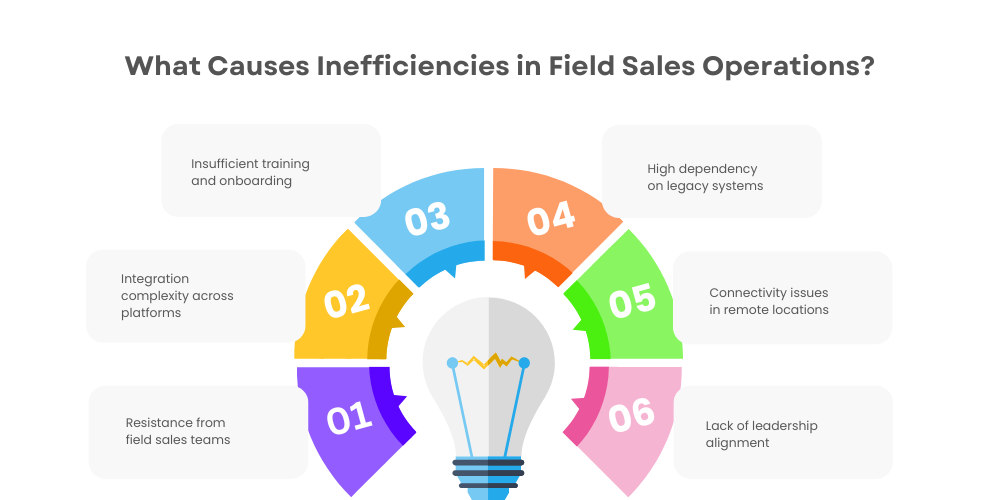
Key Challenges in Improving Sales Processes:
- Resistance from field sales teams
Employees often hesitate to adopt new systems due to comfort with manual methods. - Integration complexity across platforms
Connecting CRM, inventory, and billing systems requires time, resources, and technical expertise. - Insufficient training and onboarding
Lack of proper guidance reduces effective usage of CRM software and automation tools. - High dependency on legacy systems
Older systems lack flexibility and slow down modernization of Field Sales Operations. - Connectivity issues in remote locations
Poor internet access can disrupt real-time data usage and order processing. - Lack of leadership alignment
Without strong management support, digital transformation initiatives fail to scale effectively.
Final Thoughts:
Efficient systems are essential for long-term growth. Organizations that invest in automation, data integration, and structured workflows achieve better results in Field Sales Operations.
By reducing inefficiencies, businesses can improve sales performance tracking, enhance customer satisfaction, and scale operations effectively.
Take control of your Field Sales Operations with automation, real-time visibility, and intelligent reporting.
Book a free demo of Delta Sales App and eliminate inefficiencies to unlock higher sales performance and growth.