
How Paint Companies Can Manage Dealer Sales Across Territories

Paint companies rarely struggle to find dealers. The harder problem is managing them consistently across territories. A paint company might have hundreds of dealers spread across cities, towns, construction markets, and rural areas, and each one can have a different order potential, product preference, stock level, payment cycle, and relationship with the contractors and painters who actually buy from them. Sales reps are expected to visit these dealers regularly, check stock, book orders, follow up on payments, communicate schemes, and keep the territory covered.
When all of that runs through phone calls, spreadsheets, paper notes, and end-of-day reporting, visibility starts to break down. A sales manager might know exactly how much primary sales got dispatched from the company and still have almost no idea what's happening at the dealer counter.
Dealer sales management needs a field process that connects territory planning, dealer visits, order booking, stock information, payment follow-ups, and reporting. That matters especially for paint companies, since dealer sales are tied closely to local construction activity, seasonal demand, product availability, and SKU-level movement.
This blog explains how paint companies can build a more consistent dealer sales process across territories and how field sales software can support the process.
What goes wrong when paint dealer sales are managed manually
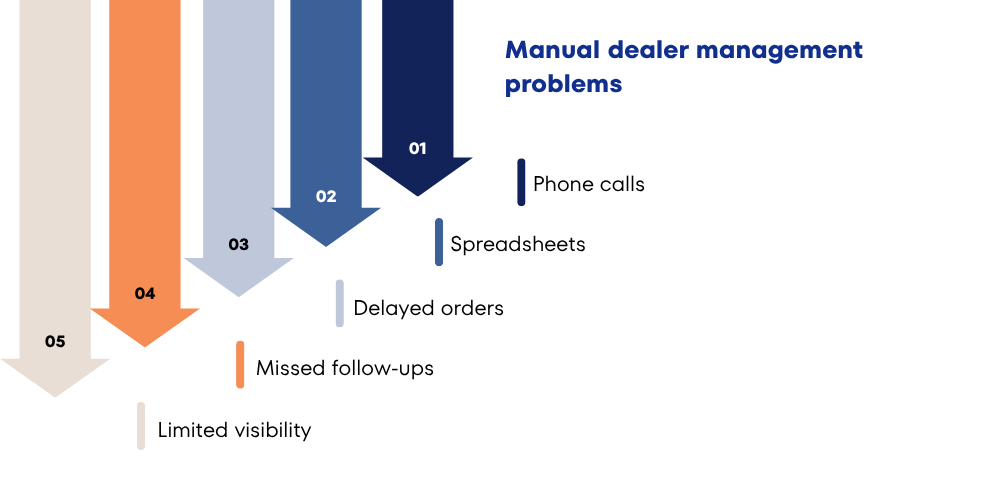
Manual dealer management creates gaps in field visibility, especially when sales teams cover large territories. Orders, stock information, visits, collections, and follow-ups can reach managers late or in inconsistent formats.
-
Orders and stock figures reach the office late
A dealer visit provides more information than the order itself. A fast-moving interior emulsion may be nearly out of stock, an exterior paint may be moving slowly, or a dealer may need a specific pack size or shade. When this information is recorded in notebooks or shared through calls and messages, managers may receive it too late to act. Capturing order quantities, SKU-level requirements, dealer stock, collections, and visit outcomes during the visit provides faster visibility into both primary and secondary sales.
-
Dealer visits depend on each salesperson's habits
Dealer coverage can vary significantly between salespeople. One may follow the beat plan closely, while another may spend more time with familiar accounts and miss lower-frequency or newly assigned dealers. Visit frequency should reflect dealer potential, sales history, location, product mix, payment status, and territory importance. Without structured beat planning, dealer coverage depends too heavily on individual salesperson habits rather than territory priorities.
-
Scheme and payment follow-ups get missed
Dealer management also involves payment collections, promotional schemes, targets, claims, and distributor coordination. When these activities are tracked across notebooks, messages, phone reminders, and spreadsheets, follow-ups can easily be missed. A centralized record of collections, scheme communication, outstanding payments, and next actions helps sales managers identify which dealers require follow-up and prevents important tasks from being lost between visits.
Building a dealer sales process that works in the field
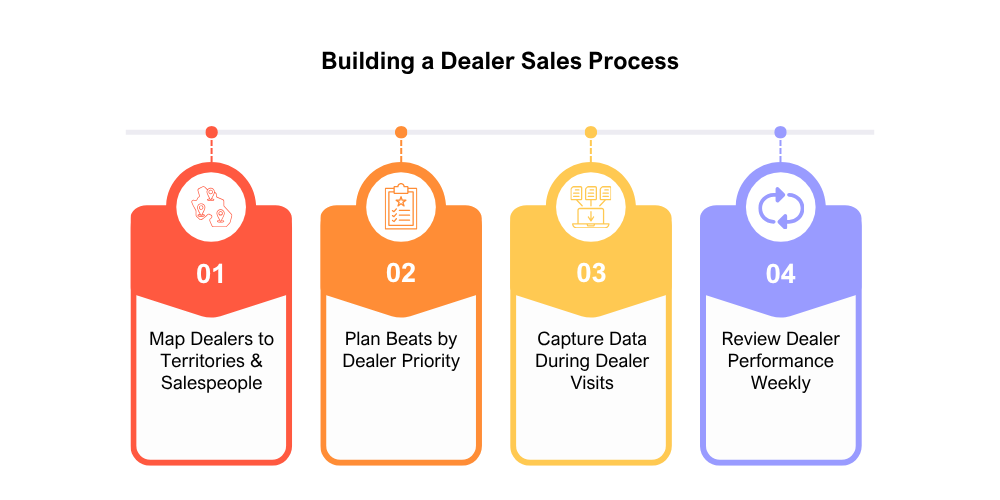
A practical dealer sales process connects territory allocation, beat planning, dealer visits, order booking, stock visibility, collections, and performance reviews. The goal is to capture field information during the visit itself and get it to managers without piling extra reporting work onto the reps.
-
Map every dealer to a territory and a salesperson
Every dealer should be mapped to a specific territory and salesperson, with the basics in place: location, contact details, distributor relationship, sales history, order potential, and payment status. Clear territory mapping lets managers monitor dealer coverage, assign new accounts, spot inactive dealers, and rebalance workloads once a territory gets lopsided.
-
Plan beats by dealer priority and order potential
A beat plan should reflect dealer potential, not just geography. Dealers can be prioritized on historical sales volume, order frequency, product and SKU mix, dealer potential, territory importance, outstanding payments, stock availability, and new product opportunities. Higher-potential dealers warrant more frequent visits. Lower-volume accounts can run on a different cycle. Route optimization trims unnecessary travel and tightens territory coverage on top of that. A good beat plan should answer three things: which dealers need a visit, when, and what has to get done once the rep is there.
-
Record orders, stock, and payments during the visit
Reps should record orders while they're at the dealer, not reconstruct the visit from memory afterward. For paint companies, that means SKUs, shades, pack sizes, order quantities, current dealer stock, payments collected, outstanding amounts, scheme information, and the next follow-up, all captured on the spot. That makes the DSR more accurate and gets managers faster visibility into what's actually happening in the field. Offline access matters here too, especially in territories with patchy connectivity. Reps should be able to record visits and orders without a live network and sync everything once they're back online.
-
Review dealer-wise numbers every week
Weekly reviews should go past the top-line sales number and look at dealer and territory performance specifically. The metrics worth checking are planned versus completed dealer visits, orders booked by dealer, sales by territory, sales by SKU, dealer order frequency, collection performance, outstanding payments, inactive or low-performing dealers, territory coverage, and secondary sales movement. Dealer-level data is what tells a manager why performance moved. Orders declining could mean stock problems, payment constraints, weaker coverage, or demand just shifting. And strong primary sales sitting next to weak dealer movement is worth a closer look on its own, since that gap usually means stock is piling up somewhere it shouldn't be.
How Delta Sales App supports paint dealer sales
For companies looking to structure dealer visits, territory coverage, order booking, and field reporting in one workflow, paint field force software can support the day-to-day field sales process without separating dealer management from sales execution.
The focus is on giving sales teams a practical way to plan work, capture field activity, and give managers visibility into what is happening across territories.
-
Daily visit plans and live field tracking
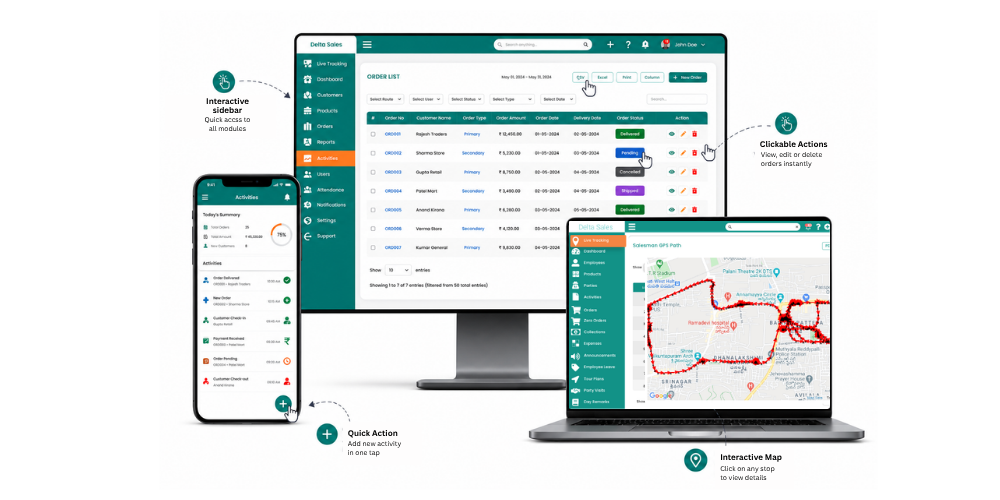
Delta Sales App helps managers assign dealers, plan daily visits, and organize field activity around territory and beat requirements. Sales representatives can follow assigned visit plans instead of deciding their routes manually. GPS-based employee location tracking provides visibility into field movement and helps managers compare planned visits with actual execution. This is useful for paint companies covering dealers across multiple towns or large territories. Attendance, visit records, location data, and daily activity can be managed within the same workflow, reducing reliance on separate reports and repeated calls to the field team.
-
Order booking from the dealer counter
Sales representatives can capture orders directly during dealer visits instead of writing them down and entering them later. For paint companies managing multiple SKUs, shades, pack sizes, and product categories, digital order booking provides faster and more accurate visibility into dealer requirements. Representatives can also record collections and visit details during the same activity. With offline-first functionality, orders and field data can be recorded in areas with poor connectivity and synced when a connection becomes available.

-
Reports on dealer and territory performance
Once visits and orders are being recorded consistently, managers can review performance by dealer, territory, salesperson, and SKU. The reports worth having are dealer-wise orders and sales, planned versus completed visits, order frequency, collection and outstanding payments, territory-wise sales, SKU movement, and low-performing or inactive dealers.
Conclusion
Managing paint dealer sales across multiple territories requires more than regular dealer visits. Sales teams need clear territory assignments, practical beat plans, accurate order and stock information, and consistent follow-up on collections and dealer performance.
A structured field sales process gives managers better visibility into dealer coverage and helps sales representatives spend more time on productive field activity. With the right system, orders, visits, collections, and territory performance can be tracked from the field without depending on scattered spreadsheets or delayed reports.
Delta Sales App brings these activities into one field sales workflow, helping paint companies manage dealer sales, improve territory coverage, and make better decisions from real-time field data. See what a more connected dealer sales process could look like for your team. Explore Delta Sales App