
How to Improve Distributor Visibility for Lubricant Companies

Lubricant companies sell through distributors to workshops, garages, spare parts retailers, and service centers, but once the product leaves the company's warehouse, it gets hard to follow. Sales reports come in late. Stock updates are patchy. Field reps log their visits in separate spreadsheets or notebooks, so nobody has one picture.
That makes it hard to spot a stock shortage, track secondary sales, or tell whether a distributor is covering the territory it was given. A popular engine oil grade can run out while slow-moving SKUs pile up in the distributor's warehouse. And a workshop with steady demand can go unserved because the sales team's outlet records are wrong.
Improving distributor visibility requires a consistent view of stock movement, orders, collections, field visits, and territory coverage. In this blog, we will explore why lubricant companies struggle with distributor visibility, where these gaps affect performance, and how field sales automation can help improve distribution management.
Why Lubricant Companies Lose Sight of What Distributors Are Doing
Lubricant distribution involves several connected activities, from primary sales to distributors to secondary sales across workshops, garages, and retailers. When these activities are recorded separately, managers struggle to understand actual market performance.
-
Secondary Sales and Stock Data Reach the Company Late
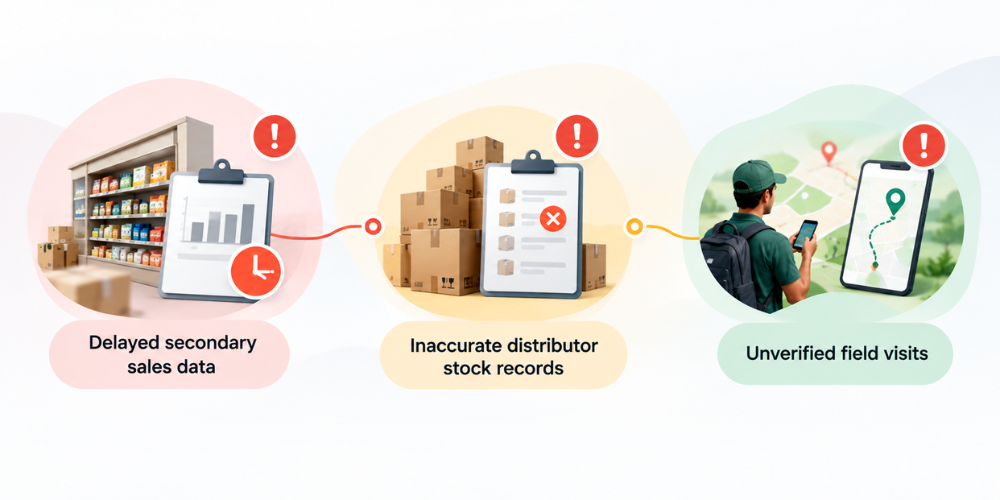
Primary sales show how much product a company sells to distributors, while secondary sales track products sold onward to customers. Without timely secondary sales and stock updates, managers cannot determine whether products are moving or accumulating in distributor warehouses. For example, a distributor may hold excess quantities of one engine oil grade while running short of another. Delayed reporting makes it difficult to identify this mismatch and plan replenishment accordingly.
-
Workshops, Garages, and Retailers Are Covered Without a Shared Record
Lubricant sales run on repeat relationships with mechanics, workshops, retailers, and service centers. When those customers live in spreadsheets and reps' personal notes, a manager can't easily see which outlets are active, which visits got missed, or where a new sale might be. A shared outlet database fixes most of that. It holds each customer's location, purchase history, territory, and past visits in one place. It also means the records stay put when a rep moves to another territory, so the next person doesn't start from zero.
-
Field Team Activity Is Reported, Not Verified
Manual daily sales reports may show completed visits and booked orders without providing enough evidence of actual field activity. Managers may struggle to identify missed calls, inconsistent territory coverage, or inaccurate reporting. GPS-based tracking systems and digital visit records help compare planned activities with recorded field execution, giving managers a clearer view of representative productivity.
Where Poor Distributor Visibility Costs the Most
Limited visibility affects inventory planning, customer coverage, and the coordination of orders and payments. These problems can reduce sales opportunities and weaken distributor relationships.
-
Stock-Outs and Overstock of fast- and slow-moving SKUs
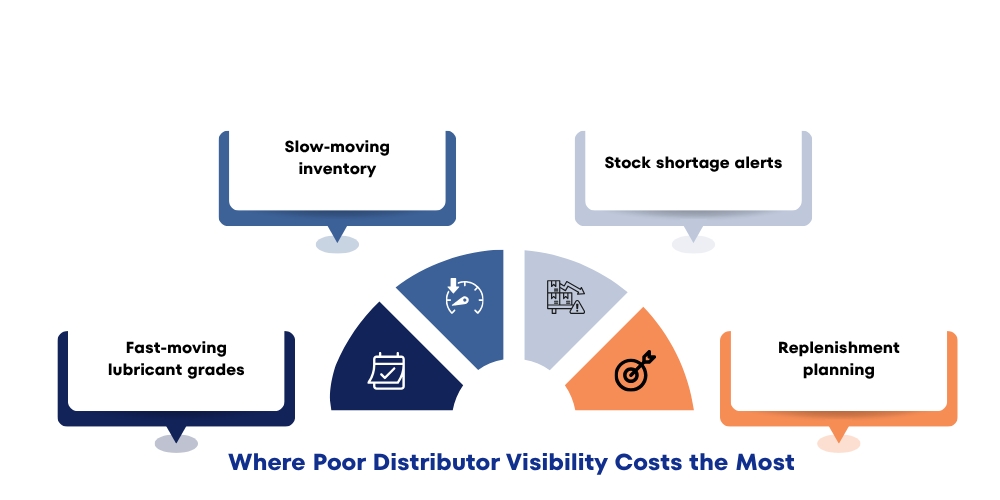
Lubricant companies manage multiple engine oil grades, transmission fluids, gear oils, greases, and industrial lubricants. Demand varies by product, customer type, and territory. Without SKU-level stock and secondary sales data, distributors may run out of popular products while holding excess slow-moving inventory. Better visibility helps managers identify replenishment needs, reduce inventory imbalances, and align stock with actual demand.
-
Missed Coverage in Workshops and Retail Outlets
Reps tend to keep going back to the customers they already know, and the workshops and retailers with room to grow get skipped. Without visit records at the outlet level, a manager has no easy way to tell whether a territory is being covered properly. Tracking planned visits against completed ones shows which accounts are being neglected. It also gives you what you need to fix the beat plan and to rank outlets by sales potential and how often they buy.
-
Delayed Orders, Payments, and Claims
When orders and collections are handled over calls, messages, and paper slips, things get delayed, and the numbers stop matching. A manager often can't say whether an order is still pending, whether a payment has actually been collected, or whether a customer's complaint needs a follow-up. Order reporting and booking collections digitally gives everyone the same transaction record. Sales and finance can then chase follow-ups from one source instead of comparing notes.

How to Get a Clear View of Distributor Performance
Improving distributor visibility requires a structured process for recording outlet information, planning visits, capturing field activity, and reviewing results. The following steps help lubricant companies establish more reliable distribution records.
-
Map Distributors, Sub-Dealers, Workshops, and Territories
Build one central database that lists every distributor, sub-dealer, garage, workshop, retailer, and service center. For each one, record the location, contact details, assigned territory, and the relevant purchase information. Then sort the outlets by customer type and by how much business they could bring in, so reps know where to visit first. Clear territory assignments also stop two people calling on the same outlet, and they show you which areas nobody is covering.
-
Set Beat Plans So Every Outlet Gets a Planned Visit
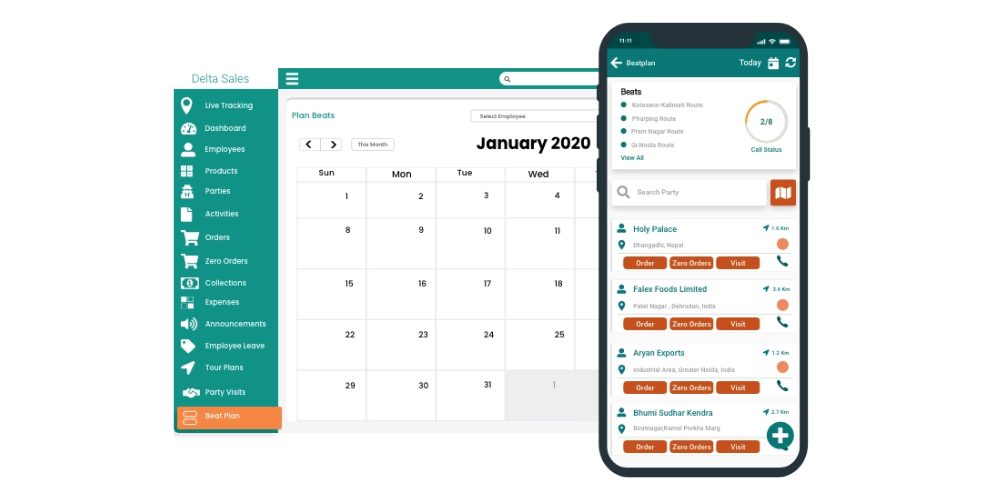
A beat plan sets out which outlets a rep should visit and when. A busy, high-volume workshop may need frequent calls, while a smaller or quieter account can be seen less often. Route optimization lets reps group their calls sensibly and cut down on wasted travel. And when the beat plan is digital, a manager can compare scheduled visits with completed ones and see where coverage is slipping.
-
Capture Orders, Stock, and Collections During the Visit
During each visit, reps should record the customer's order, what they see on the shelf, any collection, and anything that needs a follow-up. Orders captured at the SKU level show which lubricant grades are actually in demand and which ones need restocking. Where the network is weak, a mobile tool that works offline lets reps keep entering data and sync it later. One caveat: what a rep sees on a shelf is only an observation. If you need exact stock balances, check it against the distributor's own inventory records.
-
Review Distributor and Territory Performance in One Report
Managers should look at secondary sales, SKU movement, outlet coverage, order conversion, and collections side by side. Any one of them alone can mislead. Together they show why a territory is underperforming: stock wasn't available, visits were missed, or customers weren't converting. Reviewing them every week and again each month makes repeat problems easier to catch. From there, you can adjust distributor support, sales targets, and territory plans based on what the numbers show.
How Delta Sales App Supports Distributor Visibility for Lubricant Companies
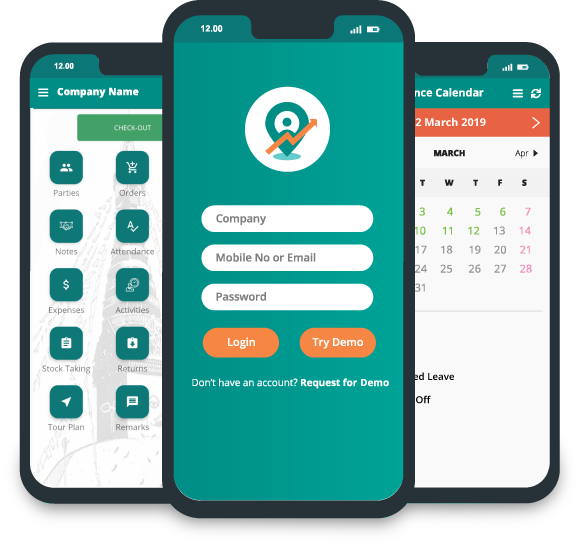
Delta Sales App is a field sales automation tool with employee tracking. It helps lubricant companies keep reps organized and hold a digital record of what happens in the market. It covers the field sales side of distributor visibility and works alongside the inventory and distribution systems a company already has.
-
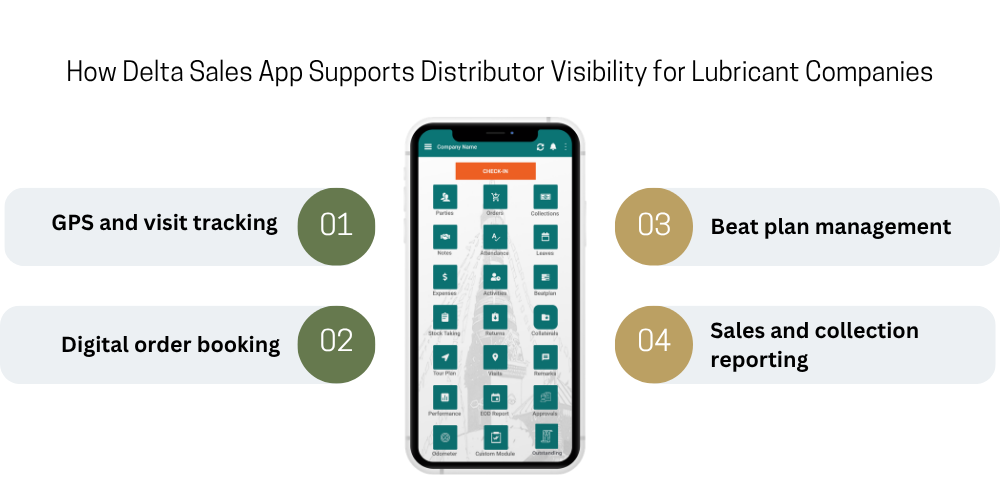
Field Tracking and Visit Tracking for Distributor and Workshop Calls
GPS tracking and digital visit records let managers see what reps are doing at distributors, garages, workshops, and retailers. Set planned visits against what was actually recorded, and missed calls and uneven territory coverage show up quickly. The same records show how much attention each customer is getting, so a manager can arrange a follow-up for an important account that has been left alone.
-
Order Booking and Stock Capture From the Field
Delta Sales App supports digital order booking and sales reporting, helping representatives record customer orders and field activity in a structured format. Where stock capture is configured, representatives can record relevant stock observations and product requirements during visits. These records help identify potential shortages, while inventory software or distributor management systems may be needed for complete stock balances and reconciliation. Offline-first functionality also helps representatives record supported activities when connectivity is limited, with data synchronizing when a connection becomes available.
-
Beat Planning and Reporting for Territory-Level Review
Delta Sales App supports beat planning, route management, and field sales reporting to help organize representative visits across distributor territories. Managers can review field activity, orders, and collections to identify coverage gaps and assess territory performance. These insights support better decisions about customer follow-ups, route planning, and distributor coordination. Combining field execution records with reliable secondary sales and inventory data provides a more complete view of distribution performance.
Conclusion
Better distributor visibility starts with what happens after the product reaches the distributor. Primary sales can't tell you whether lubricant grades are moving through workshops and retailers, whether distributors are holding sensible stock, or whether your reps are covering the market evenly.
Four things close most of that gap: a structured distributor and outlet database, beat plans reps can follow, timely order and collection reporting, and regular performance reviews. Once managers can set outlet coverage against secondary sales and stock movement, decisions about replenishment, territory development, and distributor support get easier to make. Field sales automation supplies the records behind this, including where reps were, which customers they visited, and what orders and activity came out of it. Delta Sales App helps lubricant companies organize that work and see what's happening in the field. It gives its fullest picture of distribution performance when paired with accurate distributor inventory and sales data.
Request a personalized demo of Delta Sales App to explore how digital field tracking, beat planning, and sales reporting can support better visibility across lubricant distribution territories.