
Mobile CRM vs. Traditional CRM: Which Is Better?
In today’s fast-moving business world, effectively managing customer relationships is more important than ever. Companies require Mobile Sales Apps and CRM systems that not only organizes client data but also enables teams to act on it instantly. As technology continues to advance, businesses often face the question: Mobile CRM vs Traditional CRM, which is the right choice?
This blog explores the differences, advantages, and challenges of both, helping you make a well-informed decision for your organization.
What is Mobile CRM?
Mobile CRM is a cloud-based solution that allows employees to access, update, and manage customer data anytime, anywhere using mobile devices, enabling real-time collaboration, faster decision-making, improved customer engagement, and seamless workflow for field and remote teams.
Key Features
-
Real-time access to customer data: Sales reps can instantly access customer profiles, purchase history, and interaction notes, enabling faster decision-making, timely responses, and stronger relationships by staying informed about every client interaction.
-
Cloud storage for flexibility and scalability: Customer data is securely stored in the cloud, allowing multiple users to access and update information simultaneously. Cloud storage ensures flexibility, seamless collaboration, and easy scalability as your business grows.
-
Mobile-friendly interface with simple navigation: Mobile CRM is optimized for smaller screens, offering an intuitive interface. Users can perform tasks quickly and efficiently, reducing training needs and allowing teams to focus on engaging customers effectively.
-
Analytics and reporting tools: Managers can track KPIs, generate reports, and monitor sales performance directly on mobile devices. Report & Analytics help identify trends, highlight gaps, and support faster, data-driven business decisions.
-
Integration with social media and collaboration apps: Mobile CRM integrates with social media and collaboration platforms, enabling smooth communication, efficient teamwork, and effective information sharing between office and remote employees for enhanced productivity.
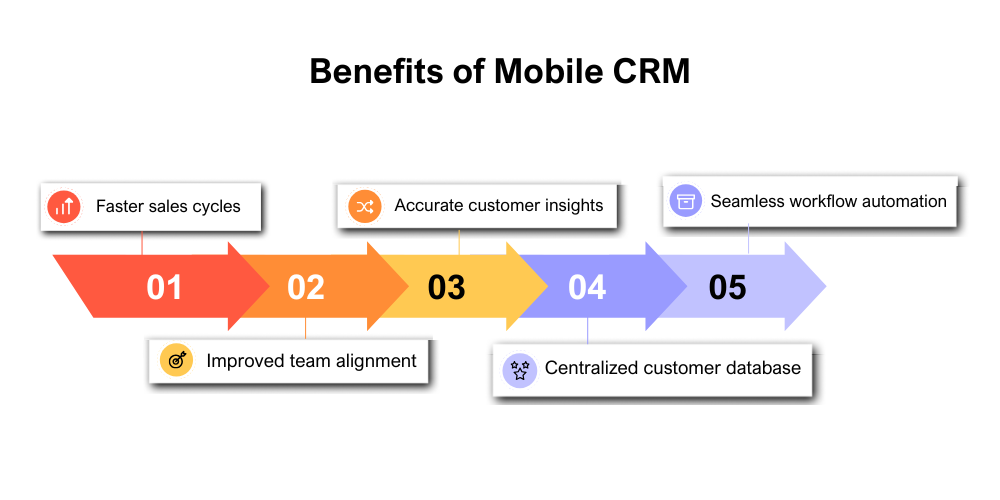
Benefits of Mobile CRM
-
On-the-go access: Field sales representatives can access and update customer information during client visits, enabling real-time decision-making, faster responses, and improved service quality, ensuring customers always receive timely and accurate attention.
-
Improved efficiency: Mobile CRM reduces time spent on manual data entry and administrative tasks, allowing sales teams to dedicate more effort to selling, nurturing leads, and closing deals, ultimately boosting overall productivity.
-
Better collaboration: Teams, whether in the office or working remotely, can communicate effortlessly and share customer data instantly. This ensures everyone is aligned, workflows are seamless, and decisions are made faster across the organization.
-
Enhanced insights: Managers gain immediate access to real-time analytics, helping them identify performance gaps, monitor sales trends, and uncover growth opportunities. Quick insights enable informed strategies and smarter, data-driven business decisions.
Top Mobile Sales Apps for Growing Businesses provide additional functionalities such as automated reminders, route optimization, and activity tracking, making them ideal for sales teams on the move.
Challenges of Mobile CRM
-
Security risks: Storing sensitive customer data on mobile devices exposes it to potential threats. Lost or stolen devices can lead to unauthorized access, making robust security measures essential to protect critical business information.
-
Privacy compliance: Companies using mobile CRM must adhere to strict data protection regulations. Ensuring compliance prevents legal penalties, safeguards customer trust, and maintains the integrity of personal and business information.
-
Dependence on internet connectivity: Mobile CRM requires a reliable internet connection for real-time data access and updates. Poor connectivity can disrupt workflows, delay information sharing, and affect timely decision-making for remote and field teams.
What is Traditional CRM?
Traditional CRM is software installed on company servers or desktops, designed to manage customer interactions, store client data, and track sales activities. It offers comprehensive features for marketing, sales, support, and reporting, but is less flexible for remote access.
Key Features
-
Centralized customer database: Traditional CRM stores all client information securely in one central location, ensuring consistency, reducing data duplication, and providing teams with a complete view of customer interactions for better relationship management.
-
Sales pipeline management: Tracks leads, opportunities, and conversions systematically, allowing sales teams to monitor progress, prioritize high-potential prospects, and manage deals efficiently from initial contact to closing, improving overall sales performance.
-
Marketing automation tools: Supports planning, executing, and tracking marketing campaigns. Automated workflows manage leads, segment audiences, and nurture prospects, saving time and ensuring consistent communication with potential and existing customers.
-
Customer support and ticketing systems: Helps teams handle customer inquiries, complaints, and support tickets efficiently. Ensures timely issue resolution, improves service quality, and enhances customer satisfaction and loyalty.
-
Reporting and analytics: Generates detailed insights on sales performance, customer behavior, and operational efficiency. Enables informed decision-making, helps identify trends, and supports strategic planning across the organization.
Benefits of Traditional CRM
-
Comprehensive features: Traditional CRM supports sales, marketing, and customer support, enabling teams to streamline operations, manage processes efficiently, and maintain consistent customer engagement across the organization.
-
Integration: Traditional CRM connects with other enterprise systems, ensuring seamless data flow, reducing manual work, and creating a cohesive workflow across departments.
-
Data centralization: Traditional CRM provides a single source of truth for customer information, ensuring accuracy, eliminating duplication, and enabling better decision-making.
-
Detailed analytics: Traditional CRM offers in-depth reporting and analytics, helping managers track performance, identify trends, and make informed strategic decisions.
Challenges of Traditional CRM
-
Complexity: Traditional CRM requires training and expertise to use effectively, which can slow adoption and reduce productivity for teams unfamiliar with the system.
-
High costs: Traditional CRM involves significant upfront investment and ongoing maintenance expenses, making it a costly solution, especially for small to medium-sized businesses.
-
Limited mobility: Accessing traditional CRM remotely can be difficult for field or distributed teams without VPNs or remote desktop setups.
-
Maintenance-heavy: Traditional CRM needs frequent updates and dedicated IT support to ensure smooth operation and prevent system downtime.
-
Free vs. Paid Sales Tracking Apps: For smaller businesses, evaluating free vs. paid sales tracking apps can help decide whether a lightweight mobile CRM solution or a full-fledged traditional system is suitable for immediate operational needs.
Why Choosing the Right CRM Matters
Customer Relationship Management (CRM) systems have come a long way. Traditional CRMs, typically on-premise, were designed to centralize customer information and streamline business processes. However, with the rise of mobile technology, mobile CRM solutions have emerged, enabling real-time access to customer data on smartphones and tablets.
Choosing the right CRM isn’t just about technology, it directly impacts sales efficiency, team productivity, and customer satisfaction. A well-suited CRM ensures that your sales and support teams can access accurate information quickly, collaborate seamlessly, and respond to customer needs proactively. On the other hand, the wrong CRM can lead to data silos, delayed responses, and missed opportunities, ultimately affecting your business growth.
By carefully evaluating your business needs, team structure, and operational goals, you can select a CRM that not only manages data but also drives meaningful results.
Mobile CRM vs. Traditional CRM: Key Differences
|
Feature / Factor |
Traditional CRM |
Mobile CRM |
|
Accessibility |
On-premise, limited to office/server |
Cloud-based, accessible anywhere on mobile devices |
|
User Interface |
Often complex, may require training |
User-friendly, optimized for mobile screens |
|
Features |
Extensive for marketing, sales, support |
Focused on real-time sales, collaboration, and analytics |
|
Integration |
Limited integration with other tools |
High integration with cloud apps, social media, and third-party tools |
|
Cost & ROI |
High upfront costs, maintenance-heavy |
Subscription-based, scalable, often higher ROI over time |
Which CRM is Right for Your Business?
Choosing the right CRM system is a critical decision that can significantly impact your sales efficiency, customer relationships, and overall business growth. Not all CRMs are created equal, and the right choice depends on a variety of factors that reflect your company’s structure, goals, and operational needs. Understanding these factors can help you select a CRM that not only manages your customer data but also empowers your team to work smarter and more effectively.
Factors to Consider
-
Team Location and Mobility Needs
One of the first things to evaluate is where your team operates. If your workforce is primarily in the office and works on a fixed schedule, a traditional CRM might meet your needs. However, if your team frequently works remotely or in the field, a mobile CRM is far more effective, providing real-time access to customer data on smartphones and tablets. Mobility ensures your team can update records, track activities, and make decisions on the go, keeping customer engagement seamless and timely. -
IT Resources and Infrastructure
Your organization’s technical capabilities play a significant role in CRM selection. Traditional CRMs typically require on-premise servers, dedicated IT staff, and regular maintenance. Businesses without strong IT infrastructure might find this challenging and costly. Mobile CRMs, being cloud-based, reduce reliance on internal IT support, offering automatic updates, secure storage, and simpler deployment. -
Budget and Cost Structure
Traditional CRM systems often involve substantial upfront costs. Mobile CRM solutions, on the other hand, operate on subscription or pay-as-you-go models, offering scalability and affordability, which is ideal for growing teams exploring Mobile Sales Apps for Growing Businesses. -
Data Control vs. Accessibility
Companies that need full control over their data, compliance with strict security standards, or highly customized workflows may lean toward traditional CRM. On the other hand, businesses that value flexibility and accessibility will benefit from mobile CRM solutions, which provide secure, anytime-anywhere access without compromising productivity. -
Integration and Compatibility Needs
Modern businesses rely on multiple tools for marketing, sales, customer service, and collaboration. Traditional CRMs may have limited integration capabilities, requiring workarounds for third-party apps. Mobile CRMs are built for seamless integration with cloud-based applications, email platforms, collaboration tools, and social media, ensuring your workflows remain streamlined and interconnected. -
Scalability and Future Growth
Consider your business’s growth trajectory. A CRM should not only meet current needs but also support expansion. Mobile CRMs are inherently more scalable, allowing additional users, locations, or features to be added without significant technical hurdles, while traditional CRMs may require more investment and IT resources to scale.
How Mobile CRM Transforms Sales Teams
Mobile CRM is more than just a convenience, it’s a game-changer for sales productivity and efficiency. By bringing customer data and workflows directly to mobile devices, it enables teams to work smarter, respond faster, and close more deals.
Real-time lead updates: Sales representatives can log activities, record customer interactions, and update lead information instantly. This ensures managers have up-to-date insights, reduces miscommunication, and allows reps to follow up on opportunities without delays.
Route optimization and scheduling: Mobile CRM helps field reps plan client visits strategically, route planning, and manage appointments efficiently. By reducing wasted time on logistics, reps can focus more on selling and engaging customers.
Instant reporting: Managers no longer have to wait for weekly or monthly reports to track performance. Mobile CRM provides real-time access to sales metrics, KPIs, and progress updates, allowing for quicker, data-driven decisions.
Collaboration: Teams can communicate and share files seamlessly through integrated messaging and collaboration tools. Office staff and field reps stay aligned, improving workflow efficiency and ensuring customer interactions are consistent and well-informed.
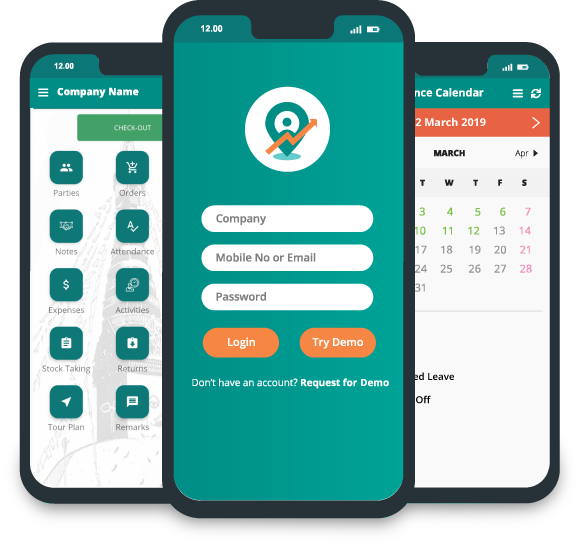
For example, solutions like Delta Sales App take mobile CRM to the next level by enabling sales teams to:
-
Track field activities automatically:
Mobile CRM records field activities in real time, eliminating manual data entry, reducing errors, and allowing sales reps to focus on selling rather than administrative tasks, improving overall productivity. -
Automate routine tasks:
Routine tasks like follow-ups, reporting, and reminders are automated, saving time, ensuring consistency, and allowing sales teams to prioritize high-value activities that drive revenue and customer satisfaction. -
Access customer data anytime, from any device:
Sales reps can access accurate customer information on smartphones, tablets, or laptops anytime, ensuring they are always prepared for client meetings and interactions, which improves engagement and decision-making.
Conclusion
Choosing between mobile and traditional CRM comes down to your business model and team needs. Traditional CRM offers depth and comprehensive features for centralized teams, while mobile CRM provides flexibility, real-time access, and scalability for modern businesses.
For businesses aiming to increase efficiency, improve responsiveness, and elevate customer experience, mobile CRM is often the smarter and more future-ready choice.
Take the next step and experience the power of a mobile CRM like Delta Sales App.
Request a Free Demo Now and discover how it can transform your sales workflow, boost productivity, and drive business growth.