
Zero Connectivity, Zero Downtime: Why Offline Synchronization is a Must-Have for FMCG Distribution
The FMCG industry operates at an extremely fast pace where delays, interruptions, or missed updates can directly affect sales performance, retailer relationships, and distribution efficiency. Despite rapid digital transformation, one major operational challenge still exists across many markets, unreliable internet connectivity.
Field sales representatives often travel through rural areas, highways, semi-urban markets, warehouses, and remote distributor locations where internet signals fluctuate constantly. In such situations, systems that depend entirely on live connectivity become operational bottlenecks instead of productivity tools.
Modern FMCG companies can no longer rely only on cloud-connected systems that stop functioning whenever the network disappears. Distribution operations require uninterrupted execution regardless of internet availability. Whether a salesperson is booking orders, tracking inventory, recording collections, or updating retailer visits, the process must continue smoothly without downtime.
A strong field sales automation software helps businesses ensure that operations continue seamlessly even when connectivity is weak or completely unavailable.
Offline synchronization is no longer just a feature. It has become a business continuity requirement for FMCG distribution ecosystems.
What is Offline Synchronization in FMCG Distribution Software?
Offline synchronization refers to the ability of a mobile application or distribution platform to continue functioning without internet access while storing operational data locally on the device. Once connectivity becomes available again, the data automatically syncs with the central server.
This means field teams can continue working without interruptions.

For example:
- Orders can still be booked
- Retailer visits can still be recorded
- Inventory updates can still be entered
- GPS activities can still be tracked
- Collections can still be documented
Without offline capability, sales teams are forced to delay activities until network connectivity returns, leading to inefficiency and operational inconsistency.
A reliable offline sales app ensures uninterrupted execution regardless of field conditions.
In FMCG distribution, sales representatives frequently operate in rural markets, remote retail areas, warehouses, and low-network zones where internet connectivity is unstable. If the application stops working every time the network drops, field productivity suffers significantly.
Offline synchronization solves this challenge by allowing the app to store data locally on the device and sync it automatically once the internet becomes available again. This ensures that important operational activities continue smoothly without disrupting field execution.
It also improves reporting accuracy because data gets captured instantly instead of being entered later manually. Sales teams can complete retailer visits faster, distributors can continue operations without delays, and management receives more reliable market data.
Why FMCG Distribution Cannot Depend on Constant Internet Access
FMCG distribution networks are geographically extensive. Sales representatives frequently operate across:
- Villages
- Interior markets
- Highway routes
- Remote retail clusters
- Low-network warehouse zones
Even urban markets experience connectivity instability inside buildings, basements, warehouses, and crowded commercial areas.
In such conditions, depending entirely on real-time internet access creates serious operational risk.
A modern distributor management software must support execution in both online and offline environments.
The challenge becomes even larger when organizations scale operations across multiple territories. Thousands of daily transactions generated by field teams cannot wait for stable connectivity.
Connectivity issues affect:
Order Booking Speed
Poor internet connectivity slows order processing, forcing sales representatives to wait longer during retailer visits and reducing daily productivity.
Reporting Timelines
Field reports often get delayed when applications fail to sync data instantly, affecting managerial visibility and operational decision-making accuracy.
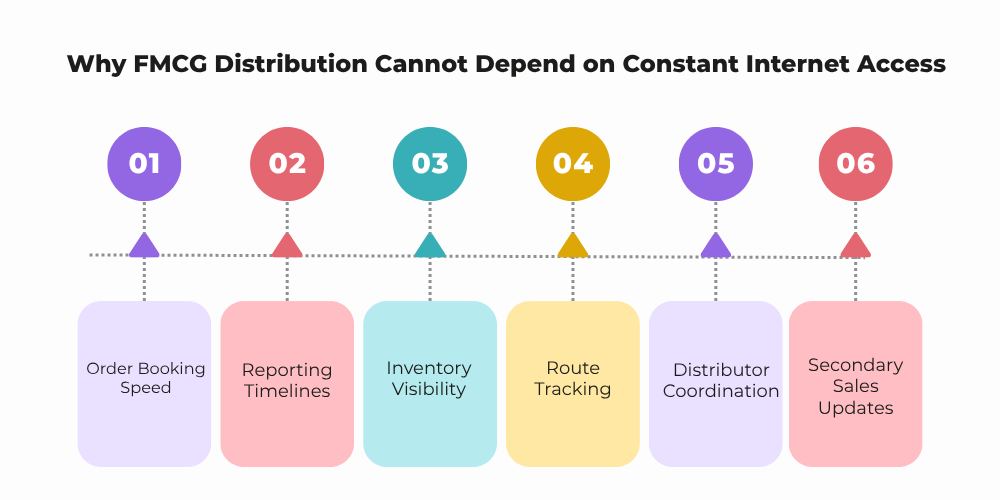
Inventory Visibility
Unstable connectivity creates delayed stock updates, making distributors and managers work with inaccurate inventory availability and replenishment information.
Route Tracking
GPS tracking interruptions reduce visibility into field movement, route completion, and salesperson productivity across assigned operational territories daily.
Distributor Coordination
Communication gaps between distributors and field teams increase when operational systems depend completely on uninterrupted internet-based synchronization processes.
Secondary Sales Updates
Delayed synchronization affects secondary sales visibility, reducing management’s ability to monitor market movement and retailer demand accurately.
The Operational Problems Caused by Poor Connectivity
Missed Orders and Delayed Reporting
When applications stop working due to network failure, sales representatives may postpone order entries or rely on manual note-taking. This leads to delayed uploads and increases the risk of forgotten, incomplete, or incorrect orders during field execution.
An advanced mobile order management system helps prevent disruptions during retailer visits by allowing continuous order capture even in unstable network conditions.
Duplicate Entries and Manual Reconciliation
Sales teams often end up entering the same data multiple times when synchronization fails or gets interrupted. This creates conflicting records that managers later need to manually verify and reconcile, consuming significant administrative effort and time.
Lost Sales Opportunities
Retailers expect quick response times during visits. If a salesperson cannot place orders instantly due to slow or failing connectivity, the buying experience is disrupted, often resulting in reduced order value or completely missed sales opportunities.
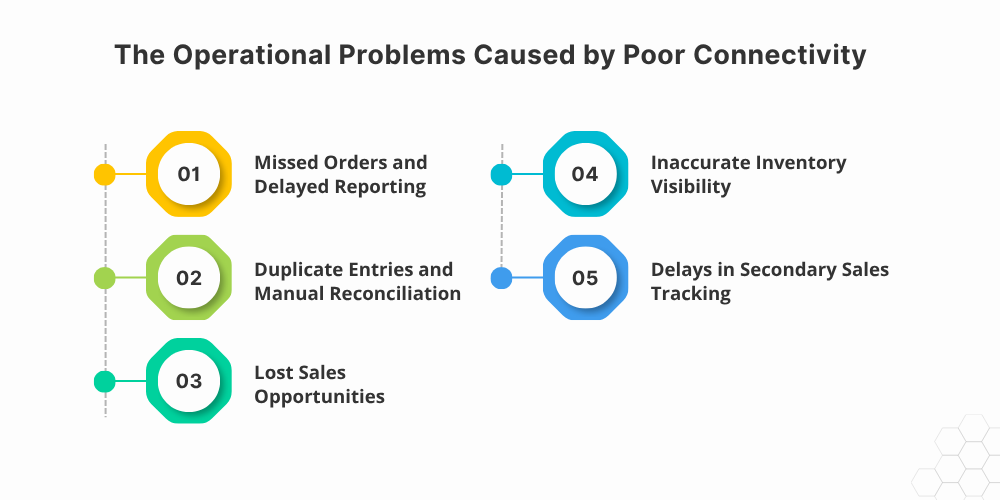
Inaccurate Inventory Visibility
Weak or delayed synchronization leads to mismatched stock data between field teams and distributors. This results in incorrect inventory visibility, causing overstocking, stockouts, and poor replenishment decisions across the supply chain.
An efficient inventory management software minimizes stock discrepancies even in offline conditions, ensuring more reliable operational data.
Delays in Secondary Sales Tracking
When field sales data is not synced in real time, management loses accurate visibility into secondary sales performance. This impacts forecasting, production planning, and timely replenishment decisions, creating inefficiencies across the entire distribution network.
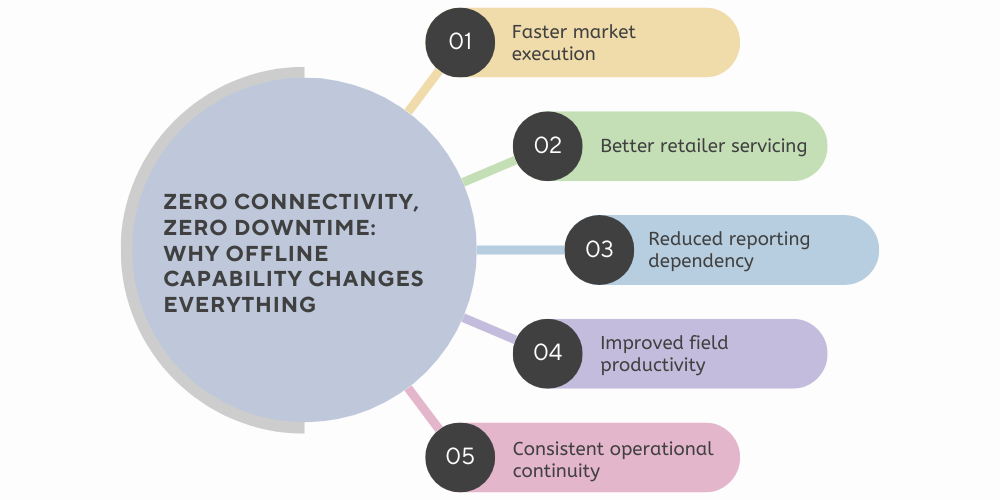
Zero Connectivity, Zero Downtime: Why Offline Capability Changes Everything
Offline synchronization fundamentally changes how FMCG field operations function. Instead of stopping work during connectivity failures, field teams continue executing tasks normally while the system securely stores all data locally on the device. Once the internet becomes available, the information is automatically synced with the central server without manual effort.
This shift eliminates operational dependency on real-time connectivity and ensures that execution never halts in real-world field conditions.
This creates:
- Faster market execution by allowing sales representatives to complete retailer visits and order booking without waiting for network availability.
- Better retailer servicing as transactions are processed instantly at the point of sale, improving customer experience and trust.
- Reduced reporting dependency since data is captured in real time and does not rely on manual post-visit reporting or memory-based updates.
- Improved field productivity because teams spend more time selling and less time dealing with app loading or connectivity issues.
- Consistent operational continuity ensures uninterrupted workflows across rural, semi-urban, and urban markets regardless of network strength.
A scalable sales force tracking app allows field teams to maintain execution consistency without internet dependency, ensuring that every activity is recorded accurately at the source.
For FMCG organizations, this directly translates into better market responsiveness, higher operational reliability, and stronger control over distributed field operations across large territories.
How Offline Synchronization Improves Field Sales Productivity
Faster Retailer Visit Execution
Field representatives do not need to wait for network loading screens during retailer visits. This reduces transaction time significantly and allows them to focus more on selling rather than system delays or connectivity issues.
Better Route Completion
When systems work smoothly in offline mode, salespeople are able to complete more outlet visits per day without interruptions caused by weak or unavailable internet connectivity.
An optimized route planning software supports uninterrupted route execution in remote territories by ensuring that field activities continue seamlessly even in low-network areas.
Increased Order Collection Capacity
Sales teams can cover larger territories and manage more retailer interactions without operational delays caused by connectivity interruptions. This directly improves daily order volume and overall field efficiency.
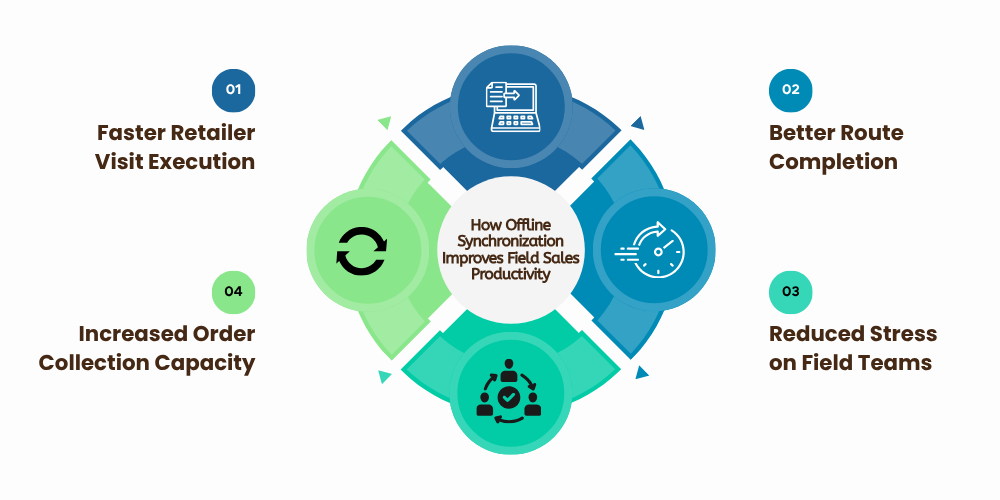
Reduced Stress on Field Teams
Sales representatives feel more confident and productive when they know the system will continue working regardless of internet quality. This reduces frustration, improves consistency, and enhances overall adoption of field tools.
A reliable FMCG sales app improves both operational speed and user adoption among field teams by ensuring uninterrupted performance in real-world working conditions.
The Role of Offline Sync in Distributor Management
Distributor operations involve continuous movement of inventory, invoices, schemes, collections, and secondary sales data. In such a high-frequency environment, even a few minutes of connectivity failure can disrupt the entire workflow and create data gaps across the supply chain.
If synchronization fails, operational visibility collapses quickly, leading to delays in decision-making and inaccurate reporting at both distributor and management levels.
Offline synchronization helps distributors:
- Continue billing operations without interruption, ensuring invoices are generated even in low-network conditions
- Track stock movements in real time at the source, reducing dependency on delayed updates
- Record collections instantly during field transactions, improving financial accuracy
- Update inventory continuously to maintain correct stock availability across systems
- Maintain retailer servicing without workflow disruption, ensuring smooth order fulfillment cycles
A robust secondary sales tracking software ensures uninterrupted data flow between distributors and management teams, even when internet connectivity is unstable or unavailable.
This becomes particularly critical during peak sales periods when order volumes are high and operational downtime can directly impact revenue generation, supply chain efficiency, and retailer satisfaction.
Offline Synchronization and Data Accuracy
Many organizations assume offline systems reduce accuracy. In reality, properly designed offline systems improve data reliability because they ensure that field information is captured at the exact point of activity, even without internet access.
The key reason is simple: data gets captured instantly at the source instead of being written later from memory, paper notes, or delayed reporting after connectivity is restored. This reduces distortion and improves operational integrity across the FMCG workflow.
A powerful retail execution software helps organizations capture real-time ground activity accurately by ensuring that every visit, order, and transaction is recorded at the moment it happens, regardless of connectivity conditions.
Offline synchronization reduces:
- Human error during manual re-entry of data after field visits
- Missing entries caused by forgotten or delayed reporting
- Duplicate uploads triggered by repeated syncing attempts
- Delayed reporting due to connectivity gaps in remote areas
- Data inconsistencies between field, distributor, and central systems
As a result, management receives cleaner, more structured, and more reliable operational insights, enabling better forecasting, demand planning, and execution decisions across the FMCG distribution network.
Critical FMCG Operations That Must Work Offline
Certain FMCG functions should never stop due to internet failure because they directly impact sales execution, retailer relationships, and supply chain continuity.
Order Management
Sales teams must continue booking retailer orders without interruption, ensuring no loss of sales opportunities even in low or no connectivity areas.
Retailer Visit Tracking
Attendance marking and outlet visit recording must remain fully operational to maintain accurate field activity visibility and accountability.
GPS Tracking
Field movement should continue recording locally even without the internet. A modern GPS tracking app for sales teams supports uninterrupted route visibility and ensures complete field coverage tracking.
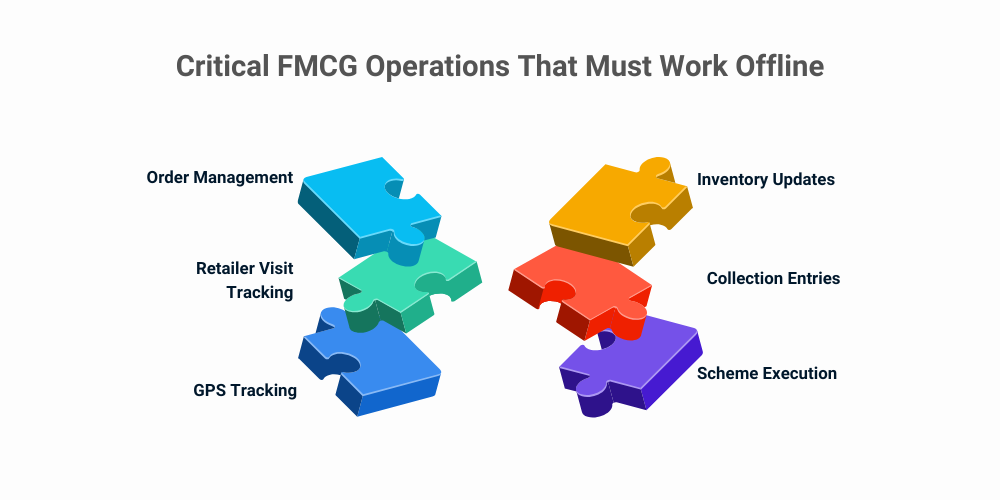
Inventory Updates
Stock availability and product updates must remain accessible in offline mode to avoid mismatches between field data and distributor systems.
Collection Entries
Payment records should never depend on network availability, as real-time financial capture is critical for accurate accounting and reconciliation.
Scheme Execution
Retail promotions, discounts, and schemes should continue functioning smoothly in all conditions to ensure consistent execution across markets.
A reliable retailer management software supports uninterrupted execution across all field activities, ensuring FMCG operations remain stable even when connectivity is unavailable.
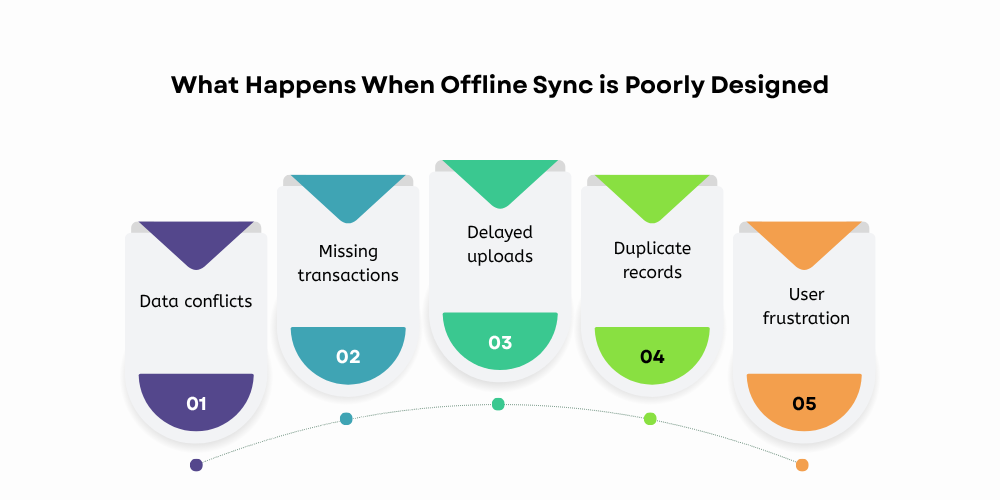
What Happens When Offline Sync is Poorly Designed
Not all offline systems are effective. When offline synchronization is poorly engineered, it does not solve connectivity problems, it often creates more operational complexity and data integrity issues.
Instead of enabling smooth field execution, weak offline design introduces inconsistencies between what happens in the field and what gets reflected in the central system.
Poorly designed synchronization creates:
- Data conflicts where multiple versions of the same record overwrite or clash during sync
- Missing transactions when locally stored data fails to upload properly after reconnection
- Delayed uploads that break real-time visibility for managers and distributors
- Duplicate records caused by repeated sync attempts or retry loops
- User frustration as field teams lose trust in the application’s reliability
In some cases, systems also sync data incorrectly when internet connectivity returns, leading to inaccurate reporting, distorted sales insights, and reduced operational confidence across teams.
An efficient cloud-based sales management app must combine both offline reliability and centralized visibility, ensuring that data captured offline is safely, accurately, and consistently integrated into the main system without corruption or loss.
Companies must therefore choose platforms with strong sync architecture, conflict resolution logic, and data validation layers instead of relying on basic offline storage capabilities that only provide temporary data capture without ensuring long-term integrity.
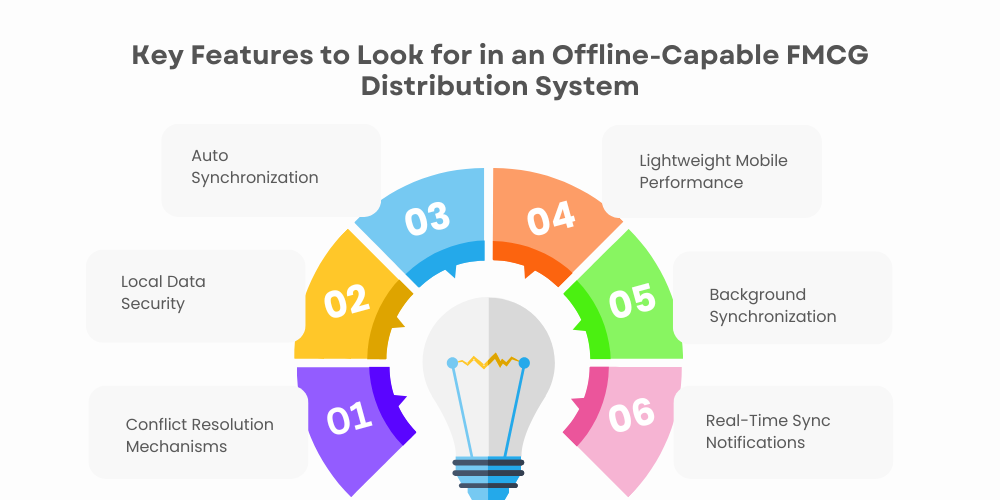
Key Features to Look for in an Offline-Capable FMCG Distribution System
Building an effective offline-enabled FMCG system is not just about allowing data entry without internet access. The real value lies in how intelligently the system manages storage, synchronization, and data integrity once connectivity is restored.
Auto Synchronization
The system should sync automatically once connectivity returns, without requiring manual intervention from field users. This ensures seamless data flow from device to central server and reduces operational delays.
Local Data Security
Offline data must remain encrypted and protected on the device to prevent unauthorized access, leakage, or manipulation during offline storage periods.
Conflict Resolution Mechanisms
The software should intelligently handle duplicate or conflicting records created during offline and online transitions. A strong logic layer ensures data consistency across all users and systems.
Lightweight Mobile Performance
Heavy applications often fail in low-network environments or consume excessive device resources. A scalable field force management software should remain responsive even in remote markets with limited device capability and weak connectivity.
Background Synchronization
Users should not be forced to manually trigger every sync process. Background synchronization ensures that data transfer happens automatically whenever the system detects stable connectivity.
Real-Time Sync Notifications
Field teams should always know the status of their data. Clear notifications about successful syncs, pending uploads, or failed transactions improve transparency and reduce confusion during field operations.
How Offline Synchronization Supports Sales Expansion into Rural Markets
Rural markets represent some of the most significant growth opportunities for FMCG companies, especially as urban markets become increasingly saturated. However, these regions often suffer from unstable or extremely limited internet connectivity, making real-time digital operations difficult to sustain.
Without offline capability, businesses struggle to scale consistently into these territories because field teams are forced to depend on network availability for even basic operations like order booking, visit tracking, or inventory updates. This creates execution gaps and reduces market penetration efficiency.
Offline synchronization enables:
- Deeper market penetration by allowing uninterrupted field operations in remote and underserved regions
- Rural retailer coverage ensuring that even small, scattered outlets can be serviced without connectivity barriers
- Continuous van sales operations where sales vehicles can function as moving distribution points without relying on constant internet access
- Reliable outlet servicing that ensures consistent order fulfillment, stock updates, and customer engagement in low-network areas
An advanced van sales software helps companies operate effectively in low-network distribution environments by ensuring that all critical sales activities continue offline and sync automatically when connectivity is restored.
Companies that invest in strong offline infrastructure gain a clear competitive advantage in underserved markets, as they can maintain consistent execution, faster servicing cycles, and stronger retailer relationships compared to competitors dependent on constant internet access.
Why Offline-First Systems Create Long-Term Operational Stability
Offline-first architecture ensures operational continuity under all circumstances by designing the system to function fully even without internet access. Instead of treating offline mode as a secondary or backup feature, modern FMCG systems now prioritize offline execution as a core operational layer that supports day-to-day field operations.
This approach fundamentally reduces dependency on network availability and ensures that field activities continue uninterrupted across diverse and challenging market environments.
This improves:
- Scalability by allowing organizations to expand into new regions without being restricted by connectivity limitations
- Reliability through consistent system performance regardless of network fluctuations or outages
- User confidence as field teams trust the system to work in all conditions without data loss or interruptions
- Market responsiveness enabling faster execution of orders, visits, and updates even in remote locations
- Operational resilience ensuring business continuity during network failures, peak loads, or infrastructure instability
A modern sales analytics dashboard becomes more reliable when synced data remains consistent across all territories, enabling leadership teams to make accurate decisions based on complete and uninterrupted field information.
Organizations that invest in resilient offline-first infrastructure experience fewer disruptions during expansion and maintain stronger operational control as they scale across rural, semi-urban, and urban markets.
How Modern FMCG Companies Use Offline Synchronization Strategically
Leading FMCG brands no longer view offline synchronization as just a technical feature or backup functionality. Instead, they treat it as a strategic enabler that directly impacts execution quality, market responsiveness, and overall operational control.
In large-scale distribution networks, where field teams operate across diverse geographies with inconsistent connectivity, offline capability becomes a core part of business strategy rather than a system add-on.
They use it strategically to:
- Improve execution consistency by ensuring every field activity, orders, visits, and updates, is captured uniformly regardless of network conditions
- Increase field accountability as real-time activity logging (even in offline mode) creates transparent tracking of salesforce performance
- Accelerate reporting speed by reducing dependency on manual reporting and enabling faster data synchronization once connectivity is restored
- Strengthen distributor coordination through continuous data flow between field teams and distribution points without operational delays
- Improve decision-making accuracy by ensuring leadership receives complete and reliable data from all territories without gaps caused by connectivity issues
A strong real-time sales reporting software enables leadership teams to maintain operational visibility despite connectivity gaps, ensuring that business decisions are based on accurate and timely field data.
This level of operational stability directly supports faster business growth by reducing execution delays, improving responsiveness to market demand, and enabling FMCG companies to scale confidently across regions with varying connectivity conditions.

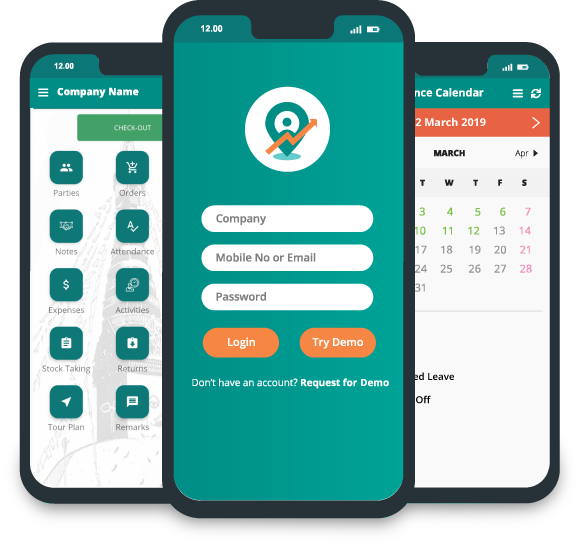
How Delta Sales App Supports Offline FMCG Distribution Operations
Delta Sales App provides offline synchronization capabilities specifically designed for FMCG field operations and complex distributor networks where connectivity is inconsistent and unpredictable.
The platform ensures that field teams are never blocked by network availability and can continue executing critical sales activities seamlessly in any environment.
The platform allows sales representatives to:
- Continue order booking without internet, ensuring no missed sales opportunities during retailer visits
- Record retailer visits offline, maintaining accurate field activity logs even in low-network areas
- Update inventory data locally, reducing delays in stock visibility and replenishment cycles
- Track field activities consistently, ensuring complete visibility of daily salesforce movements
- Sync information automatically once connectivity returns, eliminating manual intervention and data loss risks
Its offline-first operational structure helps businesses maintain uninterrupted execution across rural, urban, and semi-urban markets, ensuring that field productivity is not impacted by connectivity limitations.
The system also supports distributors by ensuring continuous visibility into stock movement, secondary sales, collections, and other operational activities, helping maintain smooth coordination between field teams and backend operations even during network disruptions.
Final Thoughts:
In FMCG distribution, downtime is expensive. Every delayed order, missed retailer visit, unsynced inventory update, or failed field report directly impacts sales performance and operational efficiency.
Offline synchronization removes dependency on constant internet availability and ensures uninterrupted field execution in real-world market conditions. It helps businesses build stable, resilient distribution systems.
As FMCG operations expand into rural and diverse markets, offline-first infrastructure is becoming a standard requirement.
Explore Delta Sales App and book a demo to see how offline synchronization can improve field productivity and distributor operations.