

Optimizing Pharma Supply Chains: How a Distributor Management System Ensures Regulatory Compliance and Efficiency?

In the pharmaceutical industry, ensuring that the right medication reaches the right patient at the right time is a matter of life and death. This responsibility lies at the heart of pharma supply chain management, a highly complex and tightly regulated ecosystem that governs how medicines move from manufacturers to patients.
With rising global demand, increasing regulatory scrutiny, cold chain requirements, and growing concerns about counterfeit drugs, pharmaceutical companies can no longer rely on manual or fragmented distribution processes. To stay compliant and competitive, organizations are turning to digital solutions like a Distributor Management System (DMS) to bring visibility, control, and efficiency to pharmaceutical distribution.
This blog explores how a DMS strengthens pharma supply chain management, ensuring regulatory compliance, operational efficiency, and scalable growth.
What is the Pharmaceutical Supply Chain?
Pharma supply chain management refers to the end-to-end coordination of processes involved in sourcing raw materials, manufacturing medicines, storing inventory, distributing products, and delivering them safely to pharmacies, hospitals, and patients.
-1766558931.png)
Unlike other industries, pharmaceutical supply chains must balance speed, accuracy, safety, and regulatory compliance, all at once.
Key Stakeholders Include:
-
Manufacturers – Produce drugs and medical products.
-
Distributors/Wholesalers – Serve as intermediaries between manufacturers and pharmacies/hospitals.
-
Retail Pharmacies & Hospitals – Dispense medication directly to patients.
-
Regulators – Government bodies that enforce compliance and monitor safety.
Major Challenges in Pharma Supply Chains
Pharmaceutical companies face several challenges that make distribution more complex than in most other industries:
1. Global Market Dependence
Pharmaceutical supply chains often rely heavily on international suppliers for raw materials and active pharmaceutical ingredients (APIs). This dependence exposes the industry to geopolitical issues, trade restrictions, and delays due to international shipping disruptions, such as those experienced during the COVID-19 pandemic.
2. Cold Chain Integrity
Many pharmaceuticals, especially vaccines and biologics, require strict temperature control during storage and transport. Any lapse in maintaining the cold chain can lead to product spoilage, posing safety risks and financial losses.
3. Regulatory Hurdles
Pharmaceuticals are highly regulated by agencies like the FDA (USA), EMA (Europe), and others worldwide. Navigating differing regulations across countries creates complexity, delays, and high compliance costs, especially when expanding into new markets.
4. Demand Forecasting
Accurate forecasting is critical to prevent shortages or overstock. However, it remains challenging due to unpredictable disease outbreaks, changing prescribing patterns, and evolving healthcare needs. Inaccurate forecasts can disrupt the entire supply chain.
5. Inventory Management
Managing inventory effectively across various distribution points is vital for ensuring timely drug availability. Poor inventory practices can lead to expired stock, missed deliveries, and inefficiencies in warehousing and logistics.
-1766559165.png)
Top 5 Challenges in the Pharmaceutical Supply Chain
|
Rank |
Challenge |
Description |
|
1 |
Regulatory Compliance |
Navigating complex and evolving global regulations, such as the Drug Supply Chain Security Act (DSCSA) in the U.S. and the EU Falsified Medicines Directive (FMD), requires meticulous tracking and documentation. |
|
2 |
Inventory Management |
Balancing stock levels to prevent shortages or overstocking is critical. Inefficient inventory management can lead to expired products or an inability to meet patient demand. |
|
3 |
Traceability |
Ensuring the ability to trace products throughout the supply chain is vital to combat counterfeiting and facilitate efficient recalls when necessary. |
|
4 |
Data Silos |
Fragmented data systems hinder real-time visibility and decision-making, leading to inefficiencies and increased risk of errors. |
|
5 |
Delivery Delays |
Timely delivery of medications is crucial. Disruptions due to logistical challenges can delay treatment and impact patient health outcomes. |
These challenges underscore the need for integrated solutions like a Distributor Management System (DMS) to enhance visibility, ensure compliance, and improve overall efficiency in the pharmaceutical supply chain.
What is a Distributor Management System (DMS)?
A Distributor Management System (DMS) is a centralized digital platform that automates and controls distributor operations, inventory movement, compliance documentation, and downstream sales data.
In pharma supply chain management, a DMS plays a critical role by connecting manufacturers, distributors, and retailers into a single, traceable ecosystem.
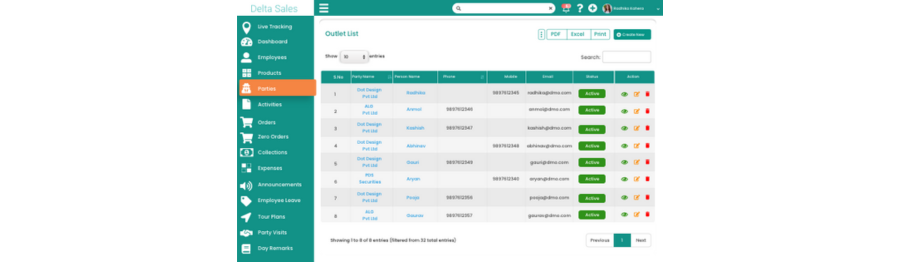
Core Functions of a DMS:
-
Centralized data management – One system for orders, stock, invoices, and compliance records.
-
Real-time inventory tracking – Monitor stock movement across all distribution points.
-
Automated compliance reporting – Maintain regulatory records with built-in audit trails.
-
End-to-end product traceability – Track each drug unit from manufacturer to patient.
Key Benefits of a DMS in Pharma Supply Chain Management
Implementing a Distribution Management System (DMS) can fundamentally transform pharmaceutical supply chains, driving efficiency, compliance, and growth across every stage of distribution. Let’s explore the key benefits in detail:
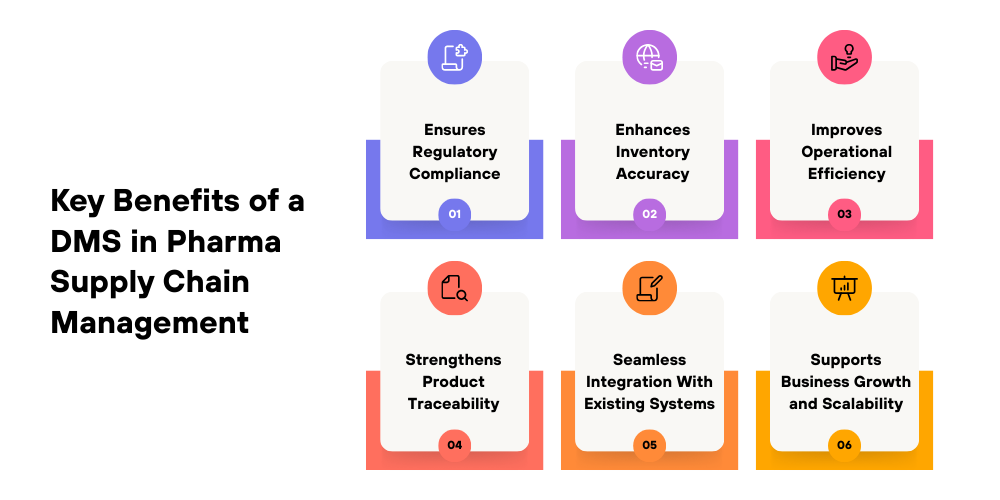
Ensures Regulatory Compliance
Pharmaceutical companies operate in a highly regulated environment, where even minor lapses can result in significant fines or legal consequences. A modern DMS ensures that every transaction is recorded digitally and traceable, simplifying compliance management.
-
Tracks product serialization and captures downstream sales data automatically.
-
Generates regulatory reports and audit-ready documentation with minimal manual effort.
-
Flags potential compliance issues in real-time, helping prevent violations before they occur.
Example: A DSCSA-compliant DMS logs each sale and transfer of drugs, enabling seamless adherence to regulatory requirements while protecting the company from penalties.
Enhances Inventory Accuracy
Maintaining precise inventory levels is critical in pharma, where stockouts or expired medicines can impact patient care and revenue. A DMS provides end-to-end visibility of stock across warehouses, distribution centers, and retail points.
-
Offers real-time inventory monitoring to prevent shortages and overstock situations.
-
Automates procurement processes based on consumption trends, reducing manual errors.
-
Helps forecast demand more accurately, ensuring the right stock reaches the right location at the right time.
Result: Better inventory control translates to fewer losses, optimized storage costs, and improved service levels for end consumers.
Improves Operational Efficiency
Manual processes like order entry, invoice generation, and distributor coordination are not only time-consuming but prone to errors. By automating these routine tasks, a DMS allows teams to focus on higher-value strategic initiatives.
-
Speeds up order processing and delivery cycles, reducing turnaround times.
-
Minimizes data entry mistakes, ensuring accurate records across the supply chain.
-
Provides real-time performance insights of distributors, aiding faster decision-making.
Efficiency gains free up resources for market expansion, product launches, and critical R&D activities.
Strengthens Product Traceability
Traceability is essential in pharma, particularly during product recalls or quality audits. A DMS keeps a digital record of each product’s journey, allowing companies to track every unit from manufacturing to point of sale.
-
Records batch numbers, manufacturing dates, and transit details across all nodes.
-
Enables rapid response to recalls, ensuring affected products are identified and removed quickly.
-
Helps fight counterfeit drugs and builds trust with regulators, distributors, and consumers.
By providing end-to-end visibility, a DMS ensures safety, transparency, and accountability throughout the supply chain.
Seamless Integration With Existing Systems
Modern pharma supply chains rely on multiple software platforms. A DMS is designed to integrate smoothly with ERP, CRM, and Warehouse Management Systems (WMS), creating a unified ecosystem.
-
Consolidates customer, product, and distributor data for a single source of truth.
-
Facilitates faster financial reconciliation and operational reporting.
-
Enhances forecasting and planning by connecting data across departments seamlessly.
Integrated systems reduce duplication, errors, and delays, allowing teams to focus on value-driven tasks.
Supports Business Growth and Scalability
As pharma businesses expand whether by adding new distributors, entering new markets, or launching additional SKUs—a scalable DMS ensures operations remain smooth without requiring costly reconfigurations.
-
Cloud-based DMS solutions allow easy addition of new users, locations, or product lines.
-
Centralized control simplifies management of global distribution networks.
-
Reduces infrastructure and maintenance costs while enabling rapid business expansion.
With the right DMS, pharma companies can scale confidently, streamline operations, and maintain high service levels regardless of growth pace.
Choosing the Right DMS: Key Considerations
Before choosing a DMS, pharma companies must evaluate several critical factors:

Conclusion: Building a Future-Ready Pharma Supply Chain
Modern pharmaceutical supply chains demand speed, accuracy, compliance, and transparency—requirements that traditional manual systems and disconnected distributor networks can no longer meet. Relying on outdated processes often leads to delays, errors, and regulatory risks, putting both businesses and patients at a disadvantage.
Implementing a robust DistÑributor Management System enables pharmaceutical companies to streamline operations, ensuring medicines are delivered safely and on time while maintaining complete regulatory compliance. It also enhances inventory management, reducing stockouts, overstock situations, and unnecessary costs.
Beyond efficiency and compliance, a DMS fosters better collaboration across sales and distribution teams, connecting every stakeholder in the supply chain. With real-time visibility and centralized control, businesses can make smarter decisions, respond quickly to challenges, and scale operations with confidence.
Book a Demo Today to transform your pharma supply chain with smarter, more effective distribution control.
Frequently Asked Questions (FAQs)
Q1: Is DMS mandatory for pharma companies?
Not legally required, but it is highly recommended as it simplifies compliance with regulations like DSCSA, reduces risks, and improves operational efficiency.
Q2: Can a DMS work with existing systems?
Yes. Most DMS platforms are designed with APIs and connectors that integrate with ERP, CRM, and WMS tools.
Q3: What’s the ROI on implementing a DMS?
Companies typically see ROI within 6–12 months through reduced errors, better stock control, fewer fines, and improved efficiency.
Q4: Is it suitable for small pharma companies?
Absolutely. Cloud-based DMS solutions offer scalable pricing and functionality to suit companies of all sizes.
Also Check,
👉Sales Distribution Strategies: How to Choose the Right Approach for Your Business?
👉Supply Chain Management Distribution: Key Strategies, Trends and Technologies
Pro Tip
Want to explore how Delta Sales App can empower your sales team?
This results in faster deliveries, better compliance, and improved collaboration across the sales and distribution network
Check out what users say about Delta Sales App through real reviews and experiences shared online.
⭐Delta Sales App on techjockey