
Order Management vs. Order Tracking: What’s the Difference
In today’s competitive sales environment, businesses cannot afford inefficiencies in their order management process or lack of visibility in order tracking systems. Both functions play a critical role in ensuring smooth operations, better customer experience, and improved revenue performance. However, many organizations still confuse the two, leading to operational gaps and missed opportunities.
This guide explains everything you need to know about order lifecycle management, differences between tracking and management, challenges, and how modern tools like field sales automation software help businesses unify both processes.
What is Order Management?
Order management refers to the end-to-end process of receiving, processing, fulfilling, and completing a customer order. It ensures that every order moves smoothly from placement to delivery.
It typically includes:
Order creation and entry
Capturing customer orders accurately in the system, ensuring correct product details, quantities, pricing, and customer information without manual errors. This step builds the foundation of an efficient order management system (OMS).
Inventory verification and allocation
Checking real-time stock availability and reserving required products to ensure smooth fulfillment and prevent stockouts or order delays. This improves accuracy in sales order management and reduces fulfillment failures.
Approval workflows and pricing validation
Ensuring orders pass through required approvals and pricing checks to maintain accuracy, compliance, and business rule consistency across sales teams. This is essential for a reliable order processing system.
Order fulfillment and dispatch
Coordinating warehouse picking, packing, and dispatch processes to ensure timely delivery and seamless execution of customer orders. Strong execution improves overall order fulfillment workflow efficiency.
Invoicing and payment processing
Generating accurate invoices, managing billing details, and tracking payment status to ensure smooth financial settlement of completed orders. This strengthens financial control within the order management platform.
A strong order management system (OMS) ensures accuracy, reduces manual errors, improves operational efficiency, and enhances overall order lifecycle management across sales operations.
What is Order Tracking?
Order tracking focuses on monitoring the status of an order after it has been dispatched. It provides real-time visibility into delivery progress and ensures transparency between businesses and customers.
It includes:
Live delivery status updates
Provides continuous updates on order movement from dispatch to delivery, ensuring customers and managers always have accurate real-time order tracking information.
GPS-based tracking of field executives
Uses location tracking technology to monitor delivery agents or sales representatives in real time, improving accountability and enabling efficient GPS tracking software usage.
Delivery confirmation and proof
Captures proof of delivery through signatures, images, or OTP verification, ensuring transparency and reducing disputes in delivery tracking system operations.
Delay notifications and alerts
Automatically sends alerts about delivery delays, route changes, or issues, helping businesses maintain communication and improve order visibility tool performance.
Modern order tracking software improves customer satisfaction by answering one key question: Where is my order right now?
Order Management vs Order Tracking: Core Differences
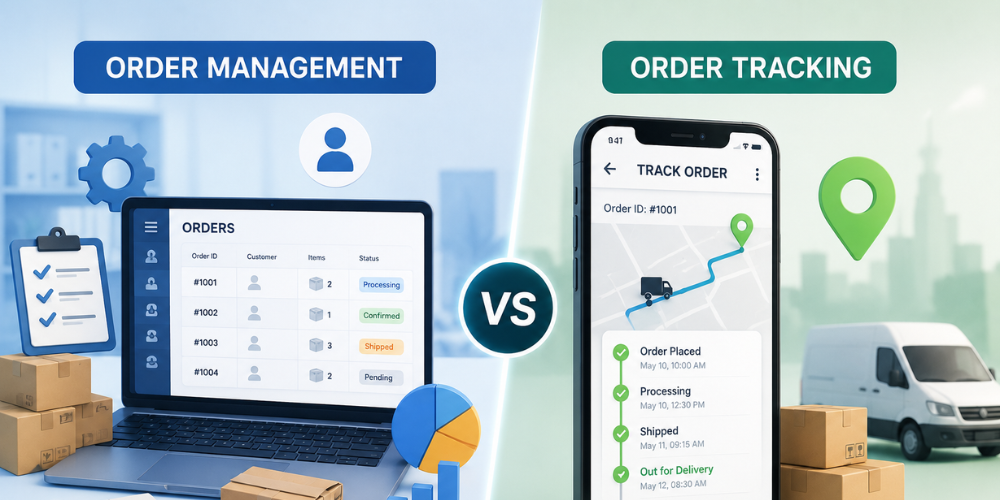
Order management and order tracking are two essential but distinct components of the overall order lifecycle management process. While both contribute to efficient sales operations, they operate at different stages and serve different purposes. Understanding these differences helps businesses improve efficiency, reduce errors, and enhance customer experience through better sales order management software and real-time order tracking systems.
Focus
- Order Management: Focuses on the entire order lifecycle from creation to fulfillment using an order processing system.
- Order Tracking: Focuses only on post-dispatch visibility through a delivery tracking system.
Purpose
- Order Management: Ensures accurate order processing, inventory control, and successful order fulfillment workflow.
- Order Tracking: Ensures transparency by providing real-time updates on delivery status and location.
Users
- Order Management: Used by sales teams, finance departments, and warehouse operations for internal coordination.
- Order Tracking: Used by customers, logistics teams, and managers for monitoring deliveries and service quality.
Tools
- Order Management: Managed through order management system (OMS) platforms integrated with CRM and inventory systems.
- Order Tracking: Powered by GPS tracking software and mobile-based tracking applications.
Value
- Order Management: Improves operational efficiency, accuracy, and speed of order processing across business functions.
- Order Tracking: Enhances transparency, customer trust, and satisfaction through real-time delivery visibility.
While sales order management software focuses on execution and backend operations, real-time delivery tracking systems ensure visibility, communication, and a better customer experience throughout the delivery journey.
Why Businesses Confuse Order Management and Tracking
Many businesses assume both are the same because they are part of a single customer journey. However, the confusion arises due to:
Lack of integrated sales automation tools
Businesses without field sales automation software or unified platforms struggle to connect order processing and delivery tracking, leading to duplicated efforts and unclear responsibilities.
Poor visibility across departments
When departments lack real-time data sharing, teams cannot differentiate between order management system (OMS) activities and real-time order tracking, causing operational confusion.
Manual reporting systems
Relying on spreadsheets and manual updates reduces accuracy and delays insights, making it difficult to distinguish between order processing system execution and delivery status monitoring.
Fragmented CRM and logistics systems
Disconnected CRM and logistics tools prevent seamless communication, breaking the flow between sales order management software and delivery tracking system functions across teams.
This often results in inefficient order lifecycle management, reduced operational clarity, and delayed decision-making across sales, warehouse, and customer service operations.
The Hidden Cost of Poor Order Visibility
Poor order visibility management creates operational inefficiencies that directly impact revenue, customer satisfaction, and overall business performance across the entire order lifecycle management process.
Delayed order fulfillment
Lack of real-time updates in order processing system leads to slower coordination between sales, warehouse, and delivery teams, causing significant delays in fulfilling customer orders.
Incorrect inventory updates
Without accurate inventory management system synchronization, stock levels become outdated, resulting in overselling, stockouts, and poor alignment between demand and actual product availability.
Customer dissatisfaction
Poor transparency in real-time order tracking increases customer uncertainty, leading to frustration, reduced trust, and lower repeat purchase rates in competitive markets.
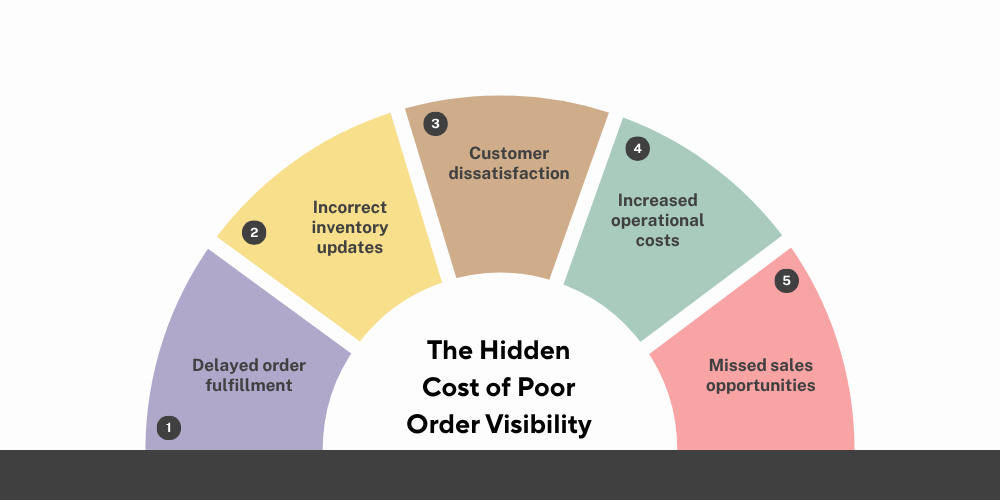
Increased operational costs
Inefficient sales order management software processes create manual rework, communication gaps, and redundant tasks, ultimately increasing overall operational expenses and reducing profit margins.
Missed sales opportunities
Without proper order management system (OMS) visibility, businesses fail to identify demand trends, leading to lost upselling opportunities and weakened sales pipeline performance.
Without a proper order management platform, businesses struggle to maintain control over their sales pipeline, resulting in reduced efficiency, visibility gaps, and weaker business growth outcomes.
How Order Management Impacts Sales Performance
A strong sales order processing system directly improves business performance by strengthening accuracy, efficiency, and overall operational control across the entire order lifecycle management process.
Reducing order errors
A reliable order management system (OMS) minimizes manual entry mistakes, incorrect pricing, and duplication issues, ensuring accurate order processing and improved customer satisfaction consistently.
Improving inventory accuracy
Integrated inventory management system updates stock levels in real time, helping businesses avoid stockouts, overstocking, and mismatches between actual availability and customer demand.
Speeding up fulfillment cycles
Efficient order fulfillment workflow automation accelerates order processing, warehouse coordination, and dispatch activities, resulting in faster deliveries and improved customer experience overall.
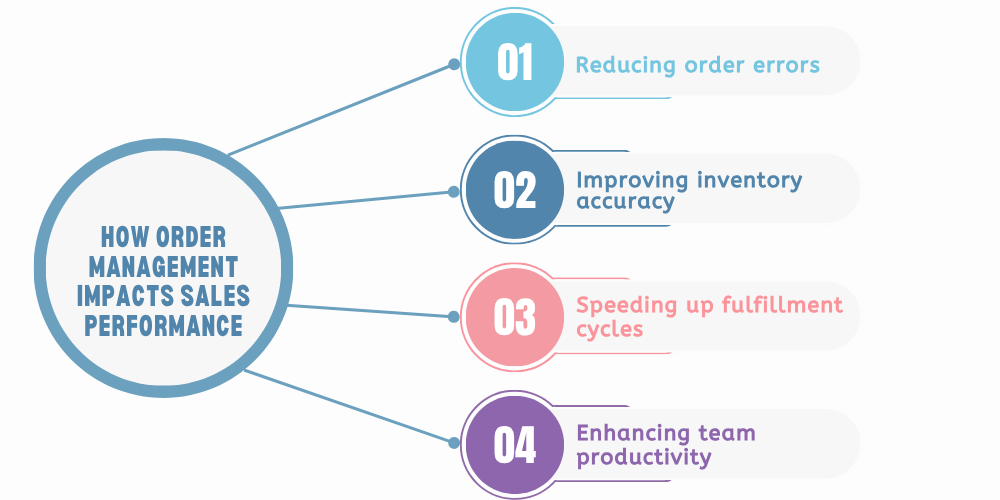
Enhancing team productivity
A structured sales order management software reduces manual tasks, allowing sales and operations teams to focus more on selling, customer engagement, and revenue generation.
Efficient order workflow automation ensures sales teams focus more on selling rather than manual coordination.
How Order Tracking Improves Customer Experience
A reliable order tracking solution plays a crucial role in improving customer satisfaction by offering transparency, communication, and real-time visibility throughout the delivery process. In modern delivery tracking systems, customers expect instant updates and accurate information at every stage of their order journey.
When businesses implement strong real-time order tracking, they not only improve operational efficiency but also build long-term trust and loyalty among customers.
Real-time delivery updates
Provides continuous updates on order movement, helping customers stay informed about their delivery status through a reliable real-time order tracking system.
Increased transparency
Offers clear visibility into order progress, reducing uncertainty and improving trust in the overall order tracking software experience.
Reduced customer support queries
Minimizes repeated customer inquiries by providing automated updates through mobile order tracking apps, reducing workload on support teams.
Better trust and retention
Builds customer confidence through consistent communication and reliable delivery tracking system performance, encouraging repeat purchases and long-term loyalty.
Customers today expect instant updates through mobile order tracking apps and real-time notifications, making order visibility tools essential for modern businesses aiming to deliver superior customer experience.
Benefits of Integrating Order Management and Tracking
Integrating order management system (OMS) and order tracking software into a single unified platform significantly improves operational efficiency, customer satisfaction, and overall business performance. When businesses combine order processing systems with real-time order tracking, they achieve complete visibility across the entire order lifecycle management process.
This integration eliminates silos between sales, warehouse, and delivery teams, ensuring smoother coordination and faster execution across all functions.
End-to-end order lifecycle visibility
Provides complete visibility from order creation to delivery completion using a unified sales order management software and tracking system.
Reduced communication gaps
Eliminates delays and misunderstandings between teams by syncing order fulfillment workflows with real-time delivery updates and notifications.
Faster decision-making
Enables managers to take quick actions using accurate data from real-time order tracking systems, improving responsiveness and operational control.
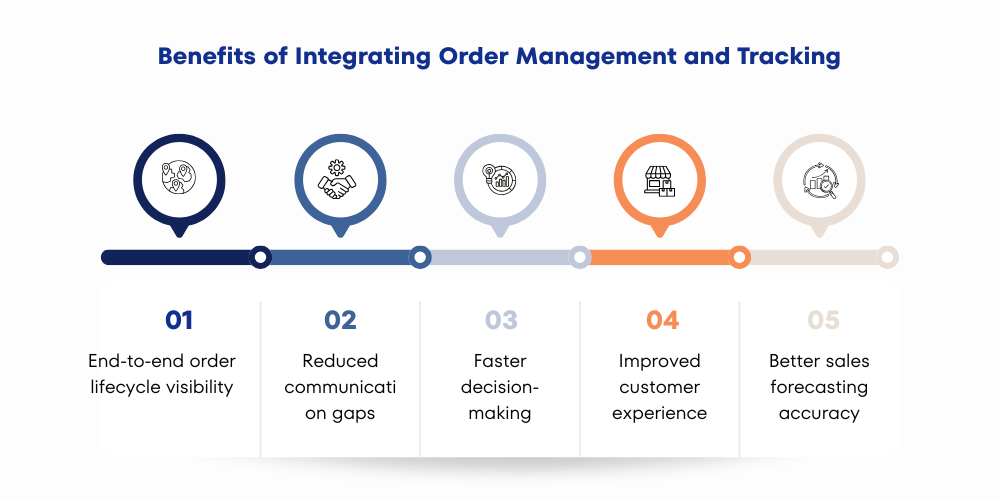
Improved customer experience
Enhances customer satisfaction by combining transparent updates from delivery tracking systems with accurate order processing and fulfillment information.
Better sales forecasting accuracy
Helps businesses analyze order trends and delivery performance using integrated order management platforms, improving demand planning and forecasting efficiency.
Integration ensures a seamless flow between order capture systems and delivery tracking platforms, enabling businesses to improve efficiency, reduce errors, and strengthen customer trust across the entire sales process.
Role of Field Sales Automation in Order Handling
Field sales automation software bridges the gap between order management system (OMS) and order tracking software by enabling real-time data capture, improved coordination, and seamless order lifecycle execution from field to backend systems.
Capture orders instantly from the field
Field sales automation enables sales representatives to record customer orders in real time using mobile apps, ensuring accurate sales order management software updates without manual entry delays or errors.
Track sales rep activity in real time
Managers can monitor field team movements, visits, and productivity instantly through GPS tracking software, improving accountability and enhancing overall field sales execution efficiency across territories.
Sync inventory and order data
Automatic synchronization between field inputs and backend systems ensures accurate stock visibility through inventory management systems, preventing stock mismatches and improving order processing system efficiency.
Improve reporting accuracy
Automated data capture reduces manual reporting errors and ensures reliable insights through real-time order tracking systems, helping businesses make better decisions using accurate sales performance data.
This is especially important for FMCG sales automation, retail distribution management, and field force tracking systems.
Real Business Challenges Solved by Integrated Systems
Integrated sales force automation platforms and field sales automation software help businesses eliminate operational inefficiencies by connecting order management systems (OMS) with real-time order tracking systems. This creates a unified workflow across sales, operations, and logistics teams.
Manual order entry errors
Automated sales order management software removes dependency on manual input, reducing data duplication, pricing mistakes, and incorrect order entries across the order processing system.
Lack of field visibility
GPS-enabled field sales tracking software provides real-time visibility into sales representative activities, ensuring managers can monitor visits, performance, and territory coverage accurately.
Delayed reporting
Real-time data sync eliminates delays in reporting by automatically updating dashboards through order lifecycle management systems, enabling faster and more informed decision-making.
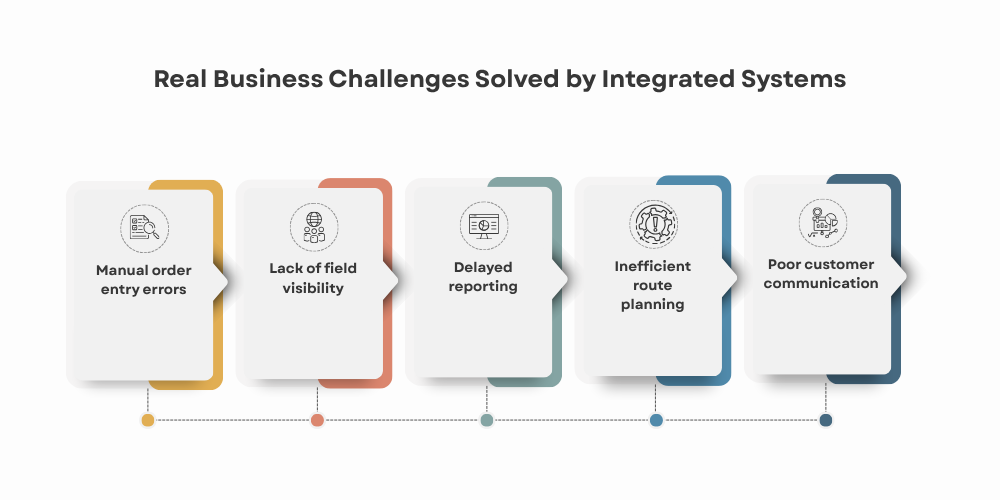
Inefficient route planning
Smart route optimization tools help sales teams plan efficient travel paths, reducing fuel costs, saving time, and increasing daily customer visit productivity.
Poor customer communication
Integrated delivery tracking systems improve communication by providing real-time order updates, reducing customer uncertainty and enhancing trust throughout the sales journey.
These systems significantly improve overall field sales execution efficiency, strengthen operational control, and ensure seamless coordination between field teams and backend operations.
How Delta Sales App Streamlines Order Management & Tracking
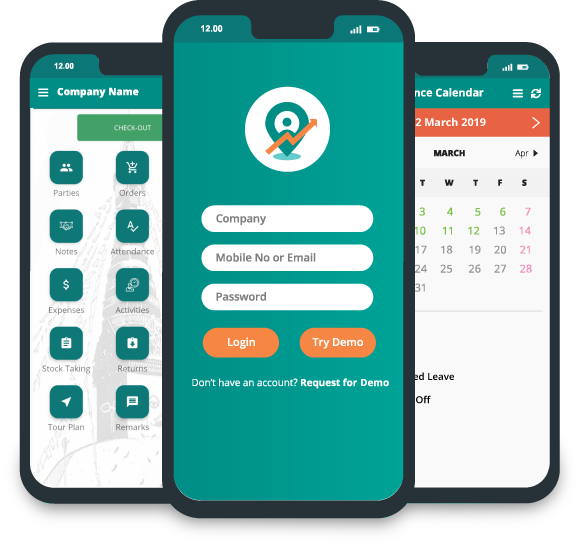
Delta Sales App is an advanced field sales management software that integrates order management system (OMS) capabilities with real-time order tracking software to deliver complete visibility and control over field operations.
It eliminates disconnected processes by unifying sales, inventory, and field execution into a single digital ecosystem, improving efficiency and decision-making across teams.
Capture orders in real time from field teams
Enables sales representatives to place orders instantly using mobile devices, ensuring accurate sales order management software updates without delays or manual entry errors.
Track sales representatives using GPS location tracking
Provides live monitoring of field staff using GPS tracking software, improving accountability, route compliance, and visibility into daily sales activities.
Manage inventory and customer data centrally
Centralized inventory management system and CRM integration ensure real-time updates of stock levels and customer information for accurate and efficient order processing.
Monitor order status across the entire lifecycle
Offers complete order lifecycle management, allowing managers to track orders from placement to delivery using a unified dashboard and real-time updates.
Generate automated sales reports and analytics
Provides instant insights through sales analytics software, helping businesses evaluate performance, identify trends, and improve forecasting accuracy with minimal manual effort.
By combining sales tracking software, order management system, and field force automation tools, Delta Sales App ensures complete operational visibility, improved productivity, and stronger control over field sales execution.

Key Features to Look for in a Modern Order System
When selecting an order management and tracking system, businesses should evaluate core capabilities that ensure efficiency, scalability, and complete order lifecycle management across field and backend operations.
A strong system should combine sales order management software, real-time order tracking software, and field sales automation tools to deliver end-to-end visibility and control.
Real-time order synchronization
Ensures instant updates across all departments, improving accuracy in order processing systems and eliminating delays between field teams and backend operations.
Mobile-based order entry system
Allows field sales representatives to capture orders on mobile devices, improving speed, reducing errors, and enhancing sales order management software efficiency.
GPS-enabled field tracking
Provides live location monitoring of sales teams using GPS tracking software, improving accountability, route optimization, and field execution visibility.
Integrated CRM and inventory management
Combines customer data and stock visibility in one platform, ensuring better coordination between inventory management systems and sales operations.
Automated reporting dashboards
Delivers real-time insights through sales analytics software, helping managers track performance, monitor KPIs, and improve decision-making efficiency.
Offline data capture capability
Allows sales representatives to record orders without internet access, ensuring uninterrupted field sales automation software functionality in remote locations.
Conclusion
Understanding the difference between order management and order tracking is crucial for building an efficient and scalable sales operation. While order management ensures smooth execution of orders, tracking provides transparency and improves customer trust.
When combined, both systems create a powerful ecosystem that enhances productivity, reduces errors, and improves overall business performance.
To truly unlock the benefits of integrated order lifecycle management, businesses need a unified platform that connects field teams, managers, and customers in real time.
Book a free demo today with Delta Sales App and streamline your order management, improve tracking visibility, and boost your sales performance with a powerful field sales automation solution.