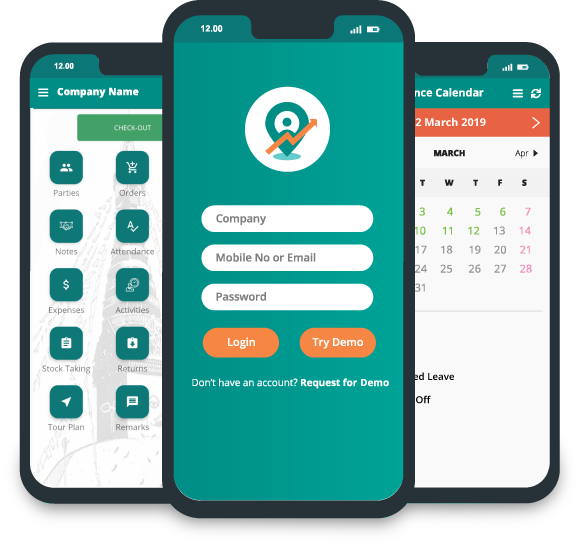

How to Replace WhatsApp Reporting with Automated Field Sales Reports

Many businesses across South Asia and the Middle East still depend on WhatsApp for daily sales reporting. While it offers quick communication and ease of use, it was never designed to handle structured business operations. As a result, companies often face hidden inefficiencies that directly affect decision-making, productivity, and long-term growth. Messages get lost in chats, data remains unorganized, and tracking performance becomes increasingly difficult as teams scale.
Without a structured system, businesses struggle with real-time reporting, delayed visibility into field activities, and a clear lack of accountability. Managers are forced to rely on incomplete or inconsistent information, which slows down strategic decisions and impacts overall execution. This is where field sales reporting automation becomes critical. By replacing scattered communication with a centralized and data-driven approach, businesses can streamline reporting, improve accuracy, and gain actionable insights that drive smarter decisions and sustainable growth.
Why WhatsApp Fails for Field Sales Reporting
WhatsApp is not designed for professional reporting systems. It lacks the structure required for managing field sales operations effectively, especially for growing and distributed teams.
Key issues include:
No centralized data storage
All reports are scattered across chats, making it difficult to store, retrieve, and analyze data efficiently. This leads to confusion, duplication, and loss of critical business information.
Difficulty tracking field sales activities
Tracking daily visits, tasks, and updates becomes challenging without structured logs. Managers cannot monitor field sales tracking effectively, leading to reduced visibility and poor performance evaluation.
Lack of standard reporting formats
Sales reps share updates in different formats, causing inconsistency. This makes it difficult to compare data, generate reports, and maintain uniformity across the entire sales team.
No integration with order management or CRM systems
WhatsApp operates in isolation and cannot connect with business systems like order management or CRM. This results in manual work, delays, and disconnected workflows.
As teams grow, these limitations significantly reduce operational efficiency, making it essential to adopt field sales reporting automation for better control and scalability.
What is Field Sales Reporting Automation?
Field sales reporting automation refers to the use of digital tools and systems to capture, track, and analyze sales activities in real time. It replaces manual reporting methods with structured, technology-driven processes.
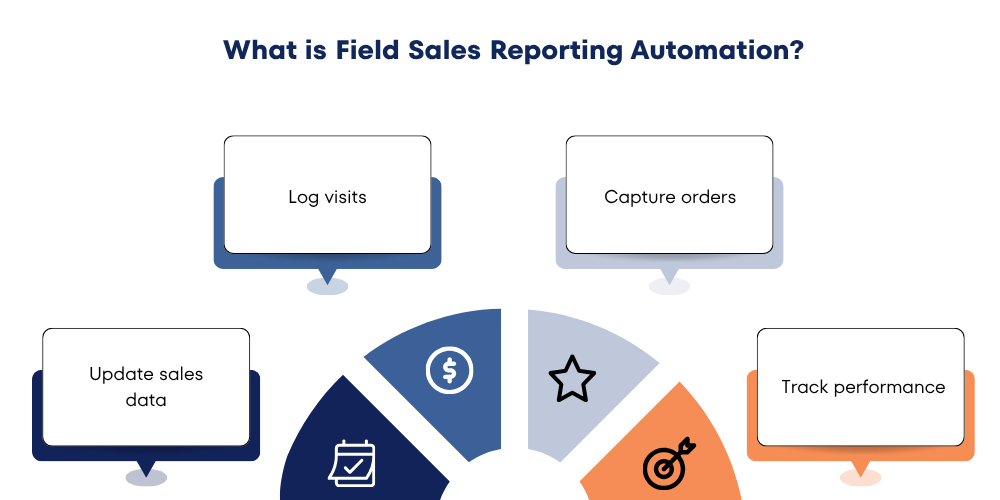
Instead of relying on WhatsApp messages or spreadsheets, sales representatives use a mobile sales app to:
- Log visits
Record customer visits instantly with time, location, and activity details, ensuring accurate tracking and complete visibility into daily field operations. - Update sales data
Input sales updates in real time, eliminating delays and ensuring that managers always have access to the latest and most accurate information. - Capture orders
Place orders directly during visits using integrated order management, reducing manual errors and improving order processing speed and customer satisfaction. - Track performance
Monitor individual and team productivity through sales performance tracking, helping managers evaluate efficiency, identify gaps, and optimize sales strategies.
This approach ensures accurate, consistent, and actionable data across the organization, enabling better decision-making, improved sales team efficiency, and stronger overall execution.
Traditional Reporting vs Automated Reporting
Understanding the difference between manual and automated systems is crucial for businesses aiming to improve efficiency through field sales reporting automation.
Manual Reporting
- WhatsApp messages and spreadsheets
Sales data is shared through chats or spreadsheets, making it unstructured, difficult to manage, and prone to miscommunication across teams. - Delayed updates
Information is often shared late, preventing managers from accessing real-time reporting and slowing down decision-making and response time. - High chances of errors
Manual data entry increases the risk of mistakes, duplication, and inaccurate reporting, which directly impacts planning and execution. - Limited visibility
Managers lack clear insights into field sales tracking, making it difficult to monitor team performance and ensure accountability.
-1775986894.png)
Automated Reporting
- Real-time updates via field force automation tools
Sales activities are updated instantly using field force automation, ensuring accurate and up-to-date information for faster decision-making. - Centralized dashboards
All data is stored in one place, providing a unified view of operations and simplifying analysis and reporting. - Accurate data capture
Automated systems reduce manual errors and ensure consistent, reliable data across all reporting activities. - Instant insights
With built-in sales performance tracking, managers can quickly analyze trends, identify gaps, and optimize strategies.
Key Limitations of Manual Reporting Systems
Manual reporting creates multiple operational bottlenecks that directly impact efficiency, accuracy, and decision-making. Without structured systems, businesses struggle to scale and maintain control over field operations..
- Lack of real-time reporting
Sales data is updated late, preventing managers from accessing real-time reporting, which delays decisions and reduces the ability to respond quickly to market changes. - Inconsistent data formats
Different sales reps share updates in varying formats, making it difficult to standardize reports, compare performance, and maintain consistency across teams. - Poor visibility into sales activities
Managers lack clear insights into daily operations, making field sales tracking ineffective and limiting their ability to monitor productivity and execution. - Difficulty in sales performance tracking
Without structured systems, analyzing KPIs becomes challenging, affecting accurate sales performance tracking and hindering data-driven decision-making. - Inefficient coordination between teams
Lack of centralized data leads to miscommunication between sales, management, and operations, reducing collaboration and slowing down workflows.
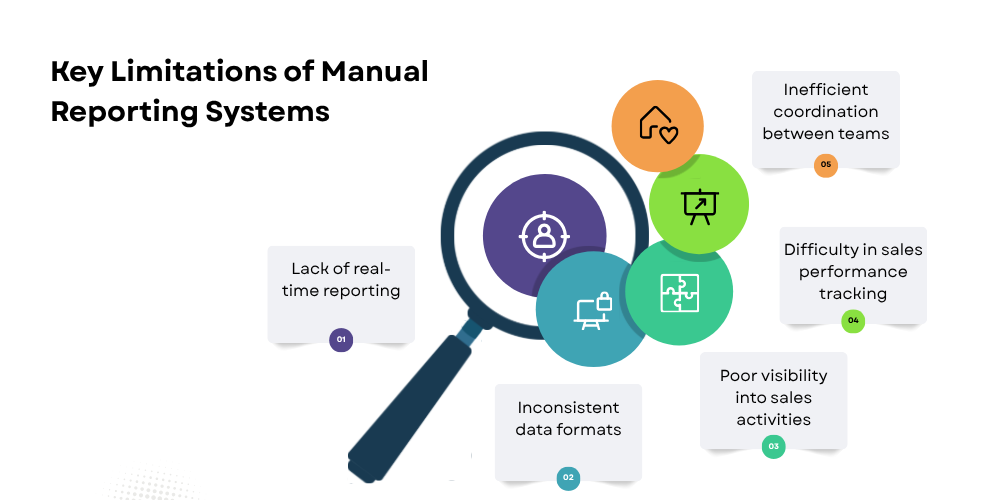
These issues slow down growth, reduce overall productivity, and highlight the need for field sales reporting automation.
Signs Your Sales Team Has Outgrown WhatsApp Reporting
If your business is experiencing the following challenges, it’s a clear signal that it’s time to upgrade to field sales reporting automation and adopt a more structured approach.
- Increasing team size with no structured reporting
As your sales team grows, managing reports through WhatsApp becomes chaotic, leading to disorganized data and lack of control over daily operations. - Difficulty tracking daily field activities
Without proper systems, monitoring visits, tasks, and updates becomes inefficient, making field sales tracking unreliable and reducing overall visibility. - Delayed decision-making due to scattered data
Information spread across chats slows down analysis, preventing managers from accessing real-time reporting and making timely, informed decisions. - Lack of transparency in performance
Managers struggle to evaluate team productivity due to absence of proper sales performance tracking, leading to unclear accountability and inconsistent results. - Growing dependency on manual follow-ups
Excessive manual coordination increases workload, delays execution, and reduces efficiency, especially when managing large and distributed field teams.
These are strong indicators that your business needs field sales reporting automation to improve efficiency, visibility, and scalability.
Key Features of Automated Field Sales Reporting Systems
A modern system offers powerful capabilities that help businesses streamline operations, improve visibility, and enhance execution through field sales reporting automation.
- Real-time field sales tracking
Track sales activities instantly with accurate location and time data, enabling managers to monitor field operations and ensure better accountability across teams. - Automated data capture via mobile sales app
Sales reps can update information directly using a mobile sales app, eliminating manual effort and ensuring consistent, error-free reporting across all activities. - Built-in sales performance tracking dashboards
Access detailed insights through sales performance tracking dashboards, helping managers evaluate KPIs, identify gaps, and make data-driven decisions. - Integration with order management systems
Seamless integration with order management ensures faster order processing, reduces delays, and improves coordination between sales and operations teams. - Seamless distributor management
With integrated distributor management, businesses can streamline communication, track supply flow, and improve coordination between field teams and distributors. - GPS-based tracking and visit verification
Verify field visits using GPS tracking, ensuring accurate reporting, improved transparency, and better control over field team activities.
Benefits of Field Sales Reporting Automation
Adopting field sales reporting automation delivers measurable advantages that directly impact productivity, visibility, and decision-making across sales operations.
- Improved sales team efficiency
Automation reduces manual tasks, enabling sales reps to focus on selling activities while improving sales team efficiency and increasing daily productivity across field operations. - Faster decision-making with real-time insights
Access to automated reports and analytics helps managers make quicker, data-driven decisions, reducing delays and improving responsiveness to market changes and field-level challenges. - Reduced manual errors
Automated data capture minimizes human errors, ensuring accurate and consistent reporting, which improves reliability of insights and strengthens overall sales performance tracking. - Better accountability and transparency
With structured reporting and field sales tracking, businesses gain complete visibility into team activities, ensuring higher accountability and improved transparency across operations. - Enhanced coordination across teams
Integration with CRM and order management systems improves communication between sales, operations, and distribution teams, leading to smoother workflows and better execution.
Step-by-Step Guide to Transition from WhatsApp to Automation
Transitioning to field sales reporting automation requires a structured approach to ensure smooth adoption and long-term success.
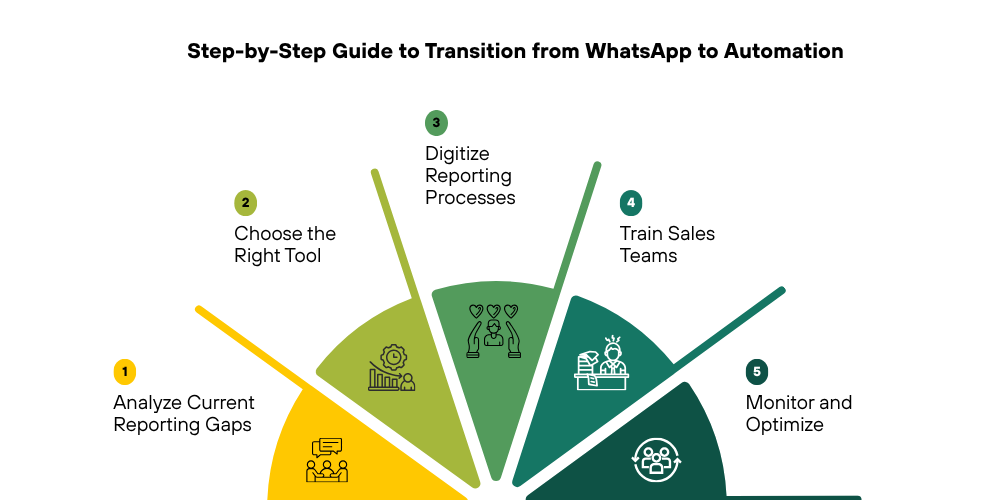
- Step 1: Analyze Current Reporting Gaps
Evaluate your existing reporting system to identify inefficiencies, data gaps, and delays in field sales tracking, helping you understand areas that need immediate improvement. - Step 2: Choose the Right Tool
Select a reliable field force automation solution that supports real-time reporting, integrates with CRM and order management, and scales with your business needs. - Step 3: Digitize Reporting Processes
Replace manual updates with structured digital formats using a mobile sales app, ensuring standardized data capture and consistent reporting across all field activities. - Step 4: Train Sales Teams
Provide proper training to ensure your team understands how to use the field sales app effectively, improving adoption rates and minimizing resistance to change. - Step 5: Monitor and Optimize
Continuously track performance using sales performance tracking dashboards, identify gaps, and optimize workflows to maximize efficiency and ROI.
Role of Mobile Sales Apps in Reporting Automation
A mobile sales app acts as the backbone of field sales reporting automation, enabling seamless data flow, real-time updates, and efficient field operations.
- On-the-go reporting
Sales reps can instantly update visits, orders, and activities from the field using a mobile sales app, ensuring timely and accurate field sales reporting. - Instant data synchronization
All data is synced in real time with centralized systems, enabling real-time reporting and eliminating delays caused by manual data consolidation. - Real-time communication
Managers and field teams stay connected through instant updates, improving coordination, faster decision-making, and better execution of sales strategies. - Seamless field sales tracking
Track location, visits, and activities with field sales tracking, ensuring complete visibility, accountability, and improved monitoring of on-ground performance.
Real-Time Visibility & Sales Performance Tracking
With field sales reporting automation, managers gain complete visibility into operations, enabling faster, data-driven decisions and improved execution across field teams.
- Monitor team activities in real time
Track on-ground activities using field sales tracking, allowing managers to view visits, routes, and task completion instantly without relying on delayed manual updates. - Track KPIs through sales performance tracking
Use advanced sales performance tracking dashboards to monitor key metrics like target achievement, productivity, and conversion rates across teams and regions. - Identify gaps and opportunities instantly
Real-time insights help identify performance gaps, missed opportunities, and inefficiencies, enabling quick corrective actions and continuous improvement in sales execution.
How Automation Improves Sales Team Efficiency
Automation eliminates repetitive tasks and streamlines operations.
Benefits include:
Reduced manual workload
Automation removes the need for manual data entry and follow-ups, enabling sales reps to save time and focus more on core selling activities.
Optimized daily schedules
With smart planning and field sales tracking, reps can manage routes efficiently, reduce travel time, and increase the number of productive daily visits.
Faster reporting processes
Using a mobile sales app, sales teams can submit reports instantly, ensuring real-time reporting and eliminating delays associated with traditional methods.
Improved focus on selling activities
By automating administrative tasks, sales reps can dedicate more time to customer interactions, relationship building, and closing deals.
Integration with CRM, Order & Distributor Management
Modern systems integrate seamlessly with business tools:
- CRM platforms for customer data
Integrating with CRM systems centralizes customer information, helping sales teams access history, preferences, and interactions to improve engagement and decision-making. - Order management systems for faster processing
Connection with order management systems ensures quick order placement, real-time tracking, and reduced processing delays, improving accuracy and customer satisfaction. - Distributor management for better supply coordination
With integrated distributor management, businesses can streamline inventory flow, track distributor performance, and ensure efficient coordination between sales and supply chain teams.
This integration creates a unified ecosystem, enhancing real-time reporting, visibility, and end-to-end sales execution.
ROI of Field Sales Reporting Automation
Investing in field sales automation delivers strong ROI:
- Reduced operational costs
Automation minimizes manual work, paperwork, and errors, helping businesses cut down administrative expenses and improve overall cost efficiency in field operations. - Increased sales productivity
With streamlined workflows and real-time reporting, sales teams can complete more visits, close deals faster, and significantly boost overall productivity. - Better resource utilization
Efficient planning and field sales tracking ensure optimal use of time, workforce, and resources, reducing wastage and improving operational effectiveness. - Higher revenue through improved execution
Better visibility and faster decision-making enable stronger execution, leading to increased conversions, improved sales performance, and higher revenue generation.
Businesses quickly recover investment through efficiency gains.
Common Challenges During Transition & How to Solve Them
Challenges
- Resistance to change
Sales teams may hesitate to adopt new systems, especially when they are comfortable with existing tools like WhatsApp or manual reporting methods. - Lack of training
Insufficient training can lead to poor adoption of the mobile sales app, reducing the effectiveness of the automation system. - Data migration issues
Transferring data from manual or unstructured sources to a new system can create inconsistencies, errors, or data loss if not handled properly.
Solutions
- Provide proper onboarding and training
Conduct structured training sessions to help teams understand the benefits of field sales automation and ensure smooth adoption. - Start with pilot implementation
Begin with a small team or region to test the system, identify gaps, and optimize processes before full-scale deployment. - Use user-friendly mobile sales app solutions
Choose an intuitive mobile sales app that simplifies usage, reduces learning curves, and encourages faster adoption among field teams.
Addressing these challenges ensures a smoother transition, higher adoption rates, and successful implementation of automation.
Best Practices for Successful Implementation
To maximize results:
- Standardize reporting formats
Define uniform formats for field sales reporting to ensure consistency, accuracy, and easy analysis across teams, regions, and sales activities. - Use automation tools effectively
Leverage field force automation tools to their full potential, including real-time reporting, dashboards, and integrations for improved operational efficiency. - Regularly monitor performance
Track KPIs using field sales team performance systems to identify gaps, measure success, and make data-driven decisions for continuous improvement. - Continuously train teams
Provide ongoing training on the mobile sales app to ensure teams stay updated, confident, and capable of using the system effectively. - Optimize workflows using real-time insights
Use real-time insights to refine processes, improve execution, and enhance productivity across the entire sales cycle.
Consistency in execution is key to achieving long-term success and scalability.
How Delta Sales App Enables Smart Field Sales Reporting Automation
Modern businesses need more than just basic tools, they need a complete system that can streamline reporting, improve visibility, and drive execution. This is where Delta Sales App plays a crucial role in enabling field sales reporting automation.
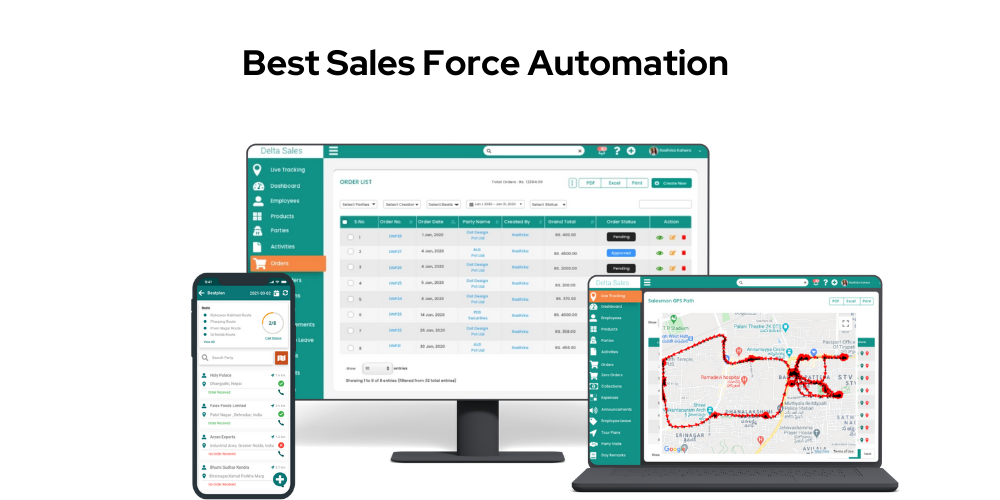
By replacing fragmented tools like WhatsApp with a unified mobile sales app, businesses can transform their reporting process into a structured, real-time, and data-driven system.
Key Capabilities of Delta Sales App
1. Real-Time Field Sales Tracking
With built-in field sales tracking app, managers can monitor sales activities as they happen. Every visit, update, and task is recorded instantly, ensuring complete transparency and accountability.
2. Automated Reporting via Mobile Sales App
Sales representatives can update their activities directly through the mobile sales app, eliminating manual reporting. This ensures accurate data capture and consistent reporting formats across the team.
3. Integrated Order Management
Using integrated order management, sales reps can place orders during field visits. This reduces delays, improves order accuracy, and enhances customer satisfaction.
4. Seamless Distributor Management
The platform enables smooth coordination with distributors through distributor management software, ensuring faster order processing and better supply chain visibility.
5. Advanced Sales Performance Tracking
With powerful dashboards and analytics, businesses can track KPIs using sales performance tracking tools. Managers can identify gaps, measure productivity, and make informed decisions.
6. Smart Automation & Workflow Optimization
As a complete field force automation solution, Delta Sales App automates repetitive tasks, optimizes workflows, and ensures efficient execution of sales plans.
Business Impact of Using Delta Sales App
Implementing field sales reporting automation with Delta Sales App leads to:
- Improved sales team efficiency
- Faster and more accurate reporting
- Enhanced real-time visibility across operations
- Better decision-making with actionable insights
- Stronger coordination between field teams and back office
Future of Field Sales Reporting Automation
The future of sales automation is being shaped by advanced technologies that enable smarter, faster, and more predictive decision-making.

- AI-powered reporting
Artificial Intelligence will automate data analysis, generate intelligent insights, and reduce manual intervention, making field sales reporting more accurate and efficient. - Predictive analytics
With predictive models, businesses can forecast sales trends, identify opportunities, and proactively address challenges using advanced sales tracker app. - Advanced field force automation tools
Next-gen field force automation tools will offer deeper integrations, enhanced customization, and smarter workflows to streamline complex sales operations. - Smarter mobile solutions
Modern mobile sales apps will become more intuitive, enabling faster data entry, offline capabilities, and seamless real-time reporting from any location.
Businesses that embrace these innovations will gain a competitive edge, improve agility, and drive long-term growth in an increasingly dynamic market.
Conclusion
Replacing WhatsApp with field sales reporting automation is no longer optional, it is a strategic necessity for modern businesses.
By adopting structured reporting systems, companies can improve visibility, enhance execution, and drive consistent growth. Automation not only simplifies operations but also empowers teams with real-time insights and better decision-making capabilities.
To transform your reporting process and boost sales performance, it’s time to switch to a smarter solution.
Book a demo of Delta Sales App today and experience the power of automated field sales reporting.