
What Sales Apps Really Save: Time, Costs, or Both?

Every Hour Your Sales Team Spends on Admin Work Is Money Lost. Your sales representatives were hired to sell, not spend hours writing reports, searching for customer information, planning routes, or calling managers for updates.
That's why more businesses are investing in a sales app. While many companies initially adopt a sales app to digitize their field operations, they soon realize that its biggest advantage goes far beyond replacing paper-based processes. A modern field sales app helps businesses streamline daily operations, automate repetitive tasks, improve communication, and give managers complete visibility into their sales teams in real time.
But one question often comes up before making the investment: What does a sales app actually save? Is it time, operational costs, or both?
The answer is both, and the two are closely connected. When sales representatives spend less time on manual work, they can visit more customers, close more deals, and improve productivity. At the same time, businesses reduce fuel expenses, administrative work, reporting delays, order errors, and overall operational costs.
In this blog, we'll explore how a sales app saves valuable time, reduces business costs, and helps companies achieve better sales performance while making field operations more efficient.
What Is a Sales App?
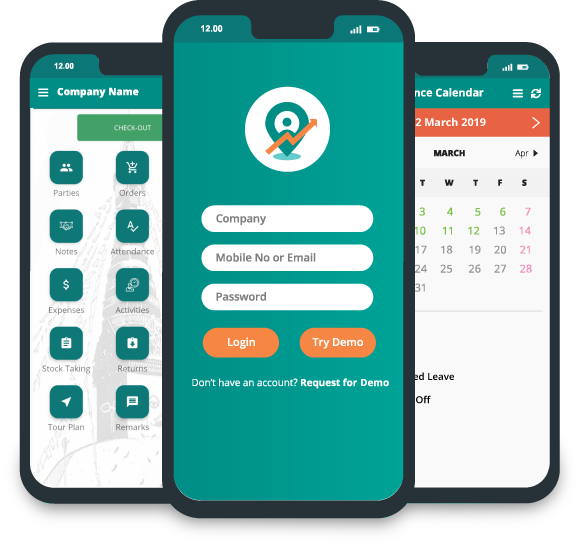
A sales app is a mobile application designed to simplify and automate field sales operations. It allows sales representatives to manage customer visits, collect orders, update activities, record payments, and access customer information directly from their smartphones.
Instead of relying on spreadsheets, WhatsApp messages, phone calls, and paper reports, everything is managed from one centralized platform.
For managers, the app provides complete visibility into field activities, helping them monitor performance without waiting for end-of-day updates.
Some of the key features of a sales app include:
- Customer Visit Management
- Order Management
- Beat Planning and Route Optimization
- GPS Employee Tracking
- Attendance and Leave Management
- Payment Collection
- Expense Management
By combining these capabilities into a single platform, a sales app reduces repetitive manual work, supports collaboration between field and office teams, decreases errors, and allows businesses to operate more efficiently. Sales reps spend less time doing admin and more time doing what they do best: meeting customers, generating orders, and driving growth.
Why Saving Time Matters More Than Ever
In field sales, time is money. Every minute a sales rep spends on admin is a minute they are not spending with customers, generating orders or looking for new business. These seemingly small tasks, preparing reports, updating spreadsheets, making follow-up calls, add up quickly and take away from the overall productivity of the sales team.
If you have a lot of field reps on your payroll, these lost hours can accumulate. A team of 20 reps, spending only 2-3 hours each day on manual tasks, could be losing more than 40-60 hours of productive selling every day. That’s thousands of hours per month, or years, that could have been spent increasing sales and building customer relationships.
Some of the most common time-consuming activities include:
- Preparing manual daily sales reports (DSR)
- Recording customer visit details
- Creating orders on paper and entering them later
- Planning daily routes and beat plans
- Calling managers for updates or approvals
- Searching for customer history and previous orders
- Tracking pending payments manually
- Updating spreadsheets and duplicate records
- Coordinating with distributors over phone calls
- Correcting order entry mistakes
These repetitive tasks not only consume valuable selling time but also increase the chances of errors, delays, and miscommunication.
How a Sales App Saves Time
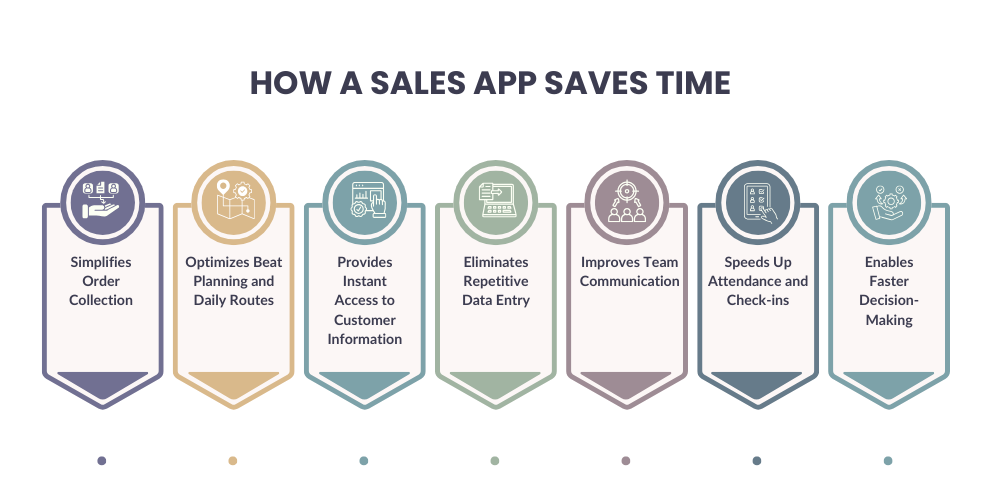
One of the biggest advantages of implementing a sales app is the amount of time it saves across every stage of the sales cycle. From planning the day's customer visits to submitting reports at the end of the day, a sales app automates repetitive tasks that would otherwise consume hours of a sales representative's time. By reducing manual work and streamlining daily operations, sales teams can focus more on selling, serving customers, and achieving their targets.
-
Automates Daily Sales Reporting
Preparing end-of-day (EOD) reports manually is one of the most time-consuming tasks for field sales representatives. They often have to recall customer visits, list orders, update payment details, and summarize their activities before submitting reports to managers. With a sales app, every activity is recorded automatically as it happens. Customer visits, orders, payments, attendance, and follow-ups are logged in real time, allowing daily reports to be generated instantly. This eliminates manual reporting and gives managers immediate access to accurate field data.
-
Simplifies Order Collection
Manual order booking often involves writing orders on paper or sending them through calls or messaging apps, which can lead to delays and errors. A sales app enables representatives to create and submit customer orders directly from their mobile devices during the visit. Orders are instantly shared with the back office or distributors, reducing processing time and improving order accuracy while allowing sales reps to move on to their next customer more quickly.
-
Optimizes Beat Planning and Daily Routes
Poor route planning leads to unnecessary travel time, increased fuel consumption, and fewer customer visits in a day. With built-in beat planning and route optimization, a sales app helps representatives organize customer visits based on location and priority. By following optimized routes, sales teams spend less time traveling and more time meeting customers, improving both productivity and customer coverage.
-
Provides Instant Access to Customer Information
Sales representatives often waste valuable time searching for previous orders, payment history, or customer contact details before or during a visit. A sales app stores complete customer information in one place, allowing representatives to instantly access purchase history, outstanding payments, previous interactions, and product preferences. Having this information readily available helps sales reps serve customers more efficiently and make informed recommendations.
-
Eliminates Repetitive Data Entry
In many businesses, the same sales information is entered multiple times into notebooks, spreadsheets, and office systems, increasing workload and the risk of human error. A sales app captures information once and synchronizes it across the entire system. This removes duplicate data entry, saves administrative time, and ensures that everyone works with accurate and up-to-date information.
-
Improves Team Communication
Field representatives often spend time making phone calls to managers for task updates, approvals, or sharing field information. Similarly, managers need to contact sales reps frequently to understand their progress. A sales app centralizes communication by providing real-time updates, task notifications, and live activity tracking. Managers can monitor field operations through dashboards, while sales representatives receive updates directly within the app, reducing unnecessary calls and improving collaboration.
-
Speeds Up Attendance and Check-ins
Traditional attendance systems often require manual registers, office visits, or separate reporting methods, all of which consume valuable time. A sales app with GPS-based attendance and geo-tagged check-ins allows representatives to mark attendance and customer visits directly from their smartphones. The process takes only a few seconds while providing managers with accurate attendance records and location verification.
-
Enables Faster Decision-Making
Managers relying on manual reports often have to wait until the end of the day or even the end of the week to understand what's happening in the field. With real-time dashboards and live sales data, a sales app provides instant visibility into customer visits, field sales team performance, pending tasks, and team activities. Managers can identify issues early, make faster decisions, and provide immediate support whenever required, keeping sales operations running smoothly.
How a Sales App Reduces Business Costs
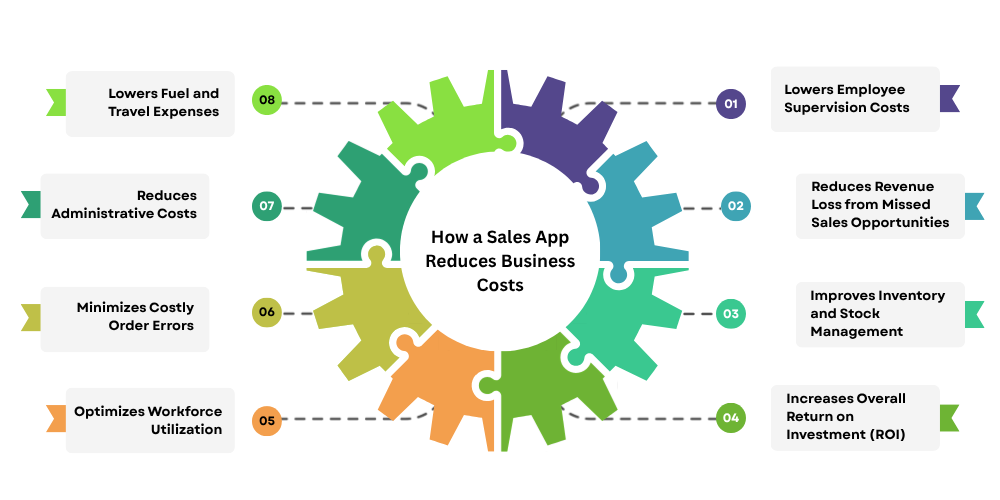
While the time-saving benefits of a sales app are easy to recognize, its impact on reducing business costs is equally significant. Many operational expenses stem from inefficient processes, manual data handling, poor visibility, and unnecessary travel. By automating field sales operations and improving resource utilization, a sales app helps businesses lower recurring expenses while increasing overall efficiency and profitability.
-
Reduces Paperwork and Printing Costs
Businesses that rely on manual processes often spend money on printed order forms, attendance registers, sales reports, invoices, expense sheets, and customer records. Besides the printing costs, storing and managing physical documents also requires additional time and resources. A sales app digitizes these processes by storing all sales data electronically. Customer information, orders, reports, and receipts are recorded within the app, reducing the need for paperwork while making information easier to access and manage.
-
Lowers Fuel and Travel Expenses
Poor route planning and unplanned customer visits often result in unnecessary travel, increased fuel consumption, and higher transportation costs. With features like beat planning, GPS navigation, and route planning, a sales app helps representatives follow the most efficient travel routes. This reduces travel distance, saves fuel, minimizes vehicle wear and tear, and allows sales teams to cover more customers in less time.
-
Reduces Administrative Costs
Manual sales operations require office staff to collect reports, enter data into systems, verify records, and resolve discrepancies. As the business grows, these administrative tasks become increasingly expensive. A sales app automates data collection and synchronizes information in real time, eliminating repetitive administrative work. This enables office teams to focus on strategic tasks instead of spending hours processing paperwork.
-
Minimizes Costly Order Errors
Manual order collection increases the chances of incorrect product selection, pricing mistakes, duplicate entries, and missing order details. These errors often lead to returns, delayed deliveries, customer complaints, and additional operational costs. A sales app standardizes the order collection process by allowing representatives to select products, quantities, and pricing directly within the system. This improves order accuracy, reduces costly mistakes, and enhances customer satisfaction.
-
Optimizes Workforce Utilization
Without real-time visibility, managers may unknowingly assign overlapping territories, duplicate customer visits, or inefficient schedules, resulting in wasted time and resources. A sales app provides complete visibility into field activities, allowing managers to allocate territories, assign tasks, and monitor workloads more effectively. Better workforce planning helps businesses achieve more without increasing team size.
-
Lowers Employee Supervision Costs
Many businesses spend considerable time and money supervising field representatives through frequent phone calls, physical visits, or manual verification methods. With GPS tracking, geo-tagged customer visits, attendance management, and real-time activity updates, managers can remotely monitor field operations from a centralized dashboard. This reduces supervision costs while improving accountability and transparency across the sales team.
-
Reduces Revenue Loss from Missed Sales Opportunities
When follow-ups are missed, customer visits are delayed, or leads are forgotten, businesses lose potential revenue that could have been converted into sales. A sales app helps representatives manage follow-ups, schedule customer visits, receive reminders, and track pending activities. This ensures that sales opportunities are not overlooked, helping businesses maximize revenue without increasing marketing or acquisition costs.
-
Improves Inventory and Stock Management
Poor coordination between field sales teams and inventory can result in stock shortages, overstocking, or order cancellations, all of which increase operational costs. A sales app provides better coordination between sales, distributors, and inventory teams by offering real-time order visibility and stock information. This helps businesses maintain optimal inventory levels, reduce wastage, and improve order fulfillment efficiency.
-
Increases Overall Return on Investment (ROI)
Every cost saved through automation contributes directly to improved profitability. Reduced paperwork, fewer manual errors, lower travel expenses, better workforce utilization, and increased sales productivity all combine to deliver a higher return on investment. Instead of hiring additional staff to manage growing operations, businesses can scale more efficiently with a sales app, making it a long-term investment that pays for itself through improved operational efficiency and cost savings.
Business Benefits Beyond Time and Cost Savings
While saving time and reducing operational costs are two of the biggest advantages of a sales app, the long-term business impact goes much further. A modern Sales Force Automation solution transforms the way field sales teams operate by improving productivity, strengthening customer relationships, increasing visibility, and enabling data-driven decision-making. These benefits help businesses scale more efficiently and stay competitive in an increasingly digital marketplace.
-
Improves Sales Team Productivity
Sales representatives perform best when they spend more time interacting with customers and less time handling administrative tasks. However, manual reporting, paperwork, and constant coordination often reduce the time available for selling. A sales app automates routine activities like attendance, reporting, order collection, and task management, allowing representatives to focus on customer engagement. With more productive selling hours each day, businesses can increase customer visits, improve order volumes, and achieve higher sales performance.
-
Provides Complete Visibility into Field Operations
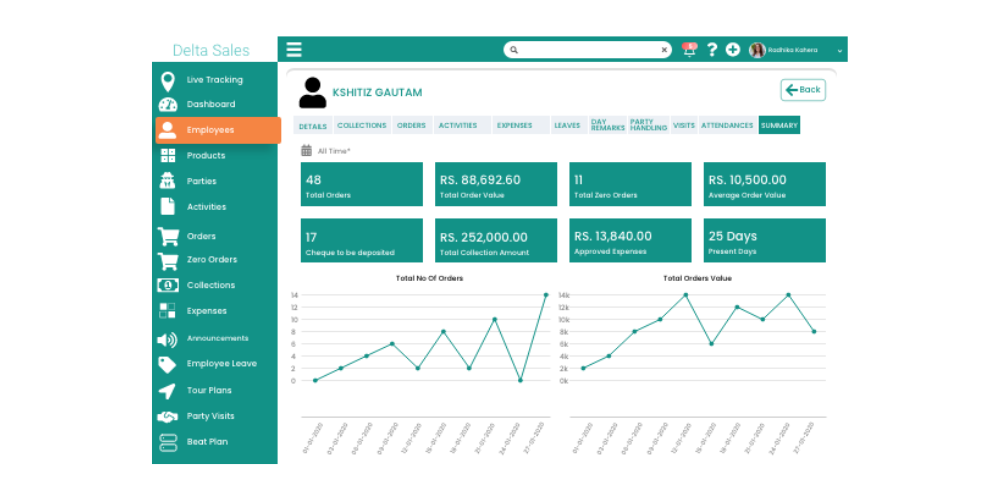
Managing a field sales team without real-time visibility can make it difficult to understand what representatives are doing throughout the day. Managers often rely on phone calls or end-of-day reports, which delay decision-making. A sales app provides live dashboards that display customer visits, order status, attendance, task completion, GPS locations, and sales performance. This transparency enables managers to monitor field activities in real time, identify bottlenecks quickly, and make informed business decisions.
-
Strengthens Customer Relationships
Building long-term customer relationships requires timely follow-ups, personalized interactions, and consistent service. Without access to customer history, representatives may miss opportunities to provide a better buying experience. A sales app stores complete customer information, including previous orders, payment history, visit records, and follow-up schedules. Having this information readily available help for sales representatives to provide faster service, understand customer needs, and build stronger relationships that encourage repeat business.
-
Increases Sales Team Accountability
One of the biggest challenges in field sales management is ensuring that planned customer visits and daily activities are actually completed. With features like GPS-based employee location tracking, geo-tagged check-ins, attendance monitoring, and activity logs, a sales app provides complete transparency into field operations. Managers can easily verify customer visits, monitor productivity, and measure individual performance, creating a more accountable and efficient sales team.
-
Enables Faster and Smarter Decision-Making
Business decisions are only as good as the data behind them. When managers rely on outdated reports or incomplete information, responding to market changes becomes difficult. A sales app provides real-time analytics on sales performance, customer coverage, pending orders, team productivity, and market trends. With instant access to accurate data, managers can identify opportunities, resolve issues quickly, and make better strategic decisions.
-
Enhances Collaboration Across Teams
Field representatives, managers, distributors, and office staff often work independently, making communication slow and increasing the chances of misunderstandings. A sales app acts as a centralized platform where everyone has access to the same real-time information. Orders, customer updates, payment status, tasks, and inventory information are shared instantly, improving collaboration across departments and reducing communication gaps.
-
Supports Business Growth and Scalability
As businesses expand into new territories, managing larger sales teams and increasing customer volumes becomes more challenging with manual processes. A sales app provides standardized workflows that make it easier to onboard new representatives, manage multiple territories, monitor performance across regions, and maintain operational consistency. This allows businesses to scale efficiently without significantly increasing administrative complexity.
-
Improves Customer Satisfaction and Retention
Accurate order processing, timely deliveries, faster issue resolution, and consistent follow-ups all contribute to a better customer experience. By helping sales representatives respond quickly and provide reliable service, a sales app increases customer satisfaction. Happy customers are more likely to place repeat orders, recommend the business to others, and remain loyal over the long term.
-
Creates a Data-Driven Sales Culture
Instead of relying on assumptions or manual reports, businesses can measure every aspect of their sales operations through real-time data. Performance metrics such as customer visits, order value, sales targets, conversion rates, attendance, and productivity are available through interactive dashboards. This enables businesses to set measurable goals, evaluate team performance objectively, and continuously optimize their sales strategy based on actionable insights.
Why Businesses Choose Delta Sales App
Choosing the right sales app is about more than just digitizing field operations. Businesses need a solution that simplifies daily sales activities, improves team productivity, provides complete visibility into field operations, and scales as the business grows. That's why thousands of businesses across industries trust Delta Sales App to manage their field sales teams more efficiently.
Delta Sales App combines powerful Sales Force Automation (SFA) features into one easy-to-use platform, helping businesses eliminate manual processes, improve decision-making, and drive consistent sales growth.
-1782992909.png)
1. Complete Sales Force Automation in One Platform
Instead of using multiple tools for attendance, order management, reporting, and employee tracking, Delta Sales App brings everything together in one centralized solution. From planning daily activities to collecting orders and tracking sales performance, every aspect of the field sales process can be managed through a single application. This reduces operational complexity while improving collaboration between sales representatives, managers, distributors, and office teams.
2. Real-Time Visibility into Field Operations
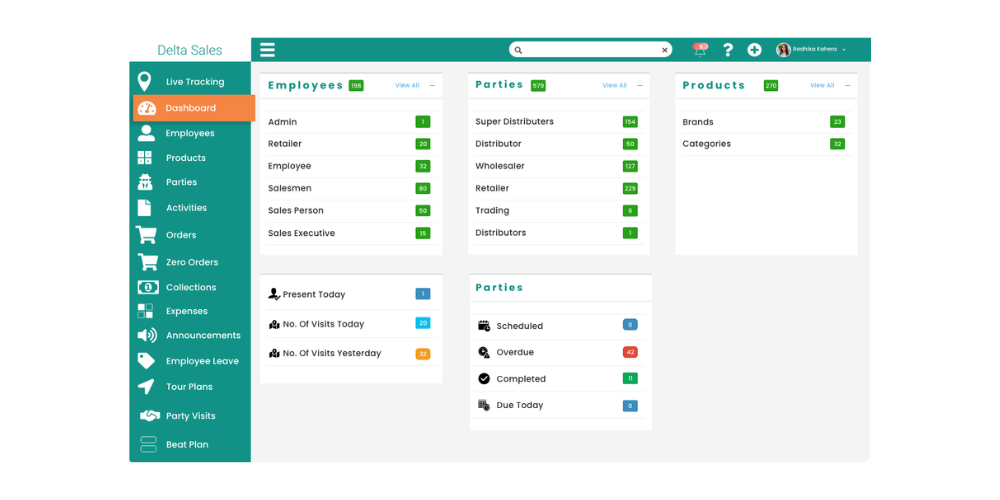
Managing remote sales teams becomes much easier when managers can see what's happening in real time. Delta Sales App provides live dashboards that display customer visits, attendance, GPS locations, orders, payments, expenses, and sales activities as they happen. This enables managers to monitor field performance, identify challenges early, and make informed decisions without waiting for end-of-day reports.
3. Powerful Order Management
Manual order collection often leads to delays and errors that affect customer satisfaction. With Delta Sales App, sales representatives can create and submit orders directly from their smartphones during customer visits. Orders are instantly shared with the back office or distributors, improving order accuracy, reducing processing time, and speeding up deliveries.
4. Smart Beat Planning and Route Optimization
Visiting customers in a planned sequence helps sales representatives cover more locations while reducing unnecessary travel. Delta Sales App includes beat planning and route management features that help field teams organize daily schedules efficiently. Optimized routes reduce travel time, save fuel, and allow representatives to spend more time meeting customers.
5. Accurate GPS Employee Tracking
Knowing where field representatives are during working hours helps businesses improve accountability and operational efficiency. Delta Sales App offers GPS-based employee tracking, geo-tagged check-ins, and live location monitoring, allowing managers to verify customer visits, monitor movement, and ensure planned activities are completed on time.
6. Automated Daily Sales Reporting
Preparing manual daily sales reports can consume valuable selling time. Delta Sales App automatically records customer visits, order management, payments, attendance, expenses, and follow-up activities throughout the day. Managers receive real-time reports instantly, while sales representatives spend more time selling instead of completing paperwork.

7. Comprehensive Customer and Distributor Management
Strong customer relationships require accurate information and timely follow-ups. Delta Sales App maintains complete customer and distributor records, including order history, payment status, visit history, outstanding balances, and communication details. Having all customer information in one place enables representatives to provide faster and more personalized service.
8. Actionable Reports and Business Analytics
Business growth depends on making informed decisions based on accurate data. Delta Sales App provides detailed dashboards and performance reports that help businesses monitor sales trends, customer coverage, team productivity, order performance, attendance, and target achievement. These insights help managers identify opportunities and continuously improve sales performance.
9. Works Even Without an Internet Connection
Field sales representatives often work in areas with limited or unreliable internet connectivity. Delta Sales App offers offline functionality, allowing users to record customer visits, collect orders, capture attendance, and update sales activities without an internet connection. Once connectivity is restored, all data is automatically synchronized, ensuring uninterrupted field operations.
10. Scalable for Businesses of Every Size
Whether you're managing a small sales team or a nationwide distribution network, Delta Sales App grows with your business. Its flexible features support businesses across industries such as FMCG, pharmaceuticals, construction materials, consumer goods, manufacturing, food and beverage, electrical products, and wholesale distribution, making it a reliable solution for organizations at every stage of growth.
Conclusion
So, what does a sales app really save: time, costs, or both?
The answer is clear. A modern sales app helps businesses save both. By automating repetitive tasks, streamlining order management, improving field visibility, and reducing manual processes, businesses can recover valuable selling time while significantly lowering operational expenses. More importantly, these improvements lead to higher sales productivity, better customer relationships, smarter decision-making, and sustainable business growth.
Whether you're managing a small field sales team or a large distribution network, investing in the right Sales Force Automation (SFA) solution can transform the way your business operates. Instead of spending time on paperwork and administrative tasks, your sales team can focus on what truly matters, building customer relationships, closing more deals, and driving revenue.
Ready to See the Difference?
Book a free demo today and see how our Sales Force Automation solution can simplify your field operations, improve team performance, and accelerate your business growth.