Sales Force Automation Software for Oil and Lubricant Distributors

Oil and lubricant distribution takes more than supplying engine oil to retailers. Distributors juggle multiple lubricant grades, pack sizes, product categories, dealer networks, mechanic relationships, fleet customers, credit transactions, and recurring orders. A distributor handling engine oils, industrial lubricants, gear oils, hydraulic oils, and greases can easily have hundreds of SKUs moving through different sales channels.
Run all of that through spreadsheets, phone calls, WhatsApp messages, and manual Daily Sales Reports (DSRs), and visibility starts to slip. Managers can't tell which dealers got visited, which products are selling, how much stock is left at retail outlets, or whether reps are collecting payments on time.
That's where a field sales app for oil and lubricant distributors comes in. It ties field sales activity to order booking, customer management, route planning, payment collection, and sales reporting in one system. For lubricant distributors with field reps spread across several territories, SFA software standardizes daily operations, improves dealer coverage, and gives managers sales information they can trust.
This blog covers the operational challenges lubricant distributors face, the features to look for in SFA software, and how to evaluate the right solution for your distribution business.
Why Oil and Lubricant Distributors Struggle Without SFA
Lubricant distribution has a few operational quirks that make field sales hard to manage. A distributor might serve automobile workshops, spare parts retailers, authorized dealers, service centers, transport companies, and industrial customers all at once. Each type buys differently, wants different products, orders at its own pace, and works out payment in its own way. Without a central sales management system, much of this rests on individual reps keeping their own records and reporting by hand.
-
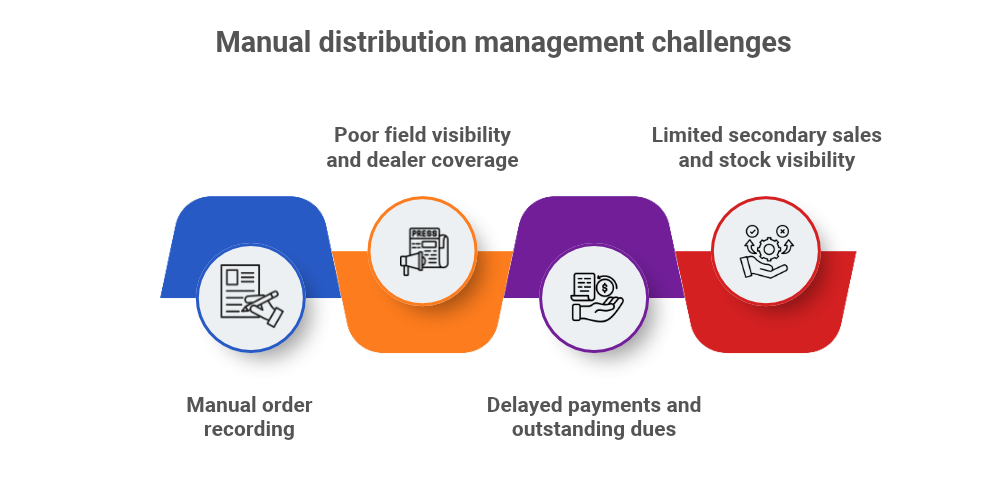
Manual Order Errors Across SKUs and Pack Sizes
Lubricant distributors handle many product categories, grades, and pack sizes. Recording orders by hand makes it easier to pick the wrong product, get a quantity wrong, or misprice an item. Mistakes like these slow down order processing and cause confusion between reps and distributors.
-
Poor Field Visibility and Dealer Coverage
Without GPS tracking and structured beat plans, managers can't easily verify customer visits or see how well a territory is covered. Reps may keep returning to the same dealers while other potential customers go unvisited, and those sales opportunities slip away.
-
Delayed Payments and Outstanding Dues
Credit-based transactions with dealers and workshops make payment tracking essential. Manual records can lead to missed follow-ups, delayed collections, and limited visibility into customer outstanding balances.
-
Limited Secondary Sales and Stock Visibility
Primary sales figures can't show how products move through dealers and retailers. Without outlet-level sales and stock information, distributors have a hard time spotting which SKUs sell fast, which ones sit, and what needs replenishing.
Key Features to Look for in SFA Software for Lubricant Distribution
Picking SFA software takes more than confirming it supports order booking and GPS tracking. Lubricant distributors should check whether the platform can handle their product catalog, dealer network, collection process, territory structure, and reporting needs. These features matter most for lubricant distribution.
-
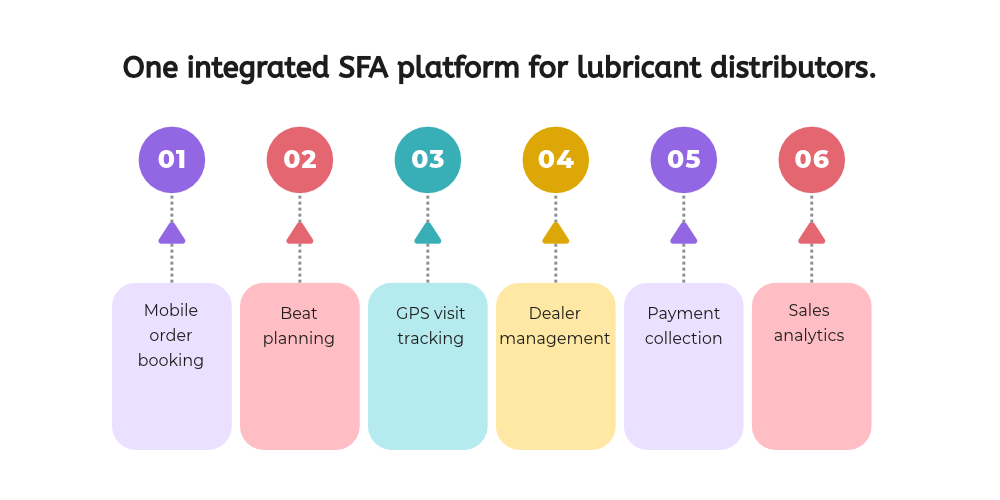
Mobile Order Booking and Product Catalogs
Lubricant distributors sell across many product categories, grades, SKUs, and pack sizes. SFA software should give reps a digital product catalog where they can pick products, enter quantities, see the applicable prices, and book orders from their phones. Access to previous orders and current promotional schemes also helps reps handle repeat purchases.
-
Beat Planning and GPS Visit Tracking
SFA software should let managers assign daily or weekly beat plans and watch dealer visits through GPS tracking. Route planning, visit verification, and territory management keep reps covering their assigned dealers, workshops, and service centers consistently.
-
Dealer and Customer Management
Distributors serve several kinds of customers, including lubricant dealers, automobile workshops, spare parts retailers, and fleet operators. Central customer records should hold contact details, purchase history, visit schedules, and outstanding balances, so reps can build better relationships with each one.
-
Payment Collection and Outstanding Tracking
Reps should be able to record customer payments during field visits, and the software should keep each customer's collection history. Customer-wise outstanding reports and accounting integration help managers watch pending dues and plan payment follow-ups.
-
Scheme and Discount Management
Lubricant distributors often run volume discounts, dealer incentives, and promotional schemes. SFA software should show the applicable offers and pricing during order booking, so reps don't have to work out discounts by hand, and every dealer hears about a scheme the same way.
-
Offline Order Booking and Data Synchronization
Reps may visit dealers in areas where the internet is unreliable. With offline functionality, they can open their synced customer information, record orders, and complete supported field activities with no signal. The data syncs to the central system once the connection comes back.
-
Real-Time Sales Dashboards and Reporting
Sales managers need visibility into daily orders, territory performance, customer visits, collections, and representative productivity. Real-time dashboards and automated reports help identify sales gaps, monitor targets, and make informed decisions without depending on manually prepared DSRs.
How SFA Software Improves Sales Performance for Lubricant Distributors
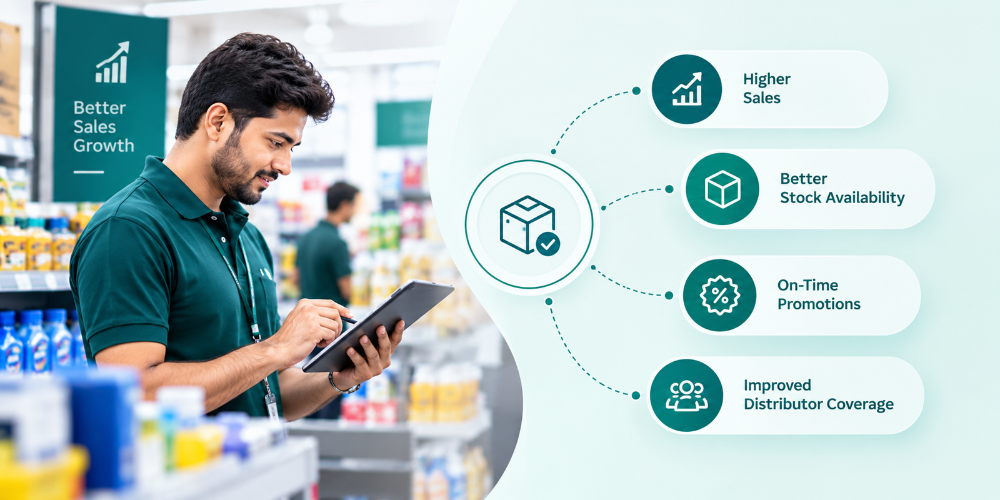
Implementing SFA software is not simply about replacing manual paperwork with mobile applications. Its real value comes from improving how distributors plan sales activities, manage customer relationships, and monitor field execution. When order booking, route planning, customer management, and reporting work together, distributors gain better control over their sales operations.
-
Higher Order Value and Better Product Mix
SFA software gives representatives access to customer purchase history, product catalogs, and previous orders. This helps them identify repeat purchasing patterns and recommend relevant lubricant products across different categories. Managers can also review SKU-wise sales reports to identify popular products and opportunities to improve product mix at individual outlets.
-
Faster Order-to-Delivery Process
Digital order management reduces the delays associated with handwritten orders, phone calls, and repeated data entry. Representatives can submit orders directly through the mobile application, allowing distributors to access order details sooner and process them more efficiently. ERP or DMS integration can further improve coordination between sales and back-office teams.
-
Better Rep Productivity and Territory Coverage
Beat planning, route management, and GPS tracking help representatives follow assigned schedules and cover more customers systematically. Managers can monitor completed visits, identify missed outlets, and review individual performance. This improves territory management and reduces unnecessary travel.
-
Improved Payment Collection and Credit Management
Digital collection records help representatives report payments during customer visits. Managers can monitor collection performance, review pending dues, and organize follow-ups with dealers and workshops. Integration with accounting systems can provide better visibility into customer outstanding balances and support more informed credit decisions.
How to Evaluate and Choose the Right SFA Software
Not every SFA platform is designed for the same distribution model. A lubricant distributor managing 10 representatives across one city has different requirements from a manufacturer managing multiple distributors and hundreds of field representatives.
Before selecting software, businesses should evaluate their existing operations and identify the areas where automation will have the greatest impact.
1. Assess Your Distribution Model
Understand how products move through your distribution network and identify your sales requirements.
-
Primary Sales: Check support for manufacturer-to-distributor coordination and ERP or DMS integration.
-
Secondary Sales: Prioritize mobile order booking, dealer visit tracking, SKU-wise reporting, and territory management.
-
Direct Sales: Look for customer management, order history, payment tracking, and follow-up features for workshops, garages, and fleet operators.
Choose software that supports your actual sales structure.
2. Check ERP, DMS, and Accounting Integration
Your SFA platform should work alongside existing business systems rather than operate separately. Check whether it supports:
-
Customer and product data synchronization.
-
Order transfer to ERP or DMS.
-
Pricing and product information sharing.
-
Payment collection integration.
-
APIs or other integration options.
Proper integration reduces duplicate data entry and improves information consistency.

3. Evaluate Ease of Use for Field Reps
An SFA application should be simple enough for representatives with different levels of technical experience. Check whether reps can:
-
Mark attendance and record visits.
-
Access customer details and product catalogs.
-
Book orders and record collections.
-
View previous orders.
-
Access essential information offline.
Also evaluate the vendor's onboarding, employee training, and ongoing support.
4. Compare Pricing, Scalability, and Support
Compare the total cost rather than choosing software based only on subscription price. Consider:
-
Per-user and subscription charges.
-
Implementation and training costs.
-
Integration and customization expenses.
-
Additional module charges.
-
Technical support and future expansion costs.
Choose a platform that can accommodate additional representatives, dealers, and territories as your lubricant distribution business grows.
Conclusion
Managing oil and lubricant distribution requires coordination between field representatives, dealers, workshops, and distributors. As product catalogs and dealer networks expand, manual processes make it difficult to track orders, monitor territory coverage, manage collections, and measure sales performance. The right Sales Force Automation software helps bring these activities together through mobile order booking, GPS-based employee tracking, beat planning, attendance management, payment collection, and real-time sales reporting.
Delta Sales App provides an integrated field sales management solution for manufacturers, wholesalers, and distributors managing outside sales teams. Its features help businesses organize field activities, improve dealer coverage, monitor representative performance, and maintain better visibility into daily sales operations.
Want to improve visibility and control over your lubricant distribution operations? Get a Personalized Product Demo and explore how Delta Sales App can support your sales team.