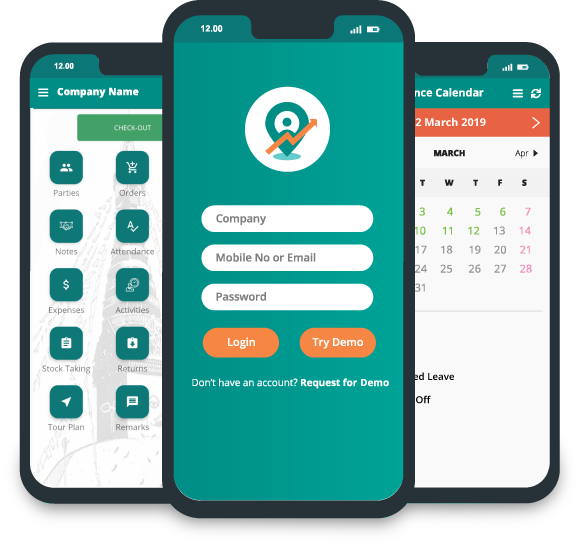

The Ultimate Guide to Choosing the Right Distributor Management System

In today’s competitive business environment, leveraging an efficient and reliable Distributor Management System (DMS) is no longer optional—it’s essential. A robust Distributor Management System helps businesses in industries such as FMCG, pharmaceuticals, and consumer goods to optimize their distribution networks. By simplifying operations, tracking inventory, automating order processes, and providing real-time insights, a DMS becomes the backbone of an efficient supply chain.
This comprehensive guide will delve into the critical aspects of a Distributor Management System, its benefits, key features, and the steps to choose the best solution for your business. Practical examples are included to illustrate the transformative potential of a well-implemented Distributor Management System.
What is a Distributor Management System (DMS)?
A Distributor Management System (DMS) is a software platform designed to manage and optimize the entire distribution lifecycle, from manufacturer to distributor to retailer. It acts as a centralized system that connects all stakeholders, enabling businesses to streamline operations such as inventory tracking, order management, sales monitoring, and reporting.
In industries like FMCG, pharmaceuticals, consumer goods, and building materials where distribution networks are large and complex, a DMS becomes critical for maintaining operational control and visibility.
Instead of relying on disconnected tools, spreadsheets, or manual coordination, a DMS provides a unified digital ecosystem where:
- Inventory levels are tracked in real time
- Orders are placed, processed, and fulfilled efficiently
- Sales data is captured across primary and secondary channels
- Distributors and retailers remain aligned with business goals
In simple terms, a DMS helps businesses digitize and control their distribution network, ensuring accuracy, speed, and scalability.
Why Your Business Needs a Distributor Management System?
A Distributor Management System (DMS) helps businesses automate and streamline the entire distribution process by connecting manufacturers, distributors, and retailers on a single platform. It improves visibility, reduces manual work, and enables faster, data-driven decision-making across the supply chain.
By replacing manual tracking methods with automation, a DMS ensures smoother operations and better control over inventory, orders, and sales performance. It also strengthens supply chain efficiency by improving accuracy, reducing delays, and ensuring better coordination across all stakeholders.
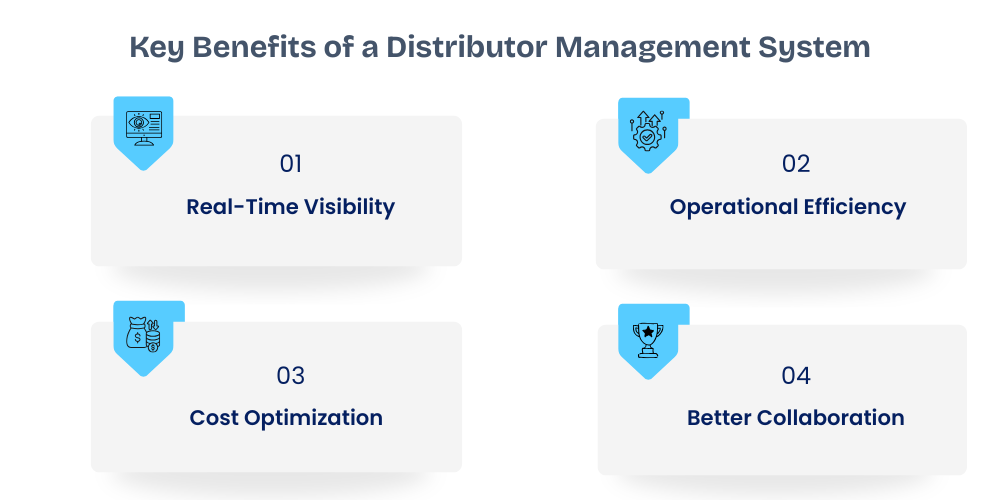
Key Benefits of a Distributor Management System
Real-Time Visibility
Access up-to-date data on inventory, sales, and orders, enabling faster and more accurate decision-making.
Provides complete supply chain transparency, helping businesses track stock movement, reduce delays, and respond quickly to demand changes.
Operational Efficiency
Reduces manual tasks such as order entry and reporting, minimizing errors and saving valuable time.
Streamlines workflows through automation, allowing sales and distribution teams to focus more on execution and business growth activities.
Cost Optimization
Helps reduce logistics costs, prevents stock imbalances, and improves overall resource utilization.
Optimizes delivery routes, reduces wastage, and ensures efficient inventory planning, leading to improved profitability and reduced operational expenses.
Better Collaboration
Improves communication and coordination between manufacturers, distributors, and retailers for smoother execution.
Creates a unified system where all stakeholders share real-time updates, improving trust, transparency, and faster issue resolution across the network.
Benefits of Using a Distributor Management System
Implementing a Distributor Management System brings significant operational and strategic advantages. It not only improves day-to-day execution but also strengthens long-term business growth by creating a data-driven, scalable, and efficient distribution ecosystem.
1. Real-Time Visibility Across the Supply Chain
A DMS provides live updates on:
-
Inventory levels
-
Sales performance
-
Order status
This real-time visibility allows businesses to:
-
Identify stock shortages before they impact sales
-
Monitor distributor performance instantly
-
Track product movement across regions
Instead of relying on delayed reports, decision-makers get instant insights, enabling faster and more accurate actions in dynamic market conditions.
2. Improved Operational Efficiency
Manual processes such as order entry, stock tracking, and reporting are automated. This leads to:
-
Reduced human errors
-
Faster processing times
-
Better coordination between teams
Additionally, automation standardizes workflows across the organization, ensuring consistency in execution. Sales teams, distributors, and back-office staff operate on the same system, reducing confusion and improving overall productivity.
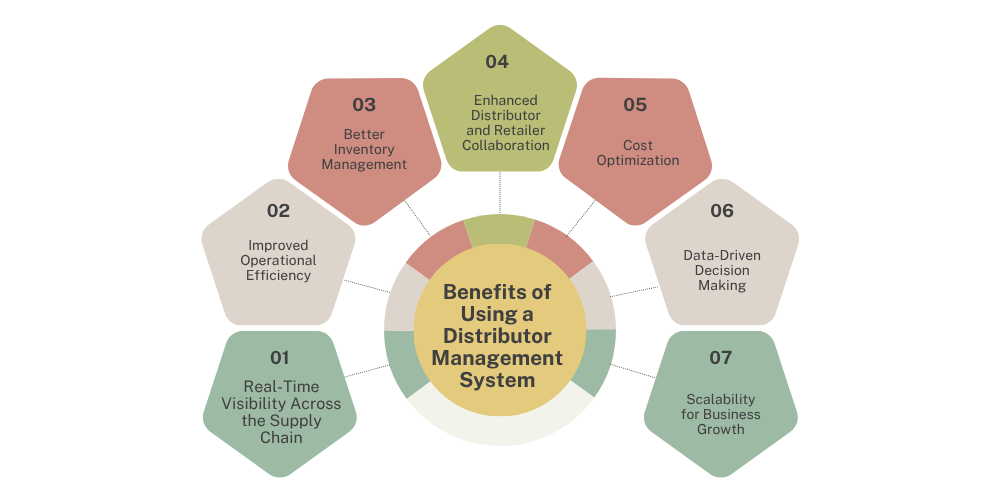
3. Better Inventory Management
With accurate stock tracking, businesses can:
-
Avoid stockouts and overstocking
-
Plan replenishment efficiently
-
Optimize warehouse operations
A DMS also helps in demand forecasting by analyzing historical sales data. This ensures that the right products are available at the right time and place, improving service levels and minimizing lost sales opportunities.
4. Enhanced Distributor and Retailer Collaboration
A DMS improves communication between all stakeholders by providing:
-
Shared access to data
-
Transparent order and delivery tracking
-
Faster issue resolution
Distributors and retailers gain visibility into order status, stock availability, and delivery timelines. This builds trust and strengthens relationships, leading to smoother operations and better alignment across the supply chain.
5. Cost Optimization
By streamlining logistics and operations, businesses can:
-
Reduce transportation costs through route optimization
-
Minimize wastage and excess inventory
-
Lower administrative expenses
Automation reduces dependency on manual processes, cutting down labor costs and operational inefficiencies. Over time, these savings contribute significantly to improving overall profitability.
6. Data-Driven Decision Making
With built-in analytics and reporting, businesses gain insights into:
-
Sales trends
-
Product performance
-
Regional demand patterns
Managers can use this data to:
-
Identify high-performing products and markets
-
Adjust pricing or promotional strategies
-
Allocate resources more effectively
This shifts decision-making from intuition-based to insight-driven, improving accuracy and business outcomes.
7. Scalability for Business Growth
As businesses expand, a DMS can easily scale to:
-
Add new distributors and regions
-
Handle higher order volumes
-
Integrate with ERP, CRM, and other systems
This flexibility ensures that the system continues to support operations as complexity increases. Whether entering new markets or expanding product lines, a DMS provides the foundation for sustainable and controlled growth.
How a Distributor Management System Works
A Distributor Management System (DMS) works by integrating and automating key distribution management processes into a single platform, ensuring seamless coordination from order placement to final delivery. It connects manufacturers, distributors, retailers, and sales teams into a unified system, enabling real-time data visibility, faster execution, and better control over the entire supply chain management system.
By eliminating manual dependencies and fragmented workflows, a DMS ensures that every stage from order capture to reporting is digitized, traceable, and optimized for operational efficiency.
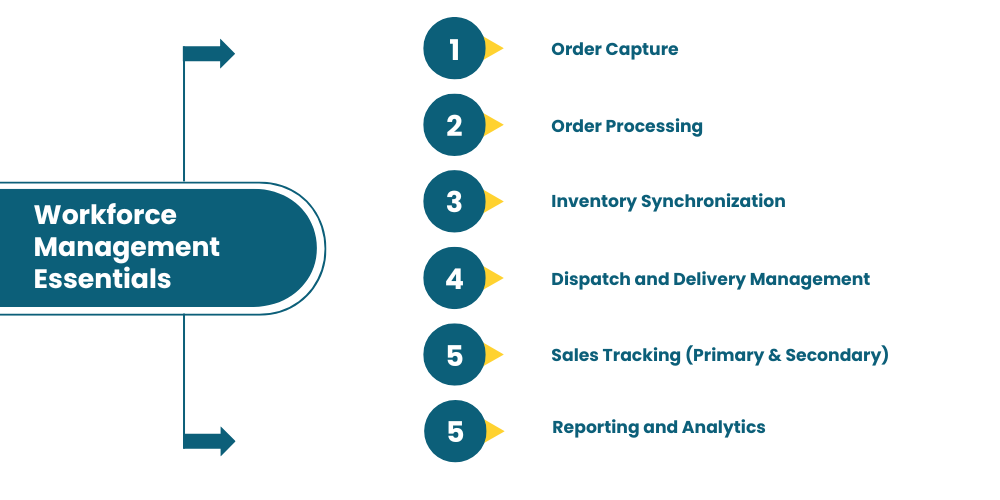
Step-by-step working of DMS:
1. Order Capture
Orders are placed by:
-
Distributors
-
Retailers
-
Field sales representatives
These orders are captured digitally through mobile apps or web platforms. This ensures accuracy, reduces paperwork, and enables instant order placement from any location.
Orders captured digitally using sales order management app, ensuring accuracy and real-time visibility across the network.
2. Order Processing
Once an order is received, the system:
-
Validates order details
-
Applies pricing and discount rules
-
Confirms product availability
The system processes orders based on predefined business rules, minimizing delays and reducing manual intervention.
System validates orders using automated order processing, improving speed, accuracy, and overall operational efficiency.
3. Inventory Synchronization
The system updates inventory levels in real time across:
-
Warehouses
-
Distribution centers
-
Retail points
This synchronization ensures that stock data remains accurate and consistent across all locations.
Real-time updates through inventory management software ensure accurate stock visibility and prevent stock discrepancies.
4. Dispatch and Delivery Management
DMS supports logistics by:
-
Planning delivery routes
-
Assigning shipments
-
Tracking delivery status
Advanced systems also optimize routes and schedules, improving delivery speed and reducing transportation costs.
Uses route optimization software and logistics management systems to improve delivery efficiency and reduce operational delays.
5. Sales Tracking (Primary & Secondary)
The system tracks:
-
Primary sales (company to distributor)
-
Secondary sales (distributor to retailer)
This provides complete visibility into product movement and helps identify demand trends.
Tracks sales using sales tracker app and field sales tracking systems, ensuring complete visibility across the distribution network.
6. Reporting and Analytics
Managers can access dashboards showing:
-
Sales performance
-
Inventory trends
-
Distributor performance
-
Demand patterns
These insights help optimize operations and support data-driven decision-making.
Provides insights through business intelligence tools and sales analytics dashboards to support smarter decision-making.
Key Features to Look for in a Distributor Management System
Inventory Management
What It Does: Tracks stock levels, monitors product movements, and facilitates timely replenishments.
Example: A beverage company uses a Distributor Management System to monitor inventory across multiple warehouses. Automated alerts notify the team when stock levels dip below a predefined threshold, ensuring popular products are always available.
Order Automation
What It Does: Simplifies order placement, tracking, and invoicing, reducing manual interventions.
Example: An electronics distributor implemented a DMS with automated order management, enabling distributors to place orders through a mobile app. This change reduced order processing errors by 70% and improved customer satisfaction.
Sales Tracking and Analysis
What It Does: Tracks primary and secondary sales data, offering insights into performance trends and market dynamics.
Example: A dairy company used their Distributor Management System to analyze sales patterns, uncovering a regional preference for low-fat milk. By adjusting supply strategies, they boosted sales in those regions.
Route Optimization
What It Does: Plans efficient delivery routes, reducing transportation costs and improving delivery times.
Example: A logistics company implemented a DMS with advanced route optimization features, cutting fuel expenses by 25% and ensuring timely deliveries.
Customizable Reporting and Dashboards
What It Does: Provides actionable insights through customizable dashboards and real-time reporting tools.
Example: An FMCG firm used a DMS’s dashboard to monitor distributor performance. Identifying low-performing areas allowed them to reallocate resources effectively, driving sales growth.
Integration and Scalability
What It Does: Integrates seamlessly with ERP, CRM, and other software, while scaling to accommodate business growth.
Example: A mid-sized cosmetics brand integrated their Distributor Management System with their ERP platform, creating a unified solution for managing inventory, orders, and customer data.
Industries That Use Distributor Management Systems
A Distributor Management System (DMS) is widely adopted across industries that rely on complex distribution networks, multi-tier supply chains, and high-volume product movement. These industries require strong control over inventory, orders, and field operations, making distribution management software a critical component of their business infrastructure.
Below are the key industries where DMS plays a vital role:
1. FMCG (Fast-Moving Consumer Goods)
The FMCG industry depends heavily on large distributor and retailer networks with fast product turnover.
A DMS helps FMCG companies to:
-
Manage high-volume with secondary sales automation app.
-
Ensure product availability across retail outlets
-
Optimize field sales operations using field force automation software
-
Monitor distributor performance in real time
This ensures faster product movement and better market coverage.
FMCG companies use sales and distribution software to manage large networks and ensure product availability.

2. Pharmaceuticals
Pharmaceutical companies operate in a highly regulated environment where accuracy and compliance are critical.
A DMS helps in:
-
Tracking batch numbers and expiry dates
-
Managing inventory across distributors and stockists
-
Ensuring compliance with regulatory standards
-
Improving order accuracy and delivery timelines
This ensures safe, efficient, and compliant distribution of medicines.
Pharma companies rely on inventory tracking systems and distribution automation tools for compliance and accuracy.
3. Consumer Electronics
The consumer electronics industry deals with high-value products and multi-location distribution.
A DMS enables:
-
Real-time inventory visibility across warehouses
-
Efficient order processing and fulfillment
-
Tracking product movement across regions
-
Analyzing sales trends and demand patterns
This helps businesses maintain stock accuracy and avoid losses.
Electronics companies use inventory management software and order management systems to handle complex distribution networks.
4. Building Materials (Cement, Steel, Hardware)
This industry involves bulk distribution and large dealer networks spread across regions.
A DMS supports:
-
Managing dealer and distributor relationships
-
Tracking bulk orders and dispatch schedules
-
Optimizing logistics and transportation
-
Monitoring regional demand and supply
This ensures smooth operations in a geographically distributed supply chain.
Building material companies use logistics management systems and distribution channel management tools for efficient operations.
5. Automotive and Spare Parts
The automotive industry relies on timely availability of spare parts across dealers and service centers.
A DMS helps in:
-
Managing spare parts inventory across multiple locations
-
Tracking dealer orders and fulfillment
-
Reducing delays in parts availability
-
Improving service efficiency
This ensures better customer satisfaction and service quality.
Automotive businesses use dealer management systems and supply chain management software for streamlined distribution.
6. Retail and E-commerce Distribution
Retail and e-commerce businesses manage multi-channel distribution with high order volumes.
A DMS enables:
-
Managing orders from multiple sales channels
-
Tracking inventory across warehouses and fulfillment centers
-
Ensuring timely deliveries
-
Integrating with online platforms and marketplaces
This helps maintain consistency across online and offline distribution channels.
Retail businesses rely on order management systems and inventory control software for efficient multi-channel distribution.
7. Food and Beverage Industry
The food and beverage sector requires strict control over inventory freshness and fast distribution cycles.
A DMS helps:
-
Track perishable goods and expiry dates
-
Manage cold chain distribution
-
Ensure timely delivery to retailers
-
Monitor stock levels across locations
This minimizes wastage and ensures product quality.
F&B companies use inventory management software and distribution automation systems to manage fast-moving perishable goods.
Steps to Choose the Right Distributor Management System
Selecting the right Distributor Management System (DMS) is a strategic decision that directly impacts your distribution efficiency, sales performance, and overall supply chain visibility. A well-chosen system should align with your business size, operational complexity, and future growth plans. Below are the key steps to help you make the right choice.
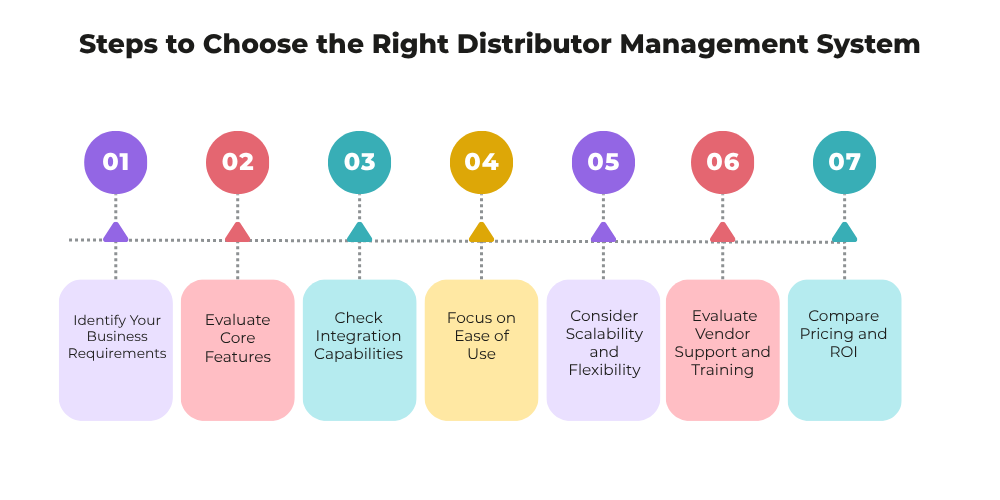
1. Identify Your Business Requirements
Start by analyzing your current distribution challenges such as delayed orders, poor inventory visibility, or lack of sales tracking. Clearly defining your pain points helps you understand what features you actually need in a DMS.
Understanding your operational gaps ensures you choose a system that solves real business problems instead of adding unnecessary complexity.
2. Evaluate Core Features
Compare different DMS platforms based on essential features like inventory management, order automation, sales tracking, route optimization, and reporting tools. Ensure the system supports both primary and secondary sales visibility.
A feature-rich system should improve efficiency while offering flexibility to adapt to your distribution model.
3. Check Integration Capabilities
A good DMS should integrate seamlessly with existing systems such as ERP, CRM, accounting tools, or field sales applications. This ensures smooth data flow across departments without duplication or manual entry.
Strong integration capabilities help create a unified and connected business ecosystem.
4. Focus on Ease of Use
The system should be simple and user-friendly for distributors, sales teams, and managers. Complex systems often lead to poor adoption and reduced efficiency.
A mobile-friendly interface and intuitive design ensure higher adoption rates and better operational results.
5. Consider Scalability and Flexibility
Choose a system that can grow with your business. As your distributor network expands, the DMS should handle increased data, users, and transactions without performance issues.
Scalable systems support long-term business expansion and multi-region operations.
6. Evaluate Vendor Support and Training
Reliable customer support and proper training are essential for successful implementation. Check whether the vendor provides onboarding assistance, technical support, and regular updates.
Good support ensures smooth adoption and minimizes operational disruptions.
7. Compare Pricing and ROI
Instead of focusing only on cost, evaluate the long-term return on investment. A slightly higher-priced system may offer better efficiency, automation, and cost savings over time.
A value-driven approach ensures better profitability and sustainable growth.
Common Mistakes to Avoid When Implementing a Distributor Management System
-
Overlooking Scalability: Ensure the Distributor Management System can scale with your business as it grows.
-
Neglecting User Training: A powerful DMS is only effective if your team knows how to use it efficiently.
-
Focusing Solely on Cost: Avoid opting for the cheapest solution, as it might lack critical features, leading to inefficiencies in the long run.
Conclusion:
Choosing the right Distributor Management System (DMS) plays a critical role in improving distribution efficiency and supporting long-term business growth. A well-implemented DMS helps businesses streamline operations, gain real-time visibility, and optimize every stage of the supply chain. Solutions like Delta Sales App offer advanced capabilities and user-friendly interfaces that make managing distributors, inventory, and orders more effective and scalable.
With the right DMS, businesses can monitor inventory and sales in real time, automate order processing, reduce manual errors, improve coordination between distributors and retailers, gain actionable insights through analytics, and scale operations across regions with better control and efficiency.
Ready to Transform Your Distribution Operations?
Book a free demo of Delta Sales App today and discover how it can streamline your distribution network and accelerate your business growth.