
Why Do Retail Orders Get Lost Between Sales Reps and Distributors?
A retailer places an order with a sales representative. The rep records the products and quantities, shares the order with the distributor, and moves on to the next outlet. On paper, the sale looks almost complete.
But what happens next?
Sometimes the distributor never receives the order on time. Sometimes the order reaches the distributor but has to be entered again manually. In other cases, the requested products are out of stock, the quantities are changed, or the order sits unnoticed until the retailer follows up.
This is where retail order management becomes important.
The problem is rarely just one person's mistake. Retail orders pass through several hands before they become an invoice and eventually reach the retailer. Every handoff creates a chance for information to be delayed, changed, or overlooked.
For businesses managing a large retail network, these small gaps can lead to missed sales orders, order processing delays, incorrect deliveries, and lost revenue opportunities.
Understanding where these gaps occur is the first step toward preventing lost retail orders and creating a more reliable process with sales order management app.
Where Does a Retail Order Go After a Sales Rep Collects It?
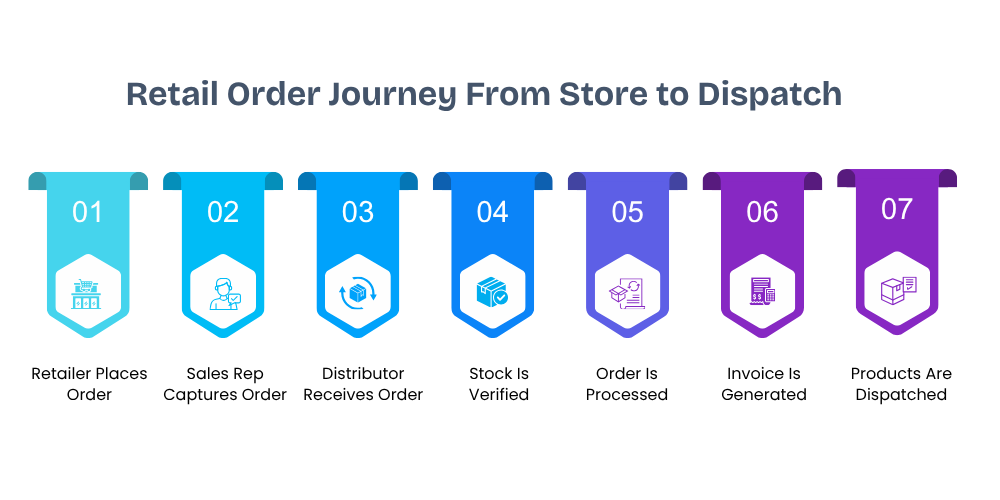
The journey of a retail order usually looks straightforward:
Retailer → Sales Rep → Distributor → Stock Check → Order Processing → Billing → Dispatch
A sales representative visits the outlet, discusses requirements, checks what the retailer needs, and records the order. This activity is often referred to as sales rep order booking or mobile order booking when the order is captured using a mobile sales application.
The order then needs to reach the distributor or distribution team.
The distributor checks the requested products, quantities, pricing, schemes, credit status, and stock availability. Once everything is confirmed, the order moves toward billing and dispatch.
The difficulty begins when these steps are handled through disconnected methods.
A rep may write the order in a notebook, send a photograph through WhatsApp, make a phone call, or enter the details into a spreadsheet later in the day. The distributor then has to interpret or re-enter that information.
Nothing may appear wrong at first. But when dozens or hundreds of orders are handled this way every day, even a small gap can turn into a significant number of missed or delayed orders.
A well-designed order processing workflow reduces these unnecessary handoffs and makes it easier to follow an order from the initial order capture to final fulfillment.
7 Common Points Where Retail Orders Get Lost
1. Orders Are Recorded but Submitted Late
Field sales representatives rarely visit just one outlet in a day. A rep may cover dozens of retailers across a territory.
If orders are written down and submitted only after several visits, there is a greater chance of delays or mistakes. A rep may forget one order, submit the wrong quantity, or discover later that an important detail was missing.
Late submission also affects the distributor. If the distributor receives the order near the end of the working day, it may miss the normal processing or dispatch cycle.
This is one reason businesses looking at how to prevent lost retail orders should first examine how quickly orders move from capture to submission.
Immediate sales tracker app and order transmission remove one unnecessary gap from the process.
2. Orders Get Buried in WhatsApp Messages and Phone Calls
WhatsApp and phone calls are convenient, which is why many sales and distribution teams rely on them.
The problem appears when business-critical order information is mixed with dozens of other messages.
A distributor may receive messages from several sales reps, retailers, drivers, warehouse staff, and managers. An order shared as a photograph or text message can easily be overlooked.
Phone calls create a different problem. There may be no reliable record of exactly what was discussed.
Was the retailer asking for 10 cases or 10 pieces? Was the order for the current scheme or the regular price? Did the distributor confirm the full quantity?
When order information lives inside conversations instead of a structured sales order workflow, finding and verifying that information becomes difficult.
For businesses asking why sales orders get missed, disconnected communication is often one of the first areas worth investigating.
3. Manual Order Entry Creates Errors
Even when an order reaches the distributor, someone may have to enter it into another system.
That creates another opportunity for mistakes.
A product code can be entered incorrectly. A quantity can be changed accidentally. A similar product can be selected instead of the requested SKU. A handwritten figure may also be difficult to read.
These sales order errors are particularly troublesome when the distributor handles a large product range.
The sales rep may have collected the correct order, but the final order processed by the distributor may not match what the retailer requested.
The result can be a short shipment, a correction call, a return, or a disappointed retailer.
This is why order data accuracy matters at the point of capture rather than only during final processing.
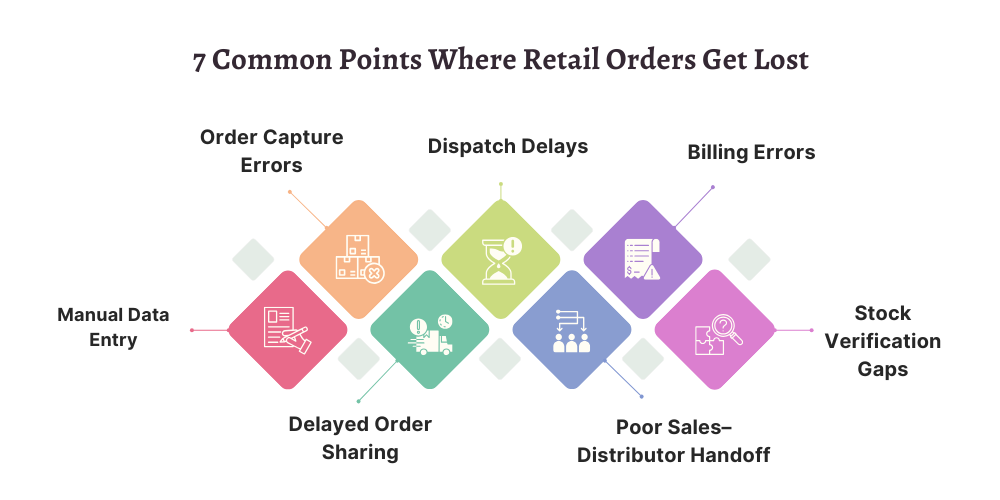
4. Stock Availability Is Not Visible During Order Booking
A sales representative can only sell what they know is available.
If the rep does not have reliable information about distributor stock, they may book an order for products that are unavailable.
The distributor discovers the problem later while processing the order.
Now someone has to call the sales rep. The rep may need to contact the retailer. The retailer may have to choose an alternative product or wait for replenishment.
This adds time to a process that could have been handled more efficiently if better inventory visibility and stock availability information had been available when the order was placed.
For businesses trying to understand how to improve retail order management, connecting order booking with useful product and stock information can remove one of the most common causes of order changes.
5. Pricing, Schemes, or Product Details Cause Order Discrepancies
Retail orders can also get stuck because the sales rep and distributor are working with different information.
For example, a retailer may be eligible for a particular scheme, while the distributor has not received the updated details. A rep may quote one price while the distributor's records show another.
Similar issues can occur with pack sizes, product variants, promotional offers, and minimum order quantities.
These discrepancies often result in calls and corrections before the order can be processed.
One small misunderstanding may not seem serious. But when the same process is repeated across hundreds of outlets, the amount of time spent resolving discrepancies becomes considerable.
Consistent product, pricing, and scheme information is therefore an important part of retailer order management and distributor management software.
6. Pending Orders Are Difficult to Track
Another common problem is the order that has not technically been lost but has simply been forgotten.
An order may be waiting for stock confirmation, approval, correction, billing, or dispatch.
If there is no clear status attached to the order, the sales rep may assume the distributor is handling it. The distributor may assume the rep is following up.
Nobody is deliberately ignoring the order. There is simply no clear view of who needs to act next.
This is where order status tracking becomes valuable.
Instead of maintaining a general list of orders, businesses can identify which orders are pending, which have been processed, and which require attention.
Tracking pending sales orders also makes it easier for managers to identify recurring bottlenecks before they become a larger sales problem.
7. Sales Reps Do Not Know the Final Order Status
Submitting an order should not be the end of the sales rep's visibility.
The rep needs to know whether the order was received, processed, partially fulfilled, invoiced, or dispatched.
Without that information, follow-up becomes guesswork.
A retailer may call the rep asking when the goods will arrive, and the rep then has to contact the distributor to find out. That creates unnecessary back-and-forth for everyone.
Effective retail order tracking should continue beyond order booking. The sales team should have enough information to understand what happened after the order was submitted.
This is particularly important when businesses want to track retail orders from booking to delivery instead of treating order collection as the end of the sales process.
Why Do These Order Gaps Happen Between Sales and Distribution Teams?
Disconnected Sales and Distributor Systems
Sales teams and distributors often work with different tools.
The rep may use a mobile application or spreadsheet, while the distributor relies on an ERP, accounting system, WhatsApp, or manual records.
When these systems do not communicate properly, information has to be transferred manually.
That is where delays and discrepancies start to appear.
A stronger sales and distribution management process connects these activities so that the information collected by the field team does not become isolated from distributor operations.
Delayed Communication and Data Sharing
Field teams spend most of their time outside the office. Distributors work from warehouses, offices, and delivery operations.
Their working environments are different, but they depend on the same order information.
If information is shared only at the end of the day, the distributor is always working with older information.
For businesses looking at how to improve sales rep and distributor coordination, reducing this communication delay should be a priority.
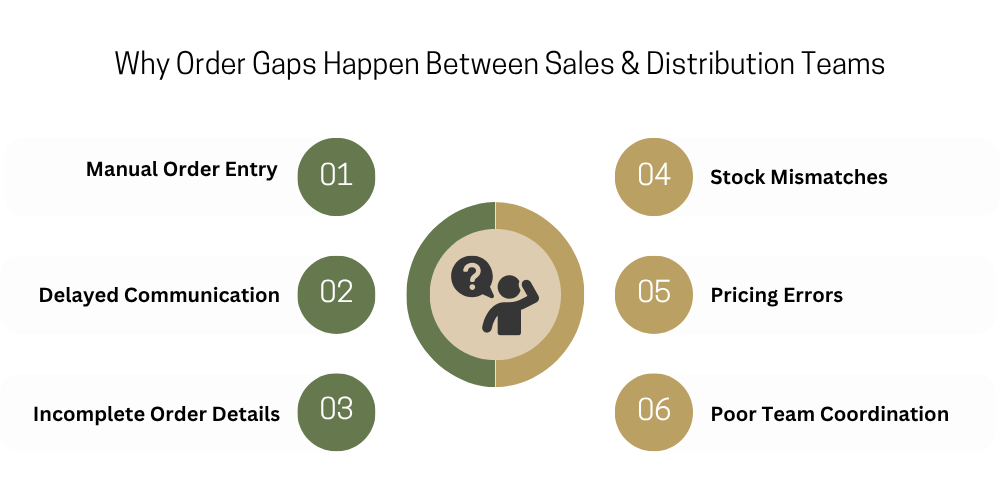
Lack of Real-Time Order Visibility
A business may have plenty of sales data but still struggle to answer a simple question:
What happened to this retailer's order?
If managers cannot answer that quickly, the process has a visibility problem.
Real-time order visibility helps teams understand whether an order has been submitted, received, processed, delayed, or completed.
It also gives sales managers better sales team visibility without requiring them to call different people for updates.
Too Many Manual Handoffs
Every time information is copied from one place to another, there is a possibility of error.
A retailer tells the rep. The rep writes it down. The information is sent to the distributor. Someone enters it into another system. Another team checks the stock. Billing processes it.
The more manual steps involved, the harder it becomes to maintain accuracy.
A connected order management system can reduce these repeated handoffs and support a more consistent digital order management process.
What Happens When Retail Orders Fall Through the Gaps?
The immediate impact is usually a delayed or missed sale. But the consequences can go further.
Missed Revenue Opportunities
A retailer may have been ready to buy, but the business fails to fulfill the requirement.
This is more than an operational inconvenience. It is a potential revenue loss.
When businesses repeatedly ask how to reduce retail order leakage, they should look beyond the number of orders booked and examine how many of those orders actually reach fulfillment.
Delayed Retailer Deliveries
Late order submission or processing can push an order into the next dispatch cycle.
For a retailer with fast-moving products, even a short delay can create a stock-out at the outlet.
Consistent order processing and faster movement through the order processing workflow can help reduce these delays.
Lower Order Fulfillment
When stock issues, incorrect information, or communication gaps are common, the difference between orders booked and orders fulfilled starts to grow.
The order fulfillment rate is therefore an important measure for businesses managing retail and distributor networks.
That gap represents demand that the business already captured but did not fully convert into delivered sales.
More Follow-Ups and Rework
Sales reps end up making repeated calls to distributors. Distributor teams spend time checking old messages. Managers have to investigate discrepancies.
All of this consumes working hours that could have been spent on selling and servicing customers.
A smoother retail sales management process reduces the amount of administrative work required after a customer visit.
Reduced Retailer Satisfaction
Retailers want reliability.
If a retailer repeatedly places an order and then has to call several times to find out what happened, confidence in the supplier starts to decline.
Reliable sales execution depends not only on collecting orders but also on making sure those orders move through the business without unnecessary friction.
How Can Businesses Identify Where Retail Orders Are Being Lost?
Before changing the process, businesses need to understand where orders are actually falling through.
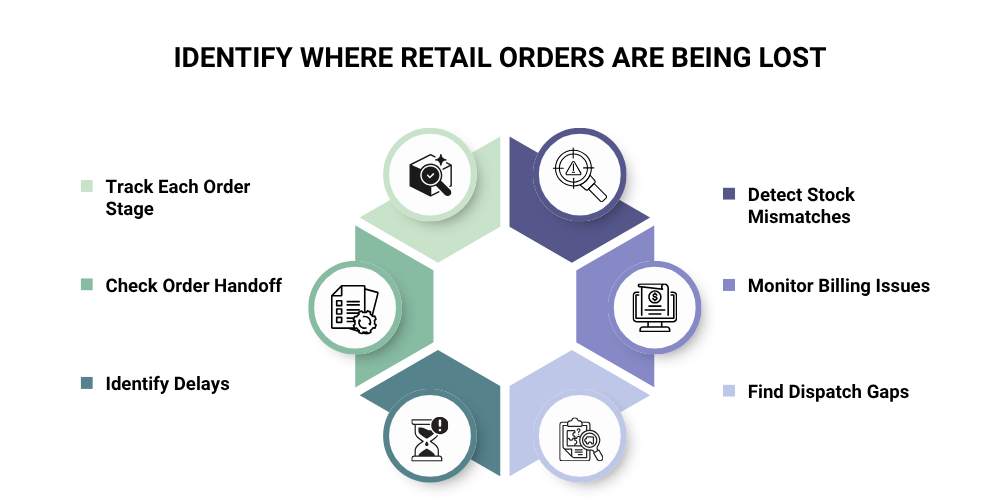
Track Orders From Capture to Fulfillment
Don't measure only the number of orders booked. Follow the order from the initial retail visit through processing, invoicing, and dispatch.
This gives businesses a complete view of the order fulfillment journey and makes it easier to identify where the numbers begin to drop.
Monitor Pending and Delayed Orders
A pending order should not disappear into a general list. Track how long orders remain pending and why they are waiting. For example, separate orders waiting for stock from orders waiting for approval or correction.
This is a practical way to track orders from sales reps and identify where distributor operations need attention.
Compare Booked Orders With Invoices
The number of orders collected by sales reps should be compared with the number eventually invoiced. Large differences may indicate problems in order processing, stock availability, or data entry.
This comparison can also help managers identify patterns across territories, distributors, products, and sales representatives.
Measure Order-to-Dispatch Time
Measure the time between order capture and dispatch. Order-to-dispatch time is a useful operational metric because it shows how quickly a booked order moves toward delivery.
If certain distributors, territories, products, or sales reps consistently show longer processing times, the business can investigate the reason.
Analyze Order Errors and Cancellations
Look for repeated patterns. Are certain SKUs frequently corrected? Are particular distributors receiving incomplete information? Are orders often cancelled because of stock shortages?
Tracking order errors and cancellations can reveal problems that are difficult to notice when teams rely only on individual follow-ups.
Businesses can also monitor order fulfillment rate, pending orders, and processing time together to get a clearer picture of overall sales execution.
What Does a Connected Retail Order Process Look Like?
A better process does not necessarily mean adding more steps. In many cases, it means removing unnecessary handoffs.

Capture Orders During the Retail Visit
The sales rep should be able to record the retailer's requirements while the conversation is happening. Product details, quantities, customer information, and other relevant order data should be captured accurately at the source.
This approach makes sales rep order booking more structured and reduces the need to recreate information later.
Send Orders Directly to the Distributor
Once an order is submitted, it should reach the appropriate distributor or sales workflow without requiring the rep to send a separate message or make a phone call. This reduces the chance of orders being forgotten between the field and office.
It also supports a more reliable automated order processing workflow.
Check Product and Stock Availability
Sales teams need useful information when booking orders. Better visibility into products and availability can reduce unrealistic commitments and avoid unnecessary corrections later.
This connects inventory visibility with retail sales execution, helping sales reps make better decisions during customer visits.
Track Processing and Fulfillment
An order should have a visible status. Whether it is pending, processed, partially fulfilled, invoiced, or dispatched, the sales team should be able to see what is happening.
This is the foundation of effective order status tracking and gives managers better sales team visibility.
Confirm Order Completion
The final goal is not simply capturing an order. The goal is getting the right products to the retailer.
Closing the loop between order booking and fulfillment helps sales teams understand whether the original retail demand was actually converted into a completed transaction.
That is why a good order management app should support the journey from order capture through fulfillment rather than stopping at the moment the order is submitted.
How Can Field Sales Technology Reduce Retail Order Leakage?
Field sales technology can connect activities that are often handled separately. Instead of relying on paper notes, calls, spreadsheets, and scattered messages, sales teams can capture customer information and orders directly from the field.
The biggest advantage is not simply replacing paper with a mobile application. It is creating a clearer flow of information.
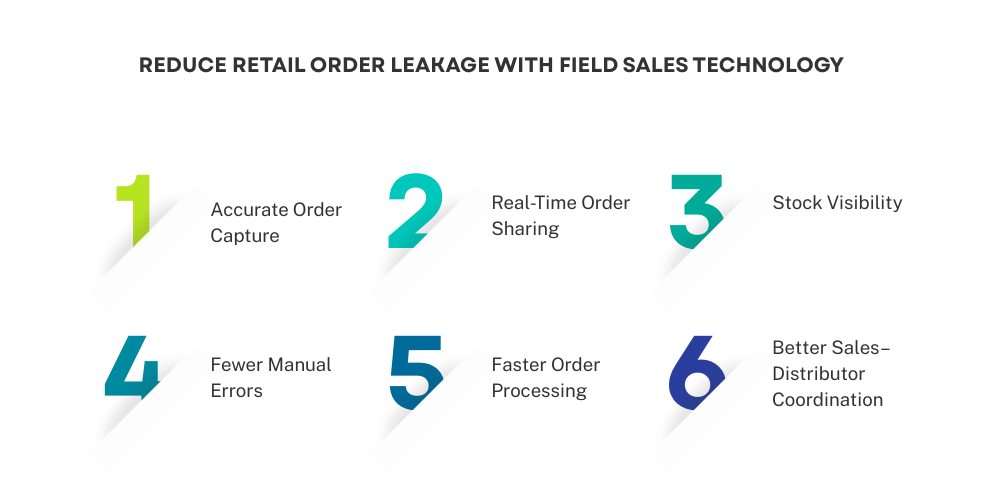
A sales representative can record an order during the customer visit. The information can then move through the relevant sales and distribution workflow without repeated manual entry.
This is where field sales automation and sales force automation can support a more connected process.
Managers can also gain better visibility into orders, customer activity, sales performance, and field execution.
For businesses with large field teams and distributor networks, this connection becomes particularly useful because small process gaps multiply quickly as the number of retailers and daily orders increases.
A mobile sales system can also support mobile order booking, retail order tracking, customer visit records, and sales reporting from the field.
The goal is simple: make it easier to know what was ordered, who submitted it, where it is in the process, and whether it was eventually fulfilled.
How Delta Sales App Helps Connect Sales Reps and Distributors
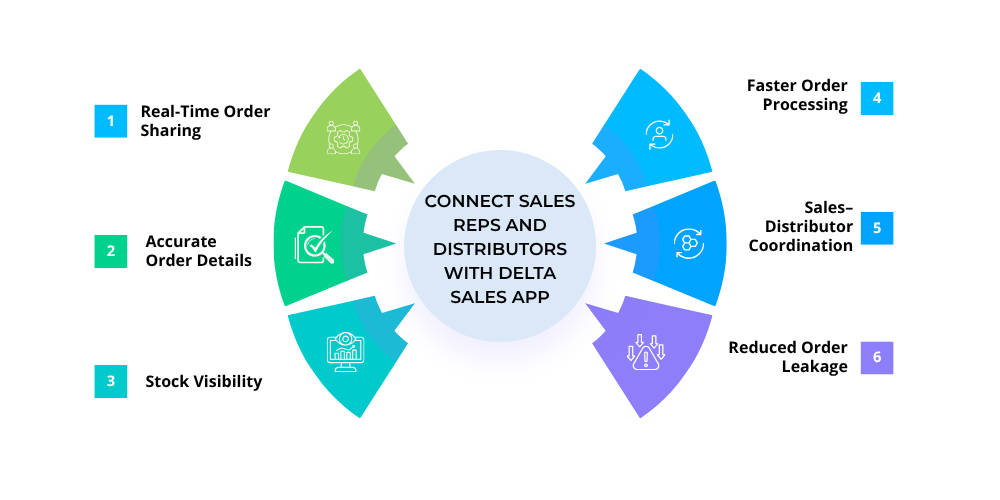
Delta Sales App helps businesses connect field sales activities with the order and distribution process. Instead of keeping retailer visits, order booking, and distributor coordination in separate channels, sales teams can manage these activities through one connected workflow.
Here is how Delta Sales App can help:
Capture Orders During Retailer Visits
Sales representatives can use the app for sales rep order booking and order capture directly from the retailer location. This reduces dependence on handwritten notes, phone calls, and scattered messages.
Keep Sales Activities Connected
Customer visits, order booking, follow-ups, and other field activities can be managed within a connected sales and distribution management process. Managers get better visibility into what is happening across different territories.
Improve Order Visibility
With better real-time order visibility, sales managers can track order-related information and identify pending activities without relying on repeated calls or manual updates from field teams.
Reduce Manual Order Errors
Digital order capture helps reduce errors caused by copying information from notebooks, messages, or calls into another system. This can improve order data accuracy and reduce unnecessary rework.
Connect Field Teams With Distribution Operations
A connected workflow makes it easier to move information from the retailer visit toward distributor processing. Businesses can follow a clearer process:
Customer Visit → Order Capture → Distributor Processing → Fulfillment → Sales Execution
Improve Sales Rep and Distributor Coordination
When order information is easier to access and track, sales representatives and distribution teams can spend less time searching for updates and more time acting on retailer requirements.
For businesses looking at how field sales automation prevents lost orders, the goal is not simply to digitize the sales rep's daily work. The bigger benefit is creating visibility across the order journey so that fewer orders are delayed, overlooked, or lost between field sales and distribution.
Conclusion
Retail orders do not always get lost because someone forgot to process them. Often, the real issue is a gap between sales reps, distributors, and the systems they use.
An order can be collected correctly but still get delayed if it is submitted late, manually re-entered, difficult to track, or disconnected from stock and processing information.
A better retail order management process gives teams visibility from order capture to sales order tracking and order fulfillment. This helps reduce errors, follow-ups, and delays while keeping sales reps and distributors aligned.
Delta Sales App helps businesses streamline field order booking and improve real-time order visibility across their sales operations.
Want to reduce gaps between sales reps and distributors?
Book a demo of Delta Sales App and see how it can improve your order management process.