
What Causes Sales Representatives to Spend Too Much Time Between Visits?

A sales rep can be busy all day and have a nonproductive sales day. The reason often lies in the time between visits from the customer. Hours can be lost driving inefficient routes, searching for outlets, waiting for customers, figuring out the next stop, updating paperwork, or manually taking orders, all without making a single sale.
But in the field, these little delays can quickly become a huge productivity problem. The rep who spends too much time moving from customer to customer may make fewer calls, see fewer retailers, miss order opportunities, and have trouble maintaining the desired frequency of sales calls.
The problem becomes even harder to identify when managers cannot see what is happening in the field. Without accurate information about travel time, customer visits, routes, and daily activities, it is difficult to determine whether time is being lost because of inefficient territory management, poor sales beat planning, excessive travel, or administrative work.
That’s why reducing the time between sales visits isn’t just about having reps work faster. It requires an improved knowledge of the organization of sales territories, the planning of routes, the scheduling of customer visits, and the tracking of field activities.
In this blog, we’ll cover the common reasons sales reps waste time between customer visits, how those delays impact field sales productivity, and the actionable strategies businesses can implement to reduce those delays and improve sales performance.
Common Causes of Time Wastage Between Sales Visits
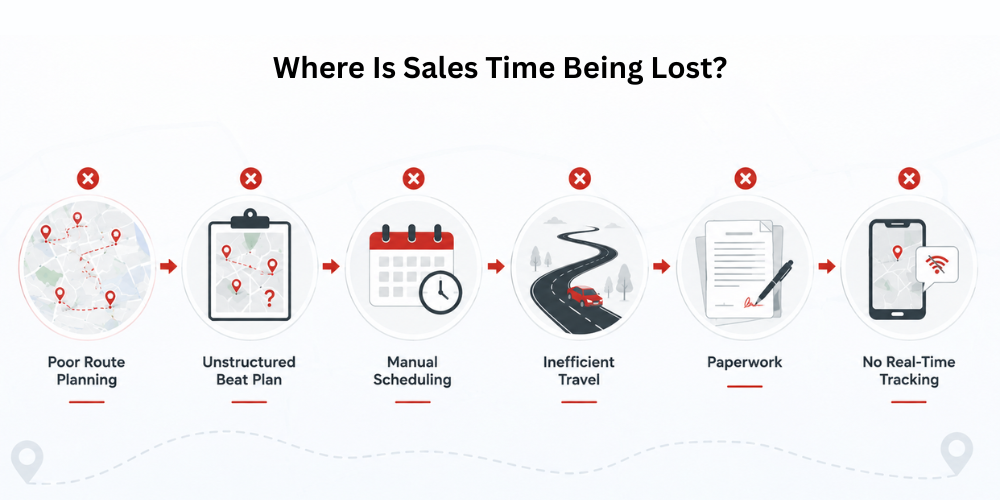
Long gaps between customer visits usually come down to operational inefficiency, not a rep slacking off. Poor planning, manual processes, inefficient routes, and limited visibility all eat into field time. Pinning down the actual cause is what tells a business where productivity is leaking and what actually needs to change.
-
Poor Route Planning and Territory Management
When customer locations aren't organized well within a territory, reps end up burning time bouncing back and forth: retracing the same roads, doubling back between areas, or covering customers spread far apart on the same day. Poor territory management also creates uneven workloads, where one rep ends up with too many customers scattered across too much ground. Organizing customers by location, sales potential, and visit frequency is what actually makes daily travel efficient.
-
Lack of a Structured Sales Beat Plan
Without a structured beat plan, reps end up deciding on the fly who to visit and when. That leads to patchy coverage, missed visits, and a lot of wasted movement through the territory. A well-built beat schedule gives reps a clear list of customers to hit on specific days, keeps visit frequency where it needs to be, and cuts out the time spent just figuring out where to go next.
-
Manual or Outdated Scheduling Processes
Running sales schedules through spreadsheets, paper, phone calls, or messaging apps creates delays that shouldn't exist. If a rep is out, a customer's availability changes, or priorities shift, someone has to manually update everything and get the word out. That's where outdated information, missed visits, and lopsided workloads creep in. Automated scheduling fixes this by making it easy to build and update the schedule while keeping reps aligned with the actual plan for the day.
-
Excessive Travel Time Due to Inefficient Routes
Travel between customers is unavoidable, but a bad route makes it take way longer than it needs to. If a rep visits customers in the wrong order, that means backtracking, retreading the same ground, or unnecessary long hauls, and across a whole day of visits, those extra minutes stack up into real lost selling hours. Route optimization arranges visits in a sequence that actually makes sense, cutting unnecessary travel so reps spend more of the day with customers instead of in the car.
-
Unproductive Time Spent on Order Booking or Paperwork
Reps often have to handle orders, customer info, reports, and other admin work during or after a visit. Doing that by hand means writing something down once and then typing it into a system again later, which slows down the next visit and opens the door to data-entry mistakes. Digital order management and reporting let reps capture everything directly through a mobile app instead, cutting out the paperwork and speeding up routine field work.
-
Lack of Real-Time Sales Rep Tracking
When managers can't see what's happening in the field, long gaps between visits are hard to explain, let alone fix. A basic attendance system tells you when someone clocked in, not where they went or how much time they burned traveling between stops. Real-time GPS tracking system gives that visibility: where the rep moved, how long each visit took, and what the travel pattern actually looked like. That lets managers catch unusual delays, understand what a territory's actually up against, and make real decisions about routes and productivity instead of guessing.
How Poor Time Management Impacts Field Sales Productivity
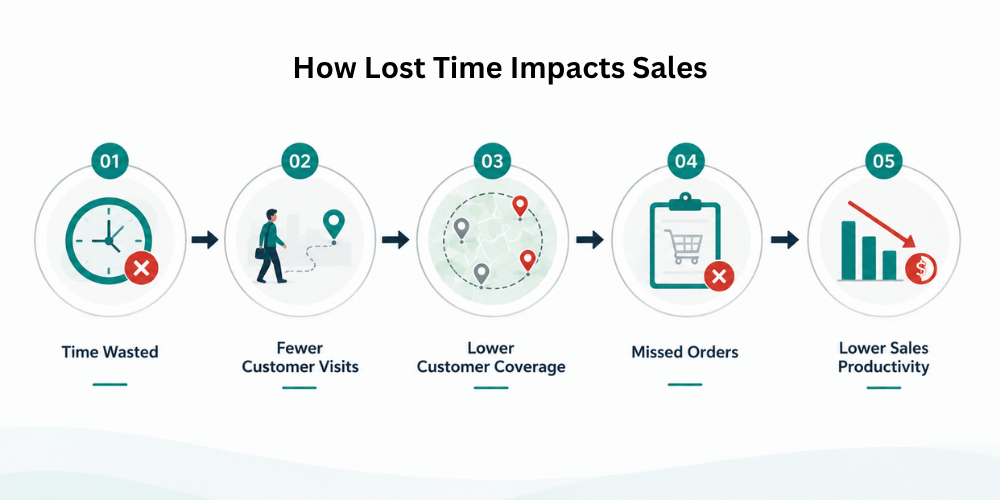
Smart time management in field sales is essential for connecting with customers, ensuring regular visits, and maximizing the time available for selling each day. When sales representatives waste time between appointments, the impact goes beyond just a few missed calls. This lost time can affect order volumes, hurt sales performance, create tension in customer relationships, and reduce the overall success of the sales team.
-
Reduced Customer Visit Frequency
When representatives spend excessive time on travel, waiting, planning routes, or handling administrative tasks, it cuts into their valuable time with customers. Consequently, they may have to delay or even miss planned visits, which diminishes their overall reach and frequency of customer interactions. This issue is especially critical for fast-moving consumer goods (FMCG) and distribution companies, where retailers depend on consistent visits for restocking and collecting orders. Over time, these irregular visits can strain customer relationships and make it increasingly challenging for sales teams to uphold their intended coverage.
-
Missed Sales Opportunities and Lower Order Volumes
Every missed or delayed visit is a potential sale slipping away. A retailer that doesn't get visited might have an order sitting there uncollected, a stock issue nobody caught, or a missed shot at introducing a new product or promotion. When that happens repeatedly across a territory, it drags order volumes and revenue down with it. Managing time well is what lets reps actually reach the right customers and keep those order-collection opportunities coming instead of letting them slip.
-
Impact on Sales Rep Performance Metrics
Poor time management shows up directly in the metrics used to judge a rep: fewer daily calls, weaker customer coverage, fewer productive visits, smaller order values. But just staring at those numbers won't tell you why performance dropped. Travel time, visit duration, planned vs. actual visits, productive calls, and sales per visit give the context needed to figure out whether the problem is the rep or the process they're stuck working within.
-
Effect on Overall Sales Team Accountability
Without real visibility into the field, holding a team accountable fairly gets hard. A low visit count could come from poor time management, an unrealistic territory, bad routing, or just genuine delays on the customer's end, and there's no way to tell which without the data. Field sales tracking system and reporting show what's actually happening between visits and line up the planned activity against what really happened. That creates real accountability, and it also points managers toward whatever actually needs fixing, whether that's planning, training, or the tools reps are working with.
Solutions to Reduce Time Between Sales Visits
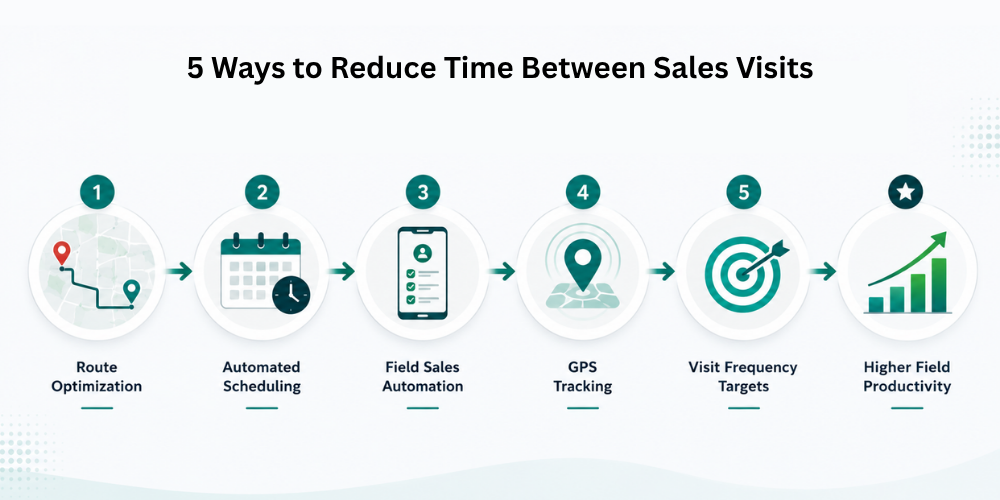
Reducing the time between sales visits is not about pushing representatives to move faster. It is about removing the operational problems that cause unnecessary delays. Businesses can improve field productivity by combining better route planning, automated scheduling, real-time visibility, and clear customer coverage targets.
-
Implementing Sales Route Optimization Tools
Sales route optimization empowers representatives to navigate more effective paths between customers. By organizing visits based on customer locations, territories, and priorities, representatives can avoid unplanned sequences. This thoughtful planning minimizes unnecessary travel, backtracking, and redundant movements through the same areas. For field teams managing extensive territories, optimized routes not only save travel time but also open up more opportunities for meaningful customer interactions.
-
Automating Sales Rep Scheduling
Scheduling sales representatives manually can be a time-consuming process, especially for businesses with numerous reps and extensive customer bases. By utilizing sales rep scheduling software, managers can efficiently craft organized daily or weekly schedules that consider territories, customer needs, and how often visits are required. When adjustments to these schedules are necessary, the software simplifies the update process, allowing for quick communication with representatives without the hassle of juggling multiple spreadsheets, phone calls, or messages.
-
Using Field Sales Automation Software
Field sales automation software transforms the way sales representatives engage with their daily tasks by bringing essential activities into a unified digital platform. Rather than juggling customer visits, orders, reporting, attendance, and field activities individually, representatives can seamlessly manage these responsibilities through a user-friendly mobile app. This shift not only lightens the administrative load but also enhances sales managers' insight into everyday operations. By streamlining repetitive tasks, representatives can dedicate more time to building meaningful relationships with customers and focusing on what truly matters in their roles.
-
Leveraging GPS Tracking for Real-Time Visibility
GPS tracking for sales teams empowers managers to gain insights into how their representatives are utilizing their time in the field. By analyzing location data, managers can pinpoint where representatives are located, track the timing of customer visits, and assess the duration of travel between different sites. This enhanced visibility allows managers to detect any unexpected delays, optimize travel routes, and address territory-related issues. Additionally, it offers valuable information that can inform and refine future sales strategies, moving beyond the limitations of traditional manual reporting.
-
Setting Clear Visit Frequency Targets
Not all customers require the same frequency of visits. Companies should establish visit goals that reflect the value of each customer, their sales potential, ordering habits, and the specifics of their territory. For instance, larger retailers might benefit from more frequent interactions compared to smaller shops. By setting clear visit frequency goals, sales representatives can better identify which customers need consistent engagement, while managers can effectively track customer coverage and spot any missed opportunities. When paired with sales data, these goals enhance the focus and efficiency of field sales planning.

Best Practices for Improving Field Force Efficiency
There is more to shortening sales cycles than just installing new technology. Businesses also need to look at how territories are organized, how reps schedule their day-to-day activities, and how managers use sales data. When coupled with the right field sales tools, these practices can help build a more efficient and consistent sales operation.
-
Territory Realignment for Better Coverage
Sales territories need regular review so reps aren't stuck covering areas that are too big or badly laid out. As a business adds new retailers, distributors, or outlets, a territory structure that made sense a year ago might not work anymore. Managers should look at customer density, sales potential, travel distance, visit frequency, and rep workload to spot the territories that need adjusting. Realigning them cuts unnecessary travel and gets reps better customer coverage in the process.
-
Training Sales Reps on Time Management
Good routes and schedules only go so far. Reps still need to know how to actually manage their time once they're in the field. Training needs to cover route adherence, customer prioritization, preparing for visits, order collection, and reporting that doesn't eat half the day. Reps should also know what actually has to happen during a visit and what can be handled faster through digital tools instead. Solid time-management habits are what cut avoidable delays while keeping the customer interaction itself productive.
-
Using Data-Driven Sales Reporting
Sales data shows managers where field productivity is actually improving and where time is still leaking out. Instead of just watching total sales, it's worth tracking planned vs. completed visits, customer coverage, visit frequency, travel time, productive calls, order value, and sales per rep. Look at that regularly, and it surfaces inefficient territories, delays that keep repeating, and shifts in how a rep is performing. With data-driven reporting, managers can adjust routes, schedules, territories, and targets based on what's actually happening, not a guess.
How Delta Sales App Helps Reduce Time Between Visits
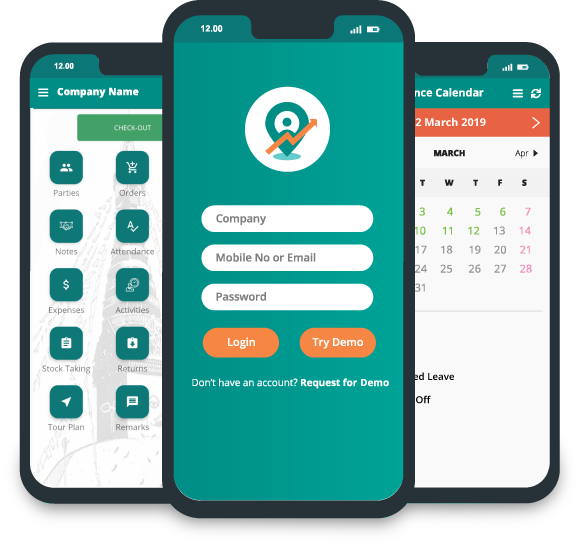
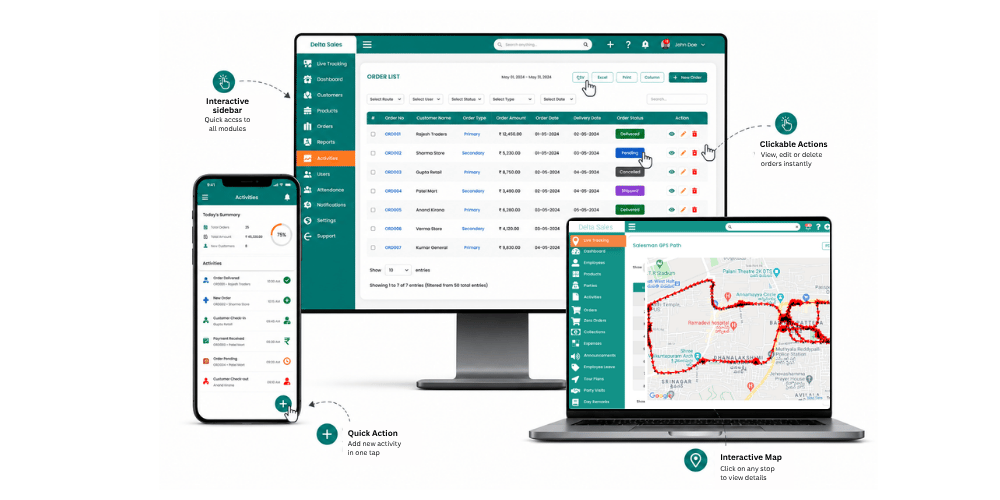
Cutting down the time between visits comes down to two things: seeing where the time is actually going and giving reps the tools to plan and run their day efficiently. Delta Sales App brings GPS tracking, beat planning, route management, order booking, and sales reporting into one platform, so managers aren't stitching together separate tools or manual processes. They can plan field activity, watch how it's executing, and spot where productivity can improve, all from one place.
-
Real-Time Sales Rep Tracking with GPS
Delta Sales App gives managers real-time GPS-based employee location tracking to see where reps actually are during the day. Managers can see field movement and customer visits, which makes it a lot easier to catch unusual gaps between visits or figure out whether a delay came from travel or something else in the field. That same visibility also helps businesses evaluate actual routes and make smarter calls on territory and sales planning.
-
Automated Beat Planning and Route Optimization
A well-structured sales beat plan empowers representatives to understand exactly which customers to visit and when. The Delta Sales App is designed to assist businesses in planning and managing these sales beats, taking into account customer locations, territories, and specific visit needs. By enhancing beat planning, it minimizes unnecessary travel and backtracking, allowing representatives to provide consistent coverage to their customers. This approach not only organizes daily field routes but also saves valuable time that would otherwise be spent figuring out the next destination.
-
Instant Order Booking to Save Field Time
Collecting orders manually and dealing with paperwork can slow down every customer visit. With the Delta Sales App, representatives can easily jot down customer orders right from their mobile devices while they're out in the field. This digital approach not only cuts down on the hassle of paper records and repetitive data entry but also allows representatives to wrap up the ordering process more smoothly, enabling them to focus on their next customer without unnecessary delays.
-
Visit Reports and Performance Dashboards
The Delta Sales App empowers managers to keep a close eye on field activities through insightful visit reports and engaging performance dashboards. By analyzing details about customer visits, orders, sales activities, and other field operations, managers can gain a clearer picture of how effectively their representatives are utilizing their time. This allows them to compare what was planned versus what was accomplished, spot any productivity gaps, and leverage real-world data to enhance future sales strategies.
-
Territory and Time Management Made Simple
Managing a large field sales team gets a lot easier when customer info, territories, beats, visits, orders, and sales activity all live in one connected system instead of scattered across five different tools. Delta Sales App handles territory management and time management together, giving managers real visibility into what's actually happening in the field day-to-day.
Conclusion
Time lost between visits doesn't look like much as a single delay, but multiply that across a whole sales team and it adds up to real hours of lost selling time. Poor route planning, unstructured beats, sloppy scheduling, too much travel, manual order booking, and limited field visibility all feed into that gap.
The fix isn't just telling reps to squeeze in more visits. It's figuring out where the time is actually going and fixing the process behind it. Better territory management, route optimization, structured visit schedules, digital order management, and real-time GPS tracking all give reps back more of their working day for actual customer interactions. Field sales automation software brings all of that together, letting businesses monitor field performance and make decisions based on real data instead of guesswork. Cut down the wasted time between visits, and every rep turns more of their day into productive conversations, timely orders, and new opportunities.
Ready to reduce wasted time in your field sales operations? Book a free demo of Delta Sales App and see how smarter field sales management can help your team improve productivity, coverage, and performance.
FAQs
1. What are the main reasons sales reps take too long between visits?
The most common causes include poor route planning, lack of a structured beat plan, manual scheduling, excessive travel due to inefficient territory mapping, and time lost in manual order booking or paperwork.
2. How does poor time management between visits affect sales performance?
It directly reduces the number of customers a rep can visit in a day, which lowers order volume, delays follow-ups, and impacts overall sales targets. Over time, it also affects customer relationships due to inconsistent visit frequency.
3. How can companies reduce travel time for field sales reps?
Using route optimization tools, realigning sales territories based on customer density, and automating beat plans are the most effective ways to cut down unnecessary travel time between visits.
4. Can technology help solve the problem of time gaps between sales visits?
Yes. Field sales automation tools with GPS tracking, automated scheduling, and real-time reporting help managers identify inefficiencies and help reps stick to optimized routes, significantly reducing idle time.
5. How often should a sales rep visit the same customer?
This depends on the customer's order cycle and business type, but most FMCG and distribution businesses recommend visit frequencies of once a week to once every two weeks, adjusted based on customer priority (A/B/C classification).
6. How does Delta Sales App help reduce time between sales visits?
Delta Sales App helps sales reps and managers cut down time gaps through GPS-based real-time tracking, automated beat planning, and instant order booking, reducing manual work and travel inefficiencies, so reps can complete more visits in less time while managers get full visibility through visit reports and dashboards.