
AI in Field Sales: What's Actually Useful vs. What's Just a Buzzword

Artificial Intelligence (AI) has become one of the most talked-about technologies in business today. From customer service chatbots to advanced analytics platforms, organizations across industries are exploring ways to leverage AI for better efficiency and decision-making. The field sales industry is no exception.
As businesses seek to improve productivity, reduce operational costs, and enhance customer engagement, AI-powered solutions are increasingly being incorporated into sales processes. However, amidst all the excitement, many organizations struggle to distinguish between AI capabilities that genuinely deliver value and those that are primarily marketing buzzwords.
Understanding where AI creates measurable business impact is essential for making informed technology investments.
Why AI Has Become a Hot Topic in Sales Technology
The modern sales environment generates enormous amounts of data every day. Sales representatives collect customer information, record visits, update orders, track inventories, and manage territories. Processing and analyzing this data manually can be time-consuming and prone to errors.
AI offers the ability to analyze large datasets quickly and identify patterns that humans might miss. Combined with growing adoption of field sales automation, AI is helping businesses optimize workflows, improve visibility, and support faster decision-making.
As competition intensifies, organizations are increasingly looking for technologies that can provide a strategic advantage and improve operational efficiency.
Key Factors Driving AI Adoption in Sales Technology
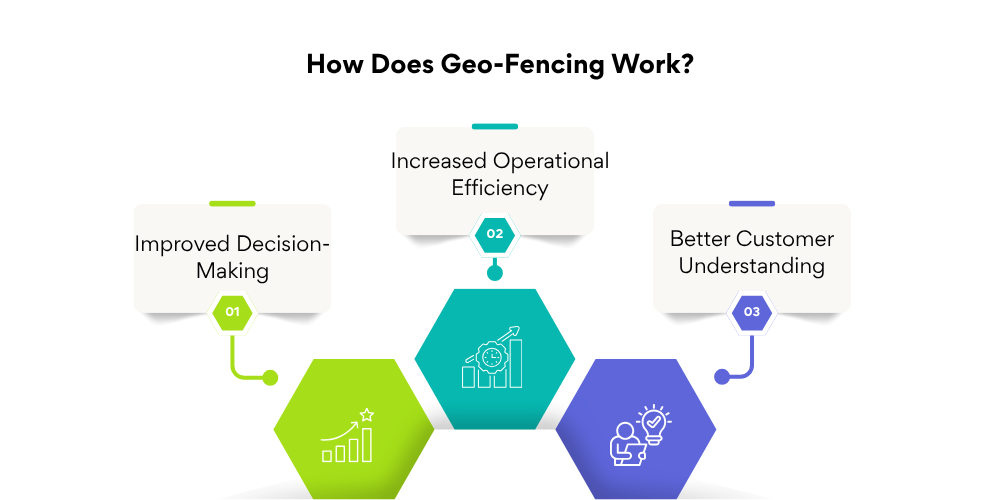
1. Improved Decision-Making
AI transforms raw sales data into meaningful insights, helping businesses make smarter decisions regarding sales strategies, resource allocation, and customer engagement.
2. Increased Operational Efficiency
By automating repetitive tasks such as data entry, reporting, scheduling, and activity tracking, AI allows sales representatives to focus more on selling and relationship building.
3. Better Customer Understanding
AI can identify buying patterns, customer behavior trends, and engagement opportunities, enabling sales teams to deliver more personalized and effective sales experiences.
Understanding AI in Field Sales
AI in field sales refers to the use of machine learning algorithms, predictive models, and intelligent automation to assist sales teams in planning, execution, and performance analysis.
Unlike traditional software that simply records information, AI-enabled systems can analyze historical data, identify trends, generate recommendations, and automate routine tasks. This allows sales professionals to focus more on customer interactions and less on administrative activities.
The goal of AI is not to replace sales representatives but to augment their capabilities and help them work smarter.
Core Capabilities of AI in Field Sales
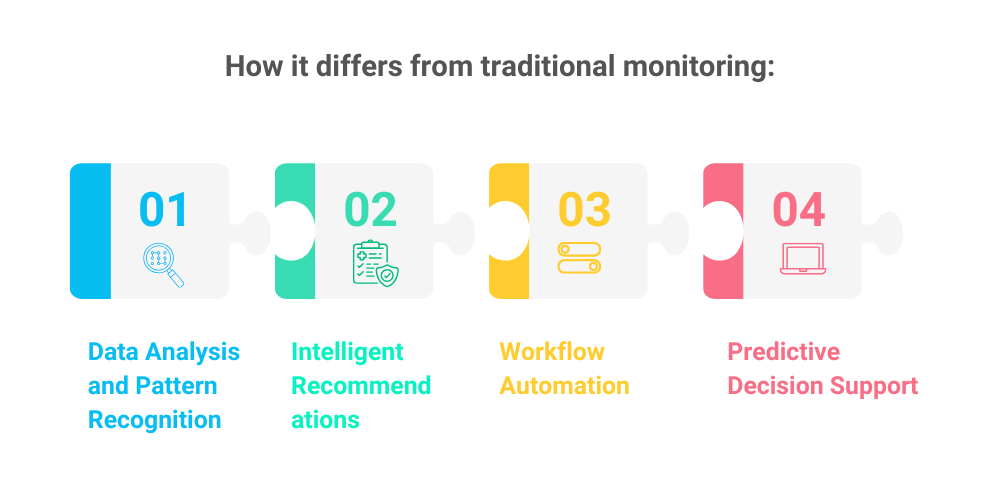
1. Data Analysis and Pattern Recognition
AI can process large volumes of sales data and uncover trends, customer behaviors, and market opportunities that may not be immediately visible through manual analysis.
2. Intelligent Recommendations
Based on historical performance and customer data, AI can suggest the next best actions, helping sales representatives prioritize activities and improve productivity.
3. Workflow Automation
AI reduces the burden of repetitive administrative tasks such as data entry, report generation, visit logging, and activity tracking, allowing teams to focus on revenue-generating activities.
4. Predictive Decision Support
By forecasting potential outcomes and identifying risks early, AI helps businesses make proactive decisions rather than reacting after problems arise.
Ultimately, AI in field sales is about empowering sales teams with better information, faster insights, and smarter tools. Organizations that use AI strategically can improve efficiency, enhance customer relationships, and create a more data-driven sales operation.
AI Features That Deliver Real Business Value
Not every AI feature provides meaningful returns. The following capabilities have demonstrated measurable value across field sales organizations.
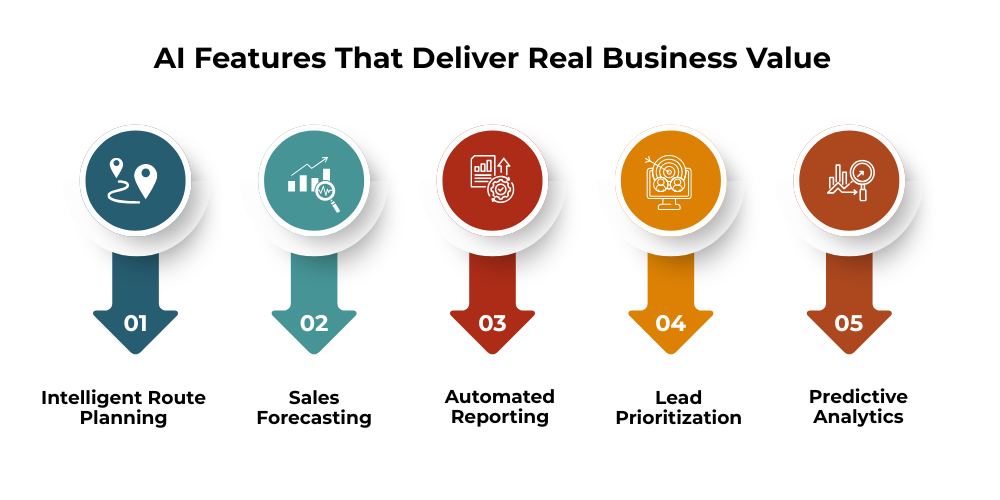
Intelligent Route Planning
One of the most practical applications of AI is route optimization. AI systems can evaluate traffic conditions, customer locations, visit priorities, and travel distances to suggest the most efficient routes.
This helps sales representatives spend less time traveling and more time engaging with customers, ultimately improving productivity and territory coverage.
Sales Forecasting
Accurate forecasting has always been a challenge for sales leaders. AI improves sales forecasting by analyzing historical sales data, market trends, seasonality, and customer behavior patterns.
More accurate forecasts enable businesses to allocate resources effectively, manage inventory efficiently, and make informed strategic decisions.
Automated Reporting
Sales teams often spend significant time creating reports and updating records. AI-powered systems can automate data collection and reporting processes.
By reducing administrative workloads, organizations can improve efficiency and ensure that managers have access to real-time insights without relying on manual updates.
AI-driven automated reports and analytics help businesses monitor sales activities, track performance metrics, identify trends, and generate actionable insights automatically. This enables faster decision-making while improving overall sales visibility and operational efficiency.
Lead Prioritization
Not every prospect has the same likelihood of converting into a customer. AI-driven lead management systems can evaluate multiple data points to rank opportunities based on their probability of success.
This allows sales representatives to focus their efforts on high-potential prospects and improve conversion rates.
Predictive Analytics
Modern sales organizations increasingly rely on predictive analytics to anticipate future outcomes. AI can identify buying patterns, customer preferences, and potential risks before they become significant challenges.
These insights enable businesses to take proactive actions rather than reacting after problems occur.
AI Buzzwords That Often Create Unrealistic Expectations
While AI offers genuine benefits, many technology vendors use exaggerated claims to attract attention.
Common buzzwords include:
- Fully Autonomous Sales Systems: Some vendors suggest AI can manage entire sales operations independently, but human oversight remains essential for strategy, relationship management, and customer engagement.
- Instant Revenue Growth Through AI: AI can improve efficiency and decision-making, but sustainable revenue growth requires proper implementation, quality data, training, and consistent execution.
- AI Replacing Human Sales Representatives: AI supports sales professionals with insights and automation, but relationship building, trust, negotiation, and closing deals still require human expertise.
- Zero-Effort Sales Management: Successful AI adoption requires setup, monitoring, data management, and employee training to achieve meaningful business results over time.
- Completely Automated Customer Relationships: While AI can enhance communication and personalization, genuine customer relationships management depends on human interactions, empathy, trust, and long-term engagement.
In reality, AI is a support tool rather than a replacement for human expertise. Successful sales outcomes still depend on relationship building, negotiation skills, and customer trust.
Organizations should remain cautious when evaluating vendors that promise unrealistic results with minimal effort.
Common Myths About AI in Field Sales
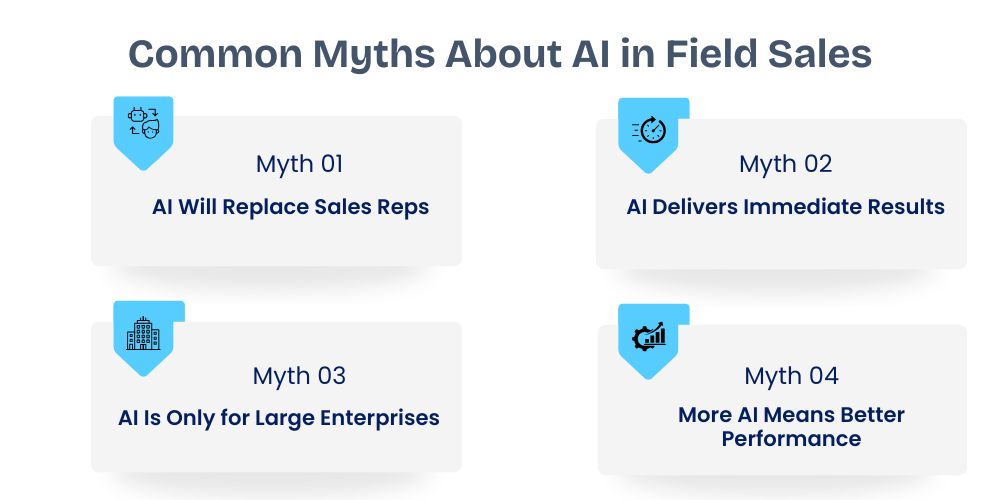
Myth 1: AI Will Replace Sales Reps
While AI can automate routine tasks and provide recommendations, successful selling still depends on human relationships, trust, communication skills, and personalized customer interactions that technology alone cannot replicate effectively.
Myth 2: AI Delivers Immediate Results
AI implementation is a gradual process that requires quality data, employee adoption, system training, and continuous optimization before businesses can experience meaningful improvements in productivity and performance.
Myth 3: AI Is Only for Large Enterprises
Modern cloud-based solutions have made AI more affordable and accessible, allowing small and medium-sized businesses to leverage advanced technologies without significant infrastructure investments or budgets.
Myth 4: More AI Means Better Performance
Implementing excessive AI features can create complexity and confusion. Businesses achieve better results when they focus on solving specific operational challenges with practical and relevant AI capabilities.
How AI Helps Field Sales Teams Improve Productivity
Productivity gains are among the most significant benefits of AI adoption.
AI can enhance sales productivity by automating repetitive activities, recommending optimal actions, and reducing administrative burdens. Representatives can spend more time engaging customers and less time managing paperwork.
AI also strengthens territory management by helping organizations allocate resources more effectively and balance workloads across teams.
Through advanced customer insights, sales professionals gain a better understanding of purchasing behavior, preferences, and engagement patterns, allowing for more personalized interactions.
Additionally, AI-powered sales intelligence enables managers to identify trends, monitor opportunities, and make data-driven decisions with greater confidence.
- AI improves route planning efficiency by optimizing travel paths, reducing idle time, and increasing daily productive customer visits.
- AI enhances lead prioritization by identifying high-value prospects and helping teams focus on conversion-ready opportunities.
- AI enables real-time performance tracking by monitoring field activities and delivering instant insights for faster decision-making.
Challenges of Implementing AI-Powered Sales Tools
Despite its advantages, AI implementation comes with challenges.
Data quality remains one of the biggest obstacles. AI systems depend on accurate and consistent information to generate reliable recommendations.
Integration can also be difficult when businesses use multiple software platforms. Effective CRM integration is often necessary to ensure seamless information flow across departments.
Employee resistance may present another challenge. Sales teams need adequate training and support to understand how AI can enhance rather than complicate their work.
Organizations must also address concerns related to privacy, security, and regulatory compliance when handling customer data.
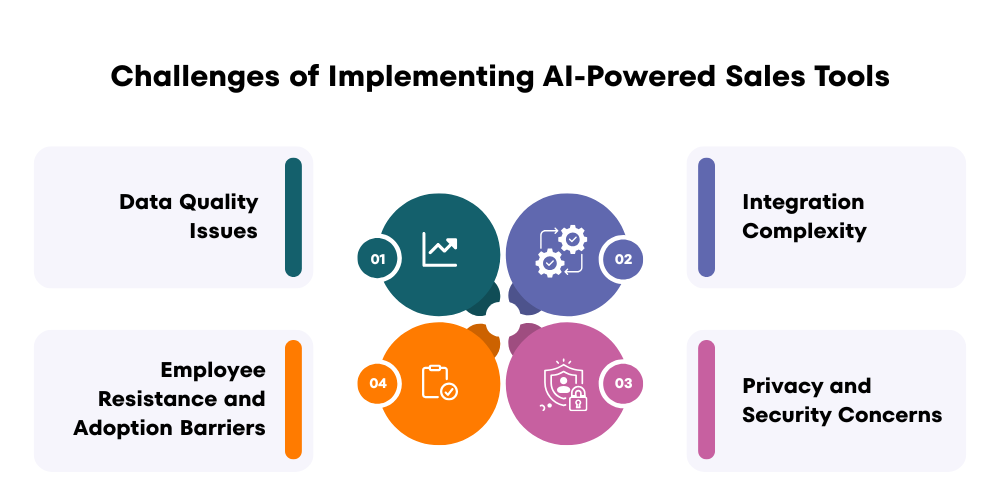
1. Data Quality Issues
Data quality remains one of the biggest obstacles in AI adoption. AI systems depend on accurate, complete, and consistent data to generate reliable insights and recommendations. Poor data leads to inaccurate forecasting and weak decision-making.
2. Integration Complexity
Integration can be difficult when businesses use multiple software platforms across sales operations. Effective CRM integration is often necessary to ensure seamless data flow, system compatibility, and unified visibility across departments.
3. Employee Resistance and Adoption Barriers
Employee resistance may present another challenge during implementation. Sales teams often require proper training, onboarding, and ongoing support to understand how AI improves productivity rather than complicating their workflow.
4. Privacy and Security Concerns
Organizations must also address concerns related to data privacy, security, and regulatory compliance when handling sensitive customer information. Strong governance policies and secure systems are essential to build trust and avoid risks.
How to Evaluate an AI Solution Before Investing
Before selecting an AI-powered sales solution, businesses should carefully assess their requirements.
Consider the following factors:
- Alignment with Business Goals: Ensure AI solution supports sales strategy, revenue growth, field sales automation, and KPIs effectively.
- Ease of Implementation: Choose AI sales tools with simple deployment, onboarding, field force management, and minimal disruption.
- Scalability: Select scalable AI platform supporting growing teams, territories, sales automation, and expanding business operations smoothly.
- Data Security Capabilities: Ensure secure AI system with encryption, compliance, CRM data protection, and secure field sales tracking.
- User Experience: Prioritize intuitive AI interface improving usability, adoption, sales productivity, and field sales app efficiency.
- Reporting Functionality: Evaluate AI dashboards offering real-time analytics, sales performance tracking, and actionable field insights reporting.
- Integration Options: Check seamless integration with CRM, ERP systems, inventory management, and sales automation software tools.
- Vendor Support: Ensure strong vendor support, training, troubleshooting, onboarding assistance, and continuous AI software improvement services.
Organizations should prioritize solutions that deliver practical value rather than simply offering the latest AI features.
Evaluating how the platform supports field force management, sales performance tracking, and overall operational efficiency can help ensure long-term success.
The Future of AI in Field Sales Management
AI will continue to evolve and become more deeply integrated into field sales operations.
Future advancements are expected to enhance mobile sales tool capabilities, enabling representatives to access intelligent recommendations and real-time insights directly from their devices.
Businesses can also expect improvements in retail execution, helping teams optimize in-store activities and improve visibility across distribution networks.
As AI technology matures, organizations will increasingly benefit from better decision-making, stronger forecasting, and more efficient sales operations.
However, the most successful companies will be those that combine AI-driven recommendations with human expertise and strategic thinking.
Below are the key future developments expected in AI-powered field sales:
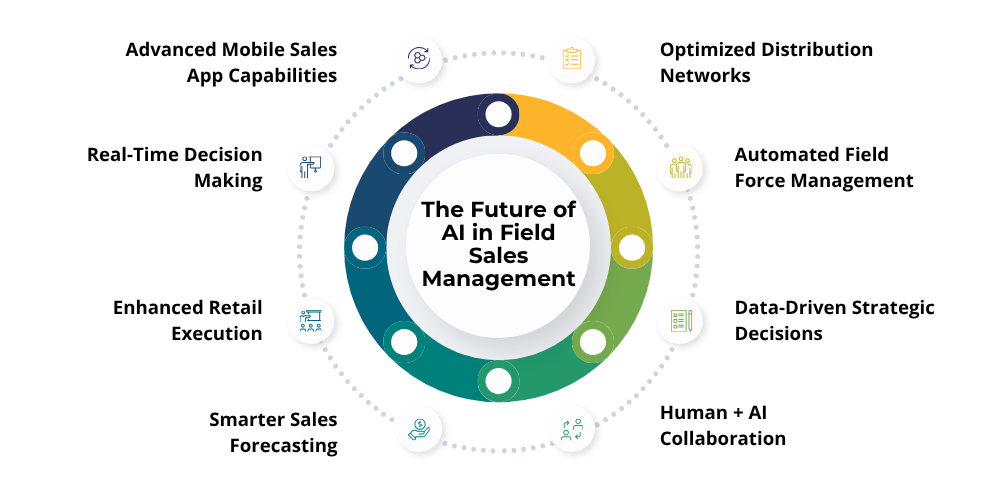
1. Advanced Mobile Sales App Capabilities
AI will deeply integrate with mobile sales apps, enabling field executives to access intelligent recommendations, customer insights, route optimization, and automated task prioritization directly from their devices.
2. Real-Time Decision Making
Field sales teams will benefit from real-time insights that guide visit planning, order suggestions, and upselling opportunities. This will improve speed, accuracy, and overall sales productivity significantly.
3. Enhanced Retail Execution
AI will strengthen retail execution by improving visibility into in-store activities, stock levels, shelf compliance, and distributor performance across multiple retail channels and geographies.
4. Smarter Sales Forecasting
Future AI systems will deliver highly accurate sales forecasting using historical data, market trends, and field inputs, helping businesses reduce uncertainty and improve demand planning.
5. Optimized Distribution Networks
AI will help identify inefficiencies in distribution networks, enabling companies to optimize supply chains, reduce stockouts, and improve product availability across regions.
6. Automated Field Force Management
Field force management will become more automated with AI handling route planning, attendance tracking, performance monitoring, and task allocation for better operational efficiency.
7. Data-Driven Strategic Decisions
Organizations will increasingly rely on AI-driven analytics for strategic planning, allowing leadership teams to make faster, more accurate, and evidence-based business decisions.
8. Human + AI Collaboration
The most successful companies will combine AI-powered recommendations with human expertise, ensuring better customer engagement, stronger relationships, and more effective sales execution.
As AI technology continues to mature, field sales operations will become more intelligent, efficient, and predictive, creating a significant competitive advantage for early adopters.

Final Thoughts
AI is transforming field sales, but not every AI feature deserves the attention it receives. Businesses should focus on solutions that deliver measurable outcomes rather than getting distracted by marketing hype.
Capabilities such as intelligent route planning, forecasting, reporting automation, lead prioritization, and predictive analytics have demonstrated real-world value. At the same time, organizations should remain cautious of exaggerated promises that overstate what AI can achieve.
The future of sales lies in balancing technology with human expertise. Companies that adopt practical AI solutions while maintaining strong customer relationships will be best positioned to achieve sustainable growth and long-term success.
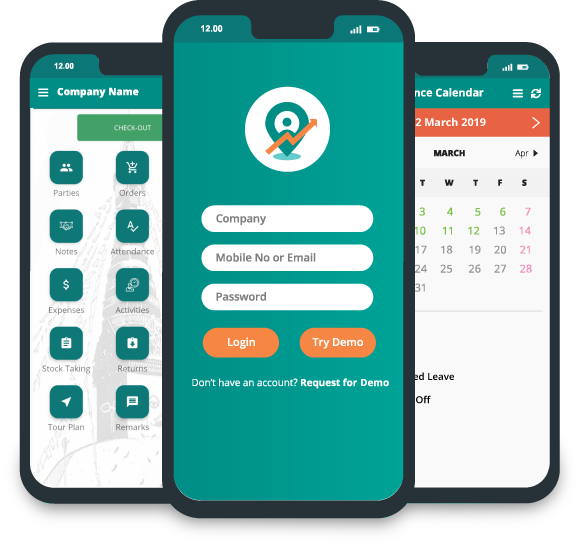
Experience how AI-powered field sales automation can improve productivity, visibility, and decision-making with Delta Sales App.
Book a free demo today and see how Delta Sales App helps you streamline field force management, boost sales performance, and drive smarter execution with real-time insights.