
How AI Is Changing FMCG Sales Execution

Sales execution is where strategy meets reality. It is the moment when products must be available on shelves, visible to customers, and ready to sell. No matter how strong your branding or marketing strategy is, poor execution leads to stock-outs, weak retail presence, and lost revenue.
Traditionally, FMCG sales execution depended heavily on manual planning, distributor intuition, static reporting, and field sales experience. Decisions were often reactive rather than proactive. But today, Artificial Intelligence is reshaping how FMCG companies execute sales at the ground level making operations faster, smarter, and more predictable.
This transformation is not about replacing people. Instead, AI is augmenting human capability, improving decision-making, and driving execution excellence.
Let’s explore how AI is fundamentally transforming FMCG Sales Execution and why companies adopting AI-driven execution are outperforming competitors.
What Is FMCG Sales Execution?
FMCG Sales Execution refers to the structured operational process through which FMCG companies ensure products are properly distributed, visible, stocked, and sold across retail networks and distribution channels.
It is the last and most critical step in the value chain the moment where demand turns into actual sales.
Core Components of FMCG Sales Execution
Field Sales Route Planning and Daily Scheduling
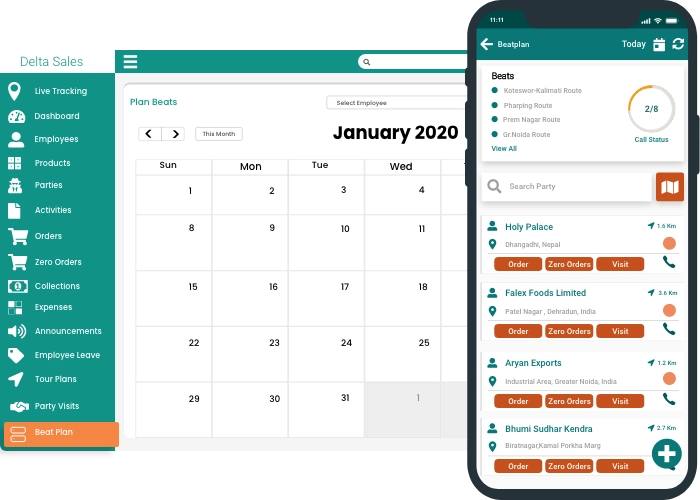
This involves deciding which outlets a field sales representative should visit, in what order, and how frequently. Effective field sales route planning ensures optimal coverage, higher sales productivity, and better execution across all retail outlets.
Distributor and Secondary Sales Management
Execution includes managing distributor stock levels, order flow, and secondary sales (sales from distributor to retailer), ensuring smooth FMCG product distribution and efficient movement across the supply chain.
Retail Order Collection and Fulfillment
Field reps collect orders from retailers, ensure timely processing, and coordinate with distributors for order fulfillment. Proper retail order management reduces stock-outs and improves customer satisfaction.
Inventory Movement and Stock Availability
Companies must maintain the right balance of stock across warehouses, distributors, and retailers to prevent shortages or excess inventory. Optimized inventory management ensures products are available at the right place and the right time.
In-Store Execution and Merchandising Compliance
Execution ensures products are displayed correctly, shelves are stocked, and promotional guidelines are followed. Maintaining merchandising compliance and in-store visibility improves FMCG sales execution and brand presence.
Territory Performance Monitoring
Sales performance is tracked across territories to identify growth areas, underperforming regions, and execution gaps. Effective territory management enables better decision-making and targeted field interventions.
Sales Reporting and Analytics
Data collected from field operations is analyzed to guide decision-making and improve execution strategies. Sales analytics provides actionable insights for FMCG field sales optimization.

Execution is where strategy meets reality. Without strong FMCG sales execution, even the best marketing and branding efforts fail to convert into revenue.
The Traditional Challenges in FMCG Sales Execution
Before AI-driven systems, FMCG execution struggled with structural inefficiencies.
Reactive Decision Making
Sales managers relied on delayed reports weekly or monthly to understand performance. When issues such as declining sales or stock shortages were discovered, the opportunity was already lost. This reactive approach prevented timely intervention and reduced operational agility.
Inefficient Route Planning
Most companies used static route plans based on historical patterns rather than dynamic demand. Field reps often visited low-priority outlets while missing high-potential ones. This led to wasted travel time, uneven territory coverage, and lower productivity.
Poor Retail Visibility
Companies lacked real-time insights into what was actually happening at the retail level. They could not accurately track shelf stock, SKU availability, competitor placement, or merchandising compliance. Without visibility, execution quality suffered.
Inventory Imbalance
Forecasting inaccuracies led to inconsistent stock distribution. High-demand regions experienced stock-outs, while low-demand regions accumulated excess inventory. This caused lost sales, increased carrying cost, and operational inefficiency.
Limited Execution Intelligence
Managers struggled to identify underperforming territories, declining retailers, slow-moving products, and distribution gaps. Decision-making relied heavily on intuition rather than data.
How AI Is Transforming FMCG Sales Execution
Intelligent Route Optimization
Traditional route planning is static and inefficient. AI introduces dynamic route optimization by analyzing outlet sales history, demand patterns, geographic data, travel time, and visit frequency. The system continuously adjusts routes based on real-time conditions and priorities.
Sales representatives are guided toward high-value outlets first, ensuring maximum productivity. Travel time is reduced, visit quality improves, and territory coverage becomes balanced. Over time, companies see improved conversion rates, lower operational cost, and more effective field execution.
Predictive Demand Forecasting
Accurate demand forecasting is essential for efficient execution. AI analyzes historical sales, seasonal trends, consumption behavior, market signals, and external variables such as festivals or regional demand surges. Instead of relying on past averages, companies can predict future demand with greater accuracy.
This enables proactive stock planning, ensuring products are available where demand exists. Stock-outs reduce, excess inventory declines, and distributor replenishment becomes more efficient. Forecasting shifts from reactive estimation to predictive intelligence.
AI-Powered Outlet Prioritization
Retail outlets contribute differently to revenue. AI evaluates outlet potential based on purchase behavior, sales contribution, growth trends, and engagement patterns. It identifies high-value outlets, declining retailers, and growth opportunities.
Sales teams can prioritize visits strategically rather than following fixed schedules. This improves revenue per visit, strengthens retailer relationships, and ensures focused execution where it matters most.
Real-Time Retail Execution Visibility
AI combined with mobile field tools provides continuous visibility into retail execution. Companies can track shelf stock, SKU availability, planogram compliance, competitor shelf share, and merchandising quality in real time.
Advanced systems use image recognition to analyze shelf photos and detect stock levels automatically. This enables immediate response to stock shortages, improving shelf availability and retail presence.
AI-Driven Secondary Sales Intelligence
AI analyzes distributor and secondary sales data to identify patterns, anomalies, and performance gaps. It detects declining orders, slow-moving products, underperforming territories, and distribution issues early.
Managers receive alerts before problems escalate, allowing proactive action rather than reactive correction. This improves distribution efficiency and prevents revenue leakage.
Automated Sales Forecasting for Field Teams
AI forecasts daily sales potential, territory performance, and rep productivity using predictive models. Sales targets become data-driven and realistic, improving accountability and execution quality.
Field teams gain clarity on achievable goals, leading to better planning and improved performance consistency.
Smart Performance Management
AI evaluates field performance using metrics such as visit productivity, conversion ratio, order value, and time utilization. Managers gain deeper insights into individual and territory management.
This enables targeted coaching, skill development, and performance optimization. Over time, execution quality improves across the organization.

Intelligent Promotion Execution
Promotions succeed only when executed correctly in the field. AI ensures promotions reach the right outlets, stock is available during campaigns, and execution compliance is maintained. It also measures sales uplift and promotion effectiveness.
This closes the gap between marketing strategy and real-world execution.
AI-Based Order Recommendations
AI suggests optimal order quantities using sales velocity, inventory levels, demand trends, and seasonality. Retailers receive smarter replenishment guidance, increasing order value while reducing wastage and stock-outs.
Execution Risk Prediction
AI predicts potential risks such as territory decline, distributor inactivity, retail disengagement, and stock imbalance. Early detection allows preventive action before revenue loss occurs.
The Business Impact of AI in FMCG Sales Execution
AI is completely changing how FMCG companies do business. By streamlining supply chains, predicting consumer trends, and personalizing marketing strategies, it enables businesses to adapt quickly to market changes. This rapid adoption highlights how the industry is embracing digital technology to remain competitive.
AI in Product Innovation and Development
AI is revolutionizing how new products are created by analyzing vast amounts of customer feedback, market trends, and competitor information. This helps companies spot gaps in the market and develop products that people really want.
The technology speeds up product development by testing different formulas and predicting how well they’ll sell before actually making anything. This saves time and money on product testing while reducing the chance that new products will fail in the market.
Supply Chain Optimization with AI
AI makes supply chains smarter by creating self-adjusting networks that respond to market changes in real-time. It helps FMCG companies spot and fix potential supply chain problems before they happen, ensuring products flow smoothly from supplier to factory and from factory to consumer.
This smart technology keeps track of inventory, makes warehouses more efficient, and helps companies work better with suppliers and distributors. The result? Lower costs, faster deliveries, and a supply chain that can handle unexpected challenges. The stock is much more optimized with less wastes.
Personalized Marketing and Consumer Insights
AI is changing the marketing game by making it truly personal. It looks at how people behave online, what they say on social media, and what they buy to help create marketing campaigns that really speak to different customer groups.
These AI-powered insights help companies recommend the right products to the right people, set better prices, and create experiences that customers love. This leads to happier customers who stick with the brand and buy more.
Demand Forecasting and Inventory Precision
AI has turned demand forecasting from guesswork into a science. By looking at past sales, seasonal patterns, economic factors, and even weather forecasts, AI can predict future demand with amazing accuracy.
This better forecasting helps FMCG companies keep just the right amount of stock, reduce storage costs, and waste less product. It ensures products are available when customers want them while keeping operational costs down.
Sustainable Practices through AI
In today’s environmentally conscious world, AI helps FMCG companies become more sustainable. It helps use resources more efficiently, reduce energy use, and design packaging that’s better for the environment.
AI keeps track of environmental impact throughout the supply chain, from where materials come from to how products are delivered. This helps companies make choices that are good for both profits and the planet, meeting growing customer demand for sustainable products.

Challenges in Implementing AI in FMCG Sales Execution
Implementing AI faces significant challenges, primarily revolving around data quality and security, a shortage of skilled talent, and high implementation costs. Key hurdles include integrating AI with legacy systems, managing ethical concerns like algorithmic bias, and overcoming internal resistance to change. Organizations must also navigate complex regulatory landscapes and prove ROI
Key Challenges in Implementing AI:
Data Quality and Security: AI requires vast amounts of high-quality, clean data. Ensuring data privacy, compliance with regulations, and protecting sensitive information against breaches are top priorities.
Lack of Skilled Talent: There is a significant shortage of professionals with expertise in AI and machine learning, making it difficult to design, develop, and maintain these systems.
Integration with Legacy Systems: Integrating AI tools into existing, often outdated, infrastructure is a major technical challenge.
Ethical and Legal Concerns: AI models can perpetuate or amplify bias, leading to ethical issues and potential discrimination. Transparency and explainability of "black box" models are also critical, especially in regulated industries.
High Costs and ROI Uncertainty: The initial investment in AI infrastructure, technology, and talent is high, while proving a clear return on investment (ROI) remains difficult.
Internal Resistance and Culture: Employees may resist adopting AI tools due to fear of job displacement or lack of understanding, requiring significant change management
Best Practices for Implementing AI in FMCG Sales Execution
Implementing AI in FMCG Sales Execution requires a focused and structured approach to ensure real operational impact. The following best practices help organizations achieve smarter, faster, and more effective execution outcomes.
-
Define Clear Execution Objectives
Start with specific, measurable goals such as improving shelf availability, reducing stock-outs, optimizing field productivity, and strengthening distributor performance to ensure AI delivers meaningful, execution-focused business outcomes consistently. -
Build High-Quality, Structured Data
Ensure clean, standardized, and real-time data across sales, inventory, distributors, and retail outlets, because accurate data is essential for reliable AI insights, forecasting accuracy, and effective execution decisions. -
Integrate AI into Field Workflows
Embed AI recommendations like route optimization, outlet prioritization, and order suggestions directly into daily field sales tools, ensuring insights translate into real execution improvements, not just analytical reports. -
Train Teams for Data-Driven Execution
Educate field teams and managers to interpret AI insights, use predictive alerts, and apply data-driven decision-making in daily execution, improving productivity, adoption, and overall sales performance outcomes. -
Implement Gradually and Optimize Continuously
Start with pilot territories, measure execution improvements, refine models using real-world data, and gradually scale AI across regions, ensuring smooth adoption, sustained performance improvement, and long-term execution efficiency.
Final Thoughts:
Marketing creates demand, but execution drives revenue. AI is transforming FMCG Sales Execution into a smarter, faster, and more predictive system helping businesses execute better, forecast accurately, optimize territories, and strengthen retail presence across every outlet.
With real-time insights, intelligent route planning, automated reporting, and data-driven decision making, companies can reduce stock-outs, improve field productivity, and respond faster to market changes. Execution is no longer reactive, it is proactive, precise, and performance-driven.
The future belongs to companies that execute intelligently and act on data, not assumptions.
Ready to upgrade your FMCG Sales Execution?
Power your field sales now, and improve retail visibility, optimize distributor performance, and drive smarter decisions with Delta Sales App. Book a demo today and experience faster execution, stronger control, and measurable sales growth.