
Build vs. Buy: Should You Build Your Own Field Sales Tracking System?
Today's field sales teams need more than spreadsheets, phone calls, and WhatsApp updates. Businesses require real-time visibility into sales activities, employee locations, customer visits, and order collection to stay competitive. This is where a field sales tracking system becomes essential.
However, many businesses face an important decision:
Should you build your own field sales tracking system or buy an existing solution?
At first glance, developing a custom solution may seem attractive. You get complete control over features and workflows. But once you consider development costs, maintenance, upgrades, and implementation time, the picture changes significantly.
In this blog, we'll compare the benefits and challenges of both approaches to help you determine whether building a custom solution or investing in a reliable field sales tracking software is the better choice for your business.
What is a Field Sales Tracking App?
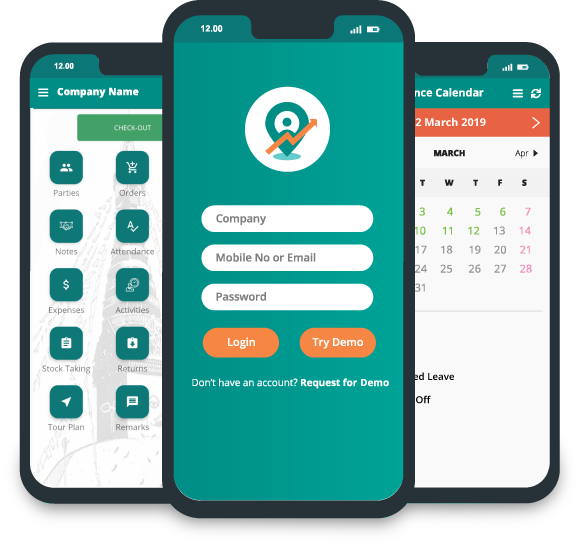
A field sales tracking app is a software tool to help companies manage, track, and improve the work of their field sales teams. Sales managers can use it to monitor field reps in real-time, assign tasks, track customer visits, record attendance, collect orders, and analyze team performance, all from one dashboard.
Businesses can have total visibility of their field operations through a field sales tracking system instead of using spreadsheets, phone calls, or manual reporting. Sales reps can update their activities directly through a mobile app, while managers receive real-time insights that allow them to make faster and better decisions.
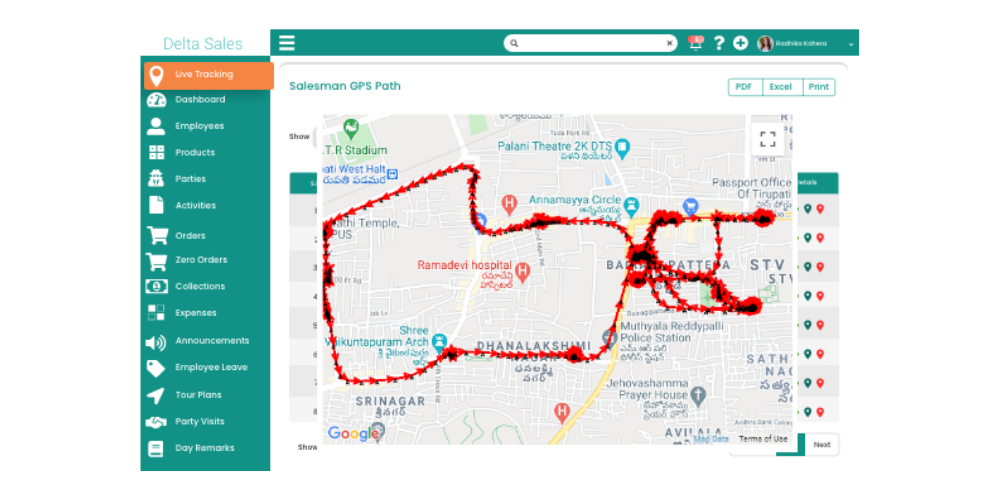
Modern field sales tracking software does much more than GPS tracking. It streamlines the entire sales process by automating routine tasks, reducing paperwork, and ensuring that field teams stay connected with the office regardless of their location. This improves accountability, enhances customer service, and increases the overall productivity of the sales force.
Depending on the business requirements, a field sales tracking app may include features such as:
- Live GPS location tracking
- Attendance and leave management
- Customer visit tracking
- Route planning and route optimization
- Order management and order taking
- Expense management
- Task and activity management
- Sales reporting and analytics
- Beat planning
- Territory management
- Performance monitoring
- Customer database management
- Digital forms and data collection
Additionally, many companies use sales force automation (SFA) software in conjunction with a field sales tracking app to automate repetitive sales activities, improve communication between field and office teams, and make data-driven decisions. When your organization grows, you will find that reliable field sales management software can help you a lot in reducing manual processes, boosting operational efficiency, and ensuring every field activity is recorded accurately and can be accessed easily.
If you’re managing a small team of sales reps or hundreds of field reps in various locations, a field sales tracking app gives you the visibility, control, and automation you need to improve productivity and create better sales results.
Consequences of Building a Field Sales Tracking App
Building a field sales tracking app may seem like the ideal solution because it gives businesses complete control over features, workflows, and integrations. However, developing reliable field sales tracking software is a complex and resource-intensive process that requires significant investment in time, money, and technical expertise. What initially appears to be a one-time investment often turns into a long-term commitment involving continuous development, maintenance, and upgrades.
Before choosing to build your own field sales tracking system, it's important to understand the challenges that come with custom software development.
-
High Development Costs
Developing a custom field sales tracking app requires a substantial financial investment. Beyond coding the application, businesses need to budget for UI/UX design, server infrastructure, testing, cloud hosting, security, deployment, and future enhancements. If the app includes advanced capabilities such as GPS tracking, route optimization, attendance management, order management, or analytics dashboards, development costs can increase significantly.
-
Requires a Dedicated Development Team
Software development is not a one-man job. A good field sales tracking system usually consists of a team of specialists: software engineers, UI/UX designers, QA engineers, DevOps engineers, project managers, and technical support specialists. The application, once launched, still needs experienced professionals to monitor its performance, fix bugs, roll out updates, and ensure the software keeps pace with the evolving business needs. Bringing this team on board and keeping them can be a large, long-term cost.
-
Longer Time to Market
It takes time to build feature-rich field sales tracking software. The whole project can take several months or even over a year, starting from gathering business requirements, app design, development, testing, deployment, and training the employees. At the same time, as you are developing your solution, your competitors might already be reaping the benefits of a proven sales force automation software, responding quicker to market demands and increasing productivity.
-
Ongoing Maintenance and Software Updates
Starting the software is just the first step. Every application needs regular maintenance to remain secure, stable and compatible with evolving technologies. Businesses need to continually fix bugs, improve performance, release security patches, support new mobile OS, and add new features as business requirements change. Without constant maintenance, a custom field sales tracking app can quickly go out of date, impacting employee productivity and the customer experience.
-
Extensive Research and Planning
Before development begins, businesses must spend a great deal of time understanding user requirements, mapping out sales workflows, designing system architecture, and prioritizing features. Before development gets underway, there are questions to answer, such as how to manage customer visits, track employee attendance, optimize sales routes, monitor field activities, and generate reports. Errors in planning can lead to expensive redesigns later in the project.
-
Scaling the Software Becomes More Complex
As your business expands, your software should expand with it. Expanding into new markets, onboarding more users, integrating with CRM/ERP systems, adding AI-powered analytics, or automating more sales processes often require additional development and testing. Each new feature increases the development cost and implementation time, making long-term scalability more complex than many businesses initially think.
-
Greater Project Risk
Custom software projects are prone to unexpected problems such as changing business needs, going over budget, technical glitches, missed deadlines, or insufficient resources. Such risks may delay implementation and increase the total cost of ownership; Such delays can mean lost opportunities and slower operations improvement than choosing a ready-made field sales tracking software if you are a business that would like to improve field sales productivity immediately.
Benefits of Building Your Own Sales Tracking System
Buying an off-the-shelf field sales tracking app is the best bet for most companies, but in some situations, building your own can offer some advantages. If your workflow is highly specialized, your operational needs are unique or you have an in-house development team, you may want to consider building a custom field sales tracking system that is tailored to your needs.
Here are some of the key benefits of building your own sales tracking system.
-
Complete Control Over Features
One of the greatest benefits of developing your own field sales tracking software is that you can control its entire functionality. You choose the features you want to use, how the user interface should work, and how the system should fit in with your sales processes. If you need custom approval workflows, industry-specific reporting, or unique sales activities, a custom-built solution lets you build the application around your business rather than adapting your business to the software.
-
Tailored to Your Business Processes
No two businesses are the same. A custom field sales management system can be customized to fit your existing workflows, sales hierarchy, territory structure, and reporting needs. That flexibility can be a boon to organizations with complex operations that standard software solutions can’t easily accommodate.
-
Full Ownership of the Software
Build your own field sales tracking app Your organization owns the software so you have complete control over future development. You can choose when to add new features, refresh the interface, or expand functionality without relying on an outside software provider. This level of ownership can be advantageous for companies with a long-term product development strategy and dedicated technical resources.
-
Easier Integration with Internal Systems
A custom-built field sales tracking system can be developed to integrate directly with your existing ERP, CRM, accounting software, inventory management system, or other internal business applications. This can create a seamless flow of information across departments and reduce manual data entry. However, many modern field sales tracking software solutions also provide APIs and integration capabilities, making it possible to connect with existing business systems without building an application from scratch.
Benefits of Buying a Field Sales Tracking App
For most businesses, buying a field sales tracking app is a faster, more cost-effective, and scalable solution than building one from scratch. Instead of spending months on development and testing, organizations can start managing their field sales operations with a proven field sales tracking software that is ready to use. Modern solutions are designed using industry best practices and are continuously improved based on customer feedback, making them suitable for businesses of all sizes.
Here are some of the key benefits of investing in a ready-made field sales tracking system.
-
Faster Implementation and Quick Return on Investment
One of the biggest advantages of purchasing a field sales tracking app is that it can be implemented quickly. Most software providers offer a structured onboarding process, allowing businesses to configure the system and start using it within days or weeks rather than waiting months for custom development. This means your sales team can immediately benefit from features such as GPS tracking, attendance management, customer visit tracking, order management, and sales reporting, resulting in faster productivity improvements and a quicker return on investment.
-
Lower Development and Maintenance Costs
Building software requires significant investment in development, infrastructure, testing, and ongoing maintenance. In contrast, buying field force automation software eliminates these expenses. Businesses pay a predictable subscription or licensing fee while the software provider handles updates, server maintenance, security enhancements, and technical improvements. This allows organizations to focus on growing their business instead of managing software development projects.
-
Customization Without Starting from Scratch
A lot of businesses think that off-the-shelf software is inflexible. But the top field sales management software providers offer a wide range of customizations such as custom forms, approval workflows, user roles, dashboards, reports, and business-specific customizations. Many vendors also offer additional feature development or custom modules for an additional investment for organizations with more advanced requirements. That means companies can reap the benefits of customization without the cost and complexity of building a whole new system.
-
Professional Training and Easy User Adoption
Even the best new software will not deliver expected results if employees do not know how to use it properly. The top vendors in field sales tracking software will help you make the transition with onboarding sessions, product demos, user guides, video tutorials, and training programs. Consequently, with the right training and an intuitive interface, field sales reps can easily learn the system, thus shortening the learning curve and enabling companies to reap the rewards of digital sales management faster.
-
Dedicated Technical Support
Even the best software sometimes needs a little help. One of the key benefits of buying a field sales tracking system is having a dedicated support team on hand to help you troubleshoot technical problems, respond to user questions, and offer guidance as needed. Companies can hire experienced people who know the software and can keep it running well, rather than having their own technical team in-house.
-
Regular Updates and Continuous Improvements
Technology and business needs continue to evolve. Leading field sales tracking app providers are constantly rolling out new features, performance, security updates and compatibility improvements based on customer feedback and changing market needs. This way your software stays secure, modern, and able to support your growing business without additional development resources.
-
White Labeling and Scalability
Some companies would like to use the software under their own name, like distributors, enterprises, or organizations with many clients. Most software providers have white-label options so that a business can customize the branding, logo, and identity of the application without having to reinvent the wheel. Also, field sales tracking software that is out-of-the-box is built to scale as your business grows. Whether you’re running a team of 10 sales reps or expanding to hundreds across multiple regions, the system can grow with you for more users, territories, and operational needs, without the pain of rebuilding your software.
-
Integrations with Existing Business Systems
Today’s modern field sales tracking apps typically sync with CRM platforms, ERP software, accounting software, inventory management systems, and other business apps. These integrations help eliminate duplicate data entry, improve collaboration between departments, and create a seamless flow of information throughout the organization. As your business grows, these integrations make it easy to automate processes and keep your operations running efficiently without having to write custom software.

Consequences of Buying a Field Sales Tracking App
The fastest way to digitize your field operations is to buy a field sales tracking app. Building a custom solution from scratch means a lot of time and development costs. That’s why buying ready-made field sales tracking software is a good option for your business. You get access to proven features and save time.
But as with any software investment, there are a few things that businesses should consider before they buy. The good news is that most of those concerns can be alleviated by selecting the right field sales tracking system that provides flexibility, good support and room to grow in the future.
1. Your Business May Need Custom Features
Every organization has unique sales processes, approval hierarchies, reporting requirements, and customer workflows. Some businesses assume that a ready-made field sales tracking software may not fully meet their operational needs. Fortunately, leading software providers understand that every business is different. Many offer configurable modules, custom forms, workflow automation, personalized dashboards, and advanced reporting. Some even provide feature development services for businesses that require additional functionality. This allows companies to enjoy the benefits of a proven solution without sacrificing business-specific requirements.
2. Employees Need Time to Learn New Software
Often this requires employees to switch to a digital way of working with a new field sales tracking app. Sales reps currently relying on manual reporting or spreadsheets might need some help initially getting the most out of the new platform.
The challenge is made much easier by providing structured onboarding, live demonstrations, user documentation, video tutorials, and ongoing training sessions by the software provider. The system can be adopted quickly by employees with proper training and a user-friendly interface, enabling businesses to realize productivity gains sooner.
Conclusions
Building versus buying isn't just a technology decision; it's a business decision.
Custom development gives you total ownership but is very costly in terms of time, money, and technical expertise. On the other hand, a generic field sales tracking app offers companies a faster route to optimizing their operations, with proven features, professional support, regular upgrades, customization options, and scalable growth.
With Delta Sales App solutions, businesses can efficiently manage field teams with GPS tracking, attendance management, order management, customer visit tracking, reporting, route planning, and performance monitoring, without the headache of building software from scratch.
Want to up your field sales game?
Request a free demo of Delta Sales App & see how easy field sales management can be.