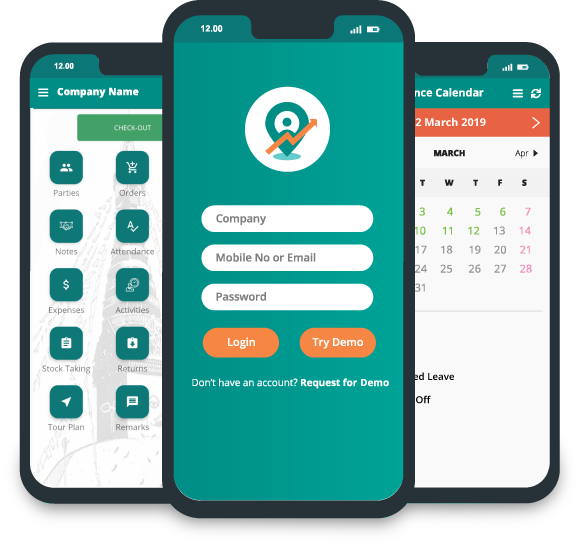

What Happens Six Months After Implementing Field Sales Application?
Did you know that companies adopting a field sales application see 20-30% improvements in field productivity in the first few months of usage, but the real transformation is only clearly evident after sustained usage?
That’s because digital transformation in field sales isn’t an instant flip. It is a change in behavior and operations that occurs over time. Teams are still learning to adjust in the early weeks. Third-month processes begin to stabilize. But at six months, something significant happens: the system goes from being “just a tool” to the backbone of field execution.
This is the time when businesses begin to see the real benefits of structured workflows like sales force automation, improved execution through beat planning, and better visibility through secondary sales tracking.
“The six-month mark is so critical because there is enough data, behavior patterns, and usage consistency to show the true state of sales operations. Now, companies aren't guessing performance; they are measuring it with clarity.
In this blog we’ll explore what really changes six months after implementing a field sales application, from daily field execution, distributor coordination, and reporting accuracy to overall business decision-making.
Month 1–2: Laying the Foundation for Smarter Field Execution

In the first two months after you launch a field sales app, you're laying the groundwork for long-term growth. It may not be immediately evident in the numbers, but this period is quietly beginning to change the way field operations work.
This is the time when companies shift from haphazard, manual processes to a more organized, trackable system, paving the way for measurable improvement in the months ahead. Here are the major improvements businesses usually notice during the first two months of adopting a field sales application:
Shift from manual reporting to structured data capture
One of the earliest visible improvements is how field data starts becoming organized and traceable. Instead of relying on informal updates or memory-based reporting, sales teams begin logging activities through a field sales app. This brings immediate foundational benefits:
- Every visit starts getting recorded consistently
- Customer interactions become trackable
- Order notes and follow-ups are no longer lost in communication gaps
Even at this early stage, businesses begin reducing information leakage.
Early discipline starts forming in field teams
While adaptation takes time, a noticeable shift in discipline begins to emerge. Sales reps slowly move toward more structured daily routines. Key improvements include:
- Increased awareness of daily visit accountability
- Better habit formation around reporting in real time
- Gradual reduction in missed or unreported visits
This is the first sign of behavioral change that will later drive productivity gains.
Managers gain their first layer of real visibility
For the first time managers begin to see structured field activity via sales force automation dashboards. Even though data is still stabilizing, it unlocks early visibility:
- Who is visiting which customers
- Basic daily movement tracking of sales reps
- Initial insight into field coverage patterns
This replaces guesswork with early-stage operational transparency.
Introduction of structured route execution
Field teams begin to coordinate their visits using planned routes in beat planning systems. Adherence is still changing, but the fact that they are putting structure in place is a big change. At this stage:
- Sales routes are defined more clearly
- Travel planning becomes more intentional
- Unstructured and random visits begin reducing gradually
This is the beginning of optimized field movement.
Data starts flowing consistently into the system
The end of the second month sees the beginning of one of the most important transformations: consistent data flow. Even though insights are still limited, businesses now have:
- A centralized record of field activities
- A growing database of customer interactions
- The foundation needed for future analytics and decision-making
This is where the system starts proving its long-term value.
Month 3–4: Stabilization, Control, and Noticeable Efficiency Gains
By the third month the transition from “adoption” to “execution discipline” is clear. This is where a field sales application starts to go beyond basic data entry and starts to actively improve how field teams operate on a day-to-day basis.
Around this time, businesses begin to notice a very important change: the system is no longer dependent on prompts; it’s becoming a habit. Major improvements businesses usually notice during the first two months of adopting a field sales application are:
Consistency replaces confusion in field reporting
As usage becomes more routine, sales reps start logging activities more consistently through the field sales application What changes here is not just usage but reliability of data:
- Visit entries become more complete and timely
- Customer interactions are recorded in a structured format
- Missing or delayed reports start reducing significantly
This improvement directly strengthens the quality of field data available to managers.
Managers shift from tracking to controlling field performance
With more stable data coming in from sales force automation systems, managers move from basic tracking to active control and optimization. Now they can:
- Compare planned vs actual field activity
- Identify underperforming regions or reps
- Take faster corrective actions based on real-time insights
This is where visibility starts turning into actionable control.
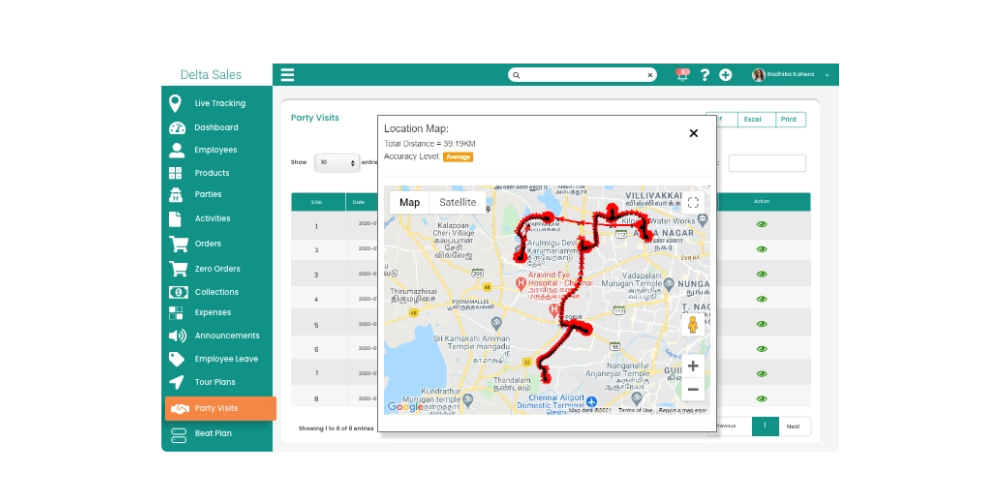
Beat execution becomes measurable and disciplined
One of the main improvements in this phase is an improved alignment with beat planning. Field execution starts becoming more structured:
- Planned routes are followed more consistently
- Deviations from schedules become visible
- Coverage gaps across territories reduce gradually
This directly improves field efficiency by minimizing random travel and unplanned visits.
Early productivity improvements start appearing
Once consistency improves, efficiency naturally follows. Companies typically start noticing:
- Reduced time wasted on unplanned field movements
- More customer visits completed per day
- Better utilization of working hours by sales reps
Even though the transformation is still in progress, the upward trend becomes clear.
Communication between field and head office improves
Another major shift is how information flows between teams. Instead of delayed updates or fragmented communication, teams benefit from centralized visibility through sales force automation tools:
- Faster coordination between reps and managers
- Reduced dependency on phone calls and manual updates
- Clearer task assignments and follow-ups
This reduces operational friction significantly.
Month 5–6: Real Performance Gains and Full Operational Maturity
The effect of a field sales application is clearly visible in day-to-day business outcomes by the fifth and sixth month. Here is where the system transitions from “usage” to the core driver of sales execution, decision-making, and growth.
What began as a digital conversion in reporting now translates directly into revenue movement, distributor efficiency, and field productivity.
Faster and more accurate order execution
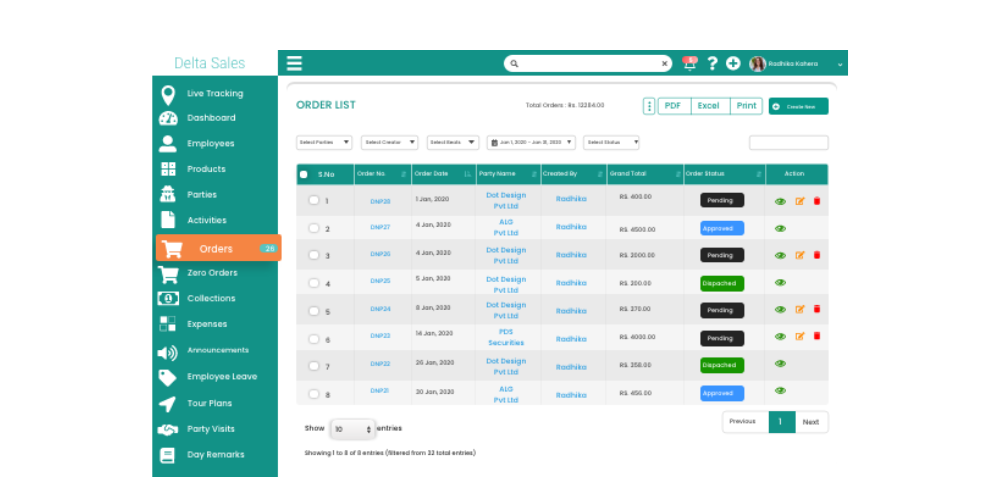
One of the most visible and measurable improvements is in order flow. A structured order management system makes field orders faster, cleaner, and more reliable. Businesses typically observe:
- Quicker order booking directly from the field
- Reduced manual entry errors and duplication
- Faster order transmission to distributors or backend teams
- Improved order fulfillment speed
This directly improves customer satisfaction and repeat ordering.
Strong visibility into secondary sales movement
Secondary sales tracking at this point provides businesses with meaningful insights into the actual product movement at the ground level. This unlocks a major strategic advantage:
- Clear understanding of what is actually selling at retail level
- Better demand forecasting and planning
- Reduced stockouts and overstock situations
- Improved alignment between primary and secondary sales
This is often where leadership teams start making data-backed decisions instead of assumptions.
Distributor coordination becomes significantly smoother
A distributor management app helps to make distributor level operations more structured and predictable with consistent digital workflows. Improvements include:
- Faster communication between sales reps and distributors
- Reduced delays in order processing
- Better stock visibility and planning
- Fewer mismatches in supply and demand
This creates a more stable supply chain between field teams and distribution networks.
Reporting becomes fully reliable and real-time
By the sixth month reporting is no longer a problem, it’s an asset. With EOD reporting organized through an EOD report system:
- Instantaneous and accurate daily sales summaries
- Manual reporting errors are almost eliminated
- Managers no longer wait for end-of-week updates
- Decision-making becomes faster and more confident
This shift dramatically improves operational responsiveness.
Field discipline and accountability reach their peak
At this stage, field behavior is fully aligned with structured systems.
- Beat plans are followed consistently
- Visit accountability is transparent
- Missed or skipped activities are easily identifiable
- Sales reps operate with higher discipline due to visibility
This creates a culture of ownership and performance across the team.
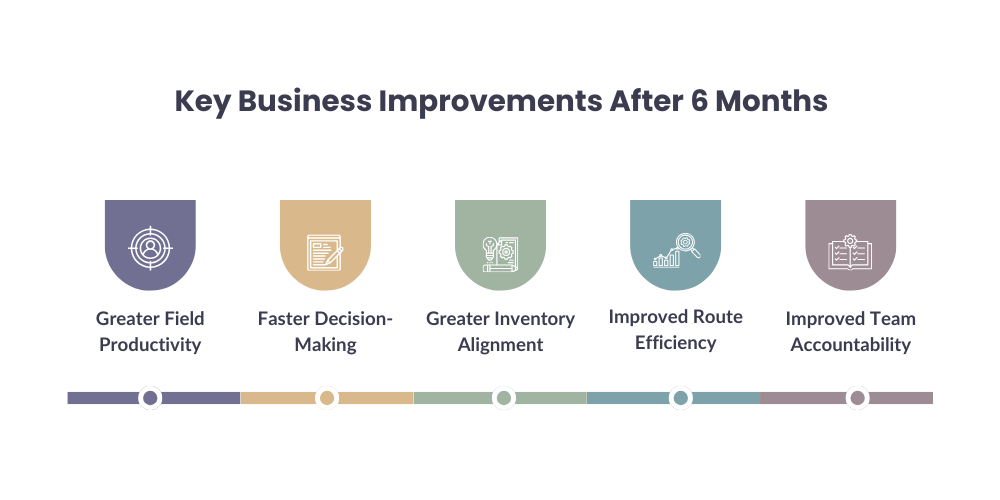
Key Business Improvements After 6 Months
At six months, a field sales application is no longer a reporting or tracking tool and begins to impact key business results. Currently, the improvements are not focused on a single function but are distributed across field execution, distribution, reporting, and decision-making. Most importantly, these changes are now real, measurable, and directly linked to business performance, not assumption.
-
Greater field productivity
After six months, field teams tend to get more productive naturally as their workflows get built and time-efficient. Sales reps can dedicate more time to selling rather than manual reporting or follow-ups. Every hour of working time is being used more efficiently, with well-planned visit schedules, digital reporting, and GPS-based tracking. This results in more customer engagement per day and better overall output from the same workforce.
-
Faster decision-making
One of the biggest changes is the pace of decision-making. Sales force automation systems allow managers to get real-time data instead of waiting for reports or guessing. Instead, they can instantly see information on sales performance, visit compliance, and territory coverage. This allows for quicker responses to market changes, better planning, and more proactive management rather than reactive problem-solving.
-
Greater inventory alignment
Enhanced visibility into secondary sales tracking offers a more accurate view of what is really happening with the product at the retail level. This better aligns inventory with actual demand. Better stock planning means fewer problems such as stockouts in high-demand areas or overstocking slow movers. As a result, the supply chain gets healthier and the availability of the product in the market improves over time.
-
Improved route efficiency
Route optimization becomes one of the most visible operational improvements over time. With a structured beat plan in place, sales reps follow more organized travel paths instead of random or unplanned movements. Over six months, this consistency reduces travel time, avoids repeated visits to the same areas, and ensures wider territory coverage. As a result, field effort becomes more focused, and less time is wasted on inefficient travel.
-
Improved team accountability
When field activities are digitally tracked, accountability naturally increases. The system maintains a log of each visit, order, and update, leaving very little room for ambiguity. Performance is visible and measurable, making sales teams more responsible for their day-to-day results. This clarity also improves discipline and develops a performance culture where consistency is rewarded and gaps can be spotted easily.
KPIs That Show Clear Improvement
The impact of a field sales application at six months is no longer only visible in day-to-day business but also measurable with clear metrics. This is where companies can safely tell whether their field execution strategy is improving or not, because the data is now consistent, structured, and reliable.
The importance of this phase is that these improvements are not isolated; they are a direct result of better discipline in field execution, stronger reporting accuracy, and better coordination between teams.
-
Completion rate per day
You’ll see more consistent completion of visits by sales reps as one of the first things you notice. By using a field sales app to plan beats and track them in real time, reps have more accountability for their day-to-day schedules. The result over time is an increase in visit completion rates as routes are clearer, expectations are set, and missed visits are easily identified and corrected.
-
Order conversion rate
The quality of sales conversations improves as field teams get more efficient and customer interactions become more structured. You get better visibility and follow-ups on time so that chances of converting visits into real orders go up. There is also a faster execution through the use of a sales force automation system that shortens the time between the customer interest and the order.
-
Beat compliance accuracy
At six months, adherence to planned routes is considerably stronger. Sales reps don’t have to wander around with no plan with a structured beat plan. This improves beat compliance accuracy, allowing managers to see if field execution is aligned with business strategy and territory planning.
-
Reporting timeliness
One of the most important operational improvements is how quickly and accurately data is reported. With digital tools field updates are captured in real time instead of being delayed or manually compiled at the end of the day. This leads to faster reporting cycles and ensures that decision-makers always have up-to-date information.
-
Distributor order turnaround time
Improve coordination between field teams and distribution channels for faster order processing. A well-organized distributor management app facilitates smoother communication and reduces delays in order confirmation, dispatch, and fulfillment. This significantly accelerates the rate at which customer demand is met in the marketplace over time.
-
Stock availability at retail level
Enhanced visibility into tracking secondary sales provides businesses with a better understanding of actual product movement at the retail level. It lessens stock mismatch and provides more consistent availability of high-demand products. This in turn increases stock availability and reduces the incidence of problems like stockouts and overstocking.
Why Businesses Choose Delta Sales App
Businesses don't see measurable improvements in field sales simply by adopting software. They see results when the platform supports every stage of field execution, from planning and reporting to order processing and distributor coordination. Delta Sales App brings all these capabilities together in one integrated solution, helping businesses achieve greater productivity, visibility, and control within the first six months.
-
Smart Beat Planning for Better Territory Coverage
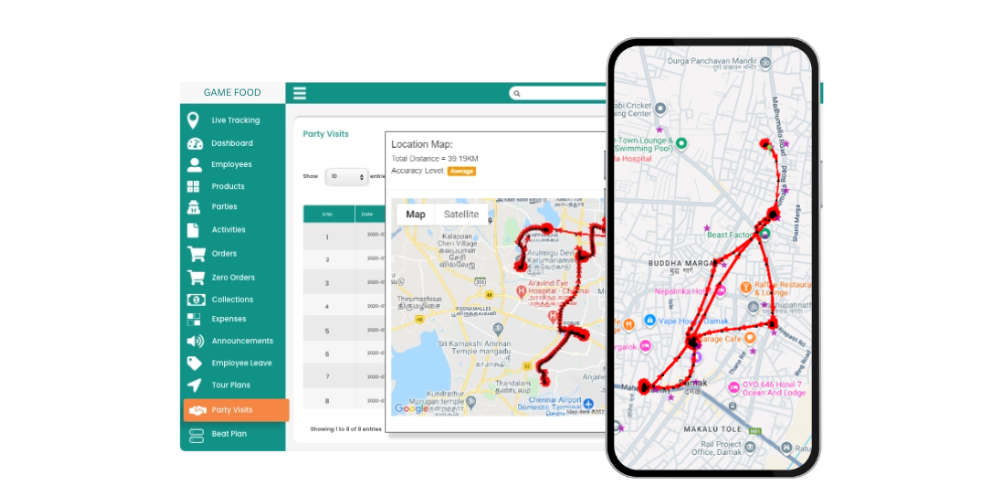
With Beat Planning, managers can create optimized visit schedules and assign territories efficiently. Sales representatives follow structured routes instead of making random customer visits, leading to better market coverage, reduced travel time, and improved beat compliance.
-
Real-Time GPS-Based Tracking
Delta Sales App provides GPS-based tracking that gives managers complete visibility into field activities. They can monitor visit locations, travel routes, attendance, and customer meetings in real time, improving accountability while ensuring every planned visit is completed.
-
Fast and Accurate Order Management
The built-in Order Management System enables sales reps to capture orders directly from the field using their mobile devices. Orders reach distributors instantly, reducing manual errors, speeding up processing, and improving overall order fulfillment.
-
Complete Distributor Management
Managing distributors becomes much easier with the Distributor Management module. Businesses can streamline communication, monitor stock availability, coordinate order fulfillment, and maintain stronger relationships across the distribution network.
-
Secondary Sales Tracking for Better Inventory Planning
With Secondary Sales Tracking, businesses gain complete visibility into product movement at the retail level. This helps identify fast-moving products, forecast demand more accurately, reduce stockouts, and maintain optimal inventory across territories.
-
Automated Reporting and Real-Time Dashboards
Delta Sales App eliminates manual reporting through automated dashboards and real-time analytics. Managers can instantly monitor sales performance, visit completion, order status, and team productivity without waiting for end-of-day spreadsheets or weekly reports.
-
Offline Functionality for Uninterrupted Field Sales
Field sales teams often work in locations with poor internet connectivity. Delta Sales App allows sales representatives to continue recording visits, capturing orders, and updating customer information even while offline. Once internet access is restored, all data syncs automatically, ensuring uninterrupted productivity.
Why Six Months Is the Real Turning Point
The first few weeks of deploying a field sales application are all about adoption. Sales reps are adapting to new workflows, managers are monitoring usage, and companies are gradually moving from manual to digital processes. These initial modifications are significant, but they don’t immediately reflect the total worth of the system.
Six months down the line the position looks very different. The app is no longer just a tool to record visits or submit reports but becomes an integral part of day-to-day sales operations. Digital workflows are being used by field teams, and managers can access reliable real-time data so decisions are based on accurate insights, not assumptions.

This is also the point where the benefits begin compounding. Better beat planning translates to better market coverage. Sales force automation cuts down on the amount of administrative work. Secondary sales tracking gives more visibility into product movement. A streamlined order management system helps improve order fulfillment. These improvements lead to a more predictable and effective sales process.
Perhaps the biggest change is that companies move from fixing problems to preventing them. Rather than identifying problems after compiling weekly or monthly reports, managers can monitor performance in real time, quickly fix gaps, and continuously improve field operations.
In short, six months is the stage where a field sales application delivers measurable business value. What begins as an investment in digital transformation evolves into a reliable system that drives higher productivity, stronger distributor coordination, better customer service, and sustainable sales growth.
Final Thoughts
The first couple of months of a field sales app rollout are all about new habits and streamlining processes. But by the six-month mark the real business impact begins to come to light. Field teams work more efficiently, managers have complete visibility into day-to-day operations, and decisions are made based on real-time data and not guesswork.
Whether it is to boost field productivity, enhance beat execution, simplify order management, or improve distributor coordination, a field sales app assists businesses in creating a more connected and efficient sales ecosystem. Such improvements over time lead to better customer service, stronger sales performance, and sustainable business growth.
Ready to Experience the Difference?
Book a free demo today and discover how the Delta Sales App can simplify field sales management and grow your business with powerful automation and real-time insights.