
Why Is Sales Data More Valuable Than Sales Reports?

Say you had a choice. Which would you rather have? A report telling you why sales dropped last month, or insights that help you prevent a drop today?
The question is an example of the difference between a sales report and sales data. Reports are useful for looking back at what has been done, but they only show a snapshot of what has already taken place. Sales data, in contrast, captures every order, customer interaction, payment, GPS check-in, and field activity in real time. This allows businesses to tackle minor problems immediately, before they turn into major ones.
Speed and accuracy are essential in the fast-moving FMCG and distribution world. If you are a manager who only relies on weekly or monthly reports, you could find yourself reacting too late to stock shortages, missed retailer visits, or changes in customer demand. Real-time sales data helps companies to identify these challenges early, improve field operations, and make better decisions.
In this blog, we discuss why sales data is more valuable than traditional sales reports, the different functions of each in driving business decisions, and how innovative sales technology helps organizations maintain a competitive edge.
What Is Sales Data?
Sales data is the information collected during the sales process, in motion. Every interaction your sales team has with a customer generates valuable information that helps companies understand how well their sales efforts are working.
Sales data is recorded as it happens, while a sales report is a historical view of results over a defined time period. And every visit to a retailer, every order placed, every payment received, every product sold, and every conversation with a customer. Businesses nowadays often use field sales management software to automatically capture this data. This makes the process easier and decreases the risk of mistakes caused by humans.
Understanding sales data is crucial for any business. Here are some key types of sales data that can help you gain insights:
-
Visits to customers and retailers
-
Orders made and their values
-
Sales broken down by product
-
GPS check-ins and tracking of locations
-
Attendance records and working hours
-
Payment collections and any outstanding balances
-
Timestamps and duration of visits
-
Completion of planned routes
While each of these data points might appear trivial on its own, together they paint a comprehensive picture of your field sales activities. For instance, if you notice a drop in sales in a specific area, analyzing the sales data can help you determine if the decline is due to missed visits to retailers, delays in collecting orders, stock shortages, or ineffective route planning.
What Is a Sales Report?
A sales report serves as a clear and organized overview of sales activities, reflecting how a business has performed over a defined timeframe, whether that’s a day, week, month, or quarter. Rather than detailing every single transaction, it distills raw data into insightful metrics that empower managers to assess overall performance and spot emerging trends.
Typically, a sales report might feature details such as:
-
Total revenue generated from sales
-
Count of orders received
-
Performance by individual sales representatives
-
Sales figures categorized by product
-
Sales distribution across different territories or regions
-
Sales performance by retailer
-
Status of payment collections
-
Comparison of sales targets versus actual results
Sales reports are essential tools in the world of business. They empower managers to assess how their teams are performing, monitor progress towards sales goals, create engaging presentations for stakeholders, and aid in strategic planning for the future. With their clear and organized format, these reports make it easier to see how performance varies over time or across different sales regions.
Key Differences Between Sales Data and Sales Reports
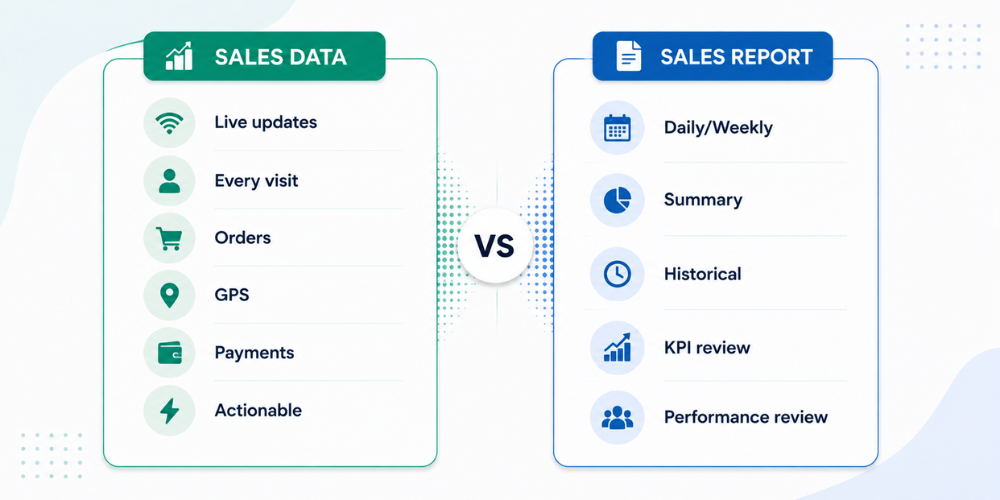
While sales data and sales reports are interrelated, they fulfill distinct roles. Sales data offers the granular details essential for everyday decision-making, whereas sales reports distill that information into a comprehensive overview of overall performance.
Let’s explore the key differences:
1. Real-Time vs. Historical Information
Sales data is collected in real-time as sales activities unfold, allowing managers to stay connected with field operations. In contrast, sales reports are compiled after a set timeframe, serving as a reflection of past achievements.
2. Detailed vs. Summarized Information
Sales data captures every single interaction, from visiting retailers and placing orders to checking in via GPS, collecting payments, and making product sales. On the other hand, sales reports take this detailed information and transform it into easy-to-understand summaries, highlighting key figures like total revenue, sales performance by region, or monthly trends.
3. Drives Faster Decisions vs. Measures Results
Sales data empowers businesses to swiftly adapt to evolving market trends, customer preferences, and on-the-ground challenges. While sales reports are valuable for assessing overall performance, they often lack the immediacy required for quick operational choices.
4. Explains the Cause vs. Shows the Outcome
A sales report might indicate that sales declined in a particular territory, but it doesn't explain why. Sales data provides the underlying details, such as missed outlet visits, stock shortages, delayed orders, or reduced field activity, helping managers identify the root cause.
5. Used by Operational Teams vs. Business Leadership
Sales teams, including field managers and supervisors, depend on sales data to keep a close eye on daily operations and enhance their performance. Meanwhile, business leaders and stakeholders often turn to sales reports to understand trends, assess progress towards goals, and guide their strategic planning efforts.
6. Continuously Updated vs. Periodically Generated
Sales data is gathered in real-time throughout the day as sales representatives engage with customers and perform their tasks. In contrast, sales reports are compiled on a daily, weekly, monthly, or quarterly basis, reflecting the organization's specific reporting timeline.
7. Supports Immediate Action vs. Performance Review
Sales data enables businesses to spot challenges in real-time, empowering managers to respond swiftly and effectively. On the other hand, sales reports serve as valuable tools for reflecting on past performance, assessing key performance indicators (KPIs), and crafting insightful business reviews.
Why Sales Data Gives You a Competitive Edge
In the rapidly evolving world of sales, relying on weekly or monthly reports can lead to missed opportunities. Customer preferences shift in the blink of an eye, competitors are quick to launch new promotions, and retailers' purchasing habits are always in flux. Companies that harness real-time sales data can spot these changes as they happen, allowing them to react swiftly and protect their revenue.
Detect Problems Before They Impact Sales
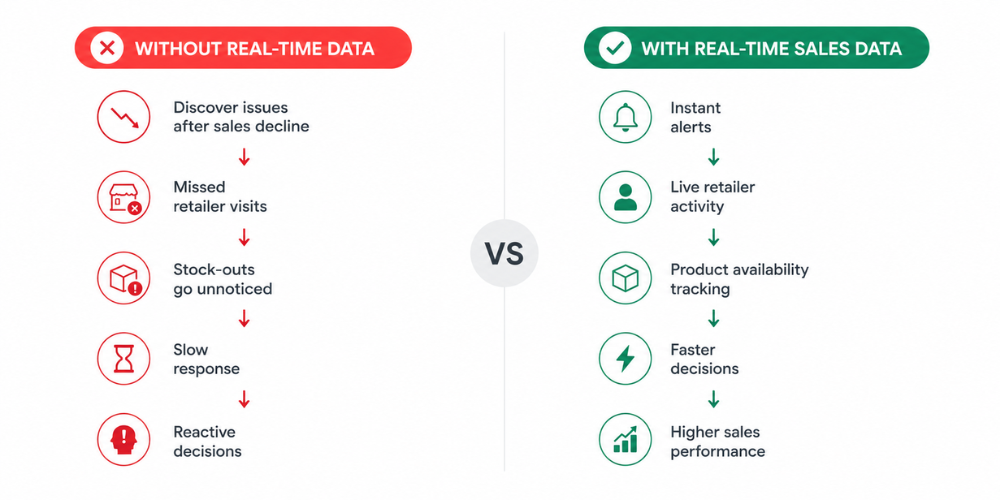
One of the biggest advantages of sales data is that it helps businesses spot issues as they happen. Instead of discovering a decline in sales after the reporting period ends, managers can monitor live field activities and take immediate action. For example, sales data can quickly reveal:
-
Missed retailer visits
-
Low product availability or stock-outs
-
Delayed order collection
-
Declining retailer engagement
-
Poor beat plan execution
-
Slow payment collections
-
Territories receiving less coverage than planned
By addressing these issues early, businesses can reduce lost sales and improve customer satisfaction.
Understand the "Why" Behind the Numbers
When reviewing a sales report that indicates a 12% drop in one territory, it’s important to dig deeper to understand the underlying reasons. Sales data offers valuable insights that go beyond the numbers. Managers can explore various factors that may have contributed to the decline, such as:
-
Sales representatives not visiting retailers as planned
-
Products being unavailable or out of stock
-
Retailers placing smaller orders than usual
-
Increased competition in the area
-
Delays in delivery affecting stock levels
-
Ineffective route planning leading to missed opportunities
By gaining this deeper understanding, businesses can address the root causes of issues rather than just reacting to the symptoms.
Make Faster, Smarter Decisions
The sooner a business identifies a problem, the faster it can respond. With access to live sales data, managers don't have to wait until the end of the week to review performance. They can reassign sales territories, adjust beat plans, restock fast-moving products, or support underperforming sales representatives while there's still time to improve results. According to McKinsey, organizations that use real-time data and analytics make faster decisions and improve operational performance compared to those relying on delayed information. Businesses that act quickly are better positioned to meet customer demand and stay ahead of competitors.

Improve Retail Execution
For FMCG brands and distributors, success depends on consistent execution in the market. Sales data provides visibility into every field activity, helping businesses ensure that products are available, promotions are executed correctly, and retailers receive regular visits. Insights from field data also make it easier to monitor shelf availability, identify gaps in execution, and improve in-store performance. As discussed in our blog on Field Sales Insights That Boost CPG Shelf Performance Growth, businesses that leverage field sales data can make better merchandising decisions, strengthen retailer relationships, and improve product visibility across outlets.
Build a More Proactive Sales Strategy
Businesses that depend only on sales reports often operate reactively, responding after performance has already declined. Those that use sales data take a proactive approach by identifying trends, predicting potential issues, and making informed decisions before problems escalate.
This shift from reacting to anticipating gives businesses a significant competitive advantage. Rather than asking, "Why did sales drop last month?" managers can focus on, "What can we do today to improve tomorrow's results? That's the real value of sales data, it helps businesses stay one step ahead instead of constantly trying to catch up.
Limitations of Relying Only on Sales Reports
Sales reports play an important role in understanding how a business is performing and what outcomes are being achieved. However, they shouldn't be the sole basis for making decisions. Because these reports focus on past activities, they can miss the nuances and immediacy required to tackle everyday challenges that arise in the field.
Here are some of the biggest limitations of relying only on sales reports:
They Show What Happened, Not Why It Happened
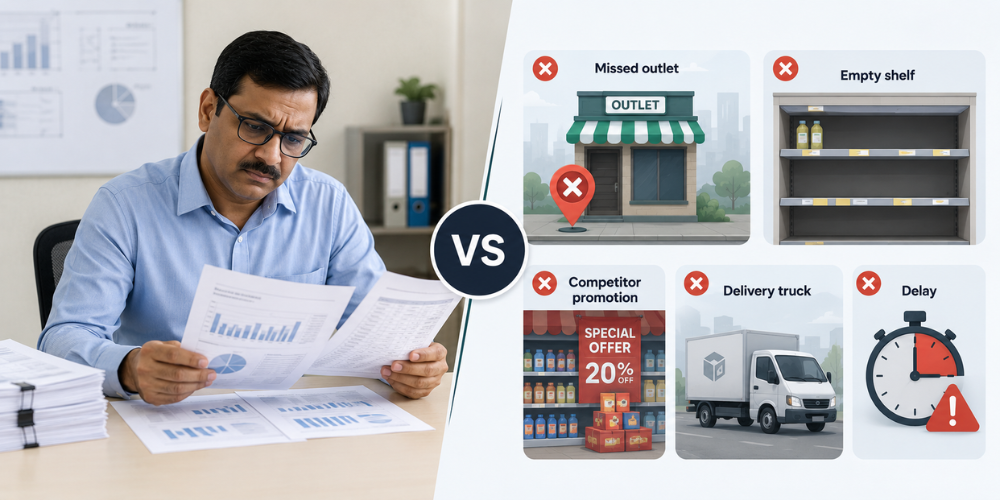
Sales reports can indicate that sales have dropped in a specific area or that a product has fallen short of its goals. However, they often leave us in the dark about why these changes occurred. Without access to the detailed sales data, it becomes challenging to understand if the decline was due to missed visits to retailers, stock shortages, late deliveries, ineffective route planning, or heightened competition. As a result, managers are aware of the problem but lack the deeper insights necessary to address and resolve the issues effectively.
Reports Are Often Delayed
Many businesses create sales reports on a daily, weekly, or monthly basis. These reports can help assess performance, but they often fall short in offering a real-time view of market dynamics. By the time a report points out an issue, precious selling opportunities might have slipped away. In fast-paced industries like FMCG, where customer demand and inventory levels fluctuate quickly, waiting for information can result in missed chances for action.
They Lack Operational Context
Sales reports often highlight broad metrics like total revenue, order volume, or how well targets were met. However, they typically miss the finer details that can really impact those figures. For instance, a report might indicate that sales are down in a particular area, but it won't provide insights into:
-
Whether all scheduled visits to retailers were made
-
If products were actually on the shelves for customers
-
Whether orders were picked up on time
-
If sales reps adhered to their planned routes
Without this crucial context, managers may find it difficult to pinpoint the underlying reasons for performance challenges.
Limited Support for Immediate Decision-Making
Sales reports play a vital role in evaluating performance and shaping strategic plans, yet they fall short when it comes to the day-to-day management of operations. Field managers require timely information to effectively reassign territories, tackle missed visits, resolve stock challenges, and provide support to sales representatives who may be struggling. Depending solely on periodic reports often results in decisions being made too late, missing the chance to take action when it matters most.
They Encourage Reactive Management
Relying only on reports often means that businesses react to issues only after they’ve already impacted sales. This kind of reactive management can create ongoing problems, slow down response times, and cause missed chances for growth. Having access to real-time sales data empowers managers to keep a close eye on field activities, spot trends as they develop, and take proactive steps to address minor issues before they escalate into significant challenges for the business.
How to Shift from Report-Driven to Data-Driven Sales
Moving from report-driven sales to data-driven sales doesn't mean eliminating sales reports. Instead, it means using real-time sales data to guide daily decisions while using reports to measure long-term performance. By capturing and analyzing live field activities, businesses can respond faster, improve execution, and make more informed decisions.
Here are some practical ways to make the shift:
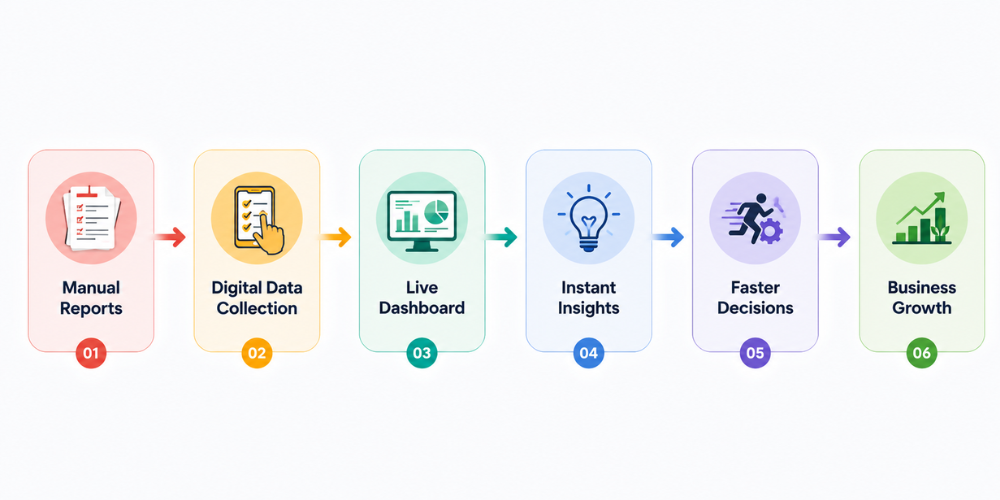
-
Capture Sales Activities in Real Time
To effectively manage sales, it's crucial to gather data in real-time rather than relying on end-of-day manual updates. Every interaction, whether it's a retailer visit, an order, a payment collection, or a conversation with a customer, should be documented as it occurs. By utilizing field sales management software, businesses can seamlessly capture these activities, providing managers with a clear and immediate understanding of the dynamics in the field. This approach not only enhances visibility but also fosters a more responsive and connected sales environment.
-
Replace Manual Processes with Automation
Manual processes like spreadsheets and paper records can create frustration due to slow updates, repeated entries, and mistakes. By embracing automation in everyday sales tasks, businesses can ensure that information is captured correctly and is readily accessible when needed. This shift allows teams to simplify essential activities such as collecting orders, tracking attendance, reporting expenses, and logging activities through sales force automation software, which not only lightens the administrative load but also enhances the reliability of data.
-
Monitor Performance Through Live Dashboards
Rather than relying on weekly or monthly reports, managers can benefit from keeping an eye on key sales metrics through real-time dashboards. This approach allows them to stay updated on sales performance, retailer coverage, order status, and team productivity throughout the day. By using live dashboards, managers can spot potential issues early on and take proactive steps to address them, ensuring that business performance remains strong.
-
Track More Than Just Sales Numbers
Revenue is just one piece of the sales puzzle. Businesses need to pay attention to the activities that fuel sales, like how often retailers are visited, adherence to beat plans, conversion rates of orders, collection of payments, and the availability of products. By keeping an eye on these operational metrics, teams can gain a better insight into their performance and uncover areas for improvement before they start affecting revenue.
-
Turn Insights Into Action
Collecting data has little value if it isn't used to improve decision-making. Managers should regularly review live insights, identify trends, and take immediate action to address operational challenges. For example, if a salesperson misses multiple planned visits or a high-demand product starts running out of stock, managers can intervene immediately instead of discovering the issue in the next sales report.
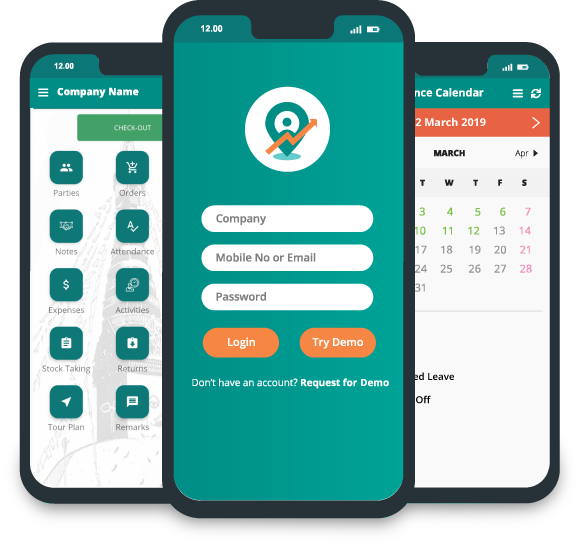
How the Delta Sales App Turns Data Into Real-Time Decisions
Gathering sales data is just the beginning of the journey. The true power comes from converting that data into meaningful insights that empower managers to make quicker and more informed decisions. Without an effective system in place, companies often find themselves juggling disorganized spreadsheets, facing delays in updates, and dealing with incomplete information that complicates decision-making.
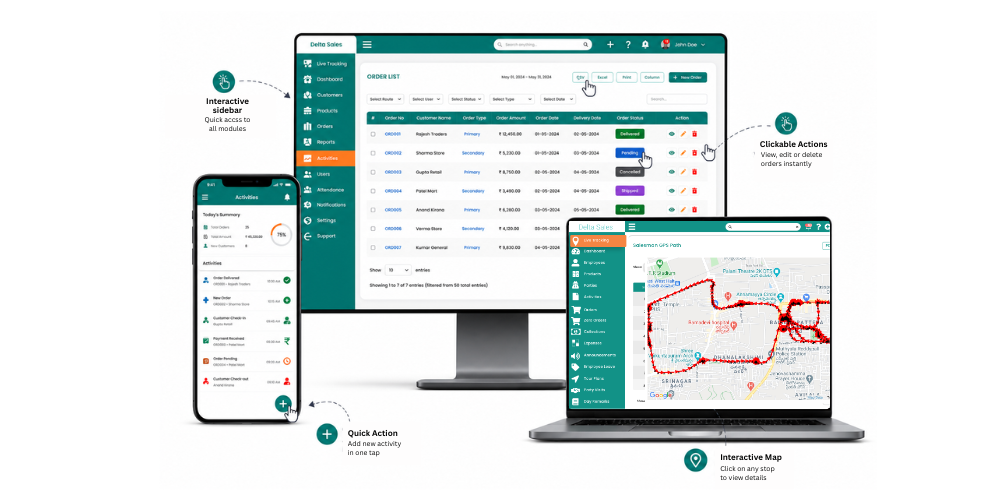
The Delta Sales App fills this void by seamlessly capturing field sales activities and presenting them in real-time dashboards and reports. Rather than waiting until the end of the day or week to grasp market dynamics, managers can keep a pulse on sales performance as it happens and take prompt action when necessary. Here’s how the Delta Sales App enables businesses to transform data into impactful decisions:
Capture Every Field Activity Automatically
Every interaction a sales representative has is captured instantly, creating a seamless flow of information. Whether it's visiting retailers, collecting orders, updating payments, or tracking attendance, the app removes the hassle of manual data entry, ensuring that everything is current and accurate. Businesses can easily monitor:
-
Visits to retailers and distributors
-
Orders placed and their values
-
Collections of payments
-
GPS check-ins and historical routes
-
Attendance records and working hours
-
Completion of beat plans
-
Availability of products and sales activities
This results in a trustworthy, centralized source of sales data that managers can access whenever they need it.
Monitor Performance with Live Dashboards
Managers can now move beyond relying solely on periodic reports; they have the ability to access live dashboards that provide instant insights into field operations. This empowers them to monitor key performance metrics such as sales achieved, outlet coverage, pending orders, payment collections, and salesperson productivity, all from a single, intuitive platform. With real-time information readily available, managers can quickly address operational challenges and help their sales teams remain engaged and productive throughout the day.
Generate Reports Without Manual Effort
While real-time data plays a crucial role in everyday decision-making, sales reports still hold significant value for evaluating performance and planning for the future. The Delta Sales App simplifies this process by transforming field data into valuable insights through its Automated Reports & Analytics. This means businesses can effortlessly create precise daily, weekly, and monthly reports, saving countless hours that would otherwise be spent on tedious spreadsheet work. Since each report is derived from live sales data, managers can have confidence in the accuracy, consistency, and timeliness of the information they receive.
Conclusion
Sales reports have long been a cornerstone of business operations. They play a crucial role in assessing performance, spotting trends, and sharing outcomes with stakeholders. However, in the rapidly evolving landscape of sales today, relying solely on these reports is no longer sufficient. To make quicker and more informed decisions, businesses must tap into real-time sales data. This data offers the clarity needed to oversee field activities, catch issues early, grasp the factors influencing performance, and act swiftly to seize opportunities before they slip away. Essentially, while sales data empowers you to navigate the present, sales reports provide valuable insights into the past.
By combining live sales data with automated reporting, businesses can improve field execution, increase team productivity, strengthen retailer relationships, and stay ahead of the competition. If you're looking to move beyond spreadsheets and delayed reports, the Delta Sales App can help. From capturing real-time field activities to generating automated reports and actionable insights, it gives your sales team the tools they need to make data-driven decisions every day.
Schedule your complimentary demo today and see how Delta Sales App can empower you to transform every sales interaction into valuable insights that foster smarter and quicker growth.