
Field Sales Automation For B2B Vs. B2C: Tailoring Solutions For Different Markets
Field sales teams operate differently depending on the market they serve. A business selling products to other businesses faces challenges that are very different from a company selling directly to consumers. As a result, a one-size-fits-all approach to field sales automation often falls short.
Modern field sales automation solutions help organizations streamline sales processes, improve productivity, and gain better visibility into field operations. However, to maximize results, businesses must tailor these solutions according to whether they operate in a B2B (Business-to-Business) or B2C (Business-to-Consumer) environment.
This guide explores the differences between B2B and B2C sales processes, how field sales automation supports each model, and the strategies businesses can adopt to achieve better sales outcomes.
What is Field Sales Automation?
Field sales automation refers to the use of digital tools and software solutions to manage, streamline, and optimize sales activities carried out in the field. These activities typically happen outside the office environment and include tasks such as customer visits, order collection, lead follow-ups, reporting, attendance tracking, and territory management.
Instead of relying on manual reporting or paper-based processes, field sales automation enables sales teams to record and access data in real time using mobile devices and cloud-based systems. This ensures that every sales activity is captured accurately and made available to managers instantly for better decision-making.
Key Activities Covered in Field Sales Automation
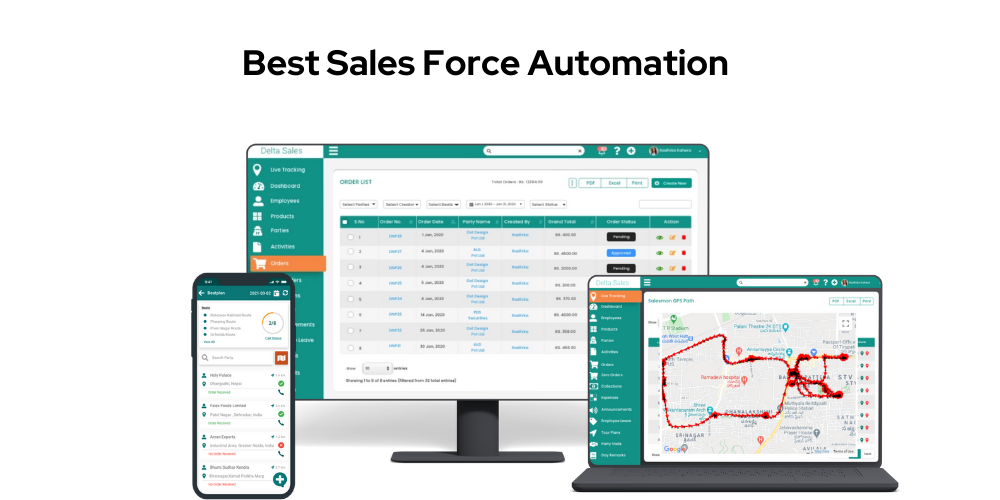
Field sales automation systems are designed to handle a wide range of daily sales operations, including:
-
Customer visit scheduling and tracking
-
Real-time order collection and processing
-
Route planning and optimization for field agents
-
Attendance marking with location verification
-
Lead tracking and follow-up management
-
Sales reporting and performance monitoring
-
Customer data and relationship management
By automating these core functions, businesses can eliminate repetitive manual work and significantly improve operational efficiency.
Understanding B2B and B2C Markets
B2B (Business-to-Business)
B2B businesses sell products or services to other organizations. Examples include manufacturers, wholesalers, distributors, and software providers. Sales processes in B2B environments are often complex and involve multiple stakeholders.
Characteristics of B2B sales include:
- Longer sales cycles
- Larger transaction values
- Multiple decision-makers
- Customized solutions
- Relationship-driven selling
B2C (Business-to-Consumer)
B2C businesses sell directly to end customers. Retail stores, e-commerce brands, and consumer goods companies are common examples.
Characteristics of B2C sales include:
- Shorter sales cycles
- High transaction volumes
- Individual decision-makers
- Standardized products
- Fast purchasing decisions
Key Differences Between B2B and B2C Sales Operations
While both B2B and B2C businesses aim to increase sales and revenue, the way they engage customers, manage opportunities, and close deals is fundamentally different. These differences impact sales strategies, customer management approaches, and the type of field sales automation features required for success.

1. Sales Journey and Buying Process
In B2B sales, the buying journey is often lengthy and involves research, evaluations, negotiations, and approvals before a purchase decision is made. Businesses typically invest significant time in understanding customer requirements and presenting customized solutions.
In contrast, B2C customers usually make purchasing decisions much faster. Factors such as price, convenience, promotions, and brand reputation often influence buying behavior, resulting in shorter sales cycles.
2. Who Makes the Purchase Decision?
B2B purchases are rarely made by a single individual. Multiple stakeholders, including managers, executives, procurement teams, and department heads, often participate in the decision-making process.
B2C sales generally involve individual consumers who can make purchasing decisions independently without requiring multiple approvals.
3. Nature of Customer Relationships
B2B organizations focus heavily on building long-term partnerships. Sales teams continuously engage customers through meetings, follow-ups, account reviews, and ongoing support to maintain relationships and encourage repeat business.
B2C relationships are typically more transactional. While customer loyalty remains important, businesses often focus on delivering excellent experiences and encouraging repeat purchases through promotions and customer engagement initiatives.
4. Products and Solutions Offered
B2B products and services are often tailored to meet specific business requirements. These solutions may involve customization, implementation support, training, and long-term service agreements.
B2C products are generally standardized and designed for a broad audience. Customers can easily compare options and make purchasing decisions based on features, pricing, and availability.
5. Revenue Generation Model
B2B businesses usually generate revenue through fewer transactions with higher monetary value. Each sale can contribute significantly to overall revenue.
B2C businesses rely on a larger number of transactions, often with lower individual order values. Success depends on maintaining high sales volumes and customer retention.
6. Sales Approach and Engagement Style
B2B sales representatives typically adopt a consultative approach. They focus on understanding business challenges, offering solutions, and demonstrating long-term value.
B2C sales strategies are often centered around convenience, promotions, emotional appeal, and customer experience. The objective is to simplify the buying process and encourage faster purchasing decisions.
7. Use of Data and Analytics
In B2B environments, businesses use sales data to manage pipelines, forecast revenue, evaluate account performance, and identify long-term growth opportunities.
B2C organizations rely more on real-time data to monitor customer behavior, track purchasing trends, measure campaign performance, and adjust strategies quickly.
8. Pricing and Negotiation Structure
Pricing in B2B sales is frequently customized based on customer requirements, order volume, contract terms, and business relationships. Negotiations are a common part of the sales process.
B2C pricing is usually fixed and transparent. Customers can instantly view prices and make purchasing decisions without extensive negotiations.
How Field Sales Automation Supports B2B Businesses
B2B sales environments are often more complex than B2C operations. Sales teams deal with longer sales cycles, multiple decision-makers, larger transaction values, and ongoing customer relationships. To manage these complexities effectively, businesses need field sales automation solutions that provide visibility, streamline workflows, and support relationship-driven selling. By automating critical sales processes, B2B organizations can improve productivity, strengthen customer relationships, and drive sustainable revenue growth.
CRM Integration
Customer relationships are at the core of B2B sales success. Integrating field sales automation with CRM systems ensures that all customer interactions, follow-ups, opportunities, and account details are stored in a centralized platform.
Benefits:
-
Maintain complete customer records and interaction history.
-
Improve follow-up management and customer engagement.
-
Provide teams with a unified view of every account.
Opportunity and Pipeline Management
B2B sales cycles often involve multiple stages before a deal is closed. Field sales automation helps representatives track opportunities, monitor progress, and manage sales pipelines more effectively.
Benefits:
-
Track prospects throughout the entire sales journey.
-
Identify high-priority opportunities quickly.
-
Improve visibility into pipeline health and performance.
Account-Based Selling
Large accounts often require personalized attention and strategic relationship management. Automation tools help sales teams manage account-specific activities and communications efficiently.
Benefits:
-
Track meetings, proposals, and customer communications.
-
Manage multiple stakeholders within key accounts.
-
Strengthen relationships with high-value customers.
Detailed Reporting and Analytics
Data-driven insights play a critical role in B2B sales decision-making. Advanced reports and analytics provide visibility into sales performance, customer behavior, and revenue trends.
Benefits:
-
Monitor sales performance across teams and territories.
-
Generate accurate revenue forecasts and projections.
-
Identify growth opportunities and performance gaps.
Customer Visit Management
Regular customer visits are essential for maintaining relationships and identifying new business opportunities. Automation helps track and verify field visits effectively.
Benefits:
-
Schedule and monitor customer visits efficiently.
-
Maintain accurate records of field activities.
-
Improve customer engagement and relationship building.
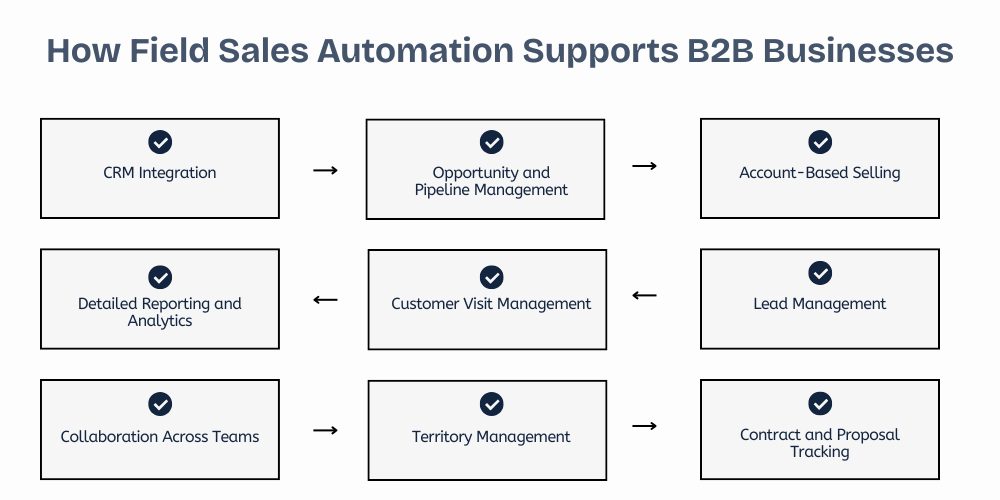
Lead Management
Managing leads effectively is crucial for converting prospects into long-term customers. Automation helps sales teams capture, assign, and nurture leads throughout the sales cycle.
Benefits:
-
Track leads from initial contact to conversion.
-
Improve lead follow-up and response times.
-
Increase conversion rates through better lead management.
Collaboration Across Teams
B2B sales often involve coordination between sales, marketing, customer support, and management teams. Automation improves communication and information sharing.
Benefits:
-
Enhance collaboration across departments.
-
Ensure consistent customer communication.
-
Improve overall customer experience and service quality.
Territory Management
Managing sales territories effectively ensures balanced workloads and better market coverage. Field sales automation provides visibility into territory performance and customer distribution.
Benefits:
-
Optimize territory allocation and coverage.
-
Identify underserved regions and opportunities.
-
Improve resource utilization and planning.
Contract and Proposal Tracking
B2B sales frequently involve contracts, quotations, and proposals that require multiple approvals. Automation simplifies tracking and management of these documents.
Benefits:
-
Monitor proposal and contract progress easily.
-
Reduce delays in approval workflows.
-
Improve deal closure efficiency and accuracy.
How Field Sales Automation Supports B2C Businesses
B2C businesses operate in a fast-paced environment where customer expectations, transaction volumes, and market trends change rapidly. To remain competitive, businesses need tools that help sales teams work efficiently, respond quickly to customer demands, and deliver exceptional experiences. Field sales automation provides the technology needed to streamline operations, improve productivity, and drive higher sales performance in B2C markets.
Faster Order Processing
B2C sales often involve a large number of transactions that need to be completed quickly and accurately. Field sales automation enables representatives to capture orders instantly through mobile devices and process them without delays.
Benefits:
-
Reduce order processing time significantly.
-
Minimize manual entry errors and paperwork.
-
Improve order accuracy and customer satisfaction.
Real-Time Customer Information
Access to accurate customer information helps sales representatives deliver personalized experiences and make informed recommendations during customer interactions.
Benefits:
-
View purchase history and buying preferences instantly.
-
Understand previous interactions and customer needs.
-
Provide more personalized and effective sales conversations.
Promotional Campaign Management
Promotions and discounts are powerful tools for driving consumer purchases. Field sales automation helps businesses manage campaigns efficiently and measure their effectiveness in real time.
Benefits:
-
Launch targeted promotional campaigns quickly.
-
Track campaign performance and customer response.
-
Maximize sales opportunities through data-driven promotions.
Route Optimization
Field representatives often need to visit multiple customers or retail outlets daily. Route optimization tools help plan efficient travel schedules and reduce unnecessary travel time.
Benefits:
-
Increase the number of customer visits per day.
-
Reduce travel costs and fuel expenses.
-
Improve overall field sales productivity.
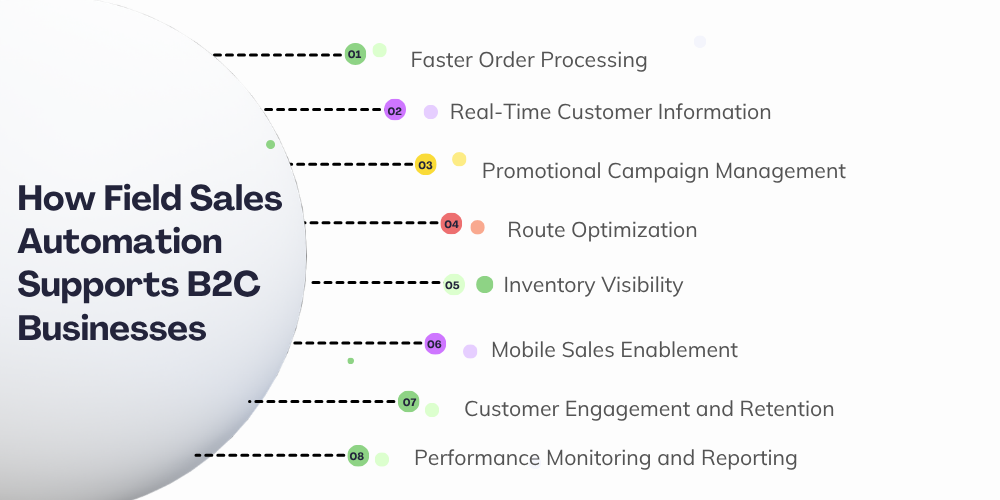
Inventory Visibility
Having access to real-time inventory information helps representatives provide accurate product availability updates and avoid stock-related issues.
Benefits:
-
Prevent stockouts and lost sales opportunities.
-
Improve inventory planning and replenishment.
-
Ensure better order fulfillment accuracy.
Mobile Sales Enablement
Mobile access empowers sales teams to perform essential tasks from anywhere without returning to the office.
Benefits:
-
Capture orders directly from customer locations.
-
Access sales reports and customer data instantly.
-
Improve responsiveness and operational flexibility.
Customer Engagement and Retention
Maintaining strong customer relationships is essential for repeat purchases and long-term business growth. Automation helps businesses stay connected with customers through timely communication and follow-ups.
Benefits:
-
Improve customer satisfaction and loyalty.
-
Encourage repeat purchases and referrals.
-
Build stronger long-term customer relationships.
Performance Monitoring and Reporting
Field sales automation provides managers with visibility into team performance, sales activities, and business outcomes through detailed reports and dashboards.
Benefits:
-
Monitor sales performance in real time.
-
Identify top-performing products and territories.
-
Make faster and more informed business decisions.
Key Strategies for Tailoring Sales Automation Solutions
Sales automation is most effective when it aligns with the unique requirements of a business. Since B2B and B2C organizations operate with different sales cycles, customer expectations, and purchasing behaviors, they require tailored automation strategies. Implementing the right features and workflows can help businesses maximize productivity, improve customer relationships, and achieve better sales outcomes.
For B2B Businesses
B2B sales environments typically involve longer sales cycles, larger deal values, and multiple decision-makers. As a result, automation solutions should focus on relationship building, strategic planning, and account management.
Focus on Relationship Management
Strong customer relationships are essential for long-term B2B success. Sales automation tools should support customer history tracking, account management, communication records, and follow-up reminders.
Benefits:
- Maintain complete customer interaction histories.
- Improve follow-up consistency and relationship nurturing.
- Strengthen long-term customer retention and loyalty.
Utilize Advanced Analytics
Data-driven decision-making is critical in B2B sales. Advanced analytics help businesses understand buying patterns, evaluate sales performance, and identify growth opportunities.
Benefits:
- Monitor sales pipeline performance effectively.
- Identify high-value accounts and opportunities.
- Improve forecasting and strategic planning accuracy.
Support Custom Workflows
B2B sales processes often vary depending on customer requirements, approval structures, and contract negotiations. Automation platforms should provide flexibility for customized workflows.
Benefits:
- Adapt sales processes to unique business requirements.
- Streamline approval and quotation management.
- Improve operational efficiency across departments.
Enable Team Collaboration
Successful B2B sales require coordination between sales, marketing, customer support, and management teams. Shared access to customer information improves collaboration.
Benefits:
- Ensure consistent customer communication.
- Improve information sharing across departments.
- Deliver a unified customer experience.
For B2C Businesses
B2C sales environments are typically characterized by high transaction volumes, shorter sales cycles, and rapidly changing customer preferences. Automation solutions should prioritize speed, efficiency, and customer experience.
Prioritize Speed and Efficiency
Customers expect fast service and seamless transactions. Automation tools should simplify sales processes and reduce delays.
Benefits:
- Accelerate order processing and fulfillment.
- Improve inventory and payment management.
- Increase overall sales productivity.
Enhance Customer Experience
Customer experience plays a major role in B2C success. Automation helps businesses deliver personalized interactions and targeted marketing campaigns.
Benefits:
- Provide personalized product recommendations.
- Improve customer satisfaction and engagement.
- Increase repeat purchases and brand loyalty.
Automate Repetitive Tasks
Routine administrative activities can slow down sales operations. Automating these tasks improves efficiency and reduces manual effort.
Benefits:
- Reduce time spent on manual data entry.
- Minimize errors in sales processes.
- Allow sales teams to focus on selling activities.
Use Real-Time Data
Real-time information enables businesses to respond quickly to customer demands and market changes.
Benefits:
- Monitor customer behavior instantly.
- Track inventory levels and product demand.
- Make faster and more informed business decisions.
Creating a Tailored Sales Automation Strategy
Whether operating in a B2B or B2C market, businesses should choose sales automation solutions that align with their goals, customer expectations, and sales processes. By focusing on the right strategies, organizations can improve efficiency, strengthen customer relationships, increase sales productivity, and gain a competitive advantage in their respective markets.
Common Challenges in B2B and B2C Field Sales
Field sales teams play a critical role in driving business growth, but their challenges often vary depending on whether they operate in a B2B or B2C environment. While both markets benefit significantly from field sales automation, they face unique obstacles that can impact productivity, customer relationships, and revenue generation. Understanding these challenges is essential for implementing the right sales strategies and technology solutions.
B2B Challenges
B2B sales processes are often more complex due to larger deal sizes, multiple stakeholders, and longer decision-making cycles.
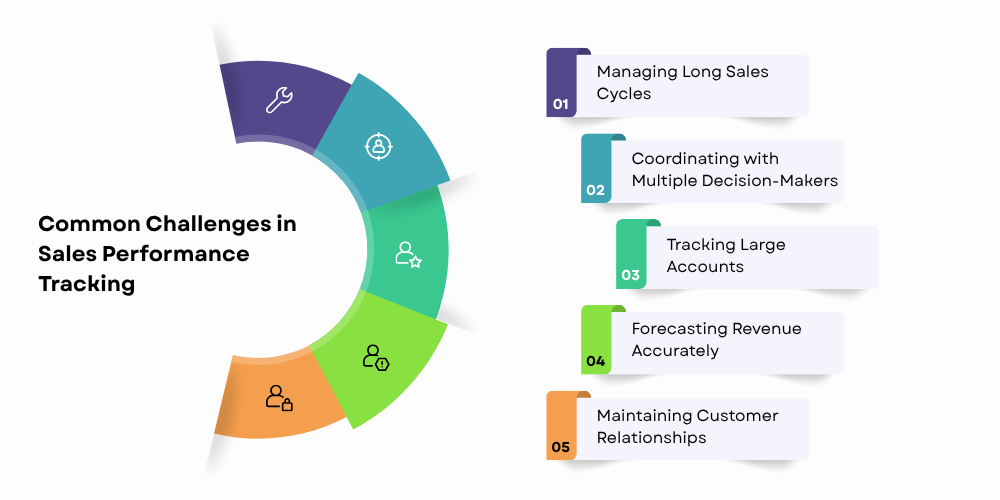
Managing Long Sales Cycles
B2B sales can take weeks or months to close, requiring continuous follow-ups, relationship building, and opportunity management throughout the process.
Coordinating with Multiple Decision-Makers
Sales representatives often engage with managers, executives, procurement teams, and stakeholders before reaching a final purchasing decision.
Tracking Large Accounts
Managing multiple customer accounts requires detailed tracking of interactions, contracts, opportunities, and ongoing business relationships.
Forecasting Revenue Accurately
Long sales cycles and complex negotiations can make revenue forecasting difficult without reliable data and visibility.
Maintaining Customer Relationships
Strong relationships are essential in B2B sales, requiring consistent communication, personalized engagement, and proactive account management.
B2C Challenges
B2C sales environments typically involve higher transaction volumes, faster purchasing decisions, and rapidly changing customer preferences.
Managing High Transaction Volumes
Sales teams must process large numbers of customer interactions, orders, and inquiries efficiently to maintain productivity.
Maintaining Customer Engagement
Keeping customers interested and engaged requires personalized experiences, regular communication, and timely promotions.
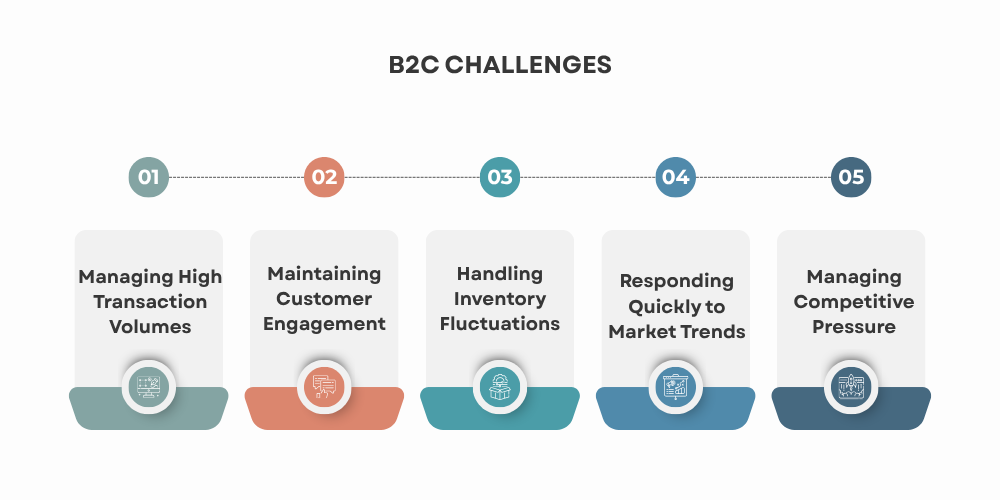
Handling Inventory Fluctuations
Changes in product demand can lead to stock shortages or excess inventory, affecting customer satisfaction and sales performance.
Responding Quickly to Market Trends
Consumer preferences can change rapidly, requiring businesses to adapt pricing, promotions, and sales strategies quickly.
Managing Competitive Pressure
B2C businesses often face intense competition and must continuously improve customer experiences to remain competitive.
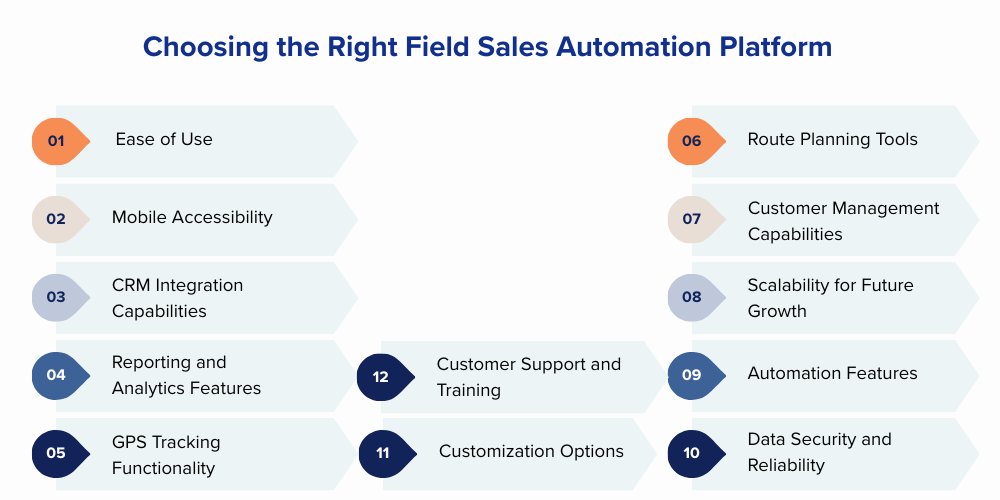
Choosing the Right Field Sales Automation Platform
Selecting the right field sales automation platform is a critical decision that can directly impact sales productivity, operational efficiency, and business growth. The ideal solution should not only address your current sales challenges but also support your future expansion plans. Before investing in a platform, businesses should carefully evaluate the following factors:
Ease of Use
Choose a platform with an intuitive interface that minimizes training requirements and enables sales teams to adopt it quickly.
Mobile Accessibility
Ensure field representatives can access customer information, update activities, and capture orders from anywhere using mobile devices.
CRM Integration Capabilities
Look for seamless CRM integration to maintain centralized customer data and improve collaboration across sales teams.
Reporting and Analytics Features
Advanced reporting tools help track performance, identify trends, and support data-driven decision-making across the organization.
GPS Tracking Functionality
GPS tracking enables businesses to monitor field activities, verify visits, improve accountability, and enhance territory management.
Route Planning Tools
Efficient route planning helps reduce travel time, increase customer coverage, and improve the productivity of field teams.
Customer Management Capabilities
A strong customer management system helps organize customer records, track interactions, and improve relationship-building efforts.
Scalability for Future Growth
Select a solution that can adapt to growing teams, expanding territories, and increasing business requirements without disruption.
Automation Features
Automation capabilities reduce manual work by streamlining order management, reporting, attendance tracking, and routine sales activities.
Data Security and Reliability
Choose a platform that offers secure data storage, user access controls, and reliable system performance to protect business information.
Customization Options
The ability to customize workflows, reports, and dashboards ensures the platform aligns with your unique business processes.
Customer Support and Training
Reliable support and training resources help businesses maximize platform adoption and quickly resolve operational issues.
The right field sales automation platform should align with your sales model, improve operational efficiency, and provide the flexibility needed to support long-term business objectives and sustainable growth.
How Delta Sales App Supports Both B2B and B2C Businesses
Delta Sales App is a powerful field sales automation platform designed to address the unique requirements of both B2B and B2C sales environments. Whether your sales team manages complex business accounts or serves a large consumer base, the platform provides the tools needed to streamline operations, improve visibility, and increase productivity.
Real-Time Sales Tracking
Monitor sales activities as they happen, enabling managers to track performance, identify opportunities, and make faster business decisions.
GPS-Based Field Employee Monitoring
Track employee locations in real time, verify customer visits, improve accountability, and ensure effective territory coverage consistently.
Route Planning and Optimization
Optimize travel routes for field representatives, reduce travel time, increase customer visits, and improve daily productivity.
Customer Relationship Management
Maintain complete customer records, track interactions, manage follow-ups efficiently, and build stronger long-term customer relationships.
Order Management
Capture orders instantly from the field, reduce processing delays, improve order accuracy, and enhance customer satisfaction.

Attendance Tracking
Automate attendance monitoring with location-based check-ins, ensuring accurate records and improved workforce management across territories.
Sales Reporting and Analytics
Generate detailed reports and gain actionable insights into sales trends, team performance, revenue growth, and productivity.
Lead and Distributor Management
Track leads effectively, manage distributor networks efficiently, improve follow-ups, and increase conversion opportunities across markets.
Inventory Visibility
Provide sales teams with real-time inventory management, helping prevent stockouts and ensuring better order fulfillment accuracy.
Task and Activity Management
Assign tasks, monitor completion status, and ensure field teams stay aligned with business goals and priorities.
Expense Management
Track field expenses accurately, simplify reimbursement processes, and maintain better financial control over sales operations.
Mobile Accessibility
Empower field teams with anytime access to customer data, orders, reports, and sales information through mobile devices.
Whether your business focuses on relationship-driven B2B sales or high-volume B2C transactions, Delta Sales App helps improve efficiency, strengthen customer engagement, and drive better sales performance through a unified and scalable platform.
Conclusion
B2B and B2C sales environments have different requirements, challenges, and customer expectations. While B2B businesses focus on relationship building and complex sales cycles, B2C organizations prioritize speed, convenience, and customer experience. Field sales automation helps both models improve efficiency, streamline operations, and increase productivity when implemented correctly.
By choosing a solution tailored to your market needs, businesses can gain greater visibility, improve team performance, and drive sustainable growth.
Ready to Transform Your Field Sales Operations?
Discover how Delta Sales App can help your business automate field sales processes, track team performance in real time, and improve sales productivity.
Book a Free Demo today and see how Delta Sales App can help your B2B or B2C sales team achieve better results.
FAQs
Q1. Why do B2B and B2C businesses need different sales automation strategies?
Because their sales cycles, customer interactions, transaction volumes, and decision-making processes differ significantly.
Q2. Can one field sales automation solution support both B2B and B2C businesses?
Yes. Modern platforms like Delta Sales App offer customizable features that can be adapted to both sales models.
Q3. What is the biggest advantage of field sales automation?
It improves productivity by automating routine tasks, providing real-time visibility, and enabling better decision-making.
Q4. How does automation improve customer relationships?
Automation helps sales teams maintain accurate customer records, schedule follow-ups, and deliver personalized interactions.
Q5. What industries benefit most from field sales automation?
FMCG, manufacturing, pharmaceuticals, retail, distribution, consumer goods, and wholesale businesses can all benefit significantly.
Q6. How can businesses get started with field sales automation?
Start by evaluating current sales processes, identifying inefficiencies, and selecting a platform that aligns with your business goals and sales model.