
The State of Field Sales Automation in 2026: Trends, Challenges, and What's Changing

Field sales automation has quietly emerged as one of the fastest-growing categories of enterprise software. Analysts tracking the larger field force and sales automation space peg the total market well into the double-digit billions in 2026, with most forecasts pointing to continued annual growth over 10% through the next decade. That growth is not happening because field sales teams suddenly have extra budgets to spend; it’s happening because the old way of running a field sales operation; spreadsheets, paper route sheets, and end-of-day phone calls, simply cannot keep up with how fast buying behavior, competition, and rep expectations are changing.
The technology goes beyond GPS tracking, digital attendance, and replacing paper order forms. Modern platforms have predictive analytics, AI-assisted decision-making, automated reporting, intelligent route planning, and connected sales workflows on the roadmap. At the same time, companies are finding that adding AI to an old sales process doesn’t automatically make it better.
The global field force automation market size was USD 2.65 billion in 2023 and is projected to reach USD 10.02 billion by 2030, growing at a CAGR of 21.4% during the forecast period (2024-2030).
What will field sales automation look like in 2026?
This blog looks at the biggest tech trends, the challenges still holding sales teams back, how the approach is changing from 2025, and what businesses should look for when choosing their next sales automation platform.
What Is Field Sales Automation?
Field sales automation involves leveraging software and digital tools to simplify and enhance the everyday tasks of sales representatives who are on the go. It transforms the chaos of disorganized spreadsheets, piles of paperwork, endless phone calls, and tedious manual reports into a cohesive system that effectively manages field sales activities. A field sales automation platform can help teams manage:
-
Customer visits, orders, and follow-ups
-
GPS tracking, routes, and territories
-
Sales reporting, inventory, and payments
-
Attendance and field team performance
The goal is not to replace sales representatives. It is to reduce repetitive administrative work, improve visibility into field activities, and give sales teams more time to focus on customers and revenue.
The State of the Industry in 2026
Field sales automation is part of a larger field force automation and sales force automation market that is now valued by several research firms at anywhere from $4.5 billion to $14 billion for 2026 alone, depending on how narrowly or broadly the category is defined. The growth projections are consistently between 8% and 20% CAGR over the next several years, driven by rising field workforce complexity, cloud-based deployment becoming the default, and, increasingly, AI integration.
Most new deployments are cloud-based solutions in demand for their ability to give managers instant access to field data anywhere, rather than waiting for end-of-day syncs. North America continues to be the largest regional market, but Asia-Pacific is the fastest growing, driven by rapid expansion of mobile and digital infrastructure across FMCG, telecom, and distribution sectors.
The numbers are a sign of a broader shift. Sales technology is moving from systems that capture sales activities to systems that actively help you manage and optimize sales execution.
Field Sales Automation Market Growth
The market is being pushed by several factors:
-
Growing field sales teams across multiple territories
-
Increasing demand for real-time sales visibility
-
Greater use of smartphones by field representatives
-
Cloud-based sales management platforms
-
Demand for automated sales reporting
-
GPS-based employee and customer visit tracking
-
Integration between sales, inventory, ERP, CRM, and payment systems
-
Increasing use of AI and predictive analytics
Cloud deployment plays a crucial role, as it allows field teams to access vital sales information from various locations and devices. According to Grand View Research, the cloud stands out as the leading deployment segment in their analysis of field force automation, and it is anticipated to continue experiencing robust growth.
Which Industries Are Adopting Fastest?
Field sales automation is key in any situation where sales reps are frequently on the road away from a central office. Field force automation is used by FMCG, retail, distribution, manufacturing, healthcare, pharmaceuticals, telecommunications, logistics, and other industries to improve visibility and operational efficiency. According to Grand View Research, some of the key end-use industries for field force automation are healthcare, IT and telecom, manufacturing, retail, and others. The retail segment is projected to be among the faster-growing segments.
In particular, for FMCG and distribution businesses, the technology has become intertwined with day-to-day execution: outlet visits, beat planning, order taking, product availability, secondary sales, payments, and merchandising.
Key Trends Shaping Field Sales Automation in 2026
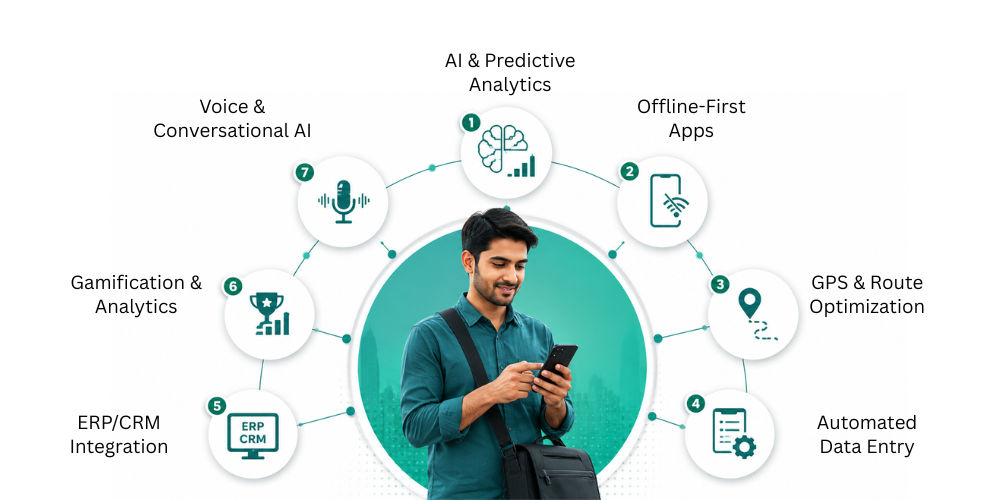
Field sales automation is evolving past mere tracking and reporting. By 2026, companies seek solutions that not only gather field data but also empower sales teams to operate more efficiently, enhance decision-making, and engage with customers more effectively. Below are the pivotal trends influencing the future of field sales automation in 2026:
-
AI-Powered Sales Intelligence and Predictive Analytics
AI is evolving from a supplementary feature to a crucial differentiator in field sales. Predictive lead scoring, next-best-action suggestions, and demand forecasting are now integrated directly into field sales platforms instead of being added as separate tools. However, the uptake of these advanced AI capabilities is inconsistent; many teams utilizing AI are still focused on basic tasks like personalizing messages rather than engaging in predictive forecasting, indicating substantial potential for growth in the coming years.
-
Offline-First Mobile Apps
Field representatives often find themselves in situations where stable Wi-Fi is a luxury rather than a guarantee. As we look ahead to 2026, a significant trend is emerging: the move towards offline-first mobile applications. These innovative tools empower reps to seamlessly capture orders, log their visits, and update customer records even when they’re not connected to the internet. Once they regain a signal, everything syncs automatically, ensuring that no valuable information is lost. This capability is particularly crucial in rural areas, basements, warehouses, and bustling urban environments where connectivity can be unreliable.
-
Real-Time GPS Tracking and Route Optimization
Real-time GPS tracking and route optimization have evolved from being a luxury to a standard expectation. Instead of representatives spending time manually organizing their schedules, contemporary platforms intelligently determine the best visit order by considering factors like territory, traffic conditions, priority clients, and available time slots. This advancement significantly boosts the number of meaningful interactions a representative can have each day.
-
Automated CRM Data Entry
The tedious task of manual data entry continues to consume valuable time for field sales representatives, making it a significant area for improvement this year. Innovations like voice-to-text order capture, automatic visit logging through geofencing, and AI-assisted form-filling are helping to free up precious hours, allowing reps to focus more on building relationships and closing deals rather than being bogged down by paperwork.
-
Deep Integration With ERP, CRM, and Payment Systems
Field sales tools that operate independently are gradually being overshadowed by integrated platforms that seamlessly connect with current ERP, accounting, and inventory management systems. The demand for real-time stock visibility and quick order-to-invoice processes is becoming a norm, particularly in the distribution and fast-moving consumer goods sectors.
-
Gamification and Performance Analytics
Leaderboards, streaks, and real-time performance dashboards are now being embraced not only as tools for motivation but also as means to identify team members who may be struggling, transforming what was once an unexpected end-of-month revelation into a timely opportunity for supportive coaching during the week.
-
Voice and Conversational AI for Order Taking
A rapidly evolving trend is taking shape: sales representatives and customers alike are increasingly turning to conversational AI interfaces to effortlessly place orders, check inventory, or obtain product information without needing their hands, a game changer in bustling retail and distribution environments where every second counts.
For a practical look at how these processes can be automated across attendance, route planning, visit reporting, order booking, follow-ups, and performance reporting, see our field sales automation playbook.
Biggest Challenges Field Sales Teams Face in 2026
While technology has enhanced connectivity in field sales, it hasn't removed the daily hurdles that sales teams encounter. Representatives continue to grapple with tedious manual tasks, disorganized data, connectivity problems, shifting customer expectations, and the relentless pressure to do more in less time. As the field sales landscape becomes more reliant on data, the focus shifts from merely accessing technology to ensuring that teams can embrace it, utilize the data efficiently, and translate technology into tangible sales results.
In 2026, some of the most pressing challenges faced by field sales teams include:

-
Low AI Adoption Despite Wide Availability
Despite the rapid growth of AI capabilities, a significant portion of field sales teams, estimated by some industry experts to be nearly one-third, are still not utilizing AI in any form. This creates a noticeable divide between field sales and desk-based sales roles, with larger sales organizations generally showing much higher rates of AI adoption. A lot of this can be attributed to tools designed primarily for office environments, which don't cater well to representatives who are often on the move and working from their phones between client meetings.
-
Poor Data Visibility and Fragmented Reporting
When field data is scattered across various spreadsheets, unintegrated applications, and handwritten logs, managers are unable to provide real-time coaching. This disjointed reporting remains one of the primary challenges reported by field sales leaders, frequently surpassing more commonly mentioned concerns such as representative turnover.
-
Rep Time Lost to Manual Admin Work
Many field sales representatives have shared that they spend a considerable amount of their week, sometimes even a full day, on tedious tasks like data entry and administrative work rather than focusing on selling. This time lost not only affects their productivity but also leads to missed client visits and potential revenue that could have been earned.
-
Connectivity Issues in Remote and Rural Areas
Despite continued 5G expansion, many field territories still have inconsistent coverage, making cloud-dependent tools unreliable without proper offline support.
-
Resistance to New Technology Adoption
Rolling out new field sales software often meets friction from reps accustomed to old habits: paper notebooks, personal spreadsheets, or informal WhatsApp coordination. Change management, not the technology itself, is frequently the bigger hurdle.
-
Rep Turnover and Onboarding Delays
Field sales turnover remains high across industries, and many organizations report needing three months or longer to fully ramp a new rep. Growing headcount without fixing productivity and onboarding systems first tends to compound the problem rather than solve it.
What's Changing: 2025 vs. 2026
Field sales automation is moving from basic digitization toward intelligent, real-time, and automated sales operations. In 2025, businesses primarily focused on replacing manual processes with digital tools, improving visibility, and centralizing sales data. In 2026, the focus is shifting toward using automation and AI to make faster decisions, optimize field activities, and improve sales team productivity.
Instead of relying on manual, end-of-day reporting, businesses are adopting real-time automated dashboards that provide instant visibility into sales performance and field activities. Order taking is also becoming more efficient, moving from paper forms and WhatsApp-based processes to mobile order capture with offline synchronization, allowing sales representatives to record orders even without an internet connection.
Territory management is evolving as well. Rather than depending on static, manually assigned territories, businesses are using AI-optimized dynamic routing to improve travel efficiency and help sales representatives cover more productive outlets. Similarly, CRM updates that were previously delayed by hours or days can now be automated through geofenced visit logging, ensuring that customer visits are recorded accurately in real time.
Sales coaching is becoming more personalized too. Instead of providing generic guidance to every representative, businesses can use sales data to deliver rep-specific coaching alerts based on individual performance, activities, and sales patterns. Most importantly, AI is no longer being treated merely as an experiment. In 2026, it is becoming increasingly embedded into core field sales workflows, supporting automation, decision-making, route optimization, performance management, and overall sales execution.
How to Choose the Right Field Sales Automation Software
Choosing field sales automation software is not simply about finding the platform with the longest list of features. The right solution should fit the way your sales team actually works, from planning daily visits and taking orders to tracking performance and generating reports.
Before making a decision, businesses should consider factors such as
-
Ease of use: Sales representatives should be able to learn and use the app without complicated processes or extensive training.
-
Offline functionality: Reps working in areas with limited connectivity should still be able to record visits, take orders, and access essential information.
-
Field tracking and route planning: GPS tracking, territory management, beat planning, and route optimization can help managers improve field coverage and productivity.
-
Order and inventory management: The software should make it easy to capture orders and keep relevant product and inventory information accessible in the field.
-
Reporting and analytics: Managers should have access to real-time sales data, activity reports, performance metrics, and territory-level insights.
-
Integrations: Check whether the platform can connect with existing CRM, ERP, accounting, payment, or other business systems.
-
Scalability: The software should be able to support additional sales representatives, territories, customers, products, and distributors as the business grows.
-
Industry fit: FMCG, distribution, manufacturing, pharmaceuticals, and other field-driven businesses may have different workflows, so industry-specific capabilities matter.
Pricing is also important, but it should not be the only deciding factor. A cheaper tool may become expensive if it requires extensive manual work or has limited reporting and integration capabilities.
Benefits of Field Sales Automation
The true benefit of field sales automation extends far beyond simply swapping out paper forms or spreadsheets. It seamlessly links daily field activities with sales data, empowering representatives to work more effectively while providing managers with clearer insights into sales performance and customer interactions.
By streamlining repetitive tasks and consolidating field information, businesses can enhance productivity, bridge operational gaps, and make quicker, informed decisions based on real-time data.
-
More Productive Sales Representatives
Automating routine tasks such as attendance management, visit reporting, order entry, and daily sales reports reduces the amount of time reps spend on administrative work. This allows them to focus more on customer visits, relationship building, and revenue-generating activities.
-
Stronger Sales Performance Management
-1786596965.png)
By harnessing centralized field data and performance analytics, managers gain the ability to compare their sales targets with actual results, track the productivity of visits, pinpoint areas where performance may be lacking, and celebrate their top-performing representatives. This fosters a more unified and supportive approach to managing sales performance across different teams and regions.
-
Better Sales Visibility
Managers can get a clearer view of what is happening across different territories without waiting for manual reports. Real-time sales reporting can show customer visits, orders, sales achievement, field activities, and other key performance indicators from a centralized dashboard.
-
Improved Territory Management
With beat planning, GPS tracking, customer visit planning, and route optimization, sales teams can organize their daily schedules more effectively. Managers can also identify under-covered areas and make better decisions about territory allocation and customer coverage.
-
More Informed Sales Forecasting
Consistently capturing sales data across various customers and regions allows managers to gain valuable insights into sales trends and future planning. By utilizing sales analytics, they can uncover shifts in product demand, understand customer buying behaviors, and evaluate how different territories are performing.
-
Better Customer Engagement
Field sales software empowers representatives with instant access to customer profiles, past orders, product details, payment histories, and visit logs. This readily available information during customer interactions enables reps to engage in more meaningful discussions and address customer needs more swiftly.
-
Lower Administrative Workload
Automated sales reporting, attendance tracking, expense management, order capture, and field activity records can significantly reduce repetitive manual work. This also means managers spend less time collecting information and more time analyzing performance and coaching their teams.
-
Faster and More Accurate Order Management
-1786596961.png)
Mobile order management allows representatives to capture customer orders directly during a visit. This reduces errors associated with paper-based or manually entered orders and helps businesses process sales information faster.
The true value of field sales automation lies in its ability to free up time, enhance the productivity of sales teams, streamline operations, and provide the insights necessary for making informed decisions.
How Delta Sales App Supports Modern Field Sales Teams
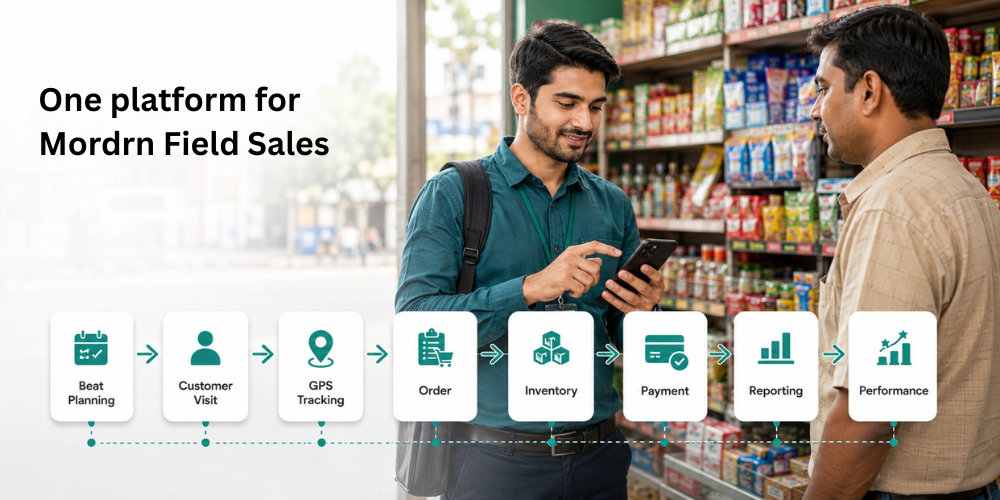
In today's increasingly interconnected and data-driven landscape, businesses require more than just basic employee tracking. They need a comprehensive platform that seamlessly integrates field activities, customer insights, orders, inventory, and sales performance into a cohesive workflow.
The Delta Sales App is thoughtfully crafted to empower businesses by automating everyday field operations while also providing managers with enhanced visibility and control over their sales teams.
-
Field Force Tracking & Attendance:
Managers have the ability to keep track of their sales representatives' attendance, locations, and field activities through a unified system. With GPS-based employee tracking and digital attendance, they gain clearer insights into whether the planned activities in the field are being carried out effectively.
-
Beat Planning & Route Management:
Sales teams can streamline customer organization into defined routes, enhancing daily visit planning. Effective route management enables representatives to minimize travel time, optimize outlet coverage, and utilize their working hours more productively.
-
Customer Visit Management:
Representatives can log customer interactions and keep a digital record of field activities. Managers can leverage this data to track visit frequency, pinpoint missed appointments, and assess the effectiveness of territory coverage.
-
Mobile Order Management:
Sales representatives have the ability to easily create and submit customer orders right from the field, eliminating the need for cumbersome paper forms or tedious manual data entry. This not only speeds up the order capture process but also significantly lowers the chances of making mistakes or experiencing delays.
-
Customer & Outlet Management:
Customer and outlet information can be seamlessly integrated into a unified system, encompassing past orders, sales activities, and essential account details. This equips representatives with enhanced insights prior to and throughout customer interactions.
-
Inventory & Product Management:
Sales representatives can easily find important product details during customer visits, allowing businesses to organize product and inventory information in a more user-friendly way. This empowers reps to offer better recommendations and minimizes the need for constant communication with the office.
-
Secondary Sales Tracking:
For companies collaborating with distributors and retailers, a secondary sales tracking system offers a clearer picture of how products are moving after the initial sale to the distributor. This insight helps managers grasp what’s happening at the retailer level, understand customer demand, and evaluate how different territories are performing.
-
Sales Reporting & Analytics:
Sales activities and data can be transformed into easy-to-read reports and dashboards. This allows managers to keep a close eye on sales success, customer engagement, team performance, territory patterns, and other key sales metrics without relying solely on reports created by hand.

-
Payment Collection & Expense Management:
Field teams can seamlessly log payment collections and business expenses within their daily routines. By integrating these activities with field operations digitally, financial tracking and expense reporting become significantly more streamlined and efficient.
-
Offline Field Sales Capability:
Sales representatives can continue performing essential activities even when internet connectivity is unavailable or unreliable. Once connectivity is restored, the recorded information can synchronize with the system, making offline functionality particularly useful for remote and rural sales territories.
-
Performance Monitoring:
Managers can assess how well planned activities align with what actually happens in the field, allowing them to monitor sales team performance across different representatives and territories. This approach helps in spotting areas where productivity may be lacking, celebrating outstanding achievements, and offering personalized coaching to support team members' growth.
Conclusion
Field sales automation in 2026 is evolving to prioritize human connection over mere data tracking. Companies are embracing more intuitive workflows, providing real-time visibility into sales activities, and leveraging AI-driven insights to empower field teams. This transformation aims to alleviate the burden of repetitive tasks, allowing sales representatives to focus on building meaningful relationships with customers. By equipping them with enhanced information, the goal is to make every interaction more impactful and personal, fostering a deeper understanding of customer needs and preferences.
As field sales transforms, companies that integrate intuitive automation with trustworthy data and streamlined processes will be more equipped to enhance efficiency and adapt swiftly to shifting market demands. The Delta Sales App consolidates essential field sales functions like attendance tracking, GPS navigation, route planning, client interactions, order processing, inventory management, analytics, and performance evaluation into a unified platform.
Ready to modernize your field sales operations?
Book a free demo of Delta Sales App and see how it can help your sales team work smarter.