
Field Sales Automation for Paints and Chemical Distributors: A Complete Guide
-1782214225.png)
The paints and chemicals industry operates in one of the most complex distribution environments. Manufacturers and distributors manage hundreds or even thousands of SKUs, multiple distributors, dealers, retailers, contractors, and field sales representatives spread across different regions.
Traditional sales management tools like manual reporting, spreadsheets, phone calls, and WhatsApp updates often lead to delays and errors and poor visibility into field operations. With competition increasing and customer expectations rising, businesses need more intelligent ways to manage their sales teams.
According to global data on digital adoption and sales productivity trends in business operations from the World Bank, businesses that implement digital systems in their sales and distribution processes consistently achieve higher operational efficiency, improved workforce productivity, and better decision-making compared to traditional manual methods.
That’s where field sales automation comes into play.
Today’s Sales Force Automation (SFA) software helps paint and chemical distributors automate routine sales tasks, boost productivity, extend market reach, and make quicker business decisions using real-time data.
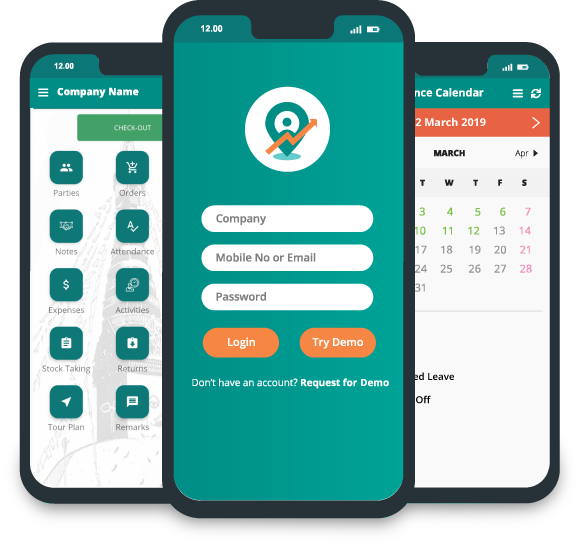
In this guide, we’ll explore how field sales automation works, the challenges it solves, and why more paint and chemical businesses are investing in digital sales management solutions such as Delta Sales App.
What is Field Sales Automation?
Field Sales Automation (FSA) is the process of using digital technology to streamline, automate, and manage the day-to-day activities of field sales teams. Instead of relying on manual processes such as paper-based order forms, spreadsheets, phone calls, or messaging apps, businesses equip their sales representatives with a mobile application that enables them to perform every sales task from a single platform.
For paint and chemical distributors, field sales automation is much more than just order taking. It builds a connected ecosystem where sales representatives, distributors, managers, and retailers are synchronized in real time. Every customer visit, product inquiry, order placement, payment collection, and follow-up is captured digitally, giving complete visibility into field operations.
A modern Sales Force Automation (SFA) software eliminates these inefficiencies by automating routine activities and centralizing field sales data. Using a mobile app, sales representatives can:
- Check in and check out of customer locations using GPS verification.
- Follow assigned beat plans and optimize daily travel routes.
- Book orders digitally with updated product catalogs and pricing.
- Record retailer visits and capture customer feedback.
- Monitor product availability and report stock levels.
- Upload photos for merchandising and shelf audits.
- Collect payments and track outstanding balances.
- Submit daily activity reports instantly without paperwork.
All data are synchronized in real time, so sales managers can see what is happening in the market without having to wait until the end of the day, or even the end of the week. A centralized dashboard enables them to view field activities, identify missed customer visits, monitor order performance, assess sales rep productivity, and make data-driven decisions on the fly.
Why Paint and Chemical Distribution Needs Field Sales Automation
The paints and chemicals industry relies on a huge network of distributors, dealers, retailers, and field sales reps to get products to customers in the most efficient way possible. As the business grows, handling large product catalogs, multiple territories, frequent retailer visits, and distributor relationships manually quickly becomes overwhelming. Field sales automation can help simplify these operations by digitizing routine sales activities, providing real-time visibility into field performance, and enabling businesses to make faster, data-driven decisions. Here are the key points and reasons why paint and chemical distributors are increasingly adopting Sales Force Automation (SFA) software.
-
Manage Large Product Catalogs More Efficiently
Paint and chemical companies often have hundreds or even thousands of SKUs, with different sizes, variants, formulations, and prices. Updating product information manually is error-prone in terms of pricing and wrong orders. Sales Force Automation (SFA) software provides sales representatives with instant access to updated product catalogs, pricing, and promotional schemes, enabling them to book accurate orders and recommend the right product while visiting retailers.
-
Improve Visibility Across Distributor and Dealer Networks
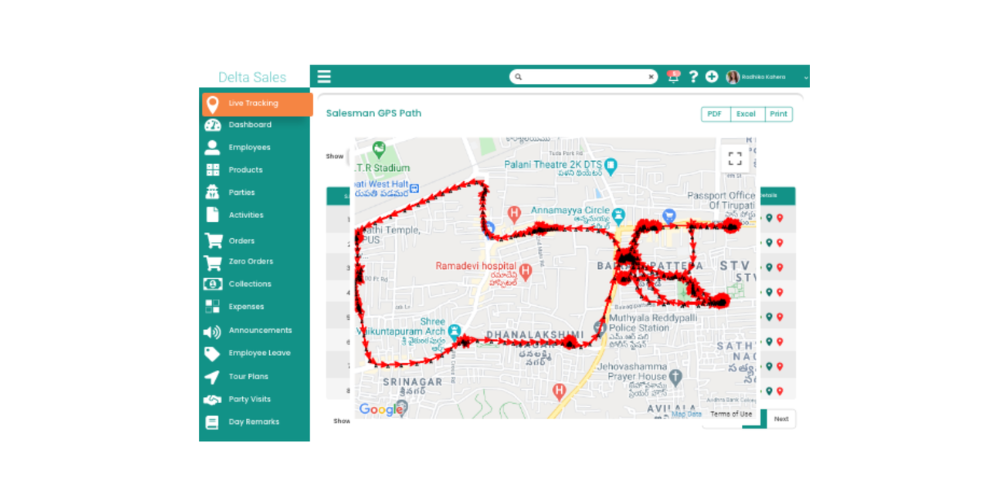
Without a centralized system, it is difficult to track distributor performance, retailer coverage, and field activities across multiple territories. Field sales management software gives managers real-time dashboards to track sales visits, order status, territory performance, and distributor activities, enabling them to make informed decisions based on live data instead of delayed reports.
-
Automate Retailer Visits and Order Booking
Manual collection of orders through paper forms or messaging apps often leads to delays and errors. Sales reps can take orders digitally during visits to retailers with mobile order management, which are instantly synced with the back office and reduce processing time. This means faster order fulfillment and a better overall customer experience.
-
Optimize Beat Planning and Territory Coverage
Ensuring every retailer receives regular visits is essential for maintaining strong customer relationships and maximizing sales opportunities. Using beat planning software, businesses can assign optimized routes, schedule retailer visits, and monitor beat completion, helping sales teams cover more outlets while reducing travel time and operational costs.
-
Increase Field Sales Team Productivity
Instead of selling, sales reps waste time preparing reports, updating spreadsheets, and sharing manual updates. Field sales automation software automates attendance, visit reporting, expense claims, and daily activity tracking, eliminating repetitive administrative tasks so sales reps can focus on building customer relationships and driving revenue.
-
Gain Real-Time Sales Insights
Business decisions are more effective when they are based on accurate, up-to-date information. A sales analytics dashboard offers real-time visibility into sales performance, visits to retailers, order values, product demand, and field employee productivity. These insights help managers identify opportunities, react to issues quickly, and continually improve sales performance.
-
Scale Operations with Standardized Sales Processes
As paint and chemical distributors expand into new markets, consistency across field teams becomes more difficult. Field sales automation helps to standardize the workflow for customer visits, order collection, reporting, and follow-ups. It makes sure every sales rep goes through the same processes, and it’s easier to scale without adding administrative complexity.
Common Challenges Faced by Paint and Chemical Distributors
Despite having a strong distribution network, many paint and chemical distributors still use manual processes to manage their field sales operations. Time-honored practices like tracking sales reps, gathering orders, keeping tabs on inventory, and evaluating distributor performance can create inefficiencies that affect productivity and customer satisfaction. Knowing these challenges, it’s easy to see how investing in field sales automation software is necessary to streamline operations and fuel sustainable growth.
-
Limited Visibility into Field Sales Activities
Managers often have no idea what their field sales teams are up to all day long. Without a central system, it is difficult to verify whether the sales reps actually visited the retailers they were assigned to, followed their beat plans, or spent adequate time with the customers. Without real-time visibility, it’s difficult to track performance, identify gaps, and offer timely support. Businesses get complete transparency into field operations with GPS-enabled field employee tracking and real-time activity reports.
-
Manual Order Collection and Processing
Distributors still rely on handwritten order forms, spreadsheets, or messaging apps to collect customer orders. Manual methods bring with them the risks of wrong quantities, incorrect pricing, duplicate entries, and delays in order processing. When sales reps visit customers, they can take orders in a digital format, which makes for faster processing, greater accuracy, and a smoother order fulfillment process with mobile order management.
-
Inefficient Beat Planning and Route Management
Without a structured visit schedule, sales reps can miss retailers, revisit the same outlets unnecessarily, or spend too much time traveling between locations. This leads to lower productivity and poor market coverage. Beat planning software implementation assists businesses in planning optimized routes, assigning territories, and ensuring that every retailer gets regular visits while minimizing travel time and operational costs.
-
Poor Inventory and Stock Visibility
Retailers want the right products in the right places at the right time, but lack of visibility into stock levels can lead to stockouts or excess inventory. Manual methods often make it difficult for sales reps to accurately report market stock. Companies use inventory management software to manage stock availability, monitor product movement and identify fast-moving or slow-moving items for better inventory planning and reduced lost sales opportunities.
-
Difficulty Monitoring Distributor Performance
The bigger the distribution networks, the harder it gets to monitor the performance of many distributors. Managers need visibility into sales volume, order frequency, retailer coverage, and territory performance to identify the top-performing distributors and areas requiring improvement. A distributor management system consolidates reporting, which makes it easier to evaluate the performance of a distributor and also bolsters channel relationships.
-
Delayed Reporting and Limited Sales Insights
Manual reporting often means sales reports reach managers at the end of the day, or even the end of the week. These delays can make it hard to respond quickly to shifts in the market or to customers’ demands. A sales analytics dashboard delivers real-time reports on sales performance, customer visits, order values, and field productivity to help businesses make faster and better-informed decisions.
-
Administrative Burden on Field Sales Teams
Field sales reps spend a lot of time preparing reports, updating spreadsheets, submitting expense claims, and communicating routine updates. Such repetitive tasks eat into time that could be spent selling and building customer relationships. Field sales automation automates attendance, reporting, expense management, and daily activity tracking, freeing sales teams to spend time on revenue-generating activities instead of paperwork.
Key Features Every Paint and Chemical Distributor Should Look For
Selecting the right field sales automation software isn’t just about digitizing your sales process – it’s about finding a solution that takes into account the unique challenges of the paints and chemicals industry. The right features can dramatically impact operational efficiencies and sales performance, from managing large product catalogs and distributor networks to optimizing visits to retailers and tracking field activities. Here are the key features that every paint and chemical distributor should look for in a Sales Force Automation (SFA) software.
-
GPS-Based Employee Tracking
You are better able to improve accountability when you know where your field sales representatives are and if they are really visiting the assigned retailers. A GPS employee tracking solution allows managers to track live locations, validate customer visits, track travel history, and ensure that sales teams are on their assigned routes. This increases transparency and helps to optimize the field activities.
-
Retailer and Distributor Management
Organize your customer data and engage with retailers and distributors on a regular basis to build long term relationships. A retailer management system helps businesses maintain detailed customer profiles, store visit history, schedule follow-ups and track distributor performance from a single platform. It enhances communication and builds channel partnerships.
-
Digital Order Management
Getting orders in quickly and accurately is important for maintaining good relationships with retailers and distributors. With a strong mobile order management capability, sales reps can place orders directly from their Smartphones, with updated product catalogs, pricing and promotional schemes. This reduces manual errors, speeds up order processing and ensures that customers get their products on time.
-
Beat Planning and Route Optimization
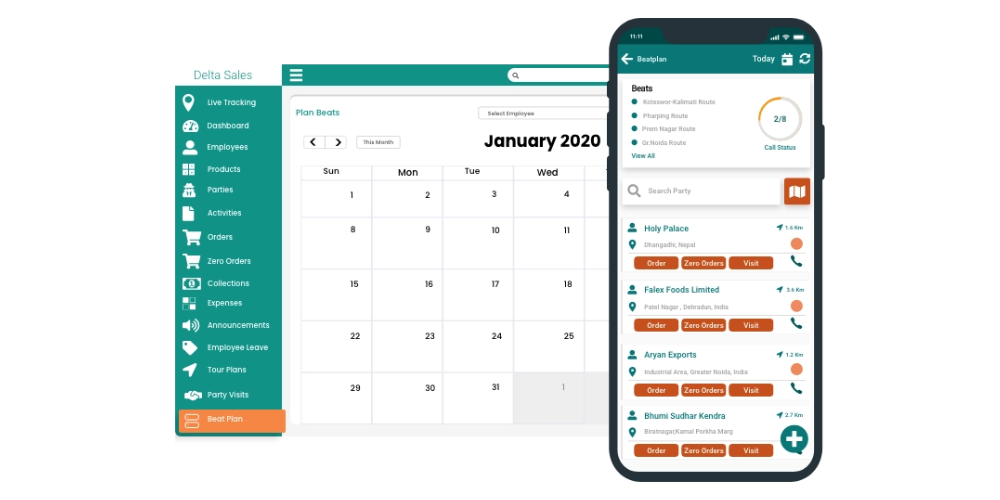
A well-planned route for sales representatives helps them visit more retailers without wasting time and fuel. Businesses can use beat planning software to assign territories, create daily visit schedules, and optimize travel routes to boost productivity. Managers can also track beat completion and make sure no customer is missed during regular sales visits.
-
Inventory and Stock Management
Product availability plays a major role in customer satisfaction and sales growth. An integrated inventory management software enables field teams to check stock availability, report market inventory, identify stockouts, and monitor product movement in real time. Better inventory visibility helps distributors avoid lost sales while improving replenishment planning.
-
Attendance and Expense Management
Manually processing attendance and travel expenses can be very time consuming and prone to error. Features like attendance management and expense management software help field employees mark attendance using GPS, submit travel claims digitally and upload supporting documentation directly via the app. This streamlines administrative processes and improves operational efficiency.
-
Real-Time Sales Reports and Analytics
Accurate, timely data is critical for making sound business decisions. A complete sales analytics dashboard can provide insight into sales performance, retailer visits, order values, product demand, territory coverage, and field employee productivity. Such live reporting allows managers to see trends, judge performance, and make quick corrections.
-
Secondary Sales Tracking
For paint and chemical manufacturers that sell through distributors, monitoring secondary sales is just as important as tracking primary sales. A secondary sales tracking feature provides visibility into how products move from distributors to retailers, helping businesses understand market demand, evaluate distributor performance, and improve sales forecasting.
-
Offline Functionality
Many remote field sales reps don't always have a reliable internet connection. Field sales management software with offline capability allows users to continue recording visits, booking orders and updating customer information even if there is no internet connection. When connectivity is restored, data is auto-synced with the central system so that the field operation never misses a beat.
-
ERP and CRM Integration
A good Sales Force Automation (SFA) software should be able to connect with existing ERP, CRM and accounting systems. This eliminates duplicate data entry, increases data accuracy and keeps sales, inventory, finance and customer information in sync across departments. Integration also helps businesses to streamline workflows and make faster, data-driven decisions.
Benefits of Field Sales Automation for Paint and Chemical Businesses
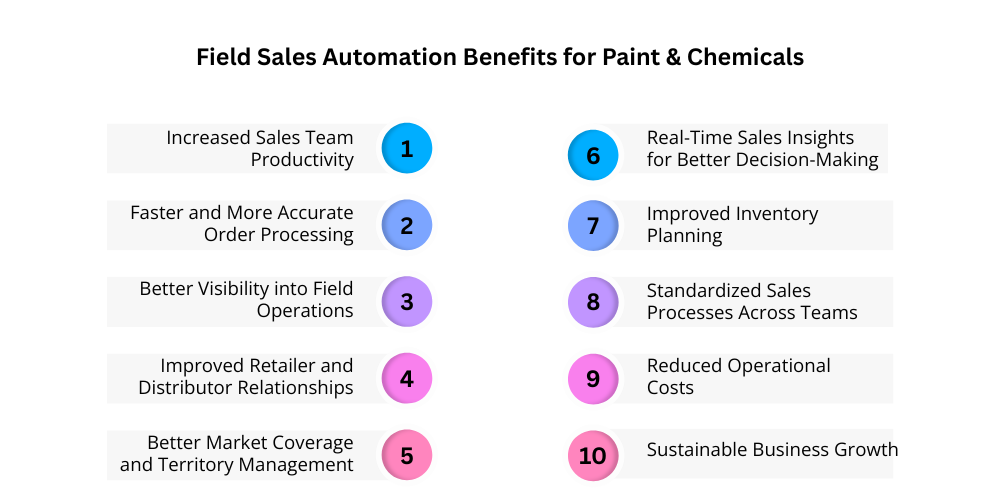
Field sales automation is not just about replacing manual processes with digital tools. It’s about transforming the way paint and chemical businesses run their sales operations. Automation of repetitive tasks, better visibility into the field and real-time insights can help companies boost productivity, build stronger relationships with distributors and provide better service to retailers. Some of the key benefits of implementing Sales Force Automation (SFA) software for paint and chemical distribution are given below:
-
Increased Sales Team Productivity
Field sales reps are at their best when they are spending more time with customers and less time on paperwork. Field sales automation software automates routine tasks such as attendance tracking, order booking, reporting and expense submissions freeing up sales teams to focus on building relationships, finding new opportunities and closing more sales.
-
Faster and More Accurate Order Processing
Pricing errors, duplicate entries and delayed processing are common outcomes of manual order collection. Mobile order management enables sales representatives to capture orders digitally with up-to-date product catalogs and pricing information. This helps to improve order accuracy and speed up processing, ensuring that retailers get their products without undue delay.
-
Better Visibility into Field Operations
One of the biggest advantages of GPS employee tracking is complete transparency into field activities. Managers can monitor customer visits, verify attendance, track travel routes, and measure sales representative performance in real time. This visibility helps identify productivity gaps, improve accountability, and ensure planned activities are executed effectively.
-
Improved Retailer and Distributor Relationships
Strong relationships with retailers and distributors are essential for long-term business success. A retailer management system helps sales teams maintain detailed customer records, schedule regular follow-ups, record visit history, and respond to customer requirements more efficiently. Consistent engagement leads to better customer satisfaction and stronger channel partnerships.
-
Better Market Coverage and Territory Management
Sales reps might skip important retailers or spend too much time traveling between locations without planning. Beat planning software enables businesses to plan routes, assign territories and ensure that each outlet is visited on time. This will enhance market coverage, boost customer engagement, and provide additional opportunities for sales growth.
-
Real-Time Sales Insights for Better Decision-Making
Managers can react quickly to changing market conditions because they have access to real-time business data. The sales analytics dashboard gives you vital information on your sales performance, order trends, retailer visits, territory performance and product demand. These reports help businesses make informed decisions, identify growth opportunities, and improve their overall sales strategy.
-
Improved Inventory Planning
Maintaining the right inventory levels is crucial for avoiding stockouts and meeting customer demand. By integrating inventory management software with field sales operations, businesses gain better visibility into stock movement, product availability, and market demand. This helps improve replenishment planning while reducing excess inventory and lost sales opportunities.
-
Standardized Sales Processes Across Teams
As businesses expand, maintaining consistency across multiple sales teams becomes increasingly important. Field sales management software standardizes processes such as customer visits, order collection, reporting, and follow-ups, ensuring every representative follows the same workflow. This improves operational efficiency, simplifies employee training, and supports scalable business growth.
-
Reduced Operational Costs
Manual processes typically result in unnecessary travel, paperwork, delays in communication and administrative overhead. Sales Force Automation (SFA) software assists companies in lowering operating costs and increasing productivity and resource utilization by automating field operations, streamlining travel routes and reducing manual data entry.
-
Sustainable Business Growth
In summary, the real strength of field sales automation is its ability to foster sustained growth. By streamlining operations, improving visibility, strengthening customer relationships, and leveraging data-driven decision-making, paint and chemical distributors can scale their business more efficiently, boost customer satisfaction, and stay competitive in an increasingly digital marketplace.
How Delta Sales App Helps Paint and Chemical Distributors
Basic sales tracking is not enough to manage field sales in the paints and chemicals industry. The businesses require a solution that can handle complex distributor networks, large product catalogs, retailer engagement, visibility of inventory and real-time field monitoring all on a single platform. The Delta Sales App is an all-in-one field sales automation software that streamlines these operations and helps paint and chemical distributors boost efficiency, increase sales productivity and gain complete visibility into their field activities.
-
Digitize Your Entire Field Sales Process
The Delta Sales App automates the sales cycle, digitizing it to eliminate the need for manual paperwork. A single mobile application can be used by field sales representatives to manage all their daily activities, including attendance tracking and daily route planning, as well as order booking and report submission. This not only saves time, but ensures that every activity is logged accurately and shared with managers in real-time.
-
Improve Order Accuracy with Mobile Order Management
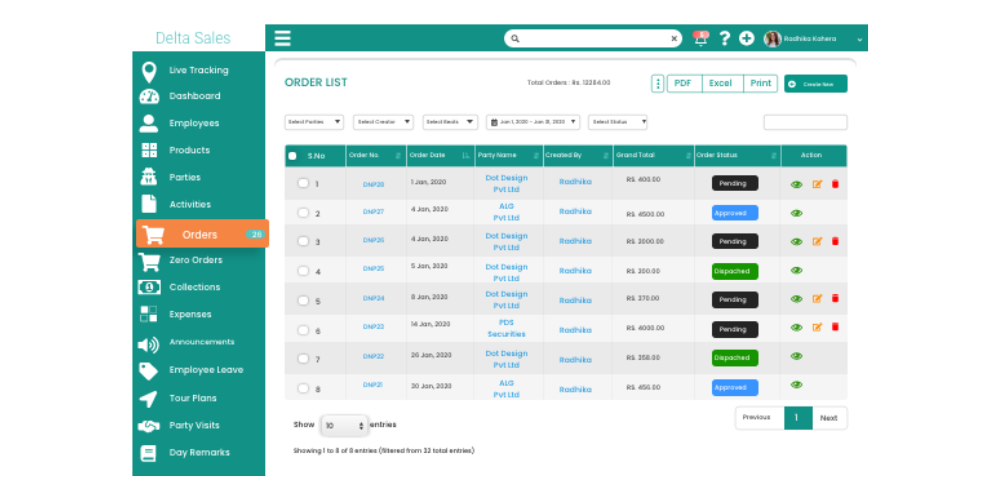
Manual order collection can slow down the sales process and lead to costly mistakes. With mobile order management, Delta Sales App enables reps to place orders directly from their smartphones with updated product catalogs, pricing and promotional schemes. Orders are immediately synchronized with the back office, allowing for faster processing, improved accuracy and a better experience for distributors and retailers.
-
Track Field Teams with GPS-Based Employee Tracking
To effectively manage your field sales force, you need to know where your sales representatives are and confirm customer visits. Delta Sales App provides GPS employee tracking, enabling managers to view live locations, confirm retailer visits, review travel history, and evaluate field productivity. This increases accountability, while making sure sales teams work their assigned territories and beat plans.
-
Optimize Retailer Visits with Beat Planning
Continuous engagement with retailers is key to building strong customer relationships. The Delta Sales App also includes beat planning software that helps businesses assign territories, create structured visit schedules, and optimize travel routes. Managers can monitor beat completion in real time, making sure that each retailer is visited on time and no sales opportunity is missed.
-
Strengthen Distributor and Retailer Management
Organizing customer information and regular follow-ups is key to building lasting relationships with distributors and retailers. Delta Sales App for Retailer Management empowers sales teams with a single dashboard to manage customer profiles, record visit history, schedule follow-ups and monitor distributor performance. This helps to improve communication and strengthen channel partnerships and increase customer satisfaction.”
-
Gain Actionable Insights with Real-Time Reports
Business growth depends on timely and accurate information. Delta Sales App provides a powerful sales analytics dashboard that offers real-time insights into sales performance, retailer visits, order values, field employee productivity, and territory performance. These reports enable managers to identify trends, monitor KPIs, and make informed decisions that improve overall sales effectiveness.
-
Scale Your Distribution Business with Confidence
Whether you are running a local distribution network or scaling into multiple markets, Delta Sales App is built to scale with your business. Its scalable Sales Force Automation (SFA) software offers consistent sales processes, enhances collaboration between field teams and managers, and easily integrates into existing business systems. This allows paint and chemical distributors to optimize their operations, reduce manual labor, and focus on delivering excellent service, all while driving sustainable business growth.
Future Trends in Field Sales Automation
As technology evolves, field sales automation is becoming more intelligent, connected and data driven. Paint and chemical distributors no longer seek software that just tracks sales activities. They need solutions that help them predict demand, optimize field operations and make faster business decisions. Those that adopt these innovations will be better positioned to improve their operational efficiency, deepen their relationships with customers, and stay competitive in a more digital marketplace.
-
Predictive Demand Forecasting
Businesses are moving away from using only historical sales data and are increasingly employing predictive analytics to predict future demand. Field sales management software can also help distributors manage their supply chain by combining sales history and seasonal trends with market activity to find the right balance of inventory levels and stock shortages.
-
Smarter Route Optimization
Location data and automation are helping to make route planning more intelligent. The advanced beat planning software can recommend the most efficient routes, focus on high-value retailers, and reduce unnecessary travel time. This enables field sales representatives to meet with more customers each day, thereby reducing travel costs and increasing productivity.
-
Real-Time Business Intelligence
The future of field sales is instant access to actionable data. Advanced sales analytics dashboards will further deliver deeper insights into sales performance, customer behavior, territory coverage, and distributor activities. With real-time reporting, managers can identify opportunities, solve problems promptly, and make smart choices using live business data.

-
Seamless Integration Across Business Systems
More than ever, businesses want their field sales automation software to integrate seamlessly with ERP, CRM, accounting, inventory and billing systems. Deeper integrations eliminate the need for duplicate data entry, increase operational efficiency, and ensure that all departments have access to accurate, up-to-date information from a single source of truth.
-
Mobile-First and Offline Capabilities
As field sales teams spend most of their time on the move, mobile-first experiences will continue to shape the future of sales automation. Solutions that support offline data capture, automatic synchronization, and user-friendly mobile interfaces will enable sales representatives to remain productive even in areas with limited internet connectivity.
-
Greater Focus on Customer-Centric Selling
The future of field sales automation isn’t just about being better at what we do, it’s about being better to our customers. businesses can customize sales conversations, establish distributor relationships and offer faster, more responsive service with full visibility into customer interactions, purchase history and retailer preferences As customer expectations continue to change, companies that combine technology with relationship-driven selling will have a sustainable competitive advantage.
Conclusion
Manual sales processes can limit business growth and reduce field team productivity in today’s competitive paints and chemicals market. Distributors should invest in field sales automation software to streamline order management, build better retailer relationships, optimize field operations and gain real-time visibility into sales performance. When companies have the right technology, they can improve their operational efficiencies, make data-driven decisions and build a more efficient and profitable distribution network.
Delta Sales App can help if you’re ready to simplify your field sales operations and empower your sales team with smarter tools. It provides all the tools paint and chemical distributors need to streamline their field sales, from mobile order management and GPS employee tracking to beat planning, retailer management and real-time sales analytics.
Book a free demo today and discover how Delta Sales App can help you automate your sales processes, increase productivity, and accelerate business growth.