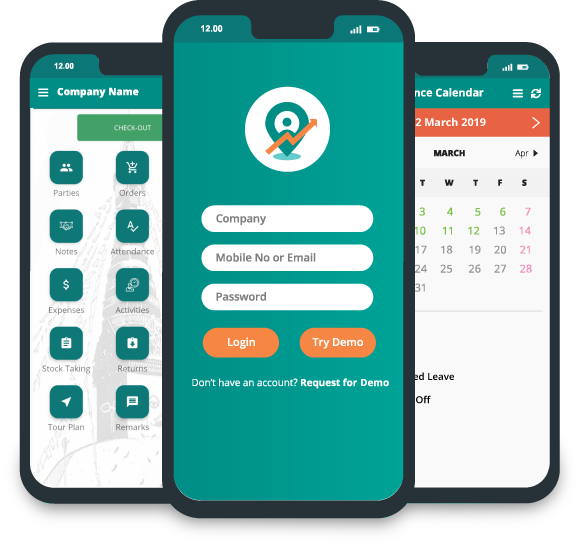

The Complete Guide to Field Sales Management Software: Tracking, Automation & Secondary Sales in 2026

Did you know? Sales reps spend only 28% of their week actually selling. The rest is consumed by manual reporting, paperwork, and chasing down data. Field sales management software is the single biggest lever companies use to reclaim that lost time, and Delta Sales App puts all of it in one place.
Managing a field sales team without the right software is like navigating a city without GPS. Your reps are on the road, visiting dozens of outlets every day, and without real-time visibility, you are always one step behind. Orders slip through, distributor sell-through goes unmonitored, and your managers are flooded with calls asking for updates that should already be on their dashboard.
In many industries, sales do not happen inside offices or conference rooms. They happen in retail stores, pharmacies, supermarkets, warehouses, and distribution outlets where field representatives interact directly with customers. These professionals are responsible for representing the company in the marketplace, building long-term relationships with retailers, ensuring product availability, and capturing orders that ultimately drive revenue.
Despite their critical role in business growth, managing field sales teams has historically been a complex and challenging task. Unlike office-based employees, field representatives operate across large geographic areas, travel between multiple customer locations each day, and perform a wide range of activities that are difficult to monitor from a central office.
Sales managers often face several operational challenges when overseeing distributed field teams. Without reliable systems in place, it becomes difficult to answer fundamental questions that influence business performance.
Managers frequently struggle to understand:
-
Whether field representatives are visiting the correct retailers according to their assigned territories
-
Which areas generate the highest sales and which require additional focus
-
Whether customer visits are happening consistently or irregularly
-
How quickly customer orders are processed and fulfilled
-
How effectively distributors are selling products to retailers
A large portion of this data is gathered by hand in conventional settings. At the end of the day, sales representatives may submit spreadsheets, send updates over the phone, or record orders on paper. These approaches impede managers' access to real-time insights, cause delays, and raise the possibility of human error.

Manual reporting is becoming less and less effective as companies grow and competition intensifies. Inaccurate forecasting, lost opportunities, and decreased operational efficiency are all consequences of delayed information.
This is where modern field sales management software becomes essential. These digital solutions provide organizations with powerful tools to monitor field employees, automate sales processes, and gain full visibility into both primary and secondary sales activities.
Mobile tracking apps, order management systems, automated reporting dashboards, distributor monitoring tools, and customer relationship management features are just a few of the operational capabilities that advanced platforms integrate into a single ecosystem.
When combined, these technologies allow businesses to convert their field sales operations from disjointed manual workflows into effective, data-driven systems.
We will go over how field sales management software functions, how field sales tracking apps enhance team visibility, how automation boosts productivity, and why distribution-driven companies need to keep an eye on secondary sales in this extensive guide.
What Is Field Sales Management Software?
A specialized technology platform called field sales management software aids businesses in managing salespeople who work remotely. This software is designed to meet the particular needs of field operations, in contrast to traditional sales management tools that are mainly concerned with internal reporting.
Field representatives visit retailers, take orders, verify product availability, advertise new products, and uphold distributor relationships, among other tasks. Effective decision-making requires real-time capture and analysis of these activities.
Without an integrated system, managers often rely on manual reporting methods such as spreadsheets or phone calls, which are prone to errors, delays, and incomplete information. Field sales management software centralizes these activities in a single platform, providing visibility, accountability, and actionable insights.
Industries That Use Field Sales Management Software
-
Fast-Moving Consumer Goods (FMCG):
FMCG companies deal with a large number of products and thousands of retail outlets. Sales representatives must make frequent store visits to restock products, record orders, and monitor competitor activity. Field sales management software enables managers to monitor representative performance, keep accurate order records, and ensure consistent product availability. -
Pharmaceuticals:
Medical representatives frequently make multiple visits to pharmacies, hospitals, and clinics each day. Keeping track of product promotions, customer interactions, and orders is critical. Software solutions automate these tasks, track attendance, and provide information on territory coverage, allowing pharmaceutical companies to streamline operations and ensure regulatory compliance. -
Distribution and Wholesale:
Distributors frequently have extensive networks of retailers and independent dealers. To maximize distribution efficiency, primary and secondary sales must be tracked, inventory movement monitored, and sales trends analyzed. Field sales software combines these processes into a single system, providing accurate and timely insights. -
Logistics and Supply Chain:
Field personnel coordinate deliveries, manage inventory, and ensure timely product availability. Managers can use digital platforms to track deliveries, optimize routes, and ensure that teams are performing as expected.
Field sales management software allows businesses to gain control over complex field operations by integrating multiple operational functions into a single platform, such as tracking, reporting, and analytics.
How Field Sales Tracking Apps Work
A field sales tracking app is a mobile solution designed to give managers real-time visibility into the activities and locations of their sales representatives. It addresses a critical challenge: sales managers cannot be present at every customer site to monitor representative performance.
These apps provide accurate, location-based insights into employee movements and interactions, allowing managers to supervise remotely while maintaining operational efficiency. The Field Sales Tracking App works in the following ways:
GPS Location Tracking
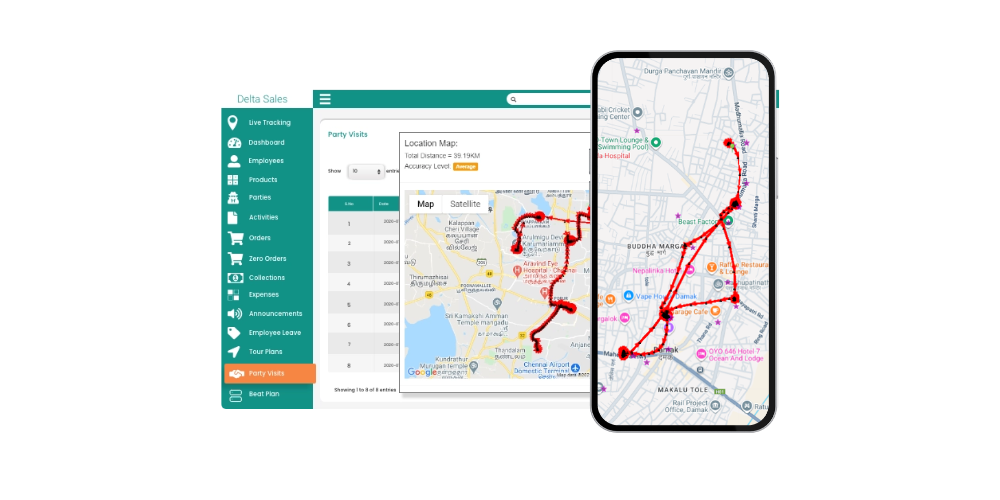
GPS tracking is a fundamental feature of modern field sales tracking apps, providing real-time visibility into the movements and activities of field employees. By continuously monitoring the live locations of representatives, managers can ensure that assigned territories are being properly covered and that designated routes are being followed efficiently. This capability not only verifies that field employees are present at the right locations but also helps optimize daily operations.
Benefits of GPS tracking include:
-
Operational Transparency: Managers can verify that employees are covering their assigned regions as planned.
-
Customer Visit Verification: Ensures representatives are physically present at customer sites, enhancing accountability.
-
Territory Optimization: Identifies over-served and under-served areas to balance workloads efficiently.
-
Route Efficiency: Analyzes travel patterns to minimize unnecessary movement and reduce operational costs.
By providing precise location data, GPS tracking allows managers to make informed decisions about resource allocation, territory management, and field team performance.
Customer Visit Logging
For field sales representatives, customer interactions are the core of daily operations. Accurately recording each visit is essential for maintaining accountability, understanding market dynamics, and improving sales performance. Modern field sales tracking apps make this process seamless by allowing representatives to log every visit digitally, replacing outdated paper-based systems and reducing manual errors.
Key Data Captured During Customer Visits:
-
Arrival and Departure Times: Precise timestamps help managers verify that representatives are spending adequate time at each location and adhering to planned schedules.
-
Products Discussed or Sold: Representatives can record which products were promoted, demonstrated, or purchased, providing a detailed view of market activity.
-
Customer Feedback and Inquiries: Notes on questions, concerns, or suggestions from customers help managers address issues promptly and adjust strategies where needed.
-
Follow-Up Actions: Recording follow-up tasks ensures no opportunity is missed and allows managers to track ongoing engagement with clients.
By logging visits digitally, organizations gain real-time insights into field activities. Managers can identify trends, evaluate territory coverage, and assess the effectiveness of sales strategies. This data also supports performance evaluation, coaching, and planning, enabling businesses to make informed decisions, optimize resource allocation, and improve overall customer engagement.
Beat Planning and Territory Management
Beat planning is the process of scheduling visits to specific customers or territories systematically. Effective beat planning ensures that sales representatives cover all their assigned accounts while minimizing travel inefficiencies.
Field sales apps allow managers to:
-
Assign territories to representatives
-
Plan daily, weekly, or monthly visits systematically
-
Track whether scheduled visits are completed on time
-
Adjust routes dynamically based on customer priority or demand
Structured beat plans ensure consistent customer engagement, optimize time spent in the field, and reduce the likelihood of missed opportunities.
Real-Time Reporting
Manual reporting often leads to delays in understanding sales performance and operational efficiency. Real-time reporting features in tracking apps allow managers to view live dashboards and generate reports instantly.
Benefits of real-time reporting include:
-
Faster Decision-Making: Managers can react immediately to issues such as missed visits, low sales, or stock-outs.
-
Performance Monitoring: Provides instant visibility into representative productivity and territory coverage.
-
Operational Insights: Helps identify trends, bottlenecks, and areas needing improvement.
By combining GPS tracking, visit logging, beat planning, and real-time reporting, field sales tracking apps provide a holistic solution for managing distributed sales teams.
Field Sales Automation: Eliminating Manual Work
In today's field sales operations, automation has completely changed the game. Paper-based order entry, attendance tracking, route planning, and report generation are examples of traditional manual processes that take a lot of time, decrease operational effectiveness, and raise the possibility of mistakes. Missed opportunities, delayed order processing, and erroneous data that adversely affect decision-making are all consequences of these inefficiencies.
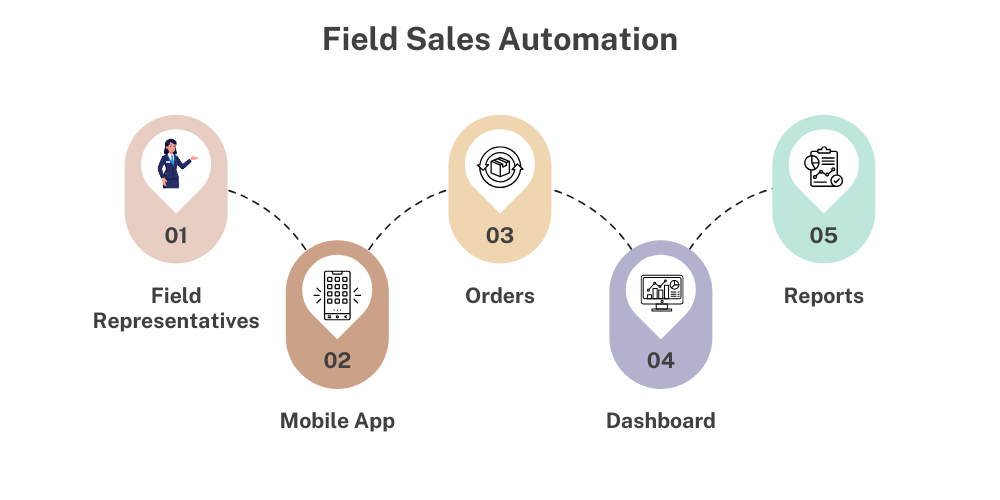
Field sales force automation software addresses these challenges by digitizing routine tasks and centralizing field operations in one platform. By automating processes such as order capture, attendance tracking, route optimization, and sales reporting, representatives can spend more time engaging customers, building relationships, and generating revenue.
Digital Order Capture
One of the most important duties of field representatives is order collection. Orders were previously written by hand and then entered into internal systems, a procedure that was prone to errors and delays.
Through mobile apps that are instantly synchronized with the company's central system, digital order capture enables representatives to directly record orders.
Advantages include:
-
Instant Processing: Orders are captured in real time, reducing lead time between order placement and fulfillment.
-
Error Reduction: Automated entry eliminates mistakes from manual transcription.
-
Improved Customer Experience: Customers receive faster confirmation and fulfillment of their orders.
Digital order management ensures smooth operations, improves accuracy, and enhances overall sales productivity.
Automated Sales Reports
Manually generating sales reports is time-consuming and often prone to errors, especially when field teams operate across multiple locations. Automated sales reporting eliminates this bottleneck by compiling real-time data from field activities, creating accurate and consistent reports without manual effort.
Key Benefits:
-
Performance Metrics: Track individual representatives’ visits, orders, and revenue, helping managers identify top performers and provide targeted support.
-
Territory Insights: Analyze sales across regions to identify high-performing areas and optimize under-served territories.
-
Product Trends: Understand which products are selling well, enabling smarter inventory planning and promotion strategies.
-
Customer Behavior: Monitor order patterns to identify cross-selling opportunities and improve customer engagement.
By providing accurate, timely, and actionable insights, automated reporting allows managers to make faster decisions, optimize field performance, and drive overall sales growth.
Geo-Tagged Attendance
Managing field employee attendance is challenging without verification mechanisms. Geo-tagged attendance ensures that employees can mark their presence only from approved locations using GPS-based validation. By tying attendance records to specific geographic coordinates, organizations gain a reliable and tamper-proof system for monitoring field workforce activity.
Benefits include:
-
Accurate Record-Keeping for Payroll and Performance Evaluation: Geo-tagged systems automatically record the exact time and location of attendance, reducing human errors and ensuring that payroll and performance metrics are based on verified data.
-
Verification of On-Site Presence for Compliance and Accountability: Managers can confirm that employees are actually present at designated customer sites, distribution centers, or retail outlets, which is particularly important for regulated industries such as pharmaceuticals or FMCG.
-
Reduced Risk of Fraudulent Attendance Entries: By restricting attendance marking to specific geographic zones, organizations eliminate opportunities for false reporting, thereby increasing trust in the system.
-
Enhanced Managerial Oversight: Supervisors can monitor trends over time, identify irregularities in attendance patterns, and provide timely feedback to improve field discipline.
-
Empowered Field Representatives: Transparency and verified reporting build trust between management and employees, fostering a culture of accountability while reducing disputes over work hours.
Geo-tagged attendance provides transparency and builds trust between management and field representatives.
Route Optimization
Travel time represents one of the largest operational costs for field sales teams. Sales representatives often spend several hours each day moving between customer sites, distributor locations, and retail outlets. Without proper planning, inefficient routes can lead to wasted time, missed visits, and reduced sales coverage. Route optimization tools use advanced algorithms and geographic data to plan the most efficient paths between multiple customer locations.

Benefits include:
-
Reducing Unnecessary Travel: Optimized routing minimizes detours and redundant travel, ensuring that representatives spend more time engaging with customers rather than commuting.
-
Maximizing the Number of Customer Visits per Day: By planning the most efficient sequence of visits, sales teams can increase their daily coverage without extending working hours, thereby enhancing overall productivity.
-
Lowering Operational Costs: Optimized routes reduce fuel consumption, vehicle wear-and-tear, and other travel-related expenses, directly impacting the bottom line.
-
Enhancing Field Representative Productivity: Representatives can focus more on selling, relationship-building, and order management rather than navigating inefficient routes.
-
Improved Customer Satisfaction: Timely visits and consistent service help build stronger relationships with customers, as retailers and distributors experience predictable and reliable engagement.
Optimized routes help businesses cover more customers efficiently while maintaining high levels of service.
Secondary Sales Tracking: Monitoring Distributor Sales
For companies that operate through distribution networks, monitoring secondary sales is essential. Primary sales track inventory sold from manufacturer to distributor, but secondary sales capture how distributors sell products to retailers or end customers.
Understanding Primary vs Secondary Sales
Primary sales reflect what distributors purchase from manufacturers. Secondary sales provide insights into market-level product movement. Without secondary sales tracking, businesses risk overestimating demand, mismanaging inventory, and failing to detect underperforming distributors.
Importance of Secondary Sales Tracking
Tracking secondary sales is crucial for businesses that operate through distributors, as it goes beyond just knowing what distributors purchase from manufacturers. Secondary sales automation provides insight into how products actually move through the market, offering a more accurate picture of demand and performance.
Key benefits include
-
Market Visibility: Provides a clear understanding of product performance across different regions, helping businesses identify high-demand and low-demand areas.
-
Accurate Demand Forecasting: Real-time secondary sales data allows companies to plan production and inventory more effectively, reducing stock-outs and overstock situations.
-
Distributor Performance Insights: Helps evaluate how efficiently distributors sell products to retailers, enabling better support and incentive planning.
-
Identifying Product Movement Trends: Detects fast-selling items that need prioritization and slow-moving products that may require promotional strategies or redistribution.
By tracking secondary sales, organizations gain actionable intelligence to optimize distribution networks, improve sales strategies, and ensure products reach customers efficiently, ultimately boosting revenue and operational efficiency.
Distributor and Inventory Monitoring
Monitoring distributors enables businesses to understand product sell-through rates and inventory turnover. This insight helps companies allocate stock effectively, plan promotions, and maintain consistent product availability at the retail level.
Secondary sales tracking also supports strategic decision-making by highlighting high-performing regions and distributors and pinpointing areas needing additional support.
Key Features to Look for in Field Sales Software
Choosing the right field sales software is critical for maximizing ROI and improving operational efficiency. While each organization may prioritize features differently, some capabilities are indispensable.
-
GPS Employee Tracking
Throughout the workday, GPS tracking gives managers real-time information about the precise location of field representatives. By verifying that workers are visiting their designated territories and client locations on time, this capability assures accountability. Beyond verification, GPS tracking enables businesses to pinpoint underserved areas, streamline travel routes, and distribute teamwork among employees.
-
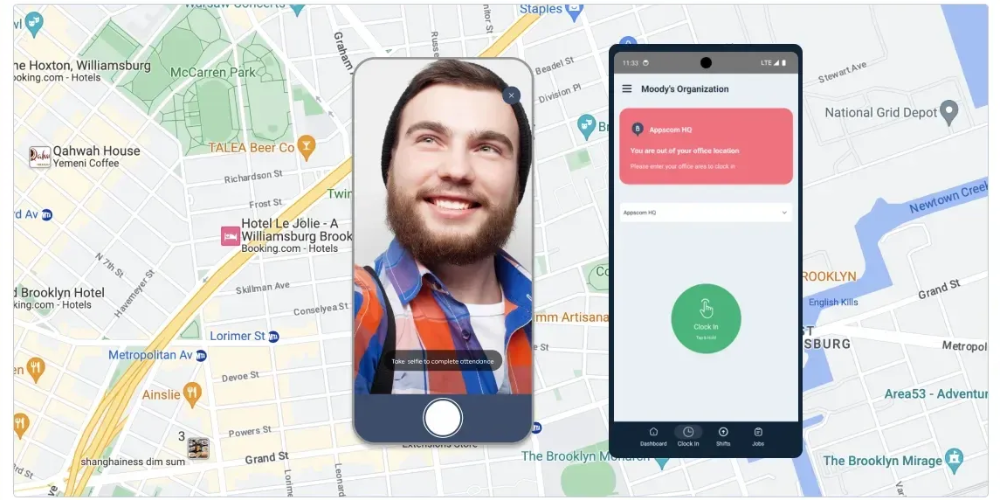
Selfie Attendance
Selfie attendance enhances traditional attendance tracking by requiring field employees to capture a photo at the time of marking their presence. This simple yet effective feature minimizes the risk of fraudulent check-ins and ensures accurate attendance records for payroll and performance evaluation. Additionally, combining selfie attendance with GPS data allows managers to verify that employees are physically present at the correct locations.
-
Geo-Fencing
Geo-fencing allows businesses to define specific geographic boundaries for certain activities, such as logging customer visits or marking attendance. Employees can only perform these actions within predefined zones, ensuring compliance with operational policies. This feature is particularly useful in industries where strict location verification is required, such as pharmaceuticals or FMCG.
-
Customer Relationship Management (CRM)
Centralized CRM capabilities allow field sales teams to access detailed customer information from a single platform. Representatives can view contact details, purchase history, preferences, and previous interactions, enabling more personalized and effective engagement. CRM integration also allows teams to track orders, follow up on pending requests, and maintain comprehensive records of each customer relationship.
-
Order Management and Inventory Tracking
Automated order management streamlines the process of capturing, processing, and fulfilling orders. Field representatives can record orders in real time using mobile apps, which syncs directly with the company’s central system. Inventory tracking ensures that stock levels are monitored continuously, preventing both overstocking and stock-outs.
-
Real-Time Analytics
Real-time analytics transform raw data into actionable insights for sales managers and executives. Dashboards and reports provide visibility into individual performance, territory coverage, product demand, and sales trends. Managers can identify underperforming regions, detect changes in customer behavior, and adjust strategies accordingly.
Benefits of Implementing Field Sales Management Software
Adopting field sales management software offers organizations both operational efficiency and strategic advantages. By centralizing data, automating processes, and providing real-time visibility, companies can optimize field operations and drive measurable growth.
-
Enhanced Visibility and Control
With real-time tracking of field activities, managers gain complete oversight of territory coverage, customer visits, and representative productivity. This visibility allows for quick identification of gaps, missed visits, or underperforming regions. -
Increased Sales Productivity
Automation reduces the time spent on manual reporting, data entry, and administrative work. Representatives can focus on core sales activities such as visiting customers, promoting products, and building relationships. By freeing teams from repetitive tasks, companies increase the number of effective customer interactions per day, which directly contributes to higher sales performance and improved customer satisfaction. -
Faster and More Accurate Order Processing
Digital order capture allows field representatives to record orders instantly using mobile apps, which sync directly with the central system. This eliminates delays and errors associated with manual reporting. -
Better Decision-Making
Analytics dashboards consolidate data from multiple sources into actionable insights. Managers can track sales trends, evaluate territory performance, and monitor distributor activity. This allows for faster, data-driven decisions such as reallocating resources, planning promotions, or addressing underperforming regions. By basing decisions on accurate, real-time data, organizations can respond proactively rather than reactively to market changes. -
Improved Distributor Management
Secondary sales tracking provides visibility into distributor-level performance, including sell-through rates and inventory movement. Companies can identify high-performing distributors, allocate stock more efficiently, and target underperforming distributors with support or incentives. This ensures products are consistently available at retail outlets, minimizes lost sales opportunities, and strengthens relationships across the distribution network.
Field sales management software empowers organizations to streamline operations, increase productivity, and make smarter, data-driven decisions. Companies that implement these solutions gain a competitive edge by improving operational efficiency, enhancing customer satisfaction, and maximizing revenue across both primary and secondary sales channels.
Results: What Teams Achieve With the Right Software
Case Study: Patel Lubricants, Mumbai
Patel Lubricants:
To obtain visibility over their field sales team, a Mumbai-based manufacturer and distributor used the Delta Sales App. Order tracking was completely manual prior to adoption, and managers had no real-time view of representative activity. The team saw notable increases in order accuracy, visit completion rates, and reporting efficiency following the implementation of the Delta Sales App. Click here to read the complete case study.
4K Paints, Punjab
The Delta Sales App was utilized by 4K Paints, a paint manufacturer located in Moga, Punjab, to monitor their field force throughout a vast distribution network. The sales team's accountability was enhanced, and hours of manual labor were eliminated each week thanks to the ability to track beat plan adherence and automate daily reporting. Explore the full case study here.
What the Data Shows
Based on customer feedback and platform data, Delta Sales App users consistently report:
• Up to 30% increase in sales team efficiency from automated order capture alone
• Significant reduction in manual reporting time through EOD automation
• Improved visit completion rates driven by beat planning and GPS verification
• Better secondary sales visibility, reducing distributor inventory disputes
• Faster expense reimbursement cycles through digital claims management
How to Choose the Right Field Sales Management Software
Selecting the right software is a strategic decision that can determine operational success. Key factors include:

Choosing field sales software is a meaningful investment. The platform your team uses will shape their daily workflow, your reporting visibility, and ultimately your sales performance. Use this buying framework to evaluate your options:
Step 1: Define Your Core Use Case
Are you primarily trying to solve a tracking problem (where are my reps?), an automation problem (too much manual work), or a visibility problem (what is selling through the channel)? Your primary pain point should drive your software selection. Most companies need all three, but understanding your priority helps you evaluate platforms more clearly.
Step 2: Check Industry Fit
Not all field sales software understands the nuances of FMCG distribution, pharmaceutical rep management, or multi-tier channel sales. Look for a platform that has customers in your industry and case studies that reflect your operational reality.
Step 3: Evaluate Mobile Experience
Your representatives will spend the entire day in this app. Adoption will be killed by a slow, clumsy, or confusing mobile experience. Make sure the app functions dependably offline by testing it on the devices your representatives actually use, which are typically low-cost Android devices in emerging markets.
Step 4: Assess Integration Needs
Will the software need to connect to your ERP, accounting system, or warehouse management platform? Check which integrations are available out of the box and whether a custom API is accessible for any bespoke connections.
Step 5: Pilot Before You Scale
Run a paid or free trial with a small group of reps in one territory before rolling out company-wide. Measure adoption rates, data quality, and manager satisfaction over 2-4 weeks. Only then scale to the full team.
Conclusion
Managing a field sales team is complex, but with the right tools, it doesn’t have to be. Field sales management software streamlines operations, provides real-time visibility, automates repetitive tasks, and enables accurate monitoring of both primary and secondary sales. Organizations that adopt these solutions gain enhanced control over territories, improved sales productivity, faster order processing, and actionable insights that drive smarter decisions.
Whether you operate in FMCG, pharmaceuticals, distribution, or logistics, implementing a modern field sales platform empowers your team to work efficiently, strengthens customer relationships, and maximizes revenue opportunities.
Transform the way your field team operates by adopting a comprehensive field sales management solution like Delta Sales App. Book a Demo Today and see how real-time tracking, automation, and secondary sales insights can elevate your sales operations and drive measurable growth.