
Route-to-Market Strategies for Cosmetics and Personal Care Distributors

A great beauty product can lose its competitive edge long before it gets to the consumer.
Why? Distribution. A new skincare product can have lots of demand, attractive packaging, and the right price, but if it is not available in the right stores, at the right time, and in the right quantities, then consumers will just choose another brand.
This means route-to-market (RTM) strategy is a whole lot more than a logistics decision for a cosmetics and personal care business. It controls the flow of products from manufacturers and distributors to retailers and finally to consumers. The challenge is all the more relevant since there are more and more beauty brands in pharmacies, supermarkets, cosmetic stores, salons, wholesalers, e-commerce, and traditional retail. Each channel has different requirements for pricing, inventory, product assortment, promotions, and service.
For distributors, therefore, moving product is not the goal. To build a scalable cosmetics distribution network that guarantees product availability, reduces operational inefficiencies, and provides sales teams with more visibility into each market.
In this blog we will look at the critical route-to-market strategies for cosmetics and personal care distributors, the challenges involved, and how technology can make execution easier.
What Is a Route-to-Market (RTM) Strategy?
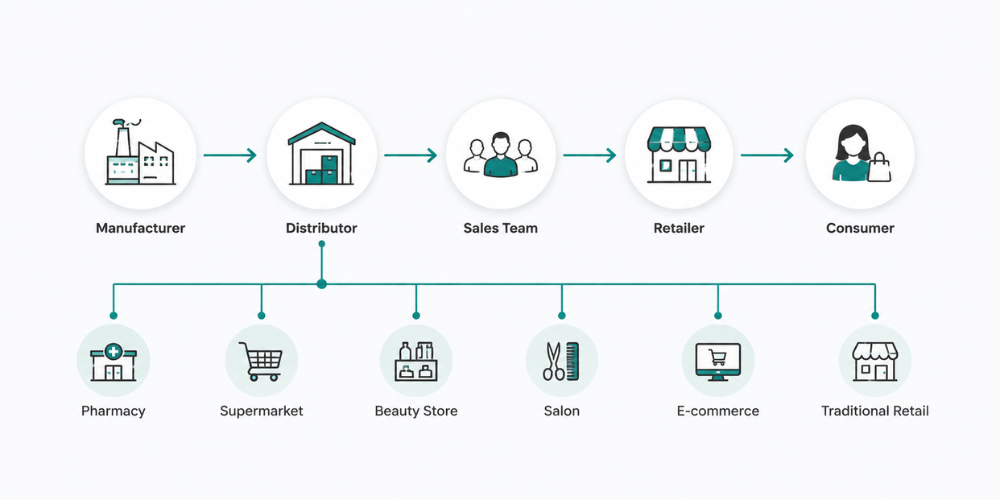
The route-to-market strategy is the systematic approach that a business uses to identify how it will get its products to customers and ultimately to end consumers. It includes decisions like:
-
Which markets should the business go into?
-
What channels to use?
-
“Direct or through distributors?” That’s the question regarding product sales.
-
Onboard which distributors / wholesalers?
-
How do sales reps cover retailers?
-
How do you manage inventory and orders?
-
How does one track products across different territories?
The best approach depends on variables such as geographic coverage, product category, brand maturity, target customers, order volumes, margins, and the level of control the company wants to have on retail execution. For example, a skincare company entering a new regional market may rely on local distributors to gain quick exposure to hundreds of retailers. Meanwhile, a well-established beauty brand may have a hybrid model of distributors, modern trade, salons, pharmacies, and online channels. That’s why an effective RTM strategy needs to be flexible, not one-size-fits-all.
Why Route-to-Market Strategy Matters for Cosmetics and Personal Care Distributors
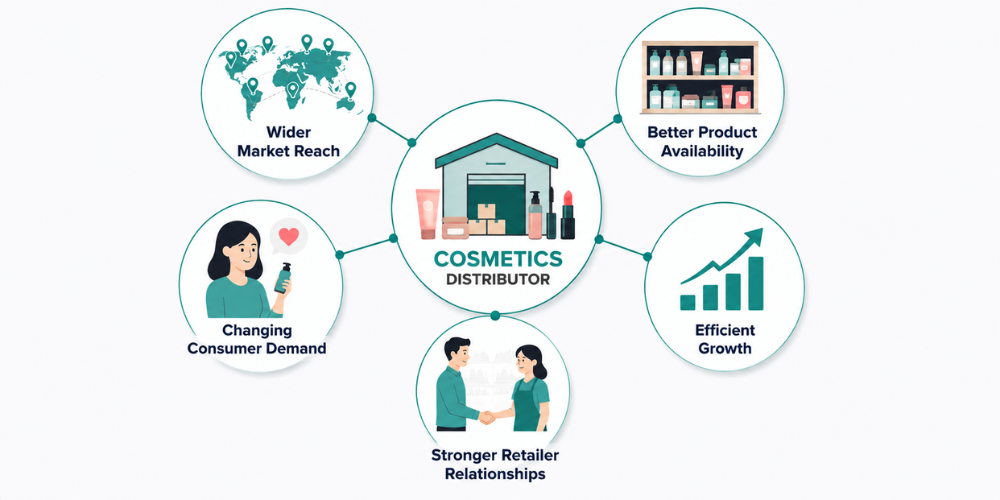
The cosmetics and personal care market is very competitive. There are so many brands out there selling pretty much the same thing to consumers, and retailers have limited space on their shelves. Availability can thus become a competitive advantage. If one retailer always has your shampoo, moisturizer, sunscreen, or face wash in stock and another brand is frequently out of stock, the in-stock brand has a better chance of winning the sale. A solid route-to-market strategy helps distributors solve this challenge in a number of ways.
1. Expanding Market Reach
Distributors frequently oversee a vast network of retail outlets, often numbering in the hundreds or thousands, spread across various regions. A thoughtfully crafted distribution strategy plays a crucial role in pinpointing the ideal locations for product availability and determining the best ways for sales representatives to engage with these outlets. This approach not only simplifies the process of entering new cities and territories but also allows for seamless expansion into different retail segments, all while minimizing operational challenges.
2. Improving Product Availability
Beauty and personal care products thrive on availability. Retailers rely on distributors to quickly restock popular items before they run out. By managing inventory effectively and visiting retailers regularly, distributors can better anticipate stock needs. This is especially crucial for high-demand products like soaps, shampoos, skincare items, deodorants, cosmetics, and oral care essentials.
3. Responding to Changing Consumer Behavior
Consumers today engage with personal care products through various channels. They might stumble upon a product on social media, check prices online, stop by a pharmacy, and ultimately buy from a nearby store. This shift has led to a more intricate distribution landscape. Distributors must gain insights across these diverse channels to identify rising demand and pinpoint products that are not meeting expectations.
4. Managing Growth More Efficiently
As a distribution network grows, the task of overseeing orders, visiting retailers, managing inventory, coordinating sales representatives, and evaluating distributor performance can become overwhelming. Implementing a flexible route-to-market strategy, enhanced by sales force automation software, can lighten the load of manual tasks while providing managers with clearer insights into field operations.
5. Strengthening Retailer Relationships
Retailers tend to prefer distributors who offer reliable and friendly service. When orders are processed accurately, products are restocked promptly, pricing is clear, promotional assistance is available, and sales representatives make regular visits, it fosters a more personal and trusting relationship between retailers and distributors.
Key Challenges in Cosmetics and Personal Care Distribution
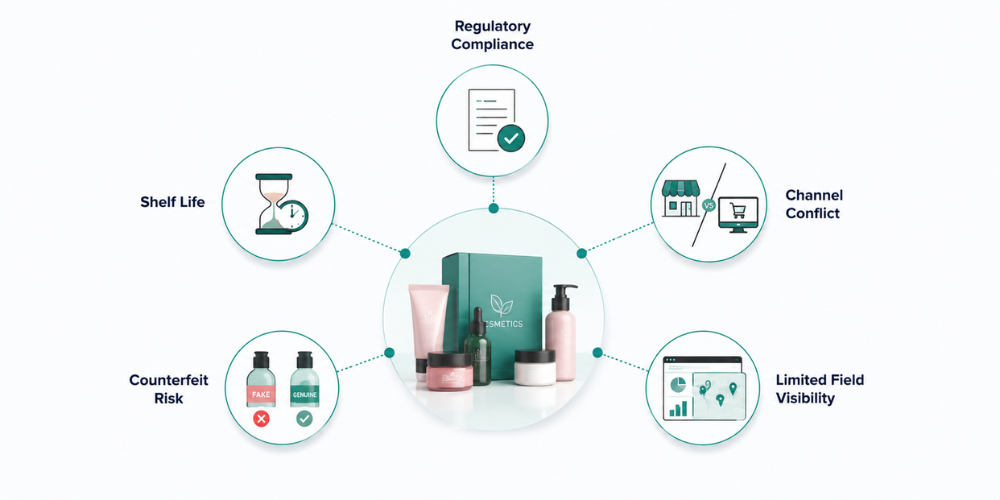
Creating a route-to-market strategy may seem simple, but it becomes complex when distributors implement it in actual markets. The distribution of cosmetics and personal care products presents various operational hurdles.
Regulatory Compliance
Beauty and personal care products often come with specific labeling, packaging, ingredient, safety, and regulatory guidelines that vary by market. It's essential for distributors to keep product information up-to-date and guarantee that the appropriate products reach the right markets.
Product Shelf Life
Certain cosmetics and personal care items have finite shelf lives. Ineffective inventory management can result in sluggish products lingering in storage or retail spaces for extended periods. Consequently, effective inventory monitoring, stock rotation, and demand forecasting become crucial elements of distribution management.
Channel Conflict
Brands that distribute their products through various channels like distributors, modern trade, e-commerce, salons, pharmacies, and traditional retailers often encounter conflicts between these channels. For instance, if one channel offers steep discounts, it can strain relationships with retailers in other channels. To navigate these challenges effectively, having a well-defined channel strategy is essential. This strategy helps businesses clarify their pricing, promotional activities, market territories, and the roles of each channel partner.
Counterfeit Products
Counterfeiters often set their sights on well-loved beauty products, making them vulnerable to imitation. These fake products can harm not only sales but also the trust consumers place in brands. To combat this issue, it's crucial for distributors and brands to have a clearer view of how products move, who is authorized to distribute them, and the retail channels involved. This transparency is key to safeguarding both revenue and consumer confidence.
Complex Retail Networks
Cosmetics and personal care products are sold through a wide variety of outlets, including:
-
Cosmetic stores
-
Supermarkets
-
Pharmacies
-
Salons
-
Department stores
-
Convenience stores
-
Traditional retail shops
-
Wholesalers
-
E-commerce channels
Each outlet can have different purchasing patterns and product requirements. This makes territory management and retail execution critical for distributors.
Limited Field Visibility
As sales representatives navigate extensive territories, managers often face challenges in understanding:
-
Which retailers have been visited?
-
What orders have been successfully collected?
-
Which products were out of stock?
-
Which outlets require a follow-up visit?
-
What is the current stock availability?
-
Which territories are driving the highest sales?
In the absence of precise field data, decisions regarding route-to-market strategies frequently rely on assumptions instead of reflecting the true market landscape.
Direct vs. Indirect Distribution: Which Works Best for Beauty Brands?
There is no universal answer. The right distribution model depends on the brand's size, market, product category, and growth objectives.
1. Direct Distribution
In a direct distribution model, the brand takes charge of its relationships with retailers or customers, minimizing reliance on intermediaries. This approach allows for greater control over:
-
Pricing
-
Strong pricing strategies and customer relationships
-
Curating product assortments
-
Crafting effective promotions
-
Ensuring retail execution quality
-
Analyzing sales data
Nonetheless, establishing an in-house distribution network across various regions can be costly and operationally challenging.
2. Indirect Distribution
Indirect distribution involves leveraging intermediaries like distributors and wholesalers. This approach is especially advantageous for cosmetics or personal care brands aiming for swift expansion into new markets. Local distributors often possess:
-
Established retailer connections
-
Trained sales personnel
-
Adequate warehousing facilities
-
In-depth market insights
-
Reliable delivery systems
However, this model may lead to diminished direct oversight of specific aspects of the customer experience.
3. Hybrid Distribution
For numerous emerging beauty brands, adopting a hybrid distribution approach can strike an optimal balance. Companies might engage distributors for general trade while directly overseeing modern trade accounts, essential retailers, salons, or online platforms.
The crucial aspect is to guarantee that each channel has well-defined responsibilities and that sales and inventory data can be tracked from a central point.
Building an Effective Route-to-Market Strategy: Step-by-Step
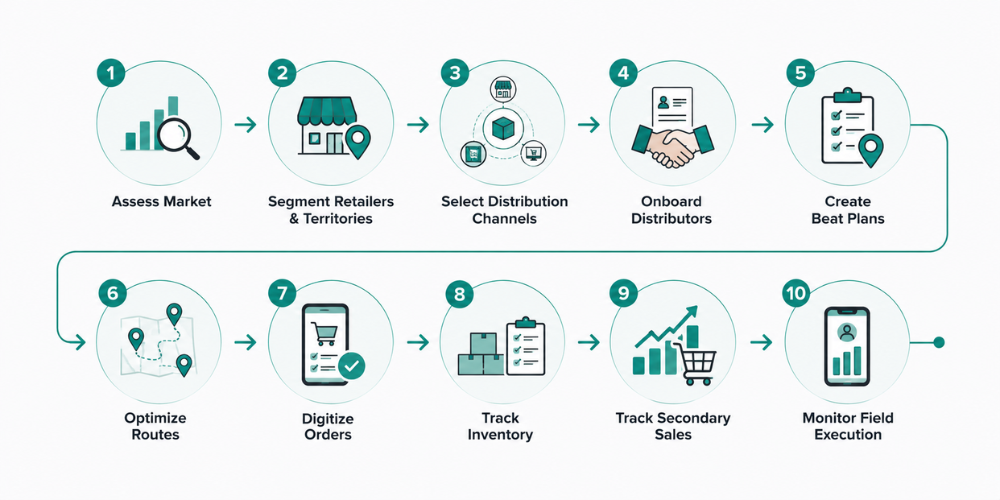
A successful route-to-market strategy thrives on the connection between thoughtful planning and real-world execution. For distributors in the cosmetics and personal care sector, this involves a deep understanding of the market landscape, selecting the most effective channels, creating a streamlined distribution network, and empowering sales representatives to carry out the plan with consistency and confidence.
As the variety of products, retailers, territories, and distributors expands, managing these elements manually can become overwhelming. Adopting a structured RTM approach provides distributors with a clear and supportive framework, enabling them to broaden their market reach while keeping a firm grip on sales, inventory, and on-the-ground execution.
Step 1: Assess the Market
The initial step involves gaining a clear understanding of the market landscape before making decisions on product distribution. Distributors should focus on identifying where consumer demand is strongest, which retail channels resonate most with their target audience, how competitors are positioned in the market, and which regions show the most promise for growth.
In the cosmetics and personal care sector, the best distribution strategy can differ widely depending on the product category. For instance, premium skincare products might thrive in pharmacies beauty stores, salons, and modern retail environments, while everyday essentials like soap, shampoo, and oral care items may benefit from broader coverage in general trade.
Conducting a thorough market assessment enables distributors to make informed decisions about where to allocate their sales and distribution efforts, rather than applying a one-size-fits-all strategy across different territories.
Step 2: Segment Retailers and Territories
After gaining a solid understanding of the market, the next important step is to thoughtfully arrange retailers and territories according to their unique potential and specific needs. For instance, a bustling cosmetics retailer might benefit from regular visits and a wider variety of products, while a smaller shop may only need occasional check-ins. Additionally, some areas may have a significantly higher number of potential customers compared to others.
By segmenting retailers and territories, distributors can make informed decisions about where their sales representatives should focus their efforts and how often to engage with different outlets. This tailored approach not only enhances the efficiency of territory management but also improves the overall execution of retail strategies.
Step 3: Select the Right Distribution Channels
The next step involves figuring out the best ways for products to connect with retailers and consumers. In the world of cosmetics and personal care, businesses have a variety of options at their disposal, including general trade, modern trade, pharmacies, salons, wholesalers, cosmetic stores, e-commerce, or even a blend of these channels. It's important to recognize that there isn't a one-size-fits-all distribution model for every beauty brand. For a brand on the rise, partnering with distributors can be a smart move to swiftly enter new markets while also keeping a close eye on key modern-trade or strategic accounts.
The goal here is to develop a channel mix that not only reaches a wide audience but also ensures control over costs, product availability, relationships with retailers, and overall sales performance.
Step 4: Select and Onboard Distributors
The right distributor can significantly influence how successfully a brand enters and grows in a market. Distributor selection should therefore go beyond simply finding a partner with warehouse space. Consider the distributor's existing retailer network, geographic coverage, sales force, delivery capabilities, storage facilities, financial capacity, and experience handling FMCG or personal care products.
Once a distributor is selected, responsibilities should be clearly defined. Territories, product portfolios, sales targets, pricing, retailer coverage, and reporting expectations should all be established during onboarding. A structured distributor management system creates clearer accountability and makes it easier for brands to monitor how their products are performing across different markets.

Step 5: Create Beat Plans for Retailer Coverage
After defining territories and selecting distributors, sales representatives require an effective strategy for retailer visits. Beat planning arranges retailers into organized routes according to their geographical location, sales potential, and necessary visit frequency. This allows representatives to follow set daily or weekly routes instead of determining which outlets to visit each day.
For instance, retailers in close proximity can be consolidated into a single beat, while high-priority outlets may be scheduled for more frequent visits. An effective beat plan enhances retailer coverage, minimizes unnecessary travel, and ensures that key outlets are consistently attended to.
Step 6: Optimize Sales Routes
Beat planning is all about figuring out which retailers to visit, while route optimization focuses on finding the best way to get there. This is especially crucial for distributors in the cosmetics and personal care sectors who have to cover extensive areas. If routes aren't planned well, it can lead to wasted travel time and fewer meaningful visits to retailers.
Incorporating route optimization into field sales management allows representatives to dedicate more time to activities that truly drive sales. This includes taking orders, checking inventory, introducing new products, and nurturing relationships with retailers.
Step 7: Digitize Order Taking
Once representatives reach retailers, efficient order collection becomes a critical part of RTM execution. Paper-based orders and manual data entry can lead to incorrect quantities, delayed processing, and difficulty maintaining accurate sales records. A digital order management process allows representatives to capture retailer orders directly during the visit.
With a mobile sales app, representatives can access product information, select required quantities, apply relevant schemes, and submit orders from the field. This reduces administrative work and creates a faster flow of information between the sales representative, distributor, and back-office team.
Step 8: Maintain Inventory Visibility
Ensuring that products reach the right stores relies heavily on having enough stock on hand. Distributors in the cosmetics and personal care industry must keep a close eye on their inventory to spot any shortages, identify products that aren’t selling well, and understand when to restock. This task becomes even more crucial when they manage a wide range of products that have varying levels of demand.
By improving inventory tracking, sales teams can make smarter choices when taking orders from retailers. This not only helps prevent stockouts but also allows distributors to avoid overstocking items that aren’t moving off the shelves.
Step 9: Track Secondary Sales
Selling products to a distributor is just one aspect of the distribution journey. It's crucial for businesses to grasp what occurs after products arrive at the distributor. Tracking secondary sales offers insights into how products move from distributors to retailers, enabling businesses to identify which items are successfully penetrating the market and which regions or retailers are driving demand.
For instance, if a specific skincare item is frequently reordered by retailers in one area but not in another, the distributor can explore whether this discrepancy stems from demand levels, retailer coverage, pricing strategies, or sales execution. Such insights render secondary sales data a vital component of a successful route-to-market (RTM) strategy.
Step 10: Monitor and Improve Field Execution
The final phase involves ongoing evaluation of the effectiveness of the route-to-market strategy. Managers should assess the alignment between scheduled retailer visits and actual visits, track orders and sales, analyze territory performance, and pinpoint any deficiencies in product availability or retailer coverage.
Field sales data plays a crucial role in this process. If representatives are fulfilling their visit schedules but sales figures remain disappointing, the challenge may lie in product selection or market demand. Conversely, if there is significant sales potential yet many planned visits are overlooked, the issue could stem from inadequate field coverage or inefficient route planning. By consistently analyzing these data points, distributors can refine territories, enhance plans, ensure product availability, and adapt sales strategies to reflect real market dynamics.
How Delta Sales App Simplifies Route-to-Market Execution
A successful route-to-market strategy requires seamless execution among distributors, territories, sales representatives, and retailers. Manual management of these tasks can hinder the ability to monitor field performance, orders, inventory, and retailer coverage effectively.
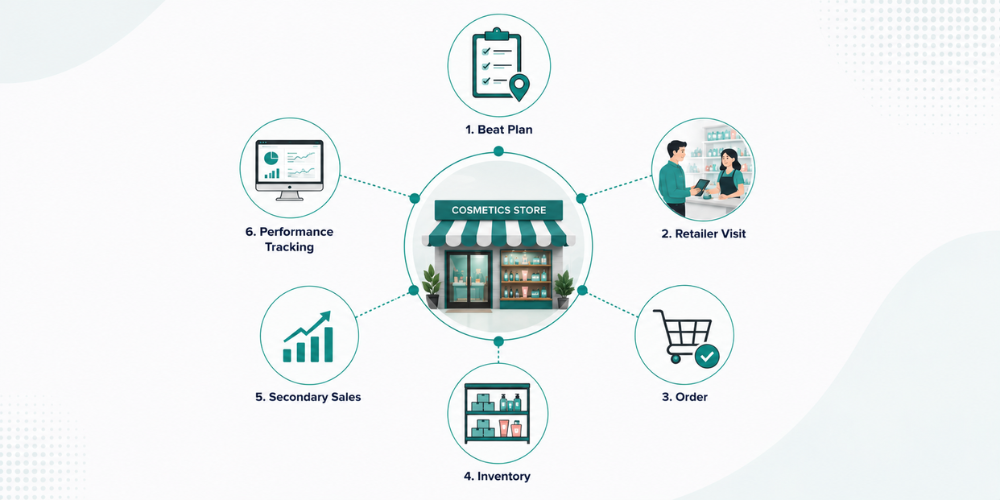
The Delta Sales App empowers cosmetics and personal care distributors to digitize these processes within a single platform, enhancing the organization and measurability of route-to-market execution.
-
Improve Distributor and Territory Management
Managing multiple territories requires visibility into sales activities and performance. Delta Sales App helps managers monitor distributor and territory-level operations from a centralized platform. This makes it easier to identify underperforming territories, monitor sales activity, and make better distribution decisions.
-
Streamline Beat Planning and Route Management
Reliable retailer coverage plays a crucial role in executing an effective route-to-market (RTM) strategy. The Delta Sales App makes it easier for sales representatives to plan their visits and manage their routes, ensuring they stick to a well-organized schedule for the retailer visits. By doing so, it minimizes unnecessary travel time and allows representatives to focus on visiting the most promising outlets throughout their day.
-
Monitor Field Sales Activities
It's essential for managers to understand if the field activities they planned are being carried out as intended. The Delta Sales App offers a clear view of sales representatives' visits and field activities, enabling managers to see how planned coverage aligns with what’s actually happening in the field. This insight helps businesses spot any shortcomings in retailer coverage and enhances the overall performance of field sales teams.
-
Simplify Retailer Order Taking
When in the field, sales reps can take retailer orders directly in the app when visiting retailers. This reduces paperwork and repetitive data entry and makes it easier to record and manage order information. For distributors with multiple cosmetics and personal care SKUs, digital order management also allows sales reps to access product and pricing information while on the road taking orders.
-
Maintain Better Inventory Visibility
Product availability significantly influences retailer orders and sales. The Delta Sales App enhances inventory management, enabling sales teams to easily access crucial stock data and pinpoint items that need restocking. This functionality is especially beneficial for distributors overseeing extensive and rapidly evolving personal care product ranges.
-
Track Secondary Sales
Gaining insight into how products move beyond the distributor is crucial for crafting a successful route-to-market (RTM) strategy. By tracking secondary sales, businesses can keep a close eye on the flow of products from distributors to retailers, helping them discover which items, regions, and stores are driving demand. This valuable information empowers companies to make informed choices about product availability, enhance retailer coverage, and explore opportunities for market growth.
-
Bring RTM Activities Into One Workflow
Delta Sales App integrates orders, field visits, territories, inventory, and sales reports into a unified workflow. This holistic approach enhances visibility for cosmetics and personal care distributors, simplifying the execution and scaling of their route-to-market strategies as their businesses expand.
Conclusion: Building a Scalable Route-to-Market Strategy
A well-crafted route-to-market strategy is essential for cosmetics and personal care distributors to connect with the right retailers, ensure product availability, and achieve consistent market presence. However, as businesses grow across different territories, products, and distribution channels, managing these tasks manually can become quite challenging. Each aspect of the route-to-market process, from assessing the market and selecting channels to planning sales routes, managing orders, tracking inventory, and monitoring secondary sales, must work in harmony.
Leveraging technology can significantly enhance this process by providing distributors with clearer insights into field activities and sales performance. The Delta Sales App empowers businesses to streamline their sales and distribution processes, fostering a more organized and scalable route-to-market operation.
Are you ready to make your route-to-market execution easier? Schedule a free demo to discover how the Delta Sales App can support your cosmetics and personal care distribution business in enhancing field sales and distribution management.