
Field Sales Tracking Software in Kuwait: Features, Benefits, and What to Look For
A field sales manager in Kuwait has to do more than hand out territories and look at monthly totals. Reps spend most of the day visiting retailers, distributors, wholesalers, pharmacies, supermarkets, and other customers, and the manager needs to know if those visits actually happened. What was ordered? What was collected? Which outlets got skipped, and where does someone need to follow up next?
If the answers are scattered across WhatsApp messages, Excel sheets, paper DSRs, and phone calls, it's hard to get a reliable picture. And by the time the reports reach management, the market has already moved on, so the business is reacting late.
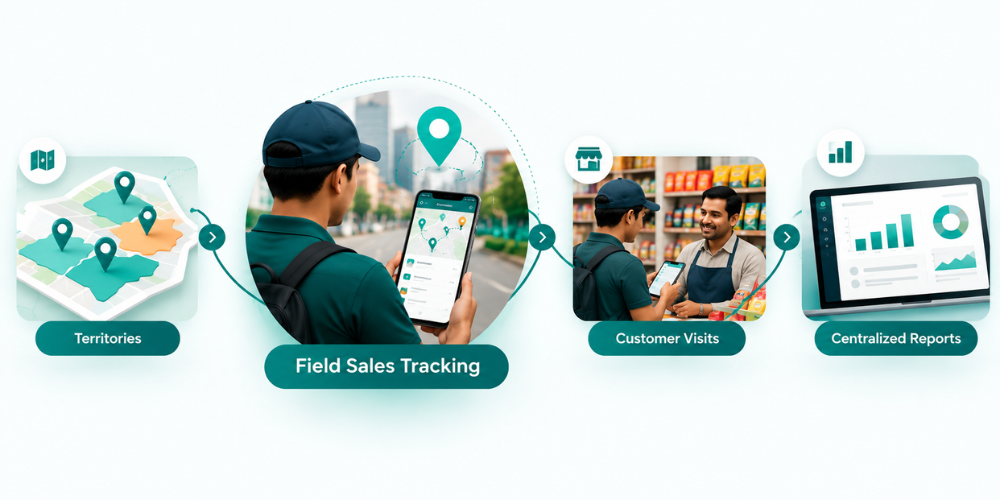
Field sales tracking software pulls these activities into one connected system. Depending on the platform, it can cover GPS tracking, attendance, beat planning, customer visits, order capture, payment collection, expense reporting, stock taking, and sales analytics.
The objective is not simply to see where a salesperson is. For an FMCG company or distributor, useful tracking should connect the representative's location and visits with actual sales execution. In this blog, we’ll cover the key features, practical benefits, Kuwait-specific factors, and important questions to consider when choosing field sales tracking software for your team.
What Is Field Sales Tracking Software?
Field sales tracking software is a mobile and web system for managing sales work that happens outside the office. Reps use the mobile app for their daily fieldwork, and managers use dashboards and reports to keep an eye on activity and results.
Without it, a team might record attendance in one place, send orders over WhatsApp, build the DSR in Excel, and get updates by phone. With it, all of that happens in one app. A rep marks attendance at the start of the day, follows the assigned beat plan, visits customers, takes orders, records collections, updates stock figures, and files the required reports, all from the same phone.
For managers, the payoff is that these pieces are linked. Each customer visit carries its location, time, order value, collection, notes, photos, and any follow-up that's needed. That tells a manager far more than a GPS dot on a map or a total at the end of the day. This matters in FMCG. A salesperson can cover a whole territory and still make too few productive calls. Another might make fewer visits and bring back bigger orders from high-value outlets. So the software should show managers where the team went and also what came out of each visit.
Why Field Sales Teams in Kuwait Need Tracking
Field sales teams in Kuwait juggle extensive customer lists across various territories, all while navigating the challenges of travel time, outlet coverage, order collection, and daily reporting. In the absence of a centralized system, managers often find it difficult to track whether their teams are completing scheduled visits or how sales representatives are allocating their time. By implementing field sales tracking, these activities can be consolidated into a single view, empowering teams to enhance their territory coverage, oversee execution more effectively, and make quicker, informed decisions based on real-time field data.
-
Covering Multiple Governorates in Heavy Traffic
Kuwait is a small country, but covering it in the field is still hard when a rep's customers are spread over several governorates and commercial areas. One territory can hold supermarkets, independent retailers, wholesalers, pharmacies, restaurants, and distributor accounts, each needing a different visit frequency and priority. Traffic and travel time also limit how many productive visits a rep can fit into a day. If the beat plan is badly built, reps spend too much of their day driving between outlets and too little of it selling. A field sales system lets managers group customers into practical beats and tour plans by territory, customer type, visit frequency, or priority. Route planning then puts the visits in a more sensible order for the rep. Managers can also set the planned route against what the rep actually did. Say a rep was assigned 25 outlets and finished 16. The data can show whether the cause was the route plan, customers who weren't available, too much travel, or visits that simply didn't get done.
-
Getting Visit-Level Visibility Instead of Guesswork
Knowing that a salesperson is somewhere in the field does not tell a manager whether the sales call was productive. A useful field sales system should connect the representative's location with the actual customer visit. When a representative checks in at an outlet, the system can record the visit time and location. Depending on the configuration, the representative can then add notes, take photos, record stock information, capture an order, or schedule a follow-up. This gives managers a more detailed view of territory execution. They can see which customers were visited, which planned calls were missed, where orders were booked, which outlets reported stock problems, and which customers require another visit. For FMCG managers, this can make secondary-sales monitoring more practical because outlet coverage and customer-level activity become visible instead of relying entirely on the representative's verbal update.
-
Moving Off WhatsApp Groups, Excel Sheets, and Paper Reports
WhatsApp is useful for quick messages, but it wasn't built to run a field sales operation. Reps send location pins, order screenshots, collection updates, attendance messages, and daily summaries across different chats, and a manager ends up stitching it all together by hand. Excel can hold sales data, but it can't verify that a customer visit took place, and it gives no ongoing view of what the field team is doing. Paper reports add more delay because someone has to collect them, check them, and type them in before management can do anything with the numbers. Field sales tracking software creates a structured record at the moment the activity happens. A rep logs the visit, order, collection, or expense once, and that entry feeds the right report or dashboard. Nobody has to report the same thing twice, and managers get one consistent source for field-sales information.
Field Sales Tracking Software Features to Look for
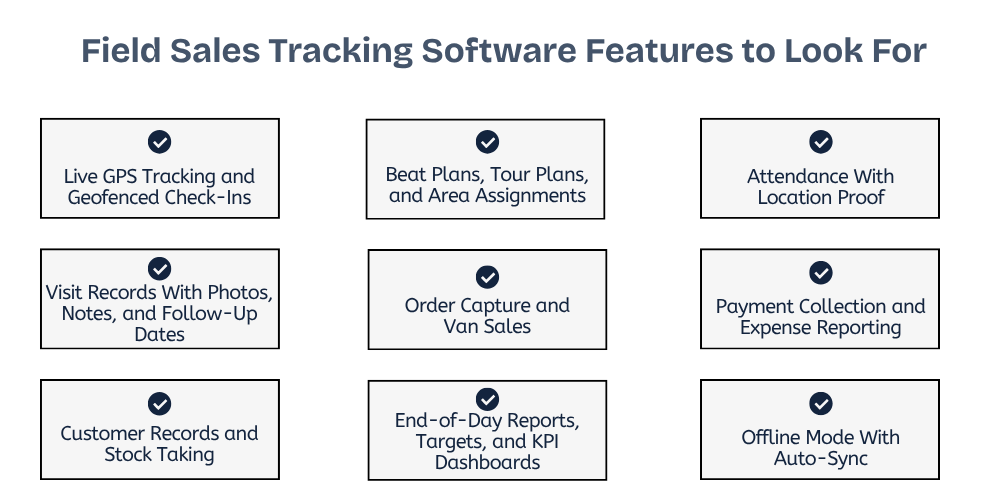
The right field sales tracking software should do more than show a representative's location on a map. For Kuwait-based FMCG companies, distributors, and wholesalers, it should support the complete field-sales workflow, from beat planning and customer visit tracking to order capture, collections, reporting, and performance tracking. The following features are worth evaluating before choosing a platform for your team.
-
Live GPS Tracking and Geofenced Check-Ins
Live GPS tracking lets a sales manager see where reps are while they work. Add geofenced check-ins, and it can also confirm that a rep actually got to the customer's location before logging a visit. A GPS map on its own doesn't say much, though. It's worth far more when the location data is linked to customer visits, attendance, planned routes, territory assignments, orders, and the rest of the field activity.
-
Beat Plans, Tour Plans, and Area Assignments
With beat planning, reps get a set schedule of customers, so they don't have to decide each morning which outlets to visit. A manager can group customers by territory, outlet type, priority, visit frequency, or distributor and assign each group to a beat. In FMCG, this counts for a lot, since some outlets need a visit every day and others only once a week or every two weeks. A well-built beat plan spreads the workload fairly and keeps important accounts from being missed visit after visit.
-
Attendance With Location Proof
Field reps often don't start their day at a company office. Some head straight to their territory, and others begin at a customer's site. With mobile attendance, they can log their working hours from wherever they are, and location verification shows where the check-in was made. That cuts down on manual attendance handling and ties attendance to what the rep actually did in the field. Managers no longer need a separate attendance sheet that they cross-check against sales activity later, because attendance, visits, and routes can all be reviewed together.
-
Visit Records With Photos, Notes, and Follow-Up Dates
A customer visit should leave behind a record the business can use, and a bump in the visit count doesn't do that. Reps may need to note what happened in the meeting, whether an order was placed, which SKUs came up, whether stock was available, and whether another visit is needed. Photos help with retail execution too: merchandising checks, promotional displays, shelf visibility, and product availability. A follow-up date turns the note into something someone can act on. Say a retailer asks for a SKU that's out of stock. The rep logs the problem and books a follow-up in the app and doesn't have to remember it or send a WhatsApp message.
-
Order Capture and Van Sales
Order capture is one of the most important parts of field sales software for FMCG companies. Representatives often need to record multiple products and quantities while standing in front of a retailer or distributor. A mobile order-entry system allows the representative to select the customer, choose products or SKUs, enter quantities, apply relevant pricing or schemes where supported, and submit the order directly from the field. Van sales teams have additional requirements because representatives may carry inventory in their vehicles and sell products directly to outlets. In this situation, the system should support the company's specific van-sales workflow, including product movement and sales recording.
-
Payment Collection and Expense Reporting
Field representatives may also be responsible for collecting payments from customers. If collection information is recorded separately from the customer visit and order, managers can find it difficult to understand the full account activity. A connected field sales system can allow representatives to record collection details against the relevant customer while managers monitor collection activity from the dashboard. This can be particularly useful for businesses managing distributor or wholesale accounts with outstanding balances. Expense reporting can follow the same approach. Representatives can submit eligible field expenses through the mobile application, while managers review and approve them according to company policies.
-
Customer Records and Stock Taking
A representative needs more than a customer name to conduct a productive sales visit. Customer records can include location, contact information, customer type, assigned territory, distributor relationship, purchase history, outstanding amounts, and planned visit frequency. This information helps the representative understand the account before making the sales call. Stocktaking is equally important for FMCG operations. A representative may need to check the availability of specific SKUs, record shelf stock, identify damaged products, or report products that are out of stock.
-
End-of-Day Reports, Targets, and KPI Dashboards
A field sales platform should reduce the amount of manual work involved in preparing the Daily Sales Report. Representatives should not have to complete the same information in the mobile application and then reproduce it again in a WhatsApp message or spreadsheet. Managers can use dashboards to monitor indicators such as planned versus completed visits, productive calls, order value, collection value, outlet coverage, target achievement, average order value, new customers, expenses, and distance travelled.
-
Offline Mode With Auto-Sync
Field sales representatives cannot always depend on a stable internet connection throughout the day. They may move between customer locations or work in areas where connectivity temporarily drops. An offline-first field sales application allows selected activities to continue without an active internet connection. The representative can record permitted information on the device, and the application can synchronize the data once connectivity returns. This is particularly useful for order booking and visit records because the representative does not have to postpone data entry until they return to an area with reliable connectivity.
Benefits for Sales Managers and Reps
Field sales tracking software makes the day easier for managers and reps alike. Managers see territory coverage, visits, orders, and reports more clearly, and reps spend less time on manual updates and more time with customers. With field activity logged in one system, everyone works from the same information, and gaps in execution get noticed sooner.
-
More Visits and Better Territory Coverage
A structured beat plan lets reps put more of their day into productive customer work. They start from an assigned schedule built around territory and customer priorities, and they don't have to work out a route from scratch each morning. Managers can compare planned visits with completed ones and see which customers keep getting missed. That makes coverage easier to manage, since gaps can be fixed during the month and don't have to wait for the monthly sales review to show up. Visiting as many outlets as possible isn't the goal. What matters is that the right customers get the right amount of attention.
-
Clear Accountability Without Constant Calls
Managers do need to see what the field team is doing, but calling reps all day is a slow way to find out. A field sales tracking system puts attendance, routes, visits, orders, collections, and other activity on one dashboard, so managers can stop asking reps where they are and what they've finished. Reps benefit as well. If someone asks whether an outlet was visited or when an order went in, the answer is in the system, and nobody has to rely on memory.
-
Faster, More Accurate Reporting
Manual reporting creates several opportunities for delays and errors. A representative may finish a customer visit at noon but not send the details until the evening. A manager may then copy that information into another spreadsheet for analysis. Capturing information directly through the mobile application reduces these repeated steps. Orders, visits, collections, and other field activities can feed reports based on the original records. This gives managers access to field information sooner and makes it easier to identify issues while there is still time to act on them.
-
Lower Fuel and Travel Costs
Travel is a real cost for field sales teams. When territories are poorly designed, reps drive back and forth between customers for no good reason, which eats into selling time and pushes up fuel and vehicle costs. Route planning puts customer visits into a more workable order, and managers can look at how reps actually travel to find territories where the routes or customer assignments need changing. Cutting kilometres isn't the whole point, though. A shorter route that skips important customers is a worse route. Travel should serve good territory coverage.
Kuwait-Specific Factors to Check Before You Buy
Field sales tracking software makes the workday smoother for managers and reps. Managers get a clearer view of territory coverage, visits, orders, and reports. Reps spend less time updating things by hand, so they have more time with customers. Since all field activity goes into one system, everyone is working from the same information, and problems in execution get caught and dealt with faster. You sent this same paragraph earlier, so this is a second version with different wording. If you wanted the first one again or a different length or tone, say so.
Arabic Language and Right-to-Left Support
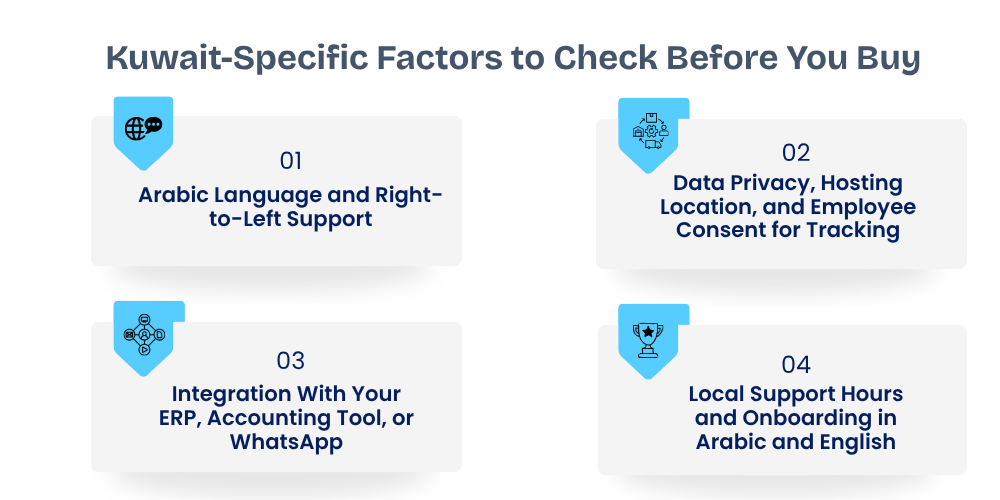
For a sales operation in Kuwait, Arabic support is often a practical must-have. A vendor calling its software "multilingual" doesn't prove the whole field-sales workflow runs properly in Arabic, so test it yourself. Try Arabic customer names, addresses, product descriptions, notes, reports, and dashboards. See whether the mobile interface handles right-to-left text correctly and whether exported reports still show readable Arabic. Bilingual support helps when management and field reps work in different languages. Managers might want English dashboards while reps and customers use Arabic during visits.
Integration With Your ERP, Accounting Tool, or WhatsApp
Field sales software should ideally fit into the wider technology stack rather than creating another isolated database. If your business already uses an ERP, CRM, accounting platform, or inventory system, ask how customer, product, inventory, order, payment, and sales-representative information can move between systems. Be particularly precise when discussing WhatsApp integration. Some vendors may mean simple message sharing, while others may refer to an official business API integration or automated notifications. Ask the vendor to demonstrate the exact workflow. This helps you understand whether the integration will actually eliminate manual work or simply add another communication channel.
Local Support Hours and Onboarding in Arabic and English
Setting up user accounts is only the start of an implementation. Field sales teams also need onboarding, workflow configuration, training, and ongoing support. If you're in Kuwait, ask whether support is available during your working hours and whether training can be given in Arabic and English when you need both. Find out too who will help set up customer data, sales territories, beats, products, reports, and integrations. A good implementation is built around how your team actually works, and a tour of where each button sits won't get you there.
Why Delta Sales App Fits Field Sales Tracking in Kuwait
Kuwait-based FMCG companies, distributors, wholesalers, and manufacturers need field sales tracking that covers a lot besides where employees are. Reps handle customer visits, beat plans, orders, collections, attendance, and daily reports across several territories.
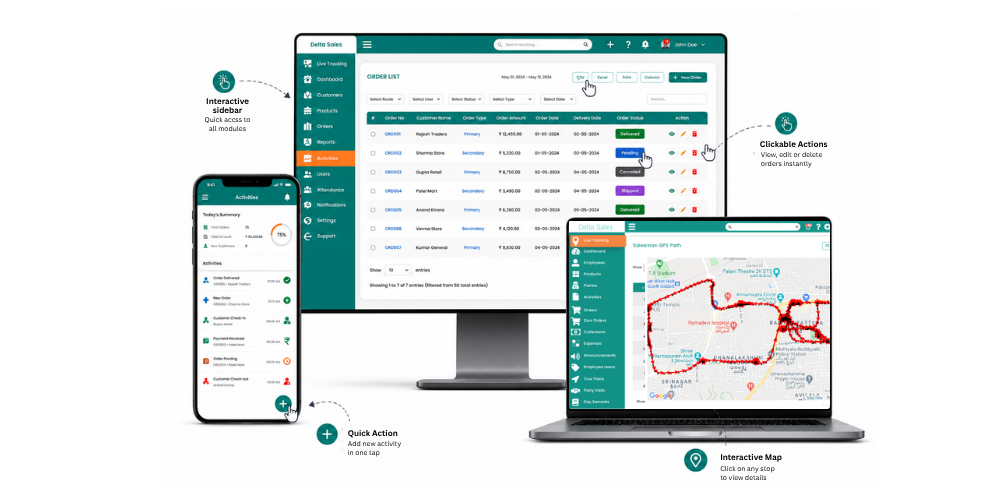
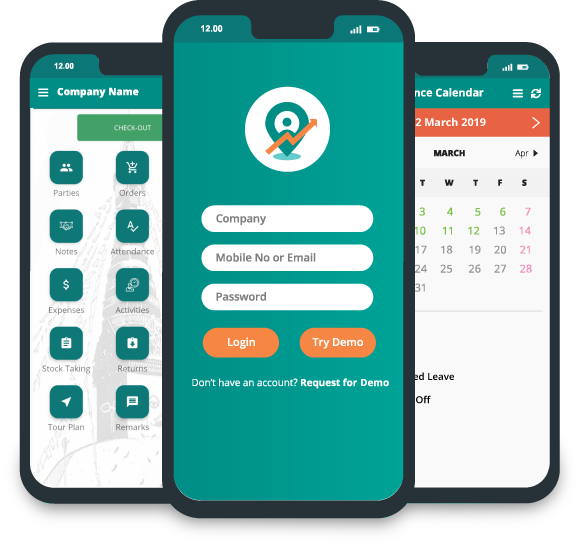
Delta Sales App puts all of this on one platform, so managers can link what the field team does to actual sales execution. The app has offline functionality, which suits teams that switch between languages and work with patchy connectivity. Here are some of the capabilities that fit Kuwait field-sales needs:
- Arabic and English language support:
Sales teams can work with Arabic and English customer information and workflows, making the platform more practical for bilingual field operations in Kuwait.
- GPS tracking and geofenced check-ins:
Managers can monitor field representatives' locations and verify attendance or customer visits through GPS-based employee location tracking. This provides greater visibility into where field activity is taking place without relying entirely on manual updates.
- Beat planning and route optimization:
Managers can organize outlets by territory, assign daily or recurring beats, and plan practical routes for representatives. This can help improve outlet coverage while reducing unnecessary travel between customer locations.
- Customer visit tracking:
Representatives can record customer visits with relevant details such as location, time, notes, and photos. Managers can use these records to understand whether planned visits were completed and identify customers that require follow-up.
- Order and collection management:
Representatives can capture orders and record customer collections directly from the field. For FMCG teams, this helps connect outlet visits with SKU-level sales activity and payment information instead of managing these records separately.

- Offline-first mobile functionality:
Representatives can continue selected field activities when internet connectivity is unavailable and synchronize the information once the connection is restored. This helps prevent gaps in visit, order, and reporting data caused by temporary connectivity issues.
- Real-time sales reports and dashboards:
Managers can monitor field activity, sales targets, visits, orders, collections, and other KPIs from centralized dashboards. This reduces dependence on manually consolidated Excel sheets and end-of-day WhatsApp updates.
These capabilities make Delta Sales App a practical option for businesses looking to manage field tracking and sales activities in one place. By connecting GPS tracking with customer visits, beat plans, order management, and reporting, managers can get a clearer view of how sales teams are covering their territories and executing daily field activities.
Conclusion
Choosing field sales tracking software in Kuwait is not just about monitoring where representatives are during the day. The right platform should help your team plan beats, verify customer visits, capture orders and collections, manage attendance, and turn field activity into useful sales reports.
For FMCG companies, distributors, wholesalers, and manufacturers, connecting these activities in one system can make territory management more organized and give managers better visibility into daily execution. Delta Sales App combines GPS-based tracking with beat planning, customer visit tracking, order management, attendance, reporting, and offline mobile functionality, with support for Arabic and English.
If you are looking to bring your Kuwait field sales operations into one connected platform, book a free demo of Delta Sales App and see how it can fit your team's day-to-day workflow.