
Why Field-Based Businesses Are Using Geo-Fencing to Stay in Control
Field operations have become more complex than ever. Whether managing sales representatives, service technicians, delivery personnel, or merchandisers, businesses need complete visibility into what happens outside the office. Effective field force management requires organizations to monitor on-ground activities accurately while maintaining operational efficiency.
Traditional reporting methods often rely on manual updates, phone calls, spreadsheets, and end-of-day reports. These methods create gaps in visibility and make it difficult for businesses to maintain operational control. Without proper field activity tracking, managers often struggle to understand what is happening in the field at any given moment.
This is why more field-based organizations are adopting geo-fencing technology. By creating virtual boundaries around business locations, customer sites, territories, and work zones, companies can monitor field activities automatically and gain real-time tracking capabilities and operational insights.
Let's explore why geo-fencing has become an essential tool for modern field businesses.
What is Geo-Fencing?
Geo-fencing is a location-based technology that creates a virtual boundary around a specific geographical area. When a mobile device enters, exits, or remains within that designated area, the system automatically triggers predefined actions.
These actions may include:
- Attendance Check-In and Check-Out: Automatically records employee attendance when they enter or leave designated work locations, eliminating manual entries and improving accuracy.
- Visit Verification: Confirms that field employees physically visited assigned customer locations, ensuring planned meetings and outlet visits actually occurred.
- Real-Time Alerts: Sends instant notifications to managers when employees enter, exit, or remain within predefined geo-fenced business locations.
- Task Assignments: Automatically triggers and assigns location-based tasks when employees arrive at specific customer sites, territories, or work zones.
- Employee Location Tracking: Provides real-time visibility into employee whereabouts, helping managers monitor field activities, improve accountability, and optimize operations.
- Route Monitoring: Tracks employee travel paths throughout the day, identifying route deviations, missed stops, and opportunities for better efficiency.
- Customer Visit Logging: Automatically records customer visit details, including arrival time, departure time, and visit duration for accurate reporting.
Geo-fencing uses GPS, mobile networks, Wi-Fi signals, and mapping technologies to determine whether a device is inside or outside the designated zone. As a core component of modern GPS tracking and location tracking software, geo-fencing provides accurate location-based verification.
For field-based businesses, geo-fencing acts as a digital control mechanism that verifies field activities without requiring constant supervision.
How Does Geo-Fencing Work?
Geo-fencing operates through a structured, automated process that enables real-time monitoring of field activities and improves operational control.
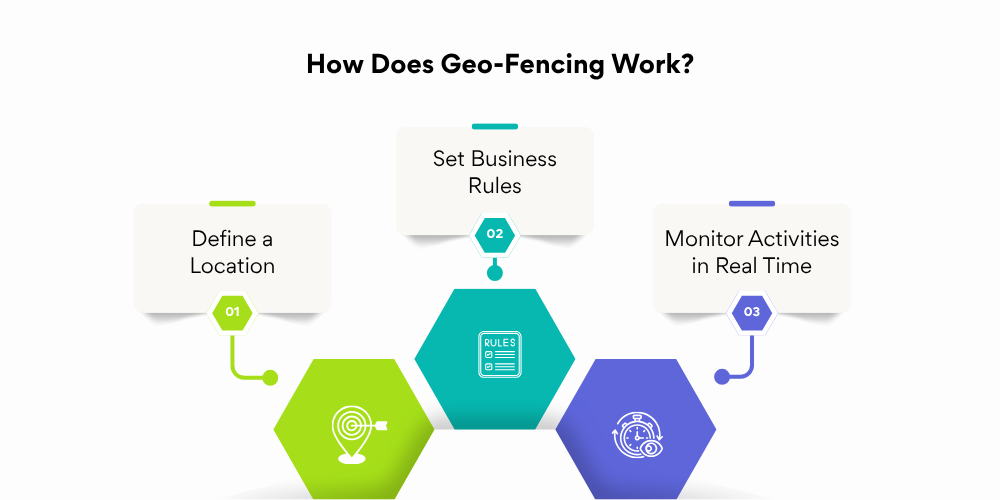
Step 1: Define a Location
Businesses first create virtual boundaries around specific geographical points where field activities need to be tracked. These typically include:
- Customer locations: Geo-fencing tracks employee visits at customer locations, ensuring accurate reporting and verified engagement activities.
- Distributor outlets: Businesses monitor distributor outlet visits using geo-fencing to improve compliance, coverage, and field sales efficiency.
- Retail stores: Geo-fencing ensures retail store visits are tracked properly, improving merchandising execution and sales performance visibility.
- Warehouses: Warehouses are geo-fenced to monitor deliveries, pickups, and ensure timely logistics coordination and movement tracking.
- Branch offices: Geo-fencing at branch offices helps track attendance, employee presence, and improves workforce accountability and reporting accuracy.
- Project sites: Project sites use geo-fencing for workforce monitoring, ensuring attendance, safety compliance, and efficient on-site operations management.
This setup forms the foundation of a location-based tracking system.
Step 2: Set Business Rules
Next, organizations define rules that determine what actions should be triggered when an employee enters, exits, or stays within a geo-fenced area.
Common rules include:
- Automatic attendance marking: Geo-fencing automatically records attendance when employees enter authorized locations, ensuring accurate time tracking and eliminating manual errors.
- Customer visit recording: System automatically logs customer visits using geo-fencing, ensuring verified engagement tracking and improving field reporting accuracy significantly.
- Manager notifications: Managers receive real-time alerts when employees enter or exit locations, enabling faster supervision and better field control decisions.
- Task updates and assignments: Geo-fencing triggers automatic task updates and assignments based on location, improving workflow efficiency and field execution speed.
- Compliance alerts: System generates compliance alerts when rules are violated, ensuring employees follow policies, routes, and assigned operational guidelines strictly.
These rules help automate field force management workflows.
Step 3: Monitor Activities in Real Time
Once configured, the employee’s mobile device continuously communicates with the geo-fencing system using GPS and network signals.
Whenever predefined conditions are met, the system automatically executes actions without manual intervention.
This ensures real-time visibility, improves field staff tracking, and eliminates dependency on manual reporting, enabling accurate and efficient field operations management.
Why Field-Based Businesses Need Better Operational Control
Managing field teams presents unique challenges compared to office-based employees.
Managers cannot physically observe every activity throughout the day. As a result, many organizations rely heavily on trust and manual reporting.
While trust remains important, businesses also need accurate operational data supported by mobile workforce management and field operations management tools.
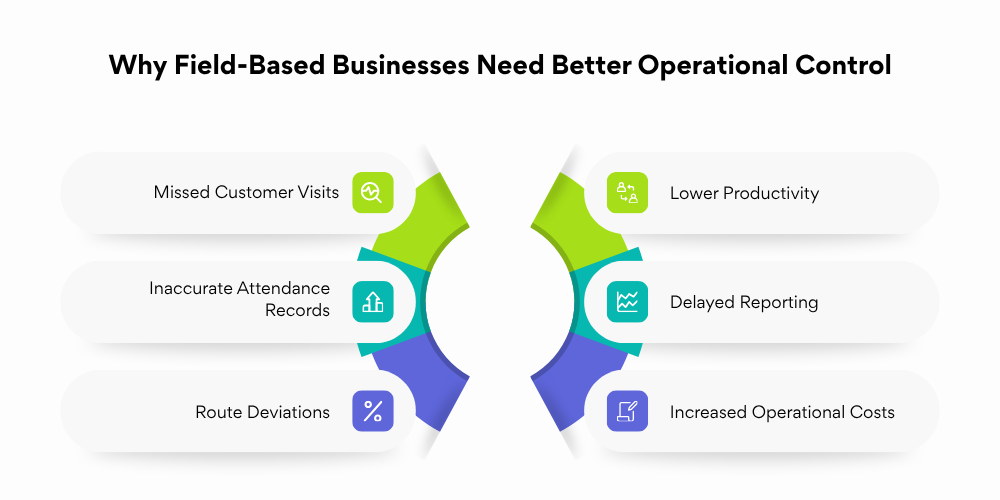
Lack of visibility can lead to:
- Missed Customer Visits: Field employees may skip assigned locations without notice, reducing sales opportunities and weakening overall customer relationship management effectiveness.
- Inaccurate Attendance Records: Manual attendance systems often lead to errors or manipulation, making it difficult for managers to ensure workforce accountability and reliability.
- Route Deviations: Employees may take inefficient or unapproved routes during field visits, increasing travel time, fuel costs, and reducing productivity levels.
- Lower Productivity: Lack of monitoring leads to unstructured field activity, causing wasted time, reduced efficiency, and poor utilization of working hours daily.
- Delayed Reporting: Manual reporting processes slow down data flow, preventing managers from making timely decisions based on accurate and updated field information.
- Increased Operational Costs: Inefficient travel, missed visits, and poor planning result in higher operational expenses, affecting overall profitability and business performance negatively.
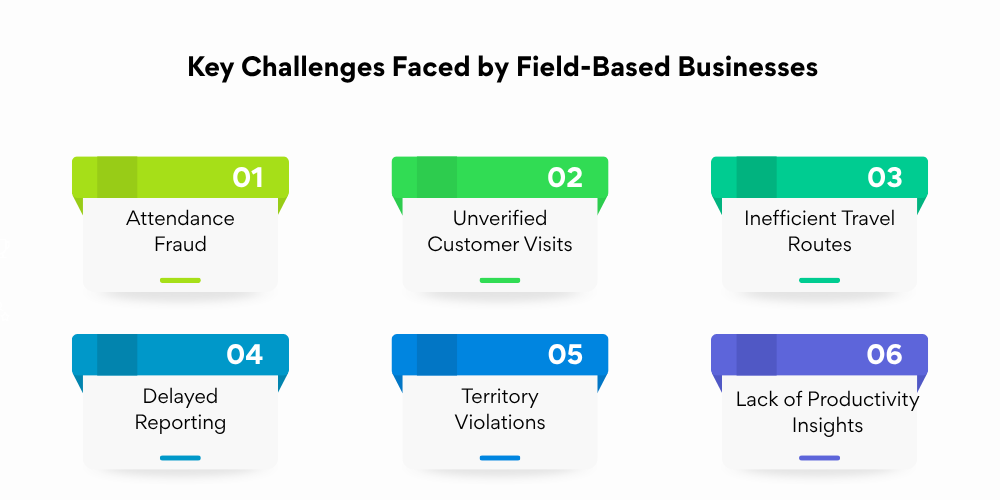
Key Challenges Faced by Field-Based Businesses
Before implementing geo-fencing and modern field force management solutions, organizations face multiple operational inefficiencies that impact productivity, visibility, and decision-making accuracy. These challenges are common across FMCG, pharmaceutical, logistics, and service-based industries where employees operate outside direct supervision.
Attendance Fraud
Employees may check in remotely or ask colleagues to mark attendance on their behalf, leading to inaccurate workforce tracking and reduced accountability.
Manual attendance systems often lack verification mechanisms, making it difficult for managers to ensure genuine presence at assigned work locations, affecting trust and payroll accuracy.
Unverified Customer Visits
Managers often cannot confirm whether planned customer visits actually occurred, resulting in poor sales visibility and unreliable field reporting data.
Without real-time verification systems, organizations struggle to ensure that field employees are meeting clients as scheduled, impacting customer engagement and sales effectiveness.
Inefficient Travel Routes
Field employees may spend excessive time traveling due to unplanned or poorly optimized routes, reducing overall productivity and increasing operational costs significantly.
Without proper route optimization systems, businesses experience higher fuel consumption, delayed meetings, and reduced daily visit capacity across field teams.
Delayed Reporting
Manual reporting often arrives hours after field activities are completed, limiting real-time decision-making and slowing down operational response times.
This delay creates information gaps between field execution and management visibility, affecting forecasting accuracy and timely corrective actions.
Territory Violations
Sales representatives may operate outside assigned territories, causing overlap between teams and creating confusion in customer ownership and sales accountability structures.
Such violations lead to internal conflicts, inefficient market coverage, and missed opportunities for structured territory-based sales planning.
Lack of Productivity Insights
Businesses find it difficult to measure actual field activity accurately, as traditional reporting methods fail to capture real-time workforce behavior effectively.
Without workforce monitoring tools, managers lack actionable insights into employee performance, visit frequency, and overall field productivity trends.
Geo-fencing directly addresses these challenges by enabling real-time tracking, automated verification, and improved field force management across all operational layers.
How Geo-Fencing Helps Businesses Stay in Control
Geo-fencing is a location-based technology that helps businesses track, control, and optimize field workforce activities in real time, improving accuracy, accountability, and operational efficiency.
Accurate Attendance Monitoring
One of the most common uses of geo-fencing is attendance management.
Employees can only check in when physically present at authorized locations.
This eliminates:
-
Buddy punching
-
False attendance entries
-
Manual attendance manipulation
Attendance records become more reliable and transparent through an automated attendance tracking system.
Real-Time Employee Location Verification
Managers gain visibility into where employees are working throughout the day.
Instead of relying on calls and messages, supervisors can verify employee presence instantly through employee location tracking and field employee tracking capabilities.
This improves accountability across the workforce.
Visit Authentication
Sales teams frequently visit distributors, retailers, dealers, and customers.
Geo-fencing automatically confirms:
-
Arrival time
-
Visit duration
-
Departure time
This ensures that customer visits are genuine and properly documented through accurate field reporting software.
Route Compliance Monitoring
Businesses can track whether field employees follow assigned routes.
Managers can identify:
-
Route deviations
-
Missed stops
-
Excessive travel time
This enables better route optimization, route planning, and operational efficiency.

Improved Territory Management
Geo-fencing helps enforce territory boundaries. Employees receive location-based guidance, ensuring they focus on assigned markets and customer segments.
This reduces territory conflicts and improves market coverage. Many organizations combine geo-fencing with territory management software for better market control.
Enhanced Customer Service
When businesses know exactly where employees are located, they can respond faster to customer requests.
This results in:
-
Quicker response times
-
Better service delivery
-
Higher customer satisfaction
Industries Benefiting from Geo-Fencing Technology
Geo-fencing is widely used across numerous industries.
Some of the major sectors include:
- FMCG Distribution: FMCG companies use geo-fencing for real-time tracking, improving distributor visits, stock checks, and efficient field sales operations management.
- Consumer Goods: Consumer goods businesses leverage geo-fencing for better retail coverage, visit validation, and improved field sales execution across territories.
- Pharmaceutical Sales: Pharmaceutical sales teams use geo-fencing for doctor visits, compliance tracking, and accurate reporting through sales force automation solutions.
- Logistics and Transportation: Logistics companies apply geo-fencing for route monitoring, delivery tracking, and ensuring timely shipments using location intelligence systems.
- Field Service Management: Field service teams use geo-fencing to track technicians, verify service visits, and improve response efficiency through automation tools.
- Manufacturing: Manufacturing firms use geo-fencing to monitor sales reps, distributor engagement, and streamline field operations using workforce tracking systems.
- Construction: Construction companies utilize geo-fencing for site attendance, workforce tracking, and ensuring compliance with project location boundaries effectively.
- Retail: Retail businesses use geo-fencing for store visits, merchandising checks, and improving in-store execution through field sales automation solutions.
- Telecommunications: Telecom companies apply geo-fencing for SIM activation visits, installation tracking, and improving technician productivity with real-time monitoring systems.
- Healthcare: Healthcare organizations use geo-fencing for medical reps, hospital visits, and compliance reporting through structured field tracking solutions.
- Insurance: Insurance firms leverage geo-fencing for agent verification, client visits, and improving policy sales tracking through automation platforms.
- Utility Services: Utility companies use geo-fencing for meter reading, maintenance visits, and field workforce monitoring with location-based tracking systems.
- Mobile Workforce Industries: Any organization with mobile employees benefits from geo-fencing and mobile workforce management solutions for better visibility and control.
Any organization with mobile employees can benefit from geo-fencing and mobile workforce management solutions.
Major Benefits of Geo-Fencing for Field Operations
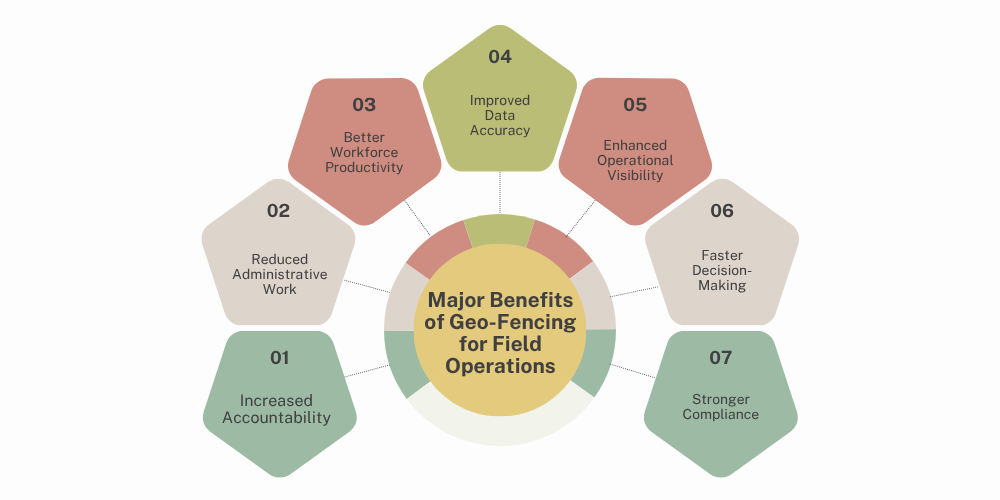
Geo-fencing enables businesses to monitor, control, and optimize field operations through real-time location data, improving transparency, efficiency, and overall workforce performance across teams.
Increased Accountability: Employees know that activities are automatically verified through location data using employee location tracking and field employee tracking systems daily.
Reduced Administrative Work: Automated attendance and visit tracking reduce manual paperwork through attendance tracking system and field reporting software efficiency improvements.
Better Workforce Productivity: Managers identify inefficiencies and optimize operations using insights from field staff tracking and workforce monitoring systems effectively.
Improved Data Accuracy: Location-based verification reduces reporting errors significantly through employee location tracking and attendance tracking system automation processes.
Enhanced Operational Visibility: Businesses gain real-time insights into field activities through location intelligence and real-time tracking technologies enabling better field employee tracking control.
Faster Decision-Making: Accurate data enables managers to make informed decisions quickly using field reporting software and employee location tracking insights instantly.
Stronger Compliance: Geo-fencing ensures employees follow organizational policies and assigned territories using territory management software and attendance tracking system enforcement.
Why Modern Businesses Combine Geo-Fencing with Field Sales Automation
Geo-fencing becomes even more powerful when integrated with field sales automation software and sales force automation solutions.
Instead of simply tracking locations, businesses can automate:
- Customer Visit Reporting: Geo-fencing automates customer visit tracking using sales force automation solutions and field reporting software, ensuring accurate visit logs, verified presence, and improved accountability across field operations.
- Order Management: Sales force automation solutions streamline order management through geo-fencing by enabling real-time order capture, reducing manual errors, and improving order accuracy within digital field workflows.
- Task Assignments: Geo-fencing enables smart task assignments, ensuring employees receive location-based tasks through sales force automation solutions for better execution efficiency and improved productivity on the field.
- Beat Planning: Geo-fencing improves beat planning through route planning tools and sales force automation solutions, optimizing travel routes, reducing time wastage, and improving daily field coverage efficiency significantly.
- Distributor Management: Sales force automation solutions enhance distributor management by integrating geo-fencing with field reporting software, ensuring consistent engagement tracking, visit verification, and stronger distributor relationship management processes.
- Performance Monitoring: Geo-fencing enables real-time performance monitoring through sales force automation solutions, allowing managers to track employee productivity, visit compliance, and execution quality with accurate insights.
- Sales Analytics: Geo-fencing strengthens sales analytics in sales force automation solutions by providing accurate location-based data, helping businesses improve forecasting, identify trends, and optimize field sales strategies effectively.
This creates a unified field operations management system that improves both visibility and execution. Organizations using integrated field sales solutions often achieve higher productivity while reducing operational inefficiencies.
Final Thoughts
As field operations grow, businesses need smarter systems to maintain visibility, control, and accountability. Manual reporting is no longer enough for accurate and real-time decision-making in today’s fast-moving environment.
Geo-fencing solves this by automating attendance verification, validating customer visits, monitoring routes, and delivering real-time insights through GPS tracking, employee location tracking, and location intelligence. It shifts operations from manual supervision to automated control.
For field-based businesses, geo-fencing is no longer optional, it is a core necessity for improving transparency, productivity, and operational control.
When combined with field sales automation software, sales team tracking, and mobile workforce management platforms, it helps organizations improve efficiency and make faster, data-driven decisions.
Explore how Delta Sales App can simplify field tracking and improve sales performance. Book a demo today and upgrade your field operations.