
Curbing Field Expense Inflation: How GPS Distance Tracking Promotes Accountability in FMCG Teams
In the FMCG industry, field operations are expanding rapidly, but so are uncontrolled travel costs and reimbursement leakages. Companies often struggle to maintain a balance between field productivity and expense discipline.
One of the biggest hidden issues is field expense inflation caused by unverified travel claims, inefficient routes, and lack of visibility into actual field movement. Without proper tracking, organizations end up paying for inflated kilometers and non-productive travel.
Modern GPS-based field monitoring systems ensure that every movement is recorded accurately, creating transparency across sales teams and improving operational discipline.
What is GPS Distance Tracking in FMCG Field Operations?
GPS distance tracking refers to the real-time monitoring of sales representatives’ travel routes using mobile-based location data. It captures actual distance traveled, route history, and movement patterns across territories.
This helps organizations replace manual reporting with accurate digital logs. A reliable field sales tracking software ensures that field activities are recorded automatically without human manipulation.
In FMCG operations, sales teams travel across multiple markets, retail outlets, and distributor locations every day. Without proper monitoring, businesses often face inaccurate travel claims, unverified outlet visits, and limited visibility into actual field movement.
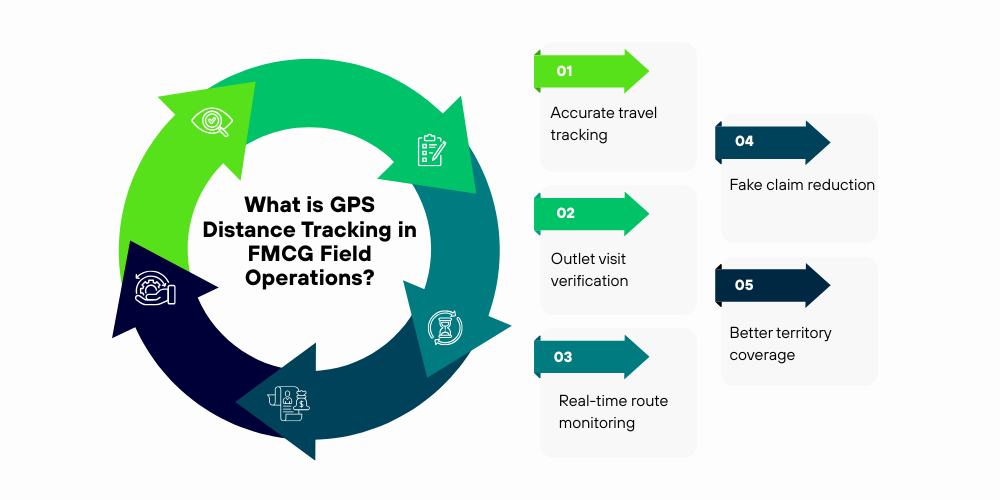
GPS distance tracking helps companies:
- Monitor actual travel distance accurately
- Verify outlet visit activity
- Track route adherence in real time
- Reduce fake travel claims
- Improve territory coverage efficiency
The system automatically records field movement through mobile applications, creating transparent travel logs for managers and organizations. This improves accountability and helps businesses compare travel activity with actual productivity levels.
As a result, FMCG companies gain better operational visibility, improved expense control, and more disciplined field execution across large sales teams.
Why Field Expense Inflation is a Growing Concern
Field expense inflation is increasing due to lack of control systems in traditional sales operations. Many FMCG companies still depend on manual reporting methods that provide limited visibility into actual field movement and travel behavior.
Key reasons include:
Fake Travel Claims and Inflated Mileage Reporting
Sales representatives may report higher travel distances than actual movement, increasing reimbursement costs and reducing operational transparency significantly overall.
Manual Expense Entries Without Validation
Manual expense submissions often contain inaccuracies, delayed reporting, and unverified claims, making auditing and financial control extremely difficult.
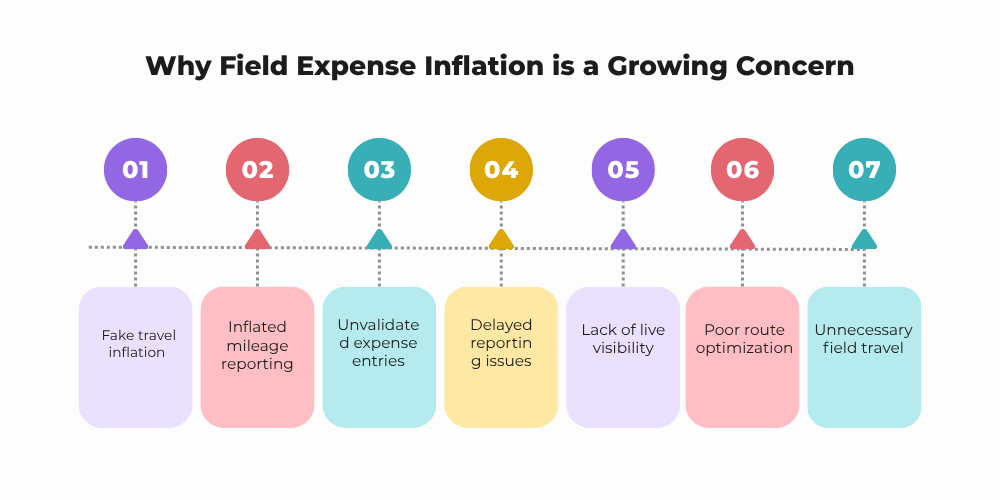
Lack of Real-Time Visibility for Managers
Managers struggle to monitor live field activity, preventing quick identification of inefficient travel patterns and abnormal expense reporting behavior.
Unoptimized Field Routing and Unnecessary Travel
Poor route planning increases fuel usage, travel time, and operational expenses while reducing daily outlet coverage and sales productivity.
A modern sales force automation platform helps eliminate these inefficiencies by digitizing field movement tracking and expense validation.
The Link Between Field Movement and Operational Costs
Field movement directly impacts operational expenses in FMCG distribution. Every unnecessary kilometer traveled increases fuel costs, travel reimbursements, and unproductive working hours across field teams.
Poorly planned routes often lead to delayed market coverage, inefficient outlet visits, and excessive travel between territories. Over time, these inefficiencies significantly increase operational spending while reducing overall sales productivity.
Common operational issues include:
- Increased fuel consumption due to inefficient route planning
- Higher travel reimbursement costs from excessive field movement
- Reduced outlet coverage caused by wasted travel time
- Lower productivity because of unplanned territory execution
Without proper monitoring, organizations often face territory management app that increase cost per visit and reduce overall field productivity. Accurate GPS distance tracking helps businesses optimize routes, improve resource utilization, and control rising field operational expenses.
How GPS Distance Tracking Improves Accountability
GPS tracking brings transparency into daily field operations by recording actual movement instead of manually reported movement. This helps organizations verify whether field activities are genuinely completed according to planned schedules and assigned routes.
In traditional FMCG operations, managers often depend on manual reports that can be inaccurate or manipulated. GPS distance tracking removes this uncertainty by providing real-time visibility into field movement and outlet coverage.
It helps organizations:
- Verify actual travel distance and route completion
- Reduce fake outlet visit reporting
- Improve discipline in daily field execution
- Increase transparency across field teams
A strong employee tracking solution framework discourages false reporting and encourages sales representatives to follow planned routes and schedules more consistently.
Curbing Fuel and Travel Expense Leakage with GPS Data
Fuel and travel reimbursements are major cost centers in FMCG operations, especially for organizations managing large field teams across multiple territories and distributor networks. Without accurate monitoring, businesses often face unnecessary expense inflation and poor reimbursement control.
GPS-based tracking ensures that travel claims are validated using actual field movement data instead of manually entered estimates. This creates more transparent and accountable expense management processes.
GPS tracking helps organizations:
- Identify unnecessary travel across territories
- Compare travel distance with outlet productivity
- Detect irregular movement patterns quickly
- Improve budget control for field operations
A strong expense reporting system for field teams prevents over-reporting and ensures fair reimbursement practices across all employees.

Improving Route Efficiency Through GPS Insights
GPS data helps managers identify inefficient routes and redesign beat plans for better coverage. By studying travel patterns and field movement behavior, organizations can improve route planning and reduce operational inefficiencies.
In FMCG operations, poorly managed routes often result in excessive travel time, delayed outlet coverage, and higher fuel expenses. This affects both productivity and overall sales performance.
GPS insights help businesses:
- Detect route overlaps between field representatives
- Minimize idle travel time during market visits
- Improve outlet sequencing for faster execution
- Balance workload across sales territories
With a route optimization software, companies can reduce redundant travel and increase outlet coverage per day, improving overall sales efficiency.
Better route planning also improves field discipline, enhances time utilization, and allows sales teams to focus more on productive selling activities instead of unnecessary movement.
How GPS Distance Tracking Supports Sales Productivity
When travel inefficiencies are minimized, sales representatives can dedicate more time to selling activities, retailer engagement, and order conversion instead of spending hours on unnecessary travel. This directly improves field output and operational effectiveness.
Better visibility into field movement allows managers to identify productivity gaps and adjust daily plans for improved performance.
A mobile sales tracker app ensures that field teams stay focused on planned outlet visits and avoid unproductive or scattered travel patterns.
It also enables organizations to streamline field routes and eliminate duplicate or wasteful travel between locations. Field representatives follow more structured movement patterns, improving discipline and consistency in execution.
Key outcomes include:
- Increased productive selling time
- Reduced unplanned travel movement
- Better route structure and execution
As a result, FMCG companies see improved outlet coverage, stronger sales efficiency, and better alignment between field effort and business results.
Preventing Field Expense Manipulation and Errors
Manual reporting in field operations often leads to inaccurate expense claims, reporting delays, and even intentional manipulation of travel data. Without proper validation systems, organizations struggle to maintain control over actual field expenses and reimbursements.
GPS tracking eliminates these risks by automatically capturing verified travel distance and movement data in real time. This ensures that reimbursement calculations are based on actual field activity rather than estimated or self-reported figures.
A digital expense management system ensures audit-ready transparency across all field operations by standardizing validation processes and reducing dependency on manual entries.
It also strengthens control over field expenses by ensuring structured monitoring and consistency across teams. Key improvements include:
- Eliminating mileage inaccuracies through automated tracking
- Identifying unusual expense patterns at an early stage
- Maintaining uniform reimbursement policies across all field staff
- Enhancing financial accountability in daily field operations
FMCG companies achieve tighter expense control, reduced financial leakage, and a more transparent reimbursement structure across their field workforce.
Key Features of an Effective GPS Tracking System for FMCG Teams
An effective GPS tracking system is essential for FMCG organizations to maintain visibility, accuracy, and control over field operations. It ensures that every movement is recorded, analyzed, and used to improve operational efficiency across territories.
A strong system should include real-time monitoring, historical insights, and automated calculations to support better decision-making and accountability.
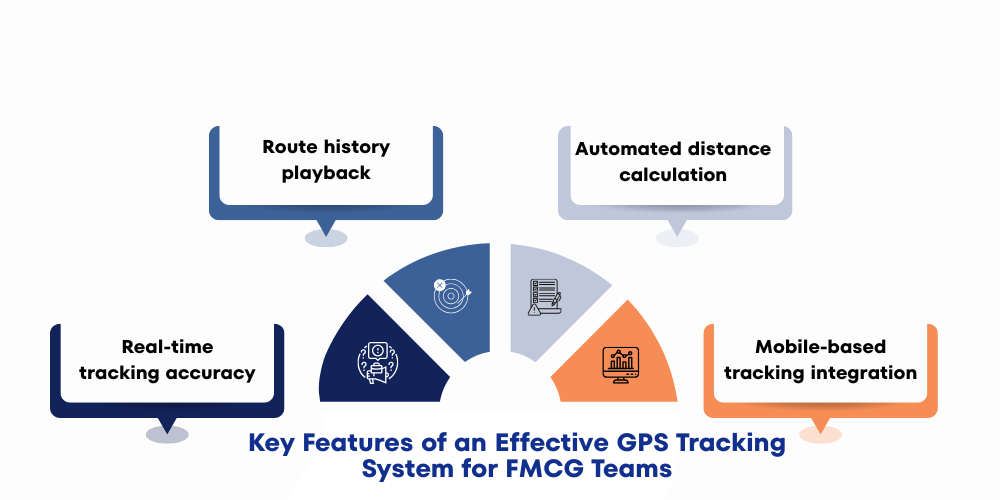
Key features include:
- Real-time tracking accuracy ensures live visibility of field staff movements enabling managers to monitor activities instantly across territories
- Route history playback allows detailed review of past travel patterns helping organizations analyze efficiency and improve future route planning decisions
- Automated distance calculation removes manual errors by accurately measuring travel distance improving transparency in reimbursement and operational expense management systems
- Mobile-based tracking integration enables seamless field adoption allowing sales teams to use GPS tracking directly through mobile applications without disruption
An advanced geo-tracking solution for field sales ensures complete visibility and control over field movement, helping FMCG companies reduce inefficiencies, improve accountability, and optimize overall field performance.
Role of GPS Tracking in Distributor and Territory Management
GPS tracking plays a critical role in improving distributor efficiency and territory-level decision-making in FMCG operations. It provides accurate visibility into field movement, helping managers understand how each territory is being covered and serviced.
By analyzing real travel data, organizations can eliminate guesswork and make more balanced operational decisions. It also ensures that resources are allocated based on actual field demand rather than assumptions.
- Evaluate territory performance using actual field movement data for more accurate productivity assessment across regions
- Ensure fair allocation of resources and travel budgets based on real workload distribution and operational needs
- Identify underperforming or overburdened territories to improve balance and efficiency in field execution structures
- Improve distributor-level planning by aligning stock movement, sales activity, and field coverage more effectively
A distribution analytics platform improves operational planning and ensures balanced workload distribution across teams, leading to better efficiency, reduced operational gaps, and stronger territory management control.
How GPS Distance Tracking Improves ROI in FMCG Operations
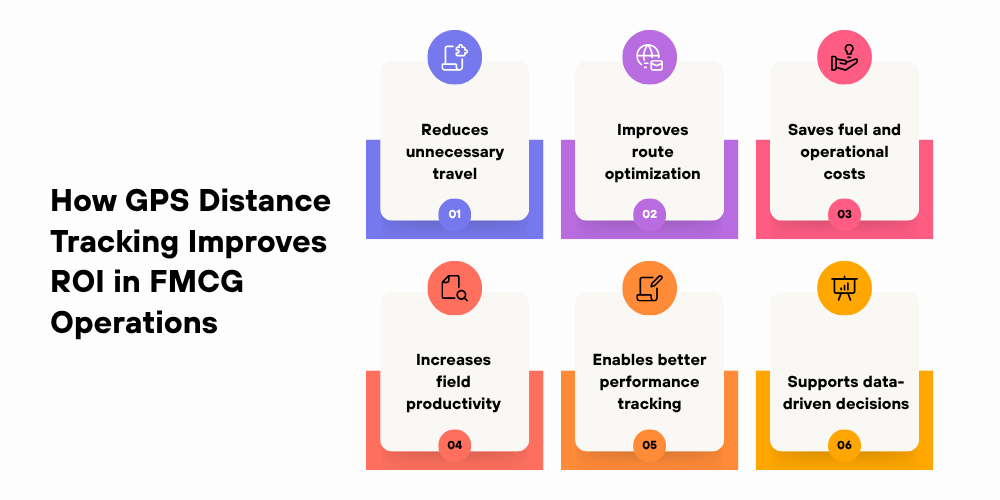
GPS distance tracking plays a critical role in improving operational efficiency in FMCG field sales. It ensures that every movement of the sales team is purposeful, measurable, and directly aligned with business outcomes. By minimizing unproductive travel and optimizing routes, organizations can significantly enhance return on investment (ROI).
- Reduces unnecessary travel: Eliminates duplicate visits and unplanned routes, helping FMCG companies cut fuel costs and improve overall field efficiency.
- Improves route optimization: Enables smarter beat planning and shortest-path routing, allowing more outlet coverage within limited working hours.
- Saves fuel and operational costs: Controls excessive travel distance, reduces idle movement, and lowers vehicle-related expenses across field operations.
- Increases field productivity: Helps sales representatives focus more on productive outlet visits and actual selling rather than untracked travel time.
- Enables better performance tracking: Provides accurate GPS-based insights to evaluate employee efficiency, territory coverage, and execution quality.
- Supports data-driven decisions: Integrates travel, visits, and sales data to improve visibility, control, and ROI-focused strategic planning.
Strategic Impact of GPS Accountability on FMCG Growth
GPS-based accountability plays a crucial role in strengthening FMCG field operations by ensuring every movement and activity is accurately tracked and verified. It builds a disciplined work culture where field execution becomes more structured, transparent, and performance-driven across all territories.
By eliminating guesswork in field reporting, organizations can achieve higher consistency in daily operations and better alignment between planned activities and actual execution.
GPS accountability helps FMCG companies:
- Improve execution discipline by ensuring sales teams follow planned routes and complete assigned outlet coverage systematically
- Strengthen field transparency through real-time visibility of employee movement, reducing scope for inaccurate reporting or missed visits
- Enhance operational consistency across regions by standardizing field processes and ensuring uniform execution across all territories
- Support scalable expansion by enabling centralized control and monitoring of large and geographically dispersed sales teams
A sales performance tracking system strengthens organizational control and supports scalable expansion across new markets, enabling FMCG companies to grow efficiently while maintaining visibility, discipline, and operational stability.
Conclusion:
GPS distance tracking has become a core requirement for FMCG companies aiming to control field expense inflation and strengthen accountability across sales operations. It enables organizations to move away from manual reporting and build a more transparent, data-driven field ecosystem.
With modern field visibility tools, businesses can monitor real movement, reduce operational leakages, and improve discipline across field teams, leading to stronger execution and better cost control.
As FMCG operations continue to scale, adopting GPS-enabled systems is no longer optional but essential for long-term efficiency, profitability, and sustainable growth.
To improve field visibility and control expenses effectively, book a demo of Delta Sales App and explore how GPS tracking can transform your FMCG field operations.