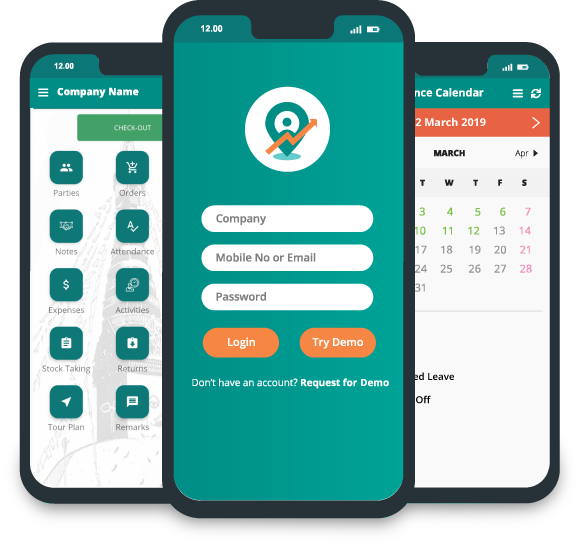

The Complete Guide to Employee Monitoring Software for Field Sales Teams
Managing field sales teams has always been more complex than managing office-based employees. Unlike desk jobs, field executives operate outside the office environment, moving between customers, territories, and market locations throughout the day. This makes it difficult for organizations to maintain visibility, ensure accountability, and measure actual productivity.
As businesses expand and competition increases, relying on manual reporting or end-of-day updates is no longer enough. Companies need real-time insights into field activities to ensure every visit, route, and task is executed as planned.
This is where employee monitoring software for field sales teams becomes essential. It provides structured visibility, improves operational control, and helps organizations make faster and more accurate decisions based on real-time field data.
What is Employee Monitoring Software for Field Sales Teams?
Employee monitoring software for field sales teams is a digital system designed to track, manage, and analyze the daily activities of employees working outside the office. It helps organizations monitor field operations in real time, ensuring that sales activities are properly executed and performance is accurately measured.
Beyond basic tracking, it acts as a centralized platform where managers can view field activities, evaluate productivity, and ensure that every planned task is executed efficiently. By digitizing field operations, businesses can eliminate guesswork and bring structure to on-ground sales processes.
Core purpose of the system:
- Track field employee movement:
Continuously monitor employee locations, travel routes, and movement patterns to ensure efficient territory coverage and minimize unnecessary travel time daily. - Validate customer visits:
Verify whether scheduled client visits actually occurred using GPS-based check-ins, timestamps, and supporting data to eliminate fake or missed reporting issues. - Improve productivity and efficiency:
Identify unproductive time, optimize daily schedules, and ensure employees complete more meaningful tasks, leading to better overall sales performance outcomes consistently. - Provide real-time operational visibility:
Enable managers to access live field data instantly, allowing quicker decisions, better coordination, and improved control over distributed sales teams efficiently.
How it differs from traditional monitoring:
Unlike office monitoring tools that focus on computer usage or screen activity, field sales monitoring focuses on:
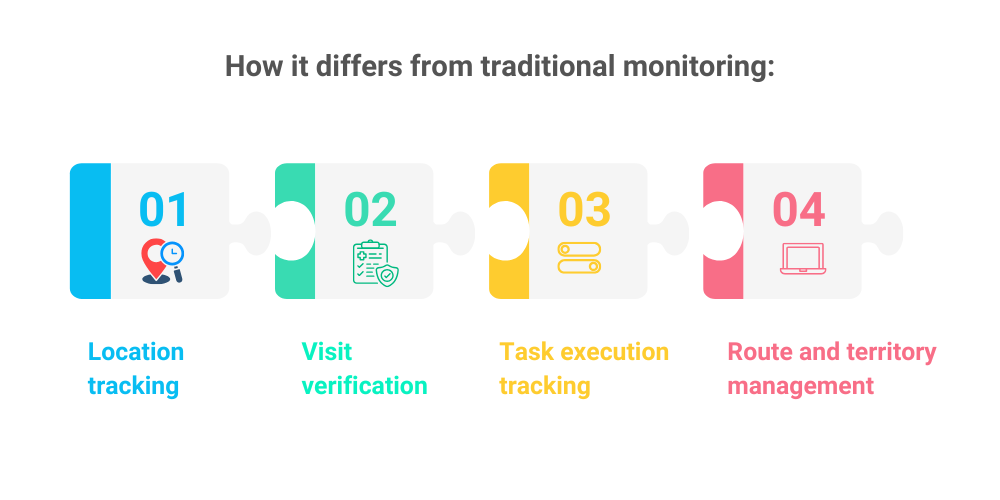
- Location tracking:
Tracks real-time geographic position of employees to ensure they are operating within assigned territories and following planned routes throughout working hours. - Visit verification:
Confirms actual customer interactions using location data, timestamps, and activity logs, ensuring transparency and accountability in field sales operations consistently. - Task execution tracking:
Monitors completion of assigned tasks and activities, ensuring field employees follow daily plans and achieve defined sales objectives without deviations. - Route and territory management:
Helps optimize travel routes and territory coverage, reducing travel time, lowering costs, and increasing the number of productive customer visits daily.
The goal is not surveillance but better execution control and sales performance improvement. For a deeper conceptual breakdown of this system, you can explore our detailed guide on what employee monitoring software is and how it works in field sales businesses.
Key Challenges in Managing Field Sales Teams Without Monitoring Tools
Without a proper monitoring system, field sales operations often become inconsistent, unstructured, and difficult to control. Managers struggle to gain clarity on execution, while employees lack clear accountability, resulting in reduced efficiency and missed opportunities.
Lack of visibility into employee movement
Managers are unable to track where employees are during working hours or what activities they are performing in the field. Without real-time tracking, managers cannot monitor movement, leading to uncertainty in field operations, poor planning decisions, and reduced overall team productivity.
Difficulty in verifying client visits
There is often no reliable way to confirm whether a reported customer visit actually took place. Without verification systems, businesses rely on manual reports, increasing chances of inaccurate data, fake visits, and missed opportunities for genuine customer engagement.
Inefficient route planning
Poorly optimized routes lead to unnecessary travel time, higher fuel costs, and fewer customer interactions. Lack of route optimization results in wasted travel time, increased operational costs, fewer daily visits, and inefficient utilization of field workforce resources.
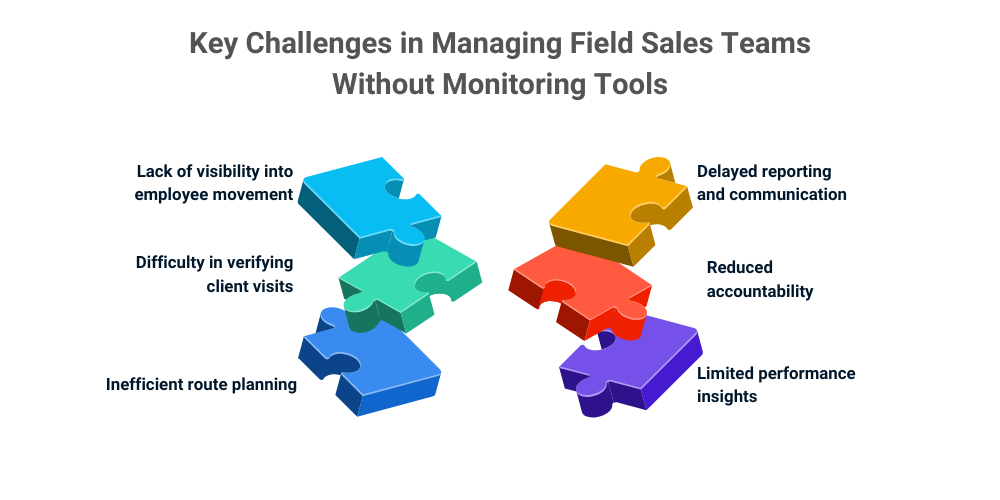
Delayed reporting and communication
Manual reporting creates delays, making it difficult to respond to field issues in real time. Delayed updates prevent managers from taking immediate actions, slowing decision-making processes and negatively impacting responsiveness to field challenges and customer needs.
Reduced accountability
Without tracking systems, employees may not strictly follow assigned schedules or tasks. Absence of monitoring reduces responsibility among employees, leading to missed tasks, inconsistent performance, and lack of adherence to assigned schedules or plans.
Limited performance insights
Managers lack access to real-time data, making performance evaluation subjective instead of data-driven. Without accurate data, managers cannot analyze productivity trends effectively, resulting in poor performance evaluation, weak strategies, and missed opportunities for improvement.
Manual Tracking vs Automated Employee Monitoring Software
Field sales operations have traditionally relied on manual tracking methods such as calls, spreadsheets, and end-of-day reporting. While these methods may work in small setups, they fail to deliver the speed, accuracy, and real-time visibility required in modern field sales. Automated employee monitoring software replaces these limitations with structured, real-time, and data-driven execution.
Delayed reporting vs Real-time data capture
Manual tracking: Depends on employees updating activities after completing tasks, leading to delays and outdated information.
Automated system: Captures field data instantly through mobile apps and GPS tracking, giving managers live visibility into operations.
Reactive control vs Proactive management
Manual tracking: Managers can only review performance after reports are submitted, limiting timely intervention during field activities.
Automated system: Enables real-time monitoring, allowing managers to make immediate corrections and improve execution on the go.
Inconsistent records vs Structured data accuracy
Manual tracking: Prone to human errors, missing entries, and inconsistent reporting formats, reducing data reliability.
Automated system: Automatically logs every activity with timestamps, location data, and structured entries for accurate reporting.
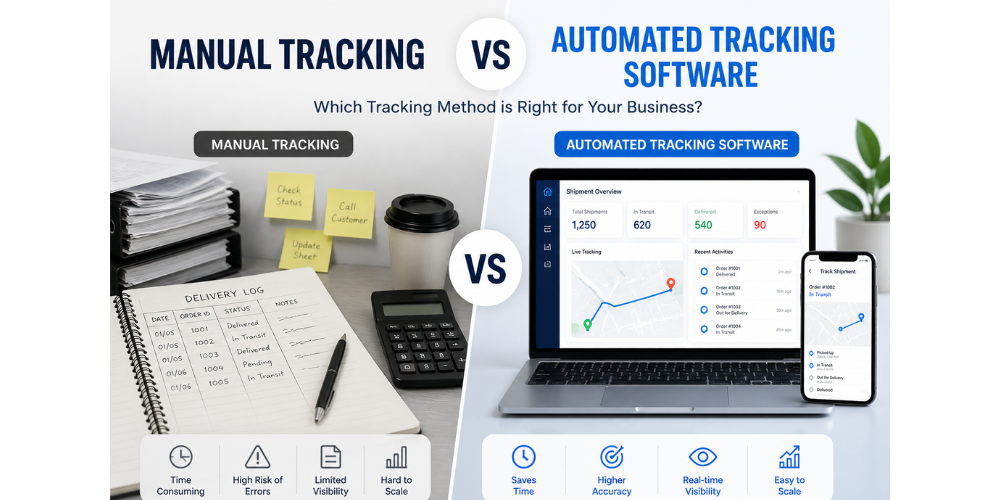
Limited scalability vs Seamless expansion
Manual tracking: Becomes difficult to manage as team size increases, leading to higher administrative effort and confusion.
Automated system: Easily scales across large teams and multiple territories without losing control or data consistency.
Low transparency vs Full operational visibility
Manual tracking: Relies on self-reported updates, which may not always reflect actual field activities.
Automated system: Provides GPS-based tracking and visit verification, ensuring complete transparency in field operations.
Slow decision-making vs Data-driven speed
Manual tracking: End-of-day reporting delays insights, making decision-making slower and less responsive.
Automated system: Delivers real-time insights that enable faster, smarter, and more effective business decisions.
How Employee Monitoring Software Works in Field Sales Operations
Employee monitoring software uses mobile technology, GPS tracking, and cloud-based systems to capture real-time field activity and transmit it to a centralized dashboard. This ensures complete visibility, structured execution, and accurate performance tracking across distributed sales teams.
By digitizing every step of field operations from attendance to customer visits organizations can eliminate manual errors, improve coordination, and make faster, data-driven decisions.
Mobile-based tracking system
Field employees use a mobile app to log tasks, update visit status, capture data, and communicate with managers, ensuring seamless coordination and accurate reporting throughout the day.
Real-time GPS location tracking
GPS tracking enables managers to monitor employee location continuously, analyze travel routes, ensure territory compliance, and identify inefficiencies in movement patterns to improve overall field productivity.
Visit logging and proof of work
Every customer interaction is logged with timestamps, geo-coordinates, and notes, providing verifiable proof of work, improving transparency, and ensuring all planned visits are completed accurately.
Automated attendance capture
Attendance is recorded through geo-tagged check-ins, eliminating manual errors, preventing fake entries, and ensuring accurate tracking of employee working hours across different field locations daily.
Centralized dashboard access
A centralized dashboard consolidates all field data, allowing managers to track performance, monitor activities, generate reports, and make informed decisions for improving sales operations efficiency.
Core Features of Employee Monitoring Software
A strong employee monitoring system includes multiple features that improve visibility, accountability, and control over field operations. These features work together to streamline execution, reduce inefficiencies, and ensure that field teams operate in a structured and measurable way.
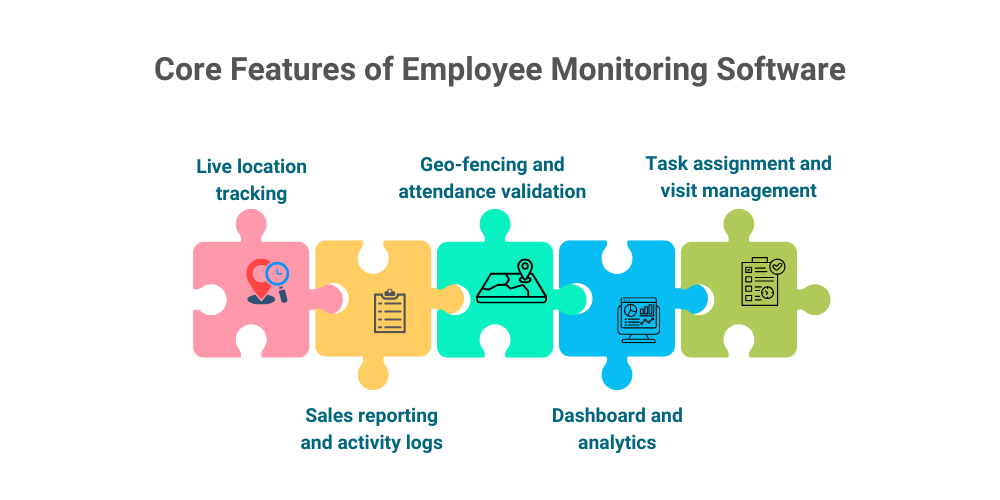
Live location tracking
Real-time monitoring of field employee movement enables managers to track routes, verify field presence, ensure territory coverage, and identify inefficiencies in daily travel patterns.
Geo-fencing and attendance validation
Geo-fencing ensures employees check in only from authorized locations, preventing fake attendance, improving accuracy, and maintaining discipline across distributed field sales teams consistently.
Task assignment and visit management
Managers can assign daily tasks, plan customer visits, and track completion status, ensuring field teams follow structured workflows and meet defined sales objectives efficiently.
Sales reporting and activity logs
Automatically captures visit details, customer interactions, and activity updates, reducing manual reporting errors while ensuring accurate and real-time data collection for analysis.
Dashboard and analytics
Provides detailed insights into employee performance, productivity trends, and operational efficiency, enabling managers to make data-driven decisions and continuously optimize field sales strategies.
These features together create a complete field execution monitoring system, helping businesses improve control, increase productivity, and drive better sales outcomes.
Common Myths About Employee Monitoring Software
Employee monitoring software is often misunderstood, especially in field sales environments where visibility and mobility are already complex. These misconceptions can create resistance during adoption and prevent businesses from realizing the full value of the system.
Myth 1: It is only used to spy on employees
One of the most common misconceptions is that monitoring software is designed for surveillance. In reality, its primary purpose is operational visibility, productivity improvement, and ensuring structured field execution rather than employee spying.
Myth 2: It reduces employee trust and morale
Many assume monitoring tools create a culture of distrust. However, when implemented transparently, they actually improve clarity, reduce conflicts in reporting, and help employees perform with better direction and accountability.
Myth 3: It is only useful for large enterprises
Another myth is that only large organizations need such systems. In fact, small and mid-sized field sales teams benefit significantly by gaining structure, improving route efficiency, and scaling operations effectively from early stages.
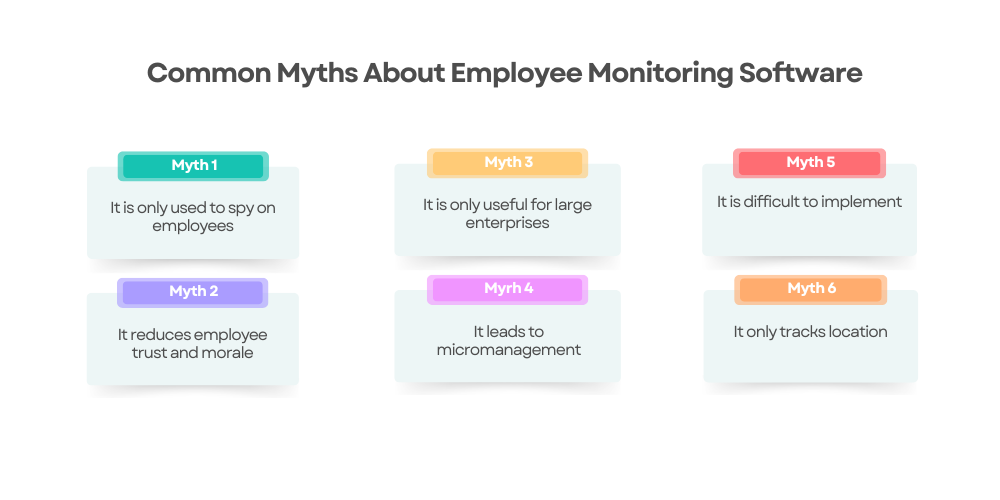
Myth 4: It leads to micromanagement
People often believe monitoring tools encourage excessive control. In practice, they reduce the need for constant follow-ups by providing real-time data, allowing managers to focus on strategy rather than day-to-day checking.
Myth 5: It is difficult to implement
Many businesses assume these systems are complex and time-consuming to deploy. Modern solutions are mobile-based, user-friendly, and can be quickly adopted with minimal training and structured onboarding processes.
Myth 6: It only tracks location
A common misunderstanding is that these tools only provide GPS tracking. In reality, they also include visit verification, task management, reporting, analytics, and performance tracking for complete field force management.
By clearing these myths, organizations can better understand that employee monitoring software is not about control, but about enabling smarter execution, better transparency, and improved field sales performance.
Workflow of Field Sales Monitoring System
A structured workflow ensures smooth coordination between managers and field employees, enabling better planning, execution, tracking, and continuous improvement in field sales operations.
Daily planning and beat assignment
Managers assign routes, customer lists, and daily targets based on territory priorities, ensuring optimized scheduling, balanced workload distribution, and maximum coverage across assigned regions.
Field execution tracking
Employees execute assigned tasks while their movement is tracked in real time, allowing managers to monitor progress, ensure adherence to plans, and identify deviations instantly.
Data capture during customer visits
Every visit is recorded with structured details such as time, location, interaction notes, and outcomes, ensuring accurate documentation and reliable data for performance evaluation.
Manager review and reporting cycle
Supervisors analyze collected data, track performance trends, identify gaps, and optimize future strategies, ensuring continuous improvement in efficiency, productivity, and sales execution quality.
Key Benefits for Businesses and Sales Managers
Employee monitoring software delivers measurable improvements in field operations by bringing visibility, structure, and control to daily sales activities. It enables organizations to optimize performance, reduce inefficiencies, and make informed decisions based on real-time data.
Improved productivity and efficiency
Better planning, route optimization, and real-time tracking help employees complete more tasks daily, reduce idle time, and ensure maximum utilization of working hours.
Better accountability and transparency
Every field activity is recorded with time and location data, making it easy to verify work, track responsibilities, and maintain complete transparency across teams.
Reduced operational leakage
Monitoring systems minimize unproductive activities, eliminate fake reporting, and reduce inefficiencies, helping businesses save costs and improve overall operational effectiveness consistently.
Data-driven decision making
Managers use real-time insights and performance data to make faster, more accurate decisions, improving strategy planning and overall field sales management efficiency significantly.
Enhanced team performance tracking
Individual and team performance can be measured using accurate data, enabling better comparisons, performance evaluation, and targeted improvements across the entire sales workforce.

Industry Use Cases of Employee Monitoring Software
Employee monitoring software is widely adopted across multiple field-driven industries where real-time visibility, structured execution, and performance tracking are critical for success. It helps businesses streamline operations and improve on-ground efficiency.
FMCG distribution teams
Ensures proper retail coverage, adherence to beat plans, and efficient distributor coordination, helping sales representatives visit more outlets and maintain consistent market presence daily.
Pharmaceutical sales teams
Tracks doctor visits, meeting frequency, and medical detailing activities, ensuring representatives follow schedules accurately while improving engagement and compliance with reporting standards.
Retail merchandising teams
Monitors store visits, product placement, stock availability, and in-store execution, ensuring brand visibility and consistency across retail outlets for better customer experience and sales.
Telecom sales teams
Supports customer acquisition, service visits, and installation tracking, enabling teams to manage field operations efficiently while improving response time and customer satisfaction levels.
Role of Monitoring Software in Business Growth
Beyond basic tracking, employee monitoring software directly contributes to business growth by improving operational efficiency, increasing market coverage, and enabling better strategic decision-making across field sales functions.
Improves territory planning and execution
Businesses can allocate territories more effectively, balance workloads across teams, and ensure better route planning for improved on-ground sales execution and efficiency.
Increases customer coverage per day
Optimized routes and better task management enable field employees to visit more customers daily, improving market penetration and expanding sales opportunities.
Enhances forecasting accuracy using real-time data
Live field data provides better visibility into activities and trends, helping businesses improve forecasting accuracy and plan future sales strategies more confidently.
Supports strategic sales planning and decision-making
Managers gain actionable insights into field performance, territory gaps, and customer engagement, enabling smarter business decisions and stronger long-term growth strategies.
Security, Privacy, and Ethical Considerations
Responsible implementation of employee monitoring software is critical for long-term adoption and trust. Businesses must balance operational visibility with employee privacy and ethical workforce management practices.
Data protection
Systems must ensure secure storage, encrypted data transmission, and restricted access controls to protect sensitive employee and business information from unauthorized access.
Employee transparency
Employees should be clearly informed about what data is being tracked, why monitoring is necessary, and how the information will be used.
Compliance
Organizations must follow legal regulations and ethical guidelines related to workforce monitoring, ensuring responsible usage and maintaining employee trust across operations.
How to Choose the Right Employee Monitoring Software
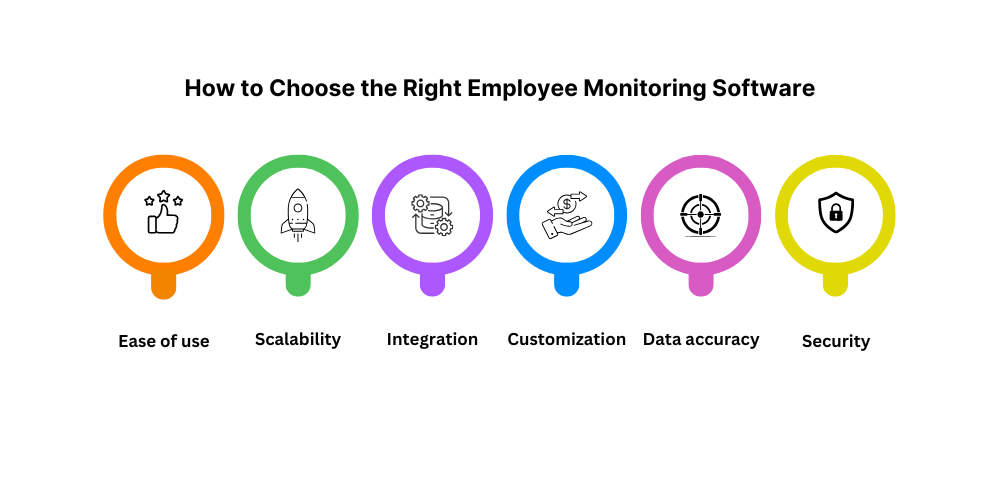
Selecting the right solution requires evaluating both technical capabilities and real-world operational requirements. A well-chosen system should improve field efficiency, support business growth, and integrate seamlessly into daily sales workflows without creating complexity for teams.
Ease of use
Simple interface for field adoption ensures employees can quickly understand and use the system without extensive training, improving adoption rates and reducing operational resistance significantly.
Scalability
Ability to support growing teams allows businesses to expand operations smoothly without performance issues, ensuring the software adapts to increasing users, territories, and data loads efficiently.
Integration
Compatibility with CRM and sales tools enables seamless data flow across systems, reduces duplication of work, and improves coordination between sales, reporting, and management functions.
Customization
Flexibility to match business workflows ensures the software can be tailored to specific sales processes, reporting structures, and operational requirements for better efficiency and control.
Data accuracy
Reliable reporting and real-time updates ensure managers receive correct field information, enabling better decision-making, improved performance tracking, and reduced errors in sales reporting processes.
Security
Strong protection for sensitive data ensures business and employee information remains secure through encryption, access controls, and compliance with industry-standard data protection practices.
For a more practical comparison and selection framework, you can refer to our detailed guide on choosing the right employee tracker app for field sales teams.
Implementation Strategy for Organizations
Proper implementation is key to successful adoption, ensuring the system is not only deployed but also consistently used by field teams to deliver measurable results.
- Train field employees on system usage: Comprehensive training ensures employees understand features clearly, use the system correctly in daily operations, and adopt it smoothly without confusion or resistance during field execution.
- Define clear tracking and reporting guidelines: Well-defined rules for check-ins, visit reporting, and task updates ensure consistency across teams, reduce ambiguity, and maintain standardised field operations across all territories.
- Monitor adoption rates regularly: Tracking usage patterns helps identify gaps in adoption, allowing managers to provide additional support, improve engagement, and ensure the system is actively used by all employees.
- Use insights for continuous improvement: Real-time data and performance insights help refine workflows, optimize routes, and improve sales strategies, ensuring continuous operational enhancement and better field productivity over time.
- Start with pilot rollout before full deployment: Launching the system with a small team first helps identify challenges, test functionality, and make necessary improvements before scaling across the entire organization effectively.
- Collect feedback from field teams: Regular feedback from users helps improve usability, resolve practical challenges, and ensure the system aligns with real-world field conditions and operational requirements.
A structured rollout ensures smoother adoption, higher engagement, and better long-term results across field sales operations.
Future of Employee Monitoring in Field Sales
Field monitoring systems are evolving rapidly with advanced technologies that go beyond tracking and focus on intelligence, automation, and predictive capabilities.
AI-powered performance insights:
Artificial intelligence will analyze field data to identify patterns, detect inefficiencies, and provide actionable recommendations for improving individual and team performance.
Predictive sales analytics:
Future systems will forecast sales outcomes based on historical and real-time field data, helping businesses plan strategies more accurately and proactively.
Automated workflow execution:
Routine tasks such as reporting, scheduling, and tracking will become automated, reducing manual effort and improving operational speed and consistency.
Fully integrated digital sales ecosystems:
Monitoring tools will seamlessly connect with CRM, ERP, and analytics platforms, creating a unified ecosystem for complete visibility and control over sales operations.
The future will focus on intelligent decision-making rather than just tracking, enabling businesses to operate more strategically and efficiently in competitive markets.
Final Thoughts
Employee monitoring software for field sales teams is no longer optional, it is a core operational requirement for modern businesses.
It brings structure to field operations, improves accountability, and enables real-time decision-making. Organizations that adopt such systems gain a clear advantage in efficiency, productivity, and overall sales performance.
With the right solution, businesses can transform field execution from a fragmented process into a fully transparent, data-driven, and high-performance system.
If you're looking to implement a reliable and scalable solution for your field teams, you can book a free demo of Delta Sales App to see how real-time tracking, reporting, and field automation can improve your sales operations and productivity.