
How Agricultural and Agri-Input Companies Can Digitize Their Field Sales Teams

Today, agriculture is not a stand-alone activity anymore; it is part of a highly interconnected agrifood system that includes production, processing, transportation, distribution, marketing, and consumption.
The Food and Agriculture Organization (FAO) defines agri-food systems as all the activities and actors involved in getting food and agricultural products from farm to table, including how they are produced, processed, transported, distributed, and consumed. Such a systems approach underscores the deep interconnections that characterize agricultural value chains in modern economies.
This means that in practice the success of agricultural and agri-input businesses (seeds, fertilizers, pesticides, farm equipment, etc.) depends not only on production but also on the efficiency with which products and information flow across distribution networks and field teams.
But even as the complexity grows, many agri-input companies still use traditional methods such as spreadsheets, phone calls, and messaging apps to manage their field sales operations. This results in large gaps in visibility, coordination, and execution in rural markets.
In industries where field teams directly interact with dealers, distributors, and farmers across vast geographies, these inefficiencies can lead to:
- Delayed order collection and reporting
- Lack of real-time visibility into field activities
- Poor coordination with distributor networks
- Limited ability to forecast demand accurately
Here is where digitization of field sales is critical.
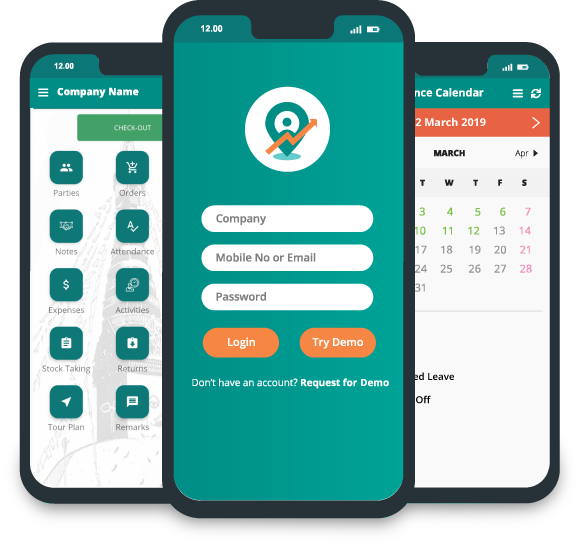
Solutions such as the Delta Sales App are enabling ag businesses to transform traditional fieldwork into structured, real-time, data-led systems for more control, better productivity, and stronger rural market execution.
Why Agricultural Companies Need Field Sales Digitization
Agricultural companies operate in highly dynamic and geographically dispersed markets where field sales teams are responsible for driving demand, managing dealer relationships, and ensuring product availability at the last mile. However, traditional manual systems make it difficult to track performance, manage operations efficiently, and respond quickly to market changes. Field sales digitization helps solve these challenges by bringing structure, visibility, and automation into everyday field activities.
-
Lack of Real-Time Field Visibility
In many agri-input companies, managers have little or no visibility of what field executives are doing in real time during the day. They tend to be available at the end of the day/week, which means that decision-making is delayed and control of operations is reduced. A field sales tracking app offers complete transparency across rural and urban territories by tracking live location, visit status, and activity logs.
-
Inefficient Order Collection Process
Collecting orders in traditional field sales is usually a manual process, based on phone calls, paper notes, or delayed reporting. This not only extends the sales cycle but increases the likelihood of errors as well. A field sales order management system allows reps to record and submit orders while they are on the move, which leads to improved accuracy, fewer delays, and faster fulfillment.
-
Weak Distributor and Dealer Coordination
Agricultural supply chains depend heavily on smooth coordination between field teams, distributors, and retailers. Without a centralized system, communication gaps often lead to stock issues, missed orders, and poor service levels. A Distributor Management System helps streamline communication, track secondary sales, and ensure better alignment across the entire distribution network.
-
Lack of Structured Beat Planning
Field executives often miss scheduled dealer visits or take inefficient routes due to poor planning. This means lost time, higher travel costs, and patchy coverage of territory. Beat planning and route optimization tools help companies to assign structured visit plans, optimize travel routes, and have complete and consistent market coverage.
-
Poor Data Visibility for Decision-Making
When field data is collected manually, it becomes scattered, delayed, and difficult to analyze. This limits the ability of leadership teams to make informed decisions about sales performance, demand forecasting, and territory optimization. Digital field sales systems consolidate all data into real-time dashboards, enabling faster and more accurate decision-making.
Key Benefits of Digitizing Agri Field Sales Teams
Digitizing field sales operations in agricultural and agri-input businesses is not just about replacing manual work with software; it’s about improving execution quality, increasing visibility, and enabling faster decision-making across the entire sales ecosystem. By connecting field teams through a structured digital system, companies have more control over distribution, demand, and on-ground performance.

-
Better real-time visibility and control
One of the biggest benefits of digitization is seeing what's going on in the field in real-time. Managers can see in real time where their field executives are, which dealers they are visiting and what tasks they are carrying out during the day. Field Sales Tracking System can ensure accountability and reduce dependence on delayed reporting which allows for quicker and more informed decision making.
-
Faster and More Accurate Order Processing
Digital tools eliminate the delays and errors associated with manual order collection. Field teams can directly capture and submit orders using mobile devices, ensuring that data is accurate and immediately available for processing. A field sales order management system improves order speed, reduces miscommunication, and ensures faster fulfillment, which is critical in seasonal agricultural demand cycles.
-
Stronger Distributor and Dealer Relationships
Digitized systems allow companies to more efficiently handle distributor and dealer interactions. All orders, stock movements and communication are captured in one platform which results in less confusion and better trust throughout the supply chain. A Distributor Management System enables better coordination, less stockouts and improved service levels at the retail point.
-
Better Beat Planning and Field Productivity
Digitization allows for structured beat planning, so each field visit can be optimized for maximum coverage and efficiency. Field reps also follow a planned route (not random or overlapping visits) which reduces travel time and increases productive customer interactions. Beat Planning and Route Optimization Tool Drives field productivity and ensures full coverage of territories.
-
Data-Driven Decision Making
Traditional field sales systems lack reliable and timely data, making it difficult for managers to evaluate performance or forecast demand. Digitized systems solve this by providing real-time dashboards and analytics. This allows leadership teams to track KPIs, identify high-performing regions, and make informed decisions based on actual field data rather than assumptions.
-
Reduced Operational Costs and Leakage
Manual processes often lead to inefficiencies such as duplicate reporting, missed orders, and untracked expenses. Digitization reduces these issues by standardizing workflows and ensuring every activity is recorded. Over time, this helps reduce operational costs and prevents revenue leakage across the distribution chain.
-
Improved Field Team Accountability
When field activities are tracked digitally, accountability naturally improves. Field executives are more consistent with visits, reporting becomes more accurate, and managers gain better oversight of daily performance. This leads to a more disciplined and result-oriented sales force.
How Delta Sales App Helps Agricultural & Agri-Input Companies
Agricultural and agri-input companies operate in vast stretches of rural areas where success depends on on-field execution, distributor management, and real-time decision making. However, these operations are difficult to handle efficiently at scale with traditional manual systems. This is where a dedicated field sales automation platform like Delta Sales App comes into play.
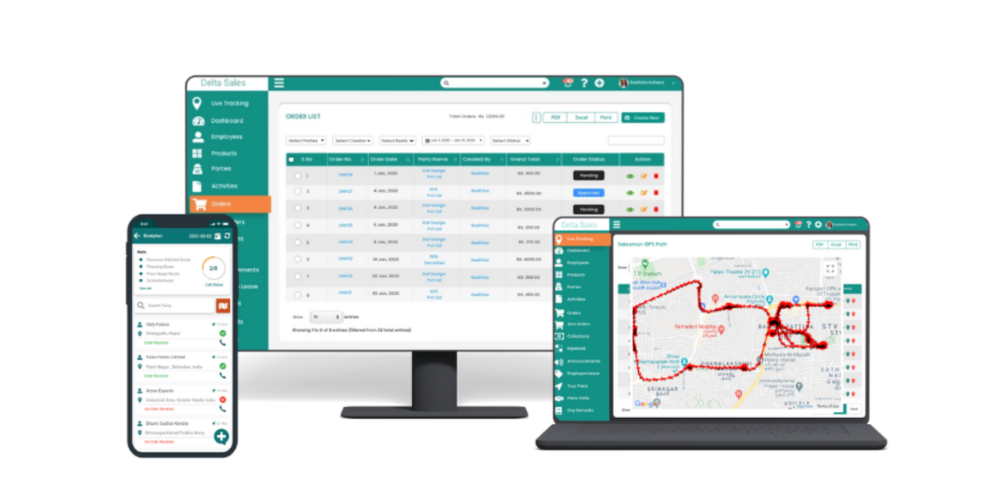
The Delta Sales App automates the entire field sales cycle for agricultural companies, from field tracking, order collection and distributor management to performance analytics, giving them better visibility, control and productivity over their sales network.
-
End-to-End Field Force Automation
With the Delta Sales App, agricultural companies can digitalize all activities carried out by their field sales teams, including visits, reporting, customer interactions, and task management. The field rep is on a standardized workflow that increases discipline and efficiency, while the structured Field Sales Automation System provides full visibility to managers on daily operations. This ensures that all field activity is logged, monitored and optimised in real time.
-
Real-Time Sales Team Tracking
One of the most important benefits of Delta Sales App is live tracking of field executives by means of GPS-based employee tracking. Companies can track movement, visit completion and route adherence through the day. With a field sales tracking app, managers can:
-
Track real-time field locations
-
Verify dealer and distributor visits
-
Improve accountability and transparency
-
Reduce missed or unplanned visits
-
Seamless Order Booking and Management
Orders must be collected in time in agricultural markets due to seasonal demand cycles. Delta Sales App makes it easy with instant mobile-based order booking so that field teams can book orders directly from dealers and retailers. Field Sales Order Management System allows companies to:
-
Reduce manual errors in order entry
-
Speed up order processing cycles
-
Improve supply chain responsiveness
-
Ensure accurate demand capture from the field
-
Efficient Distributor and Dealer Management
Strong relationships with distributors and retailers are critical for agricultural supply chains. The Delta Sales App brings all dealer and distributor data into one place, simplifying the tracking of performance, orders and engagement. Benefits of Distributor Management System for companies:
-
Monitor secondary sales performance
-
Improve stock availability tracking
-
Strengthen channel partner relationships
-
Reduce communication gaps in the supply chain
-
Smart Beat Planning and Route Optimization
Field productivity in agriculture often suffers due to unstructured travel routes and inconsistent visit planning. Delta Sales App solves this with intelligent beat planning features that ensure structured and optimized field coverage.Through a Beat Planning & Route Optimization Tool, companies can:
-
Assign structured daily visit plans
-
Optimize travel routes for rural territories
-
Reduce travel time and operational costs
-
Ensure complete geographic coverage
-
Real-Time Analytics and Performance Insights
Delta Sales App provides powerful dashboards that give leadership teams a clear view of field performance. From sales trends to territory performance, everything is available in real time. This helps agricultural companies:
-
Forecast seasonal demand more accurately
-
Identify high and low-performing regions
-
Monitor product-wise performance
-
Make faster and more informed business decisions
-
Offline Capability for Rural Connectivity
The Delta Sales App is built to function offline, as most agricultural markets are located in low- or no-network zones. Field reps can keep working without interruption and the data auto-syncs once connectivity is restored. which guarantees continuous field operation even at remote locations.
Why Agri Businesses Are Switching to Digital Field Sales
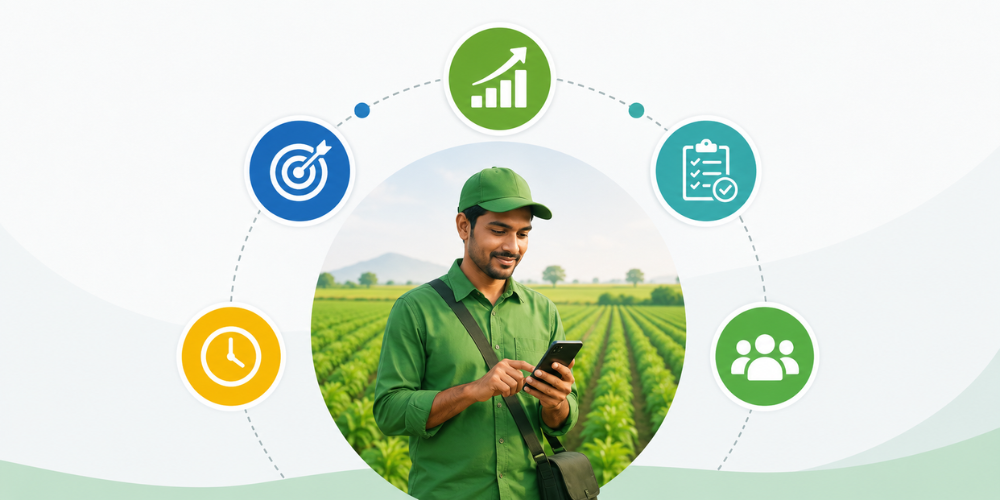
Agricultural and agri-input companies are rapidly shifting from manual field sales processes to digital field sales automation systems to improve efficiency, visibility, and execution speed across rural markets. Traditional methods such as spreadsheets, phone-based reporting, and WhatsApp updates are no longer sufficient to manage large, distributed field teams effectively.
As competition increases and demand cycles become more seasonal and data-driven, businesses are adopting sales force automation software to gain real-time control over their field operations.
-
Faster Order Processing (30–50% Improvement)
One of the most immediate benefits companies experience after digitization is significantly faster order processing. Instead of manual order collection and delayed submission, field teams can directly capture orders using mobile devices in real time. This reduces communication delays, eliminates data entry errors, and speeds up the entire order-to-delivery cycle, often improving processing speed by 30–50% depending on operational maturity.
-
Better Distributor Coordination
Digital field sales systems improve communication and coordination between field executives, distributors, and retailers. All orders, updates, and customer interactions are recorded in a centralized system, reducing dependency on fragmented communication channels. This leads to fewer stock mismatches, improved supply chain alignment, and stronger distributor relationships.
-
Reduced Field Operational Costs
By automating reporting, route planning, and order management, companies can significantly reduce unnecessary travel, manual workload, and operational inefficiencies. Digitization helps optimize field routes and minimize redundant visits, resulting in lower fuel costs, reduced administrative overhead, and improved resource utilization.
-
Higher Field Productivity
When field teams follow structured workflows supported by digital tools, their productivity increases naturally. Reps spend less time on manual reporting and more time engaging with dealers and retailers. Features like automated visit tracking, task reminders, and mobile order booking help ensure that every field activity contributes directly to sales performance.
-
Improved Stock Availability in Rural Markets
One of the biggest challenges in agri-input distribution is ensuring the right product availability at the right time in rural markets. Digital systems improve demand visibility and help companies plan inventory more accurately. With better real-time sales data from the field, companies can reduce stockouts, optimize replenishment cycles, and ensure consistent product availability across dealers and distributors.
Implementation Strategy for Agri Companies
For agri-input and agricultural companies, implementing a field sales automation system is not just a technology change; it is an operational change. Successful implementation requires a structured approach that aligns the people, processes and field execution to the goals. Even the best software needs proper planning to deliver the expected results.
A step-by-step rollout ensures smoother adoption, better field team acceptance, and faster ROI from digitization.
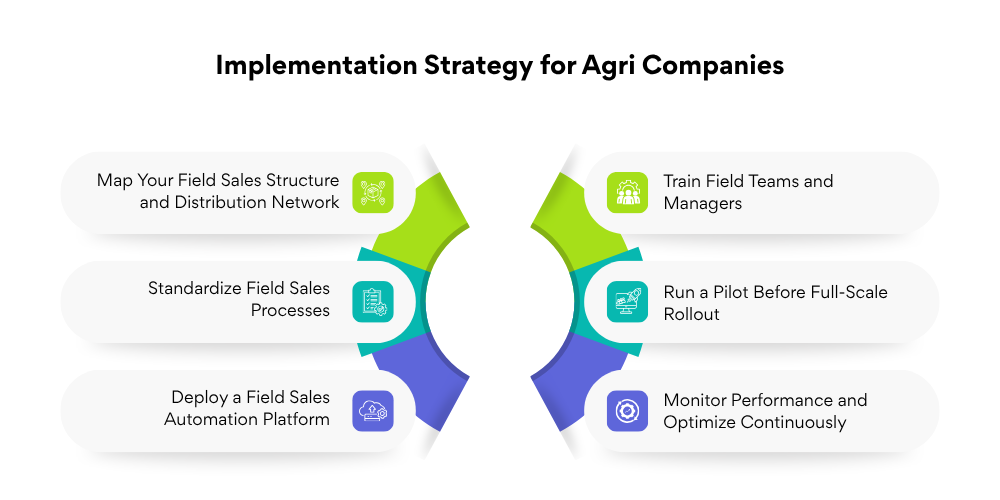
1. Map Your Field Sales Structure and Distribution Network
The first step is to clearly map your entire field ecosystem, including field executives, distributors, dealers, and territories. This helps identify how sales currently flow across rural and semi-urban markets.
Understanding your network structure ensures that the digital system is configured correctly from the beginning and reflects real-world operations without gaps.
2. Standardize Field Sales Processes
Before implementing any software, companies must define and standardize core field processes such as visit planning, order collection, reporting, and distributor communication.
A clear workflow ensures that every field executive follows the same structure, reducing inconsistencies and making digital adoption more effective across teams.
3. Deploy a Field Sales Automation Platform
Once processes are defined, the next step is implementing a scalable platform like the Delta Sales App to digitize field operations.
This includes enabling modules such as:
-
Field tracking and visit management
-
Mobile order booking
-
Distributor and customer management
-
Beat planning and route optimization
-
Real-time reporting dashboards
A structured rollout helps ensure smooth transition from manual to digital operations without disrupting ongoing sales activity.
4. Train Field Teams and Managers
Training is a critical success factor in digital adoption. Field executives and managers must understand how to use the system in real-world scenarios such as logging visits, capturing orders, and tracking performance.
Hands-on training sessions, simple onboarding guides, and continuous support help increase adoption rates and reduce resistance to change.
5. Run a Pilot Before Full-Scale Rollout
Instead of launching across all territories at once, companies should start with a pilot program in selected regions. This allows teams to test workflows, identify challenges, and refine configurations before scaling.
A pilot phase reduces risk and ensures that the system is optimized for real field conditions.
6. Monitor Performance and Optimize Continuously
After full implementation, companies should continuously track performance metrics such as order frequency, field productivity, visit completion rates, and distributor engagement.
Using real-time dashboards, leadership teams can identify gaps, optimize strategies, and continuously improve field execution efficiency.

Conclusion
The agricultural and agri-input sectors are operating in an increasingly complex market where success depends not only on product quality, but also on the efficiency with which field teams perform on the ground. The manual processes of spreadsheets, phone reporting, and disconnected communication tools are no longer scalable, quick, or visible enough for today’s agriculture distribution networks.
Digitization of field sales operations brings structure, transparency, and real-time control to the entire sales ecosystem of companies, from field tracking and order collection to distributor management and performance analytics. It will lead to faster execution, better decision making and stronger rural market penetration.
If you’re looking to improve field visibility, streamline order management, and strengthen your distributor network, it’s time to move beyond manual processes.
Book a free demo of Delta Sales App today and see how agricultural and agri-input companies are transforming their field sales operations with real-time tracking, automation, and actionable insights.