
How Can Companies Identify High-Potential Retail Outlets?

Two stores can sit on the same street, sell nearly identical products, and get visited by the same sales team, and one can still generate far more business than the other. From the outside, it's rarely obvious why.
One outlet might have stronger footfall, faster-moving SKUs, higher purchase frequency, better shelf visibility, or a customer base that just lines up better with the brand's target market. Another can get the same number of visits and contribute almost nothing to overall revenue. Treat both the same, and a sales team ends up burning time where the return barely exists.
That problem only gets bigger as a retail network grows. A brand managing hundreds or thousands of outlets can't rely on individual reps' personal judgment to decide which stores deserve more attention. Historical sales figures help, but they don't always show future potential. A growing outlet with moderate current sales can end up more valuable than a high-revenue store whose numbers have started sliding.
The real opportunity is looking past individual sales figures and weighing outlets across multiple signals: revenue contribution, sales growth, customer footfall, product assortment, outlet type, purchase behavior, location, and competitor presence. Put those together, and a company can find the outlets where more visits, better availability, stronger merchandising, or targeted sales effort are actually likely to pay off.
This blog looks at how companies can identify high-potential retail outlets, which criteria matter most, how to build an effective outlet tiering model, and how technology can help sales teams prioritize visits and improve retail execution.
What Are High-Potential Retail Outlets?
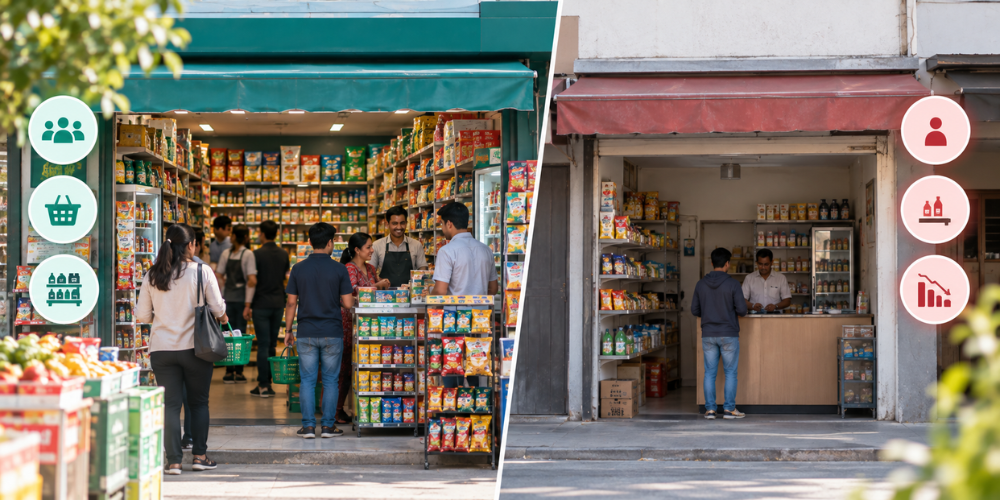
High-potential retail outlets are the stores more likely to generate higher sales, expand product distribution, grow SKU presence, or deliver future growth compared to the rest of the network.
Their potential gets assessed through a handful of indicators: past sales, customer footfall, location, assortment, purchase frequency, category demand, and competitive activity. Combine those signals instead of relying on gut instinct, and a brand gets a real picture of which stores can actually contribute more to overall growth.
Why Not All Outlets Deserve Equal Attention
Various stores, such as a small corner shop, a busy supermarket, and a specialized shop, may sell similar items, but their chances of doing well can be very different.
Treating each store the same in terms of visit frequency and resources can lead to missed opportunities and lower sales effectiveness.
Instead, it's crucial to evaluate each store's unique performance and potential. This insight enables sales managers to strategically direct their time, promotions, inventory, and field resources to where they can make the most significant difference.
Why Outlet Prioritization Matters for Retail Execution
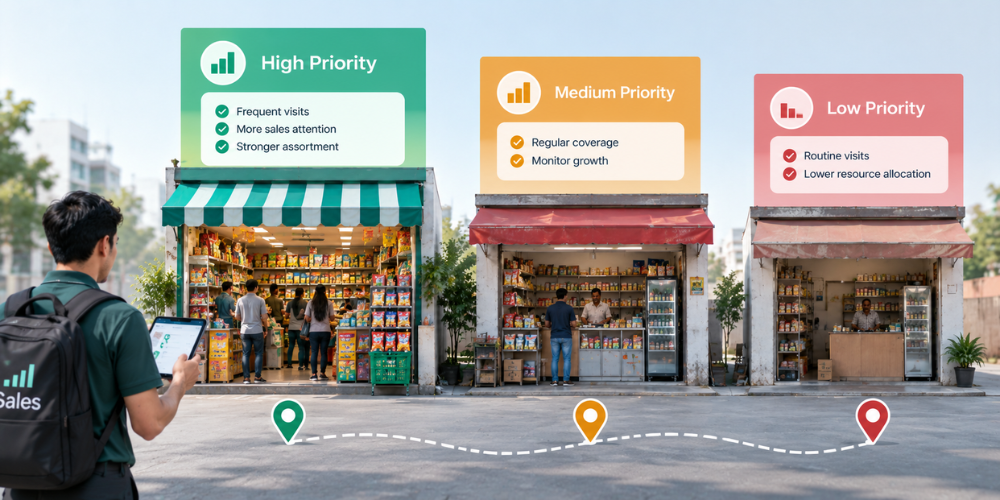
When every outlet gets treated as equally important, a sales team ends up spending the same time and resources on stores that offer wildly different levels of opportunity. Outlet prioritization fixes that by focusing field effort where it's most likely to actually generate sales, improve coverage, and support long-term growth. Once a brand knows which stores need more attention and which just need routine coverage, the sales team's limited time and resources go where they actually matter.
-
Impact on Sales Force Productivity
Field teams only have so many working hours in a day, and every unnecessary visit steals time from an outlet that might actually offer a real opportunity. Effective outlet prioritization gives sales managers a more focused field strategy: reps spend more time developing high-value stores while still maintaining decent coverage everywhere else. That improves productivity without just telling salespeople to make more visits and hoping it works out.
-
Cost of Visiting Low-Value Outlets
A store visit has a real operational cost. Travel, fuel, working hours, order-taking, reporting, follow-up- all of it eats resources. When a team keeps visiting outlets with limited sales potential, that spend produces little in return. A field sales tracking app that prioritizes stores based on actual data cuts down on that inefficient coverage and helps managers get more out of the field capacity they already have.
-
Link Between Prioritization and ROI
The goal of prioritization isn't just spotting the stores with the highest current sales. It's figuring out where extra attention would actually generate the biggest return. An outlet with moderate sales but rapidly climbing demand can deserve more attention than a currently large outlet whose purchases are already sliding. That makes retail ROI a mix of present performance, future opportunity, and what it actually costs to go after that opportunity.
Key Criteria to Identify High-Potential Outlets
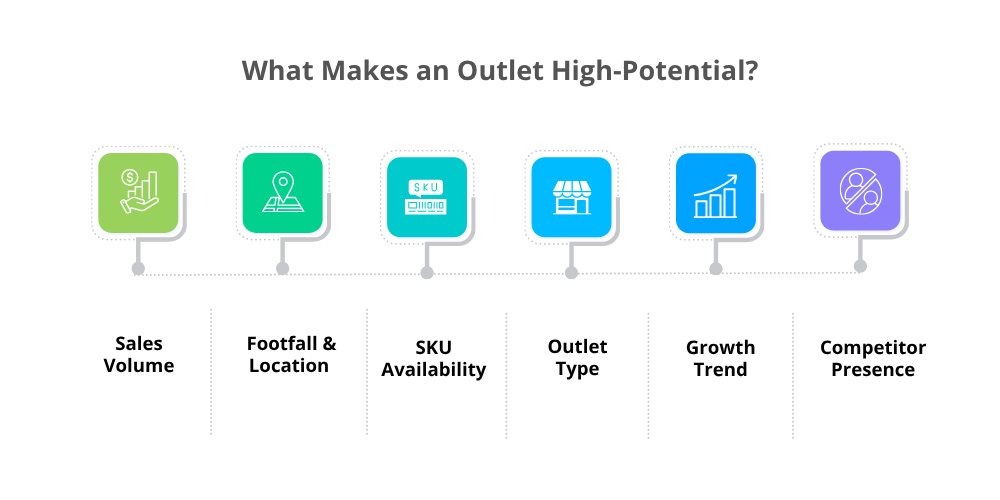
A high-potential outlet isn't always the one already posting the highest sales. Its real value can come from customer traffic, product demand, location, growth rate, or just the room to expand distribution there. Weighing those factors together gives a company a much clearer picture of which outlets actually have the most potential and where the sales team should actually be spending its effort.
-
Sales Volume and Revenue Contribution
Historical sales are one of the clearest places to start. That means looking at average order value, purchase frequency, monthly sales, revenue contribution, product category sales, and changes in order quantity over time. But historical revenue shouldn't be treated as the only measure. A smaller outlet might have plenty of room left to grow that these numbers alone won't show.
-
Footfall and Location Demographics
Customer traffic offers useful clues about future sales potential. Stores near busy markets, residential areas, commercial centers, schools, offices, or transport hubs attract different customer groups with different purchasing patterns. Combining location data with local demographics tells a company whether that outlet actually reaches its target market or not.
-
SKU Availability and Assortment Depth
An outlet can have real demand and still post limited sales simply because the important products aren't on the shelf. Worth monitoring: number of SKUs available, which products are fast-moving, gaps in the assortment, and overall assortment depth. That's what tells a sales team the difference between an outlet with genuinely low demand and one where better assortment could unlock sales that are already sitting there.
-
Outlet Category and Channel Type
Outlet-type shapes are potential too. A brand can classify stores into categories like grocery stores, supermarkets, convenience stores, wholesale outlets, specialty stores, modern trade outlets, and independent retailers. Each channel needs its own sales strategy, product mix, and service level, since selling into a supermarket looks nothing like selling into an independent corner shop.
-
Growth Trend vs. Historical Performance
Looking only at yesterday's numbers can hide tomorrow's opportunity. Compare recent sales against historical performance, and you can spot the stores showing sustained growth, declining demand, or shifting purchase behavior. A store with consistent month-on-month improvement can deserve a higher priority than an established outlet with bigger current revenue but a flat or declining trend.
-
Competitor Presence in the Outlet
Competitive activity reveals both risk and opportunity. Checking whether competitors have better shelf presence, a wider assortment, stronger promotions, or more frequent sales visits matters here. A high-potential outlet where the brand's presence is currently weak can turn into a real target for distribution expansion and better execution.
Role of Technology in Identifying and Prioritizing Outlets
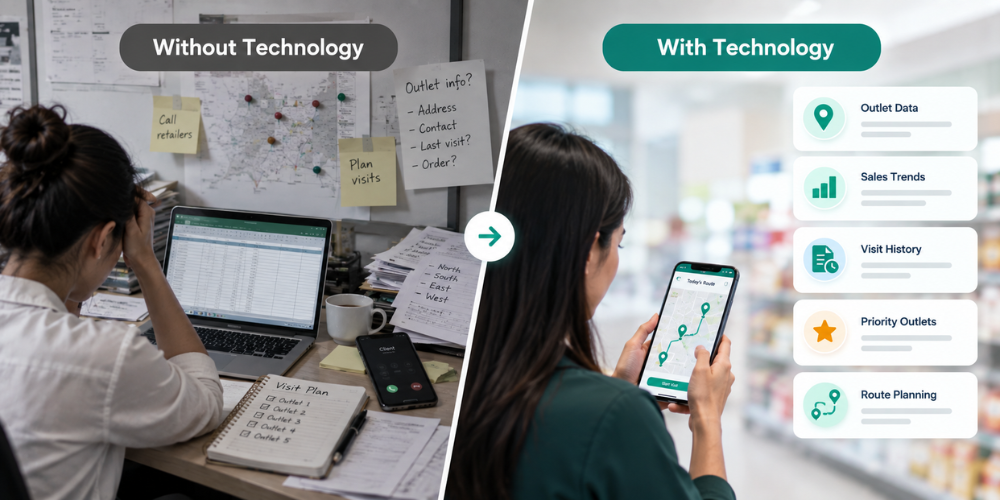
Manual spreadsheets and verbal updates make it genuinely hard to keep a current view of thousands of outlets. Technology brings outlet information, sales activity, visits, and field observations into something more structured than that.
-
Field Sales Apps
A field sales app helps brands collect and organize outlet-level information straight from the field. Delta Sales App, for instance, tracks outlet-level data, automates scoring, and optimizes visit schedules based on the criteria a business actually cares about. Managers can use that to understand outlet performance and decide where reps should actually be spending their time, instead of leaning on manually maintained lists that go stale the moment someone updates a spreadsheet by hand.
-
Real-Time Data vs. Manual Outlet Assessment
Manual assessments go stale fast. An outlet that was highly productive six months ago might be declining right now. A store that used to generate limited sales might have started growing because customer demand shifted or product availability improved. Regularly updated field information keeps managers seeing current market conditions, not a snapshot from months ago, and lets outlet priorities get adjusted quickly when something actually changes.
-
Benefits of App-Based Route and Visit Planning
Outlet prioritization gets a lot more useful once it's connected to daily field planning. A technology-enabled system helps managers organize visits by outlet importance, location, assigned territories, and planned activities. That supports better route planning, cuts down unnecessary travel, and gets reps spending more of their day in productive selling rather than driving.
-
Better Visibility Into Outlet Performance
Technology lets managers compare outlets against consistent performance indicators instead of piecing it together from scattered reports. Sales trends, order frequency, visit records, product availability, and other field data can all be reviewed together to understand why certain outlets are outperforming others. That visibility surfaces which outlets are growing, which are declining, which are underserved, and which show real room for development.
-
Faster Adjustments to Changing Outlet Potential
Outlet potential isn't fixed. A store's importance shifts with seasonal demand, new competition, changing customer behavior, product expansion, or improvements in distribution. With regularly updated outlet data, managers can review performance and adjust outlet tiers and visit priorities as needed. A territory management app can also help managers organize outlets by territory and make changes as market conditions evolve. This creates a genuinely dynamic approach to retail execution, where field resources follow the actual opportunity instead of staying locked to a fixed list that never gets revisited.
Common Mistakes Brands Make in Outlet Prioritization
Identifying high-potential outlets only works if the process runs on reliable, regularly updated information. In practice, brands often end up prioritizing stores off incomplete data, personal assumptions, or a classification that hasn't been reviewed in months. That kind of approach gets sales teams focused on the wrong outlets, missing emerging opportunities, and spreading field resources inefficiently. Avoiding a handful of common mistakes makes outlet prioritization far more accurate, flexible, and actually useful for day-to-day planning.
-
Relying Only on Gut Feeling
Experienced sales managers usually have real market knowledge, but intuition on its own can miss patterns that are actually shifting underneath it. A data-supported approach combines that field experience with measurable indicators, which makes prioritization more consistent and a lot easier to actually evaluate later.

-
Ignoring Outlet Lifecycle Stage
Every store sits at a different stage. Some are newly acquired, some are growing, some are stable, some are declining, and treating them all the same means applying one strategy to stores that actually need very different levels of attention.
-
Not Revisiting Outlet Tiers Periodically
Outlet classification shouldn't be permanent. Sales trends, customer behavior, competition, assortment, and market conditions all shift over time, and outlet scores need periodic review, moving stores between tiers as their performance or potential changes. A dynamic prioritization model is what keeps field resources following the strongest opportunities instead of an outdated snapshot from last quarter.
Conclusion
Identifying high-potential retail outlets isn't about finding the biggest stores and visiting them more often. It's about understanding which outlets combine current value, growth potential, customer opportunity, and execution needs most strongly.
Combining sales performance, footfall, assortment, location, growth trends, and competitive activity gives a company a practical prioritization framework. Tiering outlets and aligning visit frequency with their actual potential is what lets a sales team spend its time where it counts.
Technology makes this manageable at scale. Delta Sales App helps brands operationalize outlet prioritization, monitor field activity, and turn outlet-level data into decisions that actually hold up.
Want to identify priority outlets and improve field execution with better data? Book a free demo of Delta Sales App today.