
Distributor Stock vs. Retailer Stock: How to Manage Inventory Across the Distribution Network
For an FMCG company, having stock in the distribution network doesn't mean the stock is where customers need it. A distributor's warehouse can look fully stocked while several retailers run out of fast-moving SKUs. At the same time, another distributor can be sitting on excess stock of products that aren't selling. If sales teams only watch distributor inventory or only watch retailer orders, they miss what's happening between those two points.
That's why distributor stock versus retailer stock matters for FMCG brands, manufacturers, wholesalers, and distributors running large field sales operations. Distributor stock shows what's available for distribution in a territory. Retailer stock shows what's actually sitting at the outlet for consumers to buy. Watch both together, and sales managers can make better calls on replenishment, secondary sales, SKU distribution, territory coverage, and retailer visits.
In this blog, we will explain the difference between distributor and retailer stock, why visibility into both matters, how inventory levels affect field sales, the common challenges teams face when tracking stock, and how field sales and distribution software can improve inventory visibility across the network.
What Is Distributor Stock?
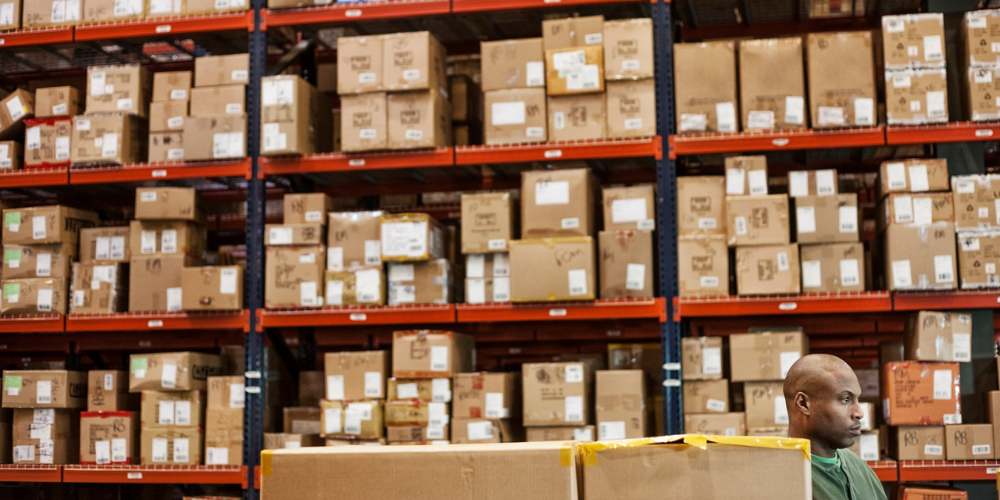
Distributor stock is what the distributor is holding after the manufacturer or brand has supplied it. The distributor sits between the manufacturer and the retail network, and depending on the model, products stay in that warehouse until retailers, wholesalers, van sales teams, or other customers order them. Distributor inventory can run to hundreds or thousands of SKUs, and how much of each one is on hand depends on sales velocity, territory demand, lead time, seasonality, promotions, minimum stock levels, and the distributor's replenishment cycle. A distributor covering a large territory, for instance, might have:
-
1,000 cases of a fast-moving beverage
-
600 cases of a packaged food product
-
250 cases of a personal care SKU
-
100 cases of a slow-moving premium product
Looking at the total inventory value alone does not tell the complete story. The distributor could have a large amount of stock but still be out of inventory for a particular high-demand SKU. That SKU-level gap can directly affect retailer orders and secondary sales.
What Distributor Stock Tells the Sales Team
Distributor stock information can help sales managers answer questions such as:
-
Which SKUs are currently available?
-
Which products are approaching minimum stock levels?
-
Which products are moving quickly?
-
Which products have remained in stock for an extended period?
-
Can the distributor fulfill current retailer orders?
-
Which SKUs require replenishment from the manufacturer?
-
Are distributors carrying the right assortment for their territory?
That picture matters most for planning primary sales and replenishment. If a rep keeps booking orders for a SKU the distributor can't actually supply, the order sits pending or gets substituted, and the retailer waits or loses the sale. Distributor stock, in other words, gives you the upstream view of what's really available.
What Is Retailer Stock?
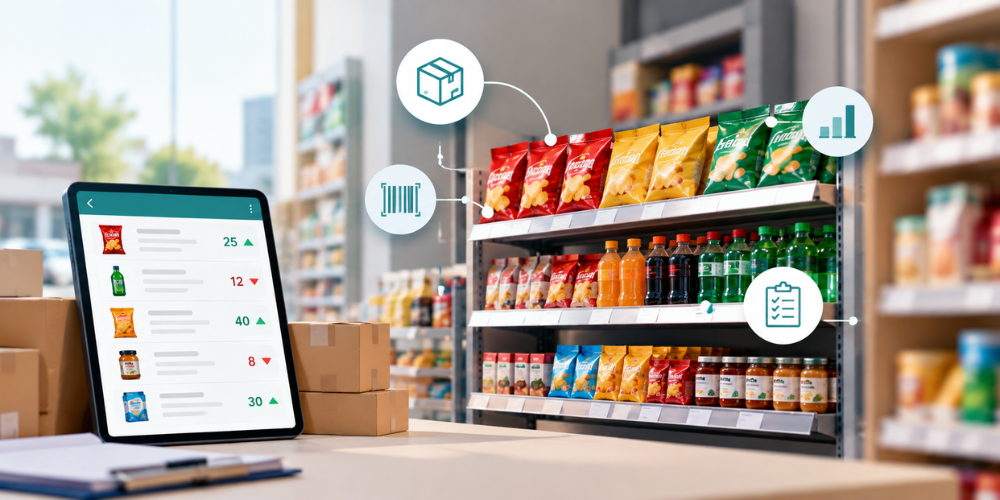
The distributor may have sufficient stock of all three SKUs. However, the replenishment requirement is different for each retailer. Retailer A may need SKU 3 urgently, while Retailer B may need SKU 1. Without retailer-level visibility, the sales team may treat both outlets in the same way.
What Retailer Stock Tells Field Teams
Retailer stock data tells reps and managers which SKUs are on the shelf, which are close to running out, which are selling fast, which are overstocked, which need restocking, which SKUs are missing from the assortment entirely, and where there are distribution gaps or outlets that need more coverage. Field teams can pick this up during regular retailer visits instead of running it as a separate reporting task.
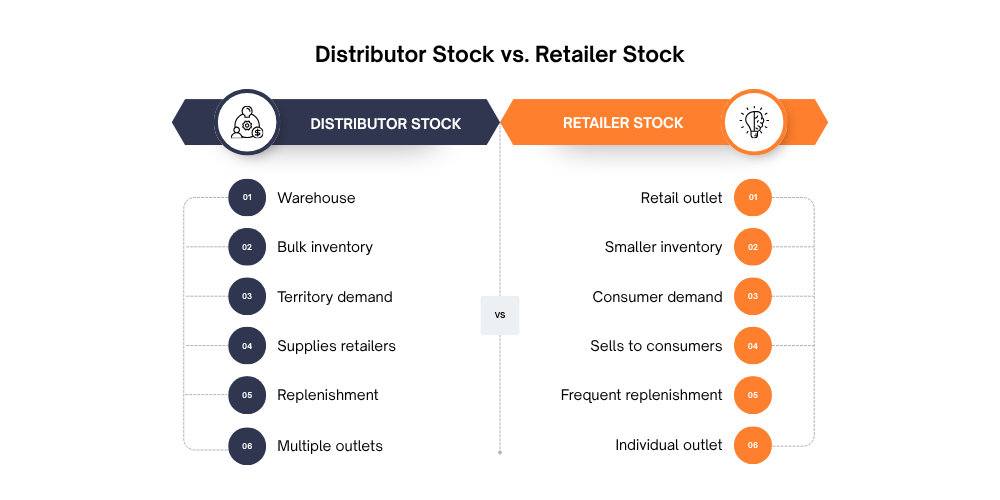
Distributor Stock vs. Retailer Stock
Distributor stock and retailer stock represent different inventory positions within the FMCG distribution network. The key differences can be understood through the following bases:
1. Location
Distributor Stock: Distributor stock is held at the distributor's warehouse or distribution center. It is positioned within the territory so that products can be supplied to retailers, wholesalers, or other customers.
Retailer Stock: Retailer stock is held at the individual retail outlet. It is the inventory available at the point where products are sold directly to consumers.
2. Purpose
Distributor Stock: The primary purpose of distributor stock is to fulfill orders from retailers and other downstream customers. It acts as the available supply for the territory.
Retailer Stock: The purpose of retailer stock is to meet consumer demand. The retailer needs enough inventory to keep products available for shoppers between replenishment visits.
3. Source of Demand
Distributor Stock: Distributor inventory is mainly influenced by retailer orders, secondary sales, territory demand, replenishment cycles, and planned primary purchases from the manufacturer.
Retailer Stock: Retailer inventory is more directly influenced by consumer purchases, outlet traffic, product popularity, seasonality, promotions, and local demand patterns.
4. Stock Movement
Distributor Stock: Products move out of distributor stock when retailers or other customers place orders. The rate of movement depends on the demand across the distributor's entire territory.
Retailer Stock: Products move out of retailer stock when consumers purchase them. Therefore, stock can change much more frequently depending on the outlet's daily sales volume.
5. Inventory Level
Distributor Stock: Distributors generally hold larger quantities because they need to supply multiple retailers within a territory. Inventory is often maintained according to expected demand and replenishment requirements.
Retailer Stock: Retailers usually hold smaller quantities based on their individual sales volume, available storage space, and expected consumer demand.
6. Stockout Risk
Distributor Stock: A distributor stockout means the distributor cannot fulfill retailer orders for a particular SKU. If the product is unavailable at the distributor, multiple retailers may eventually be affected.
Retailer Stock: A retailer stockout occurs when a particular outlet runs out of a product. The distributor may still have sufficient inventory, making the issue primarily a replenishment or field-execution concern.
7. Role in Sales Planning
Distributor Stock: Distributor stock helps sales managers plan replenishment, primary sales, distributor servicing, and SKU availability across the territory.
Retailer Stock: Retailer stock helps field teams determine which outlets need replenishment, which SKUs are moving quickly, and where additional retailer coverage may be required.
8. Monitoring Frequency
Distributor Stock: Distributor inventory can generally be reviewed at a warehouse or territory level to understand overall product availability and replenishment requirements.
Retailer Stock: Retailer inventory often requires more frequent monitoring because individual outlets can experience rapid changes in stock based on daily consumer sales.
9. Impact on Secondary Sales
Distributor Stock: High distributor stock with weak movement can indicate that products are not moving efficiently from the distributor to retailers. This may require a review of territory coverage, retailer demand, or SKU distribution.
Retailer Stock: Retailer stock provides a closer view of actual market movement. Low stock combined with strong sales can indicate a replenishment opportunity, while consistently high stock may indicate slower product movement.
10. Field Sales Relevance
Distributor Stock: Field representatives need distributor stock information to understand whether the products they are ordering for retailers are actually available for fulfillment.
Retailer Stock: Representatives use retailer stock information during outlet visits to identify low-stock products, stockouts, missing SKUs, and immediate order requirements.
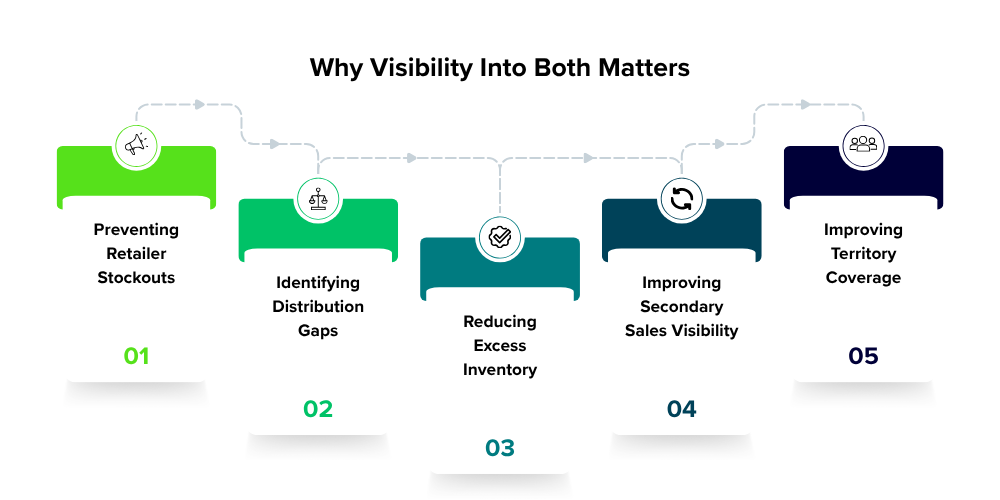
Why Visibility Into Both Matters
Visibility at both levels tells sales managers more than how much stock is out there. It tells them where the stock is sitting and whether it's actually moving. That distinction matters a lot in FMCG, where products turn over fast, and SKU availability has a direct effect on what gets sold at retail.
1. Preventing retailer stockouts
A stockout at the retailer means the consumer can't buy the product, even if plenty of it exists elsewhere in the territory. Say a retailer has two cases of a fast-moving SKU left while the distributor has 200 sitting in the warehouse. That's not a supply problem. It's a chance to replenish before the shelf goes empty if the rep catches the low stock during the visit and books the order in time.
2. Identifying distribution gaps
A product can sit fine in the distributor's warehouse and still barely show up at retailers. Say a distributor carries five products, but only two of them regularly appear across the retailer network. The other three have plenty of warehouse stock but weak market distribution. Sales managers can dig into retailer-level data to find out whether the gap comes from outlet assortment, how the rep is taking orders, weak retailer demand, poor SKU awareness, beat coverage, or distributor execution.
3. Reducing excess inventory
Too much inventory ties up working capital and strains storage. If distributor stock keeps growing while retailer movement stays weak, pushing another primary sales order through only makes it worse. A better move is to set distributor stock against actual retailer movement, which flags the slow-moving SKUs and the territories where inventory needs redistributing or sales execution needs attention.
4. Improving secondary sales visibility
Primary sales track movement from manufacturer to distributor. Secondary sales track movement from distributor to retailer. Watching secondary sales gives FMCG companies a truer picture of what's happening in the market. Strong primary sales with weak secondary sales means distributor inventory is piling up. Strong secondary sales with low retailer stock means replenishment needs to happen more often. Read together, these two numbers say more than either one does alone.
5. Improving territory coverage
Stock visibility is also connected to field-force coverage. A retailer cannot report a stock problem if the representative is not visiting the outlet regularly. When field sales teams use a structured beat plan, managers can identify whether important outlets are receiving the required visit frequency. Route optimization can further help representatives cover more outlets without spending unnecessary time traveling between locations.
How Stock Levels Affect Field Sales and Replenishment
Field representatives play a critical role in connecting retailer demand with distributor supply. During a normal outlet visit, a representative may check stock, review sales, identify missing SKUs, capture an order, collect payment, and record retail execution information. The quality of these activities depends heavily on the information available to the representative. Consider four common situations.
-
Low retailer stock and healthy distributor stock
This usually represents a straightforward replenishment opportunity. The retailer needs the product, and the distributor has sufficient inventory to fulfill the order. The representative can capture the order during the visit and help maintain product availability.
-
Low retailer stock and low distributor stock
This one takes more coordination. The retailer wants the product, but the distributor doesn't have enough. Rather than treating it as one retailer's problem, the sales manager can flag the SKU as something the distributor needs to replenish and feed that into the next primary sales or restocking decision.
-
High retailer stock and high distributor stock
This situation may indicate slow movement or excessive inventory. The sales team should review the SKU's sales velocity before continuing to push additional inventory. The issue could be related to poor demand, incorrect assortment, seasonal changes, or over-ordering.
-
High distributor stock and low retailer stock
And this one points to a distribution or execution gap. The product exists in the territory, but it's not reaching enough outlets. Managers may need to look at retailer coverage, beat plans, how orders are being taken, SKU assortment, or how well the distributor is servicing the area. All three scenarios make the same point: stock visibility needs to connect to field sales data, not sit off to the side as a warehouse-only function.
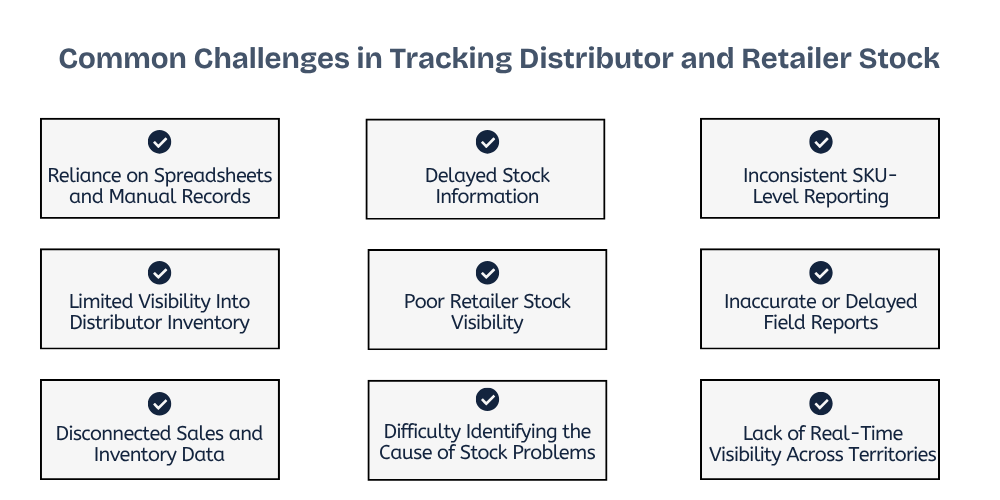
Common Challenges in Tracking Distributor and Retailer Stock
Tracking inventory across distributors and retailers becomes more difficult as the number of territories, SKUs, sales representatives, and outlets grows. When stock information is spread across spreadsheets, manual reports, and separate systems, sales teams may struggle to get an accurate view of inventory at the right time. Common challenges include:
-
Reliance on Spreadsheets and Manual Records
Many distribution networks still rely on spreadsheets, paper records, phone calls, or manually prepared stock reports to track inventory. While these methods may work for smaller operations, they become difficult to manage as the number of distributors, retailers, and SKUs increase. Manual updates can also result in duplicate entries, missing information, or outdated stock figures.
-
Delayed Stock Information
Inventory data is only as good as how current it is. If distributor or retailer stock reports update just once a day, or every few days, field teams end up working off numbers that don't match what's actually on the shelf anymore. That leads to wrong orders, missed replenishment, and stockouts that didn't have to happen.
-
Inconsistent SKU-Level Reporting
Different distributors or reps sometimes record the same SKU under different names, codes, pack sizes, or units. That makes it hard to pull inventory data together and compare stock across territories. Consistent SKU-level tracking is what lets anyone actually tell which products are available, which are selling fast, and which need restocking.
-
Limited Visibility Into Distributor Inventory
Field sales teams may know that a retailer needs a particular product but have limited visibility into whether that product is available at the distributor warehouse. If distributor stock is not updated regularly, representatives may continue collecting orders for products that cannot be fulfilled. This creates a gap between retailer demand and actual supply.
-
Poor Retailer Stock Visibility
Retailer inventory changes continuously as products are sold to consumers. Without regular stock checks, sales teams may not know which outlets are running low, which SKUs are out of stock, or where excess inventory is sitting. This can result in missed sales at high-demand outlets while other retailers continue holding slow-moving products.
-
Inaccurate or Delayed Field Reports
Field representatives often collect information about orders, stock, collections, and retailer visits during their daily routes. When this information is recorded manually and submitted later, important details can be missed or entered incorrectly. Delayed DSR and EOD reporting also makes it harder for managers to respond quickly to stock or coverage issues.
-
Disconnected Sales and Inventory Data
When retailer orders, distributor stock, field visits, collections, and sales reports are maintained in separate systems, it becomes difficult to connect inventory levels with actual sales activity. For example, a manager may see that orders have declined but may not immediately know whether the reason is low distributor stock, poor retailer coverage, or weak demand for a particular SKU.
-
Difficulty Identifying the Cause of Stock Problems
Low retailer stock does not always mean that the distributor has a supply problem. The issue could be missed field visits, poor beat coverage, inaccurate order quantities, slow replenishment, or insufficient distributor inventory. Comparing distributor stock, retailer stock, order history, and field activity helps sales teams identify where the actual breakdown is occurring.
-
Lack of Real-Time Visibility Across Territories
For companies operating across multiple territories, stock conditions can vary significantly from one area to another. One distributor may have excess inventory while another is facing a shortage of the same SKU. Without centralized visibility, managers may struggle to identify these differences and take timely action on replenishment and territory-level inventory planning.

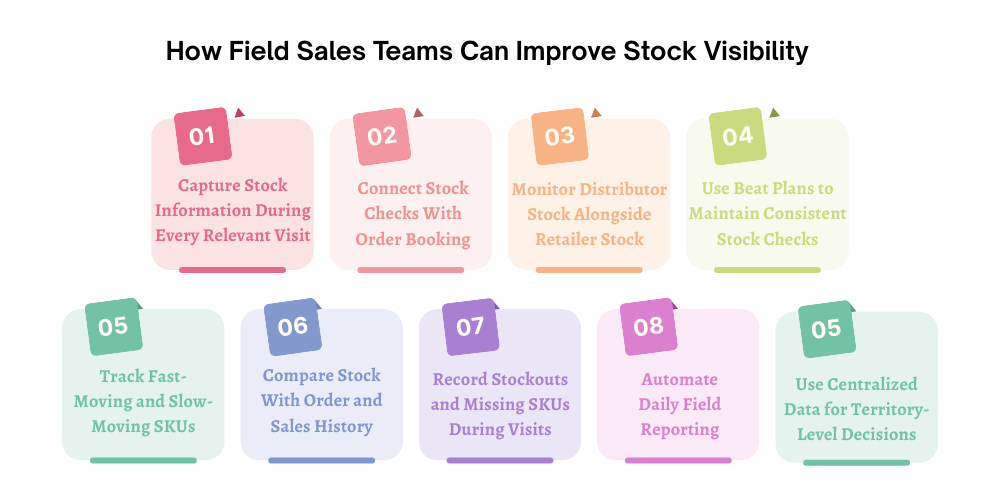
How Field Sales Teams Can Improve Stock Visibility
Field sales representatives are often the closest link between distributors, retailers, and the market. Their daily visits provide valuable information about product availability, retailer demand, and SKU movement. By making stock checks part of the regular sales process and connecting them with orders and field activity, teams can build a more accurate view of inventory across the distribution network.
1. Capture Stock Information During Every Relevant Visit
Sales representatives can record the stock available at the retailer while conducting regular outlet visits. Tracking key SKUs, current quantities, stockouts, and fast-moving products helps create a more current picture of retailer inventory. This also allows representatives to identify replenishment needs before a retailer completely runs out of stock.
2. Connect Stock Checks With Order Booking
Stock information becomes more useful when it directly supports the ordering process. If a representative identifies low stock during a retailer visit, the required quantity can be considered while preparing the next order. Comparing current stock with previous orders and sales movement also helps avoid both under-ordering and unnecessary excess inventory.
3. Monitor Distributor Stock Alongside Retailer Stock
Retailer-level information alone does not show whether products are actually available for replenishment. Field teams should also have visibility into distributor stock for important SKUs. Comparing both levels helps determine whether a retailer needs a routine replenishment order or whether the wider territory is facing a supply shortage.
4. Use Beat Plans to Maintain Consistent Stock Checks
A structured beat plan ensures that important outlets are visited at the right frequency. High-volume retailers or outlets selling fast-moving SKUs may require more frequent visits than low-volume outlets. Linking stock checks with beat planning helps reduce missed outlets and improves consistency in retail execution.
5. Track Fast-Moving and Slow-Moving SKUs
Not every product requires the same level of inventory attention. Field teams can identify fast-moving SKUs that need frequent replenishment and slow-moving products that may be accumulating at retailer or distributor level. This information helps sales managers adjust order quantities, promotions, SKU focus, and territory priorities.
6. Compare Stock With Order and Sales History
Current stock figures provide only part of the picture. Comparing stock levels with previous orders, secondary sales, and outlet-level movement can reveal changes in demand. For example, a retailer carrying low stock despite frequent orders may have strong product movement, while high stock combined with weak sales may indicate a slow-moving SKU.
7. Record Stockouts and Missing SKUs During Visits
Representatives should capture not only available stock but also products that are completely unavailable or missing from the outlet assortment. Repeated stockouts of important SKUs can indicate replenishment problems, weak distributor servicing, or gaps in distribution. Tracking these patterns helps managers address availability issues before they affect secondary sales.
8. Automate Daily Field Reporting
Manual DSR and EOD reports can delay the flow of stock information from the market to sales managers. Digital field reporting allows representatives to record visits, stock observations, orders, collections, and other activities from the field. Managers can then review updated information without waiting for separate reports from each representative.
9. Use Centralized Data for Territory-Level Decisions
Stock visibility becomes more valuable when information from different representatives, retailers, and distributors can be viewed in one place. A centralized system allows sales managers to identify territories with repeated stockouts, weak retailer coverage, unusual inventory levels, or changing SKU demand. These insights can support better replenishment and field-force planning.
Role of Sales and Distribution Software
Sales and distribution management software connects information that is often scattered across representatives, distributors, retailers, spreadsheets, and messaging platforms. The purpose is not simply to replace paper or spreadsheets. It is to connect field activity with sales and distribution decisions. A field sales management platform can provide visibility into several operational areas.
-
Field activity: Managers can review planned and completed retailer visits and understand territory coverage.
-
Orders: Retailer orders can be captured directly during field visits, creating a clearer record of SKU demand.
-
Collections: Payment collections and outstanding amounts can be recorded alongside retailer activity.
-
Retailer information: Customer and outlet information can be maintained centrally rather than across separate files.
-
Distributor activity: Sales teams can monitor activity across distributor territories and connect it with retailer demand.
-
Sales analytics: Managers can compare sales performance across territories, representatives, distributors, and products.
This connected view is particularly useful when investigating stock problems. For example, suppose five retailers in one territory repeatedly report that a particular SKU is unavailable. If the distributor has sufficient inventory, the issue may not be manufacturing or supply. The sales manager can then examine retailer coverage, order history, representative activity, and distribution patterns. That is a much more actionable starting point than simply reporting the SKU as "out of stock."
How Delta Sales App Helps Manage Orders, Stock, Sales Reps, and Retailers
-1791090767.png)
Delta Sales App is designed for FMCG companies, manufacturers, distributors, wholesalers, and other businesses managing field sales teams. The platform connects several activities that take place during the field-sales process, helping teams manage retailers, orders, representatives, collections, and reporting through one system.
-
Distributor and retailer management
Sales teams can organize distributor and party information while maintaining visibility across their customer network. This provides a structured foundation for managing outlet relationships and sales activity across different territories.
-
Field order booking
Representatives can capture retailer orders during visits instead of relying on handwritten notes or end-of-day consolidation. This gives sales managers a clearer view of retailer demand and the products being ordered across the territory.
-
Beat planning and route optimization
Beat planning helps representatives organize retailer visits according to assigned territories and coverage requirements. Route optimization can help reduce unnecessary travel and make daily field schedules more practical. This is particularly useful for teams managing a large number of outlets.
-
GPS-based employee tracking
GPS-based employee location tracking gives managers visibility into field movement and visit activity. This can help verify whether planned field visits are being completed and provide context when reviewing territory coverage.
-
Automated order and collection reporting
Sales representatives often spend considerable time preparing manual reports after completing their fieldwork. Delta Sales App can automate order and collection reporting, giving managers structured information without relying entirely on manually prepared DSRs.
-
Offline-first field functionality
Connectivity can be inconsistent across many field-sales territories. Delta Sales App supports offline-first field operations, allowing representatives to continue recording field activities in areas with weak connectivity and synchronize information when a connection becomes available. This helps reduce the operational impact of poor network coverage.
-
Retail execution
Inventory availability is only one part of outlet performance. Retail execution also involves understanding whether the right products are present, whether visits are being completed, and whether the outlet is being properly serviced. By connecting retailer visits, orders, and field activity, sales managers can get more context around SKU availability and sales performance.
-
Real-time dashboards and analytics
Sales dashboards provide a centralized view of field activity and sales information. Managers can use these insights to review territory performance, representative activity, orders, collections, and other sales indicators. The value comes from connecting these data points.
Conclusion
The difference between distributor stock vs. retailer stock matters because inventory availability at one point in the distribution network does not guarantee product availability at another. Distributor stock provides visibility into inventory available for fulfilling retailer demand. Retailer stock provides a closer view of product availability at the point of sale. Monitoring both helps FMCG businesses identify stockouts, excess inventory, SKU distribution gaps, replenishment requirements, and differences in territory-level demand. For field sales teams, stock visibility becomes more useful when it is connected to everyday activities such as beat planning, retailer visits, order booking, secondary sales, collections, retail execution, and DSR reporting.
Instead of relying on disconnected spreadsheets and delayed updates, sales teams can use field sales software to bring these activities into one workflow. Delta Sales App supports this connected field-sales approach with distributor and retailer management, field order booking, GPS employee tracking, beat planning, route optimization, automated sales and collection reporting, offline-first functionality, retail execution, and real-time sales analytics.
For FMCG companies looking to improve visibility across distributors, retailers, and field teams, book a free demo to see how Delta Sales App can fit into the existing sales and distribution workflow.
-1792906895-resized320.png)