
How Field Sales Managers Can Reduce Rep Workload Without Hurting Productivity

Field sales reps are expected to do more than sell. A typical day can include travelling between outlets, following a beat plan, taking orders, checking distributor stock, collecting payments, handling retail execution, updating customer information, submitting expenses, recording attendance, and preparing a DSR.
None of these activities is unusual on its own. The problem starts when too much time is spent on the administrative work surrounding sales instead of the sales activity itself.
For field sales managers, reducing workload does not mean reducing accountability or lowering sales targets. It means removing repetitive work, unnecessary travel, duplicate reporting, and inefficient processes that consume rep time without improving sales execution.
A rep who spends an extra hour driving between poorly planned visits or manually preparing reports has less time for customer conversations and order generation. The same rep may be able to cover more productive outlets if the territory, beat plan, reporting process, and technology are better organized.
The objective is straightforward: give reps more time for selling without losing the visibility managers need to control field operations. This blog explains where rep workload usually comes from, how managers can identify unnecessary work, and the practical changes that can reduce administrative pressure while protecting productivity.
Why Rep Workload Keeps Growing in Field Sales
Field sales workload rarely increases because of one major decision. It usually grows through small additions to the sales process. A new report is introduced. Another approval is required. More outlets are added to a territory. A new product range increases the number of SKUs reps need to manage. Managers start asking for additional updates because they do not have enough visibility into field activity. Over time, the rep's working day becomes crowded with tasks that compete for the same limited hours. The first step toward reducing workload is understanding where those hours are going.

-
Admin tasks that take time away from selling
Administrative work is necessary in field sales, but excessive manual administration can become a productivity problem. A rep may need to record attendance, update outlet information, enter order details, record collections, submit expenses, prepare a DSR, and send separate updates to the sales manager. The problem becomes more serious when the same information is entered multiple times. If the sales system already captures location, visit timing, and customer activity, asking reps to manually prepare another report containing the same information adds unnecessary workload. Managers should therefore look beyond the number of administrative tasks and examine the amount of manual effort required to complete them.
-
Travel and route inefficiency
Travel is unavoidable for field sales teams, but inefficient travel is not. Poor territory mapping can result in reps spending a significant part of their working day on the road instead of with customers. Consider a rep who has ten outlets to visit. If those outlets are arranged inefficiently across the territory, the rep may travel back and forth between areas several times during the day. Another rep might have a more compact beat and complete a similar number of visits with significantly less travel. This creates an uneven workload even when both reps have the same number of assigned customers. Beat planning should consider outlet location, visit frequency, customer potential, expected order volume, and available working hours. Route optimization can then help determine a more practical sequence for the day's visits.
-
Manual reporting and CRM updates
Reporting is another major source of rep workload. Field sales managers need information about sales, visits, collections, outlet coverage, and target achievement. But that does not mean reps should spend large portions of their day manually preparing this information. A common problem occurs when different systems or communication channels are used for different parts of the sales process. A better process captures field activity as close to the source as possible and automatically makes that information available to managers.
How to decide which work to cut and which to keep
Not every task should be removed simply because reps dislike doing it. Sales teams need accurate information, territory coverage, accountability, and control over orders and collections. The challenge is to distinguish between work that supports sales and work that simply consumes time.
-
Audit how reps spend a typical day
Start with a real day, not a guess about how reps spend their time. Shadow one from the first task to the last report and clock it: travel time, number of visits, average time per outlet, time spent taking orders, collection activity, attendance and reporting, expense submission, internal calls and messages, time waiting on approvals, and time spent just updating systems. This usually turns up things the monthly sales report never shows. One rep might have a perfectly reasonable outlet target and still lose two hours a day to travel because the territory itself was mapped badly. Another rep might have a manageable territory and still spend 45 minutes every evening typing up a manual report. Same symptom, workload is too high, but two completely different fixes.
-
Separate selling activities from support tasks
Once you've mapped the day, split it into two piles: things that need the rep's presence and judgment, and things that just support those things. Customer visits, order management, collections, merchandising, developing new outlets, retail execution, relationship management, and secondary sales- that's fieldwork. Data consolidation, repetitive reporting, some approvals, administrative follow-up, data cleanup- that stuff usually doesn't need the rep standing in a shop to get done.

One question sorts most of it out: does this task require the rep to be in front of the customer? If not, ask whether it can be automated, simplified, or handed to sales ops instead. That doesn't mean stripping every admin task away from the field team. Some data genuinely has to come from the rep, because they're the one standing there. The goal isn't to eliminate that capture. It's to make it fast.
-
Set a productivity baseline before making changes
You need a baseline before you can claim workload reduction actually helped. Track productive visits per day, average travel time, outlet coverage, sales per visit, order conversion rate, average order value, collection value, new outlets opened, SKU coverage, DSR completion time, and target achievement. Say reporting time drops from an hour to fifteen minutes. Good, but that's not proof productivity went up. The real test is what happened to that saved 45 minutes. Did it become more productive visits? Better outlet coverage? Higher order value, stronger collections, cleaner execution? If not, you just moved the time somewhere; you didn't create value with it. Measure workload reduction against sales output and field productivity. Not against how many tasks you crossed off a list.
Practical ways to reduce rep workload
Reducing rep workload does not require removing responsibilities that contribute to sales. The better approach is to remove unnecessary effort around those responsibilities. The following methods focus on cutting repetitive admin work, reducing wasted travel, improving territory balance, and giving reps clearer priorities while keeping managers informed about field performance.
-
Automate visit logging and CRM data entry
Writing down the outlet name, the time, the location, and the activity by hand, and then typing it all in later, is work the rep's phone can already do for them. A field sales management app can pull the visit record straight out of the workflow as it happens. That also cuts down on half-finished reports, since the data gets captured in the moment instead of reconstructed from memory at 9 pm. Managers get better visibility into territory coverage. Reps lose a chunk of repetitive data entry. The principle underneath it: let the field activity itself generates the record. Don't make the rep do the work twice, once in the field and once on a form.
-
Plan beats and routes so reps spend less time driving
A good beat plan does the sequencing so the rep doesn't have to. Instead of handing over a long list of outlets and letting the rep figure out the order on the fly, managers can group outlets into logical beats by geography, customer type, visit frequency, and sales potential. Route optimization tightens it further. This matters most for FMCG teams covering a lot of retailers and distributors, where bad routing adds up fast. A better route creates selling capacity out of nothing. Save a rep 30 minutes of pointless driving a day, and that's 30 minutes that can go to another visit, a collection follow-up, better execution at the shelf, or whatever's actually worth doing.
-
Rebalance territories so no rep carries an uneven load
The outlet count on its own tells you almost nothing about workload. One rep might manage 100 small outlets clustered tight together. Another manages 60, spread across a huge area, several of them high-value accounts that need longer visits. Same number on the org chart, completely different day. Territory balancing has to weigh geographic spread, outlet density, customer potential, visit frequency, travel distance, order volume, collection requirements, and SKU complexity. And managers shouldn't wait for a performance problem to show up before they check whether territories are actually balanced. By then it's already cost someone sales.
-
Prioritize accounts so reps skip low-value visits
Not every outlet earns the same visit frequency. A high-potential retailer might need frequent visits because it's generating real sales or has room to grow its SKU count. A smaller outlet might not need many physical visits at all, depending on its sales pattern and how much it actually matters. Account prioritization is how managers put field capacity where it does the most good, usually by classifying outlets on sales value, growth potential, strategic importance, collection status, and SKU opportunity.
-
Trim reporting requirements to what managers actually use
Managers should go through recurring reports every so often and ask whether each one is still earning its keep. A report nobody reads is burning rep time for nothing. For each one, ask, "Who actually reviews this?" What decision does it feed? Is this information sitting somewhere else already? Could it just generate itself? Does it really need to be daily? Cutting the dead weight also helps data quality elsewhere. Fewer forms means reps can put real care into the ones that actually matter, instead of rushing through all of them equally.
-
Simplify approvals and order processing
Approval delays create workload even when the rep isn't doing anything, just waiting. A tour plan, an expense, a discount, an order exception, and a customer request all need sign-off from someone, and if that happens over a scatter of messages and calls, nobody can track where it actually stands. A digital approval workflow fixes that: submit, review, approve, or reject, all in the same system, with a record of what happened. No more chasing the same approval three times. Order processing works the same way. The closer order capture, validation, and reporting sit to the actual field workflow, the less duplicate work lands back on the rep.
-
Move non-selling tasks to inside sales or ops
Field reps should not automatically be responsible for every task related to a customer. Some activities can be handled by sales operations or inside sales teams. Examples include certain data-cleaning tasks, customer master updates, report consolidation, invoice coordination, and administrative follow-ups. The field team should focus on activities where physical customer interaction matters. This division can also improve accountability because each team knows which responsibilities belong to them.
How field sales software takes work off reps
Field sales software should not simply replace paper forms with digital forms. If a rep has to complete the same ten manual steps in an app that previously existed on paper, the workload has not really been reduced. The value comes from connecting activities and automating information wherever possible.
-
Mobile apps that work with poor connectivity
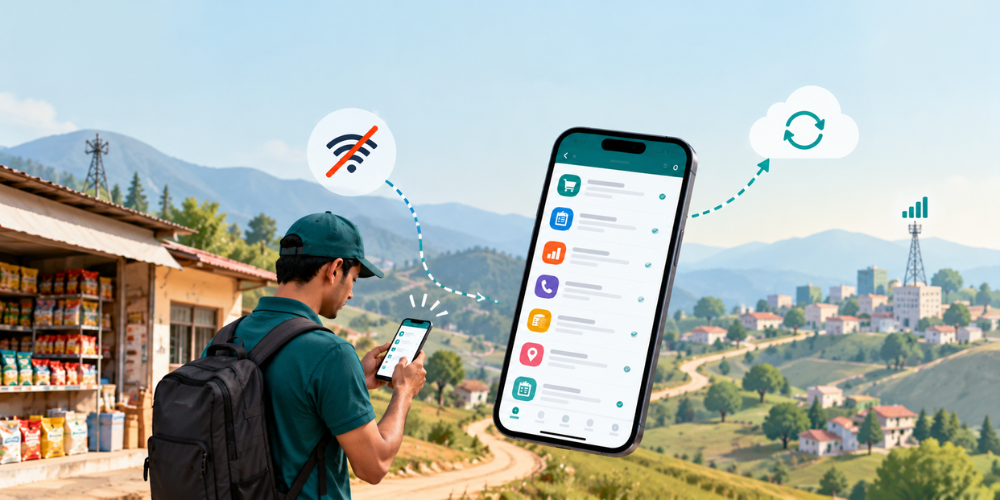
Connectivity is not consistent across every field territory. Reps may work in rural areas, inside warehouses, on highways, or in locations where mobile data is weak. An offline-first mobile application allows essential sales activities to continue without a stable internet connection. Orders can be captured, and relevant field information can be stored on the device, with synchronization taking place when connectivity returns. This prevents reps from maintaining paper records and later re-entering the same information. For field teams working across areas with inconsistent connectivity, offline capability is therefore a workload feature as much as a technical feature.
-
Automatic tracking for attendance, visits, and expenses
Attendance, visits, and expenses are routine processes, but they can create considerable administrative work when handled manually. Automated attendance can reduce the need for separate check-in processes. A GPS-based tracking system can provide managers with field visibility without requiring reps to repeatedly send their location. Expense reporting can also be simplified by allowing reps to record expenses directly from the mobile workflow. The key principle is that tracking should happen alongside normal field activity rather than becoming a separate administrative exercise.
-
End-of-day reports and dashboards that replace manual updates
-1786511268.png)
The DSR matters; managers need to know what happened. But it shouldn't make reps rebuild the whole day from memory at 6 pm. If the system already has the visits, orders, collections, attendance, or whatever else got logged along the way, that data can just assemble itself into dashboards and end-of-day reports. Managers see it without waiting on a spreadsheet. Reps finish the day without an extra hour of typing. Accountability and productivity stop fighting each other.
How Delta Sales App reduces rep workload
Delta Sales App is designed for field sales operations where reps need to manage customer visits, orders, collections, attendance, expenses, and daily execution from the field. The platform brings these activities into one mobile workflow so managers can maintain visibility without relying on constant manual updates.
-
Order taking and payment collection from the phone
Reps can take the order right there in the app during the outlet visit. Payments get recorded from the same phone, tied straight to that customer interaction. For teams running secondary sales, that means order and collection data gets captured in the moment, not rebuilt from memory or a notebook later. Fewer separate records for the rep to juggle. Faster visibility into field transactions for the manager.
-
Beat plans and tour plans with built-in approval
A beat plan tells a rep who to see and when, no guesswork. Tour plans run through the same platform with their own approval workflow, so managers keep control over planned field activity without a running thread of messages back and forth. Less noise between the rep and manager, and a more structured way to plan out territory coverage in the first place.
-
Visit tracking with time spent at each outlet
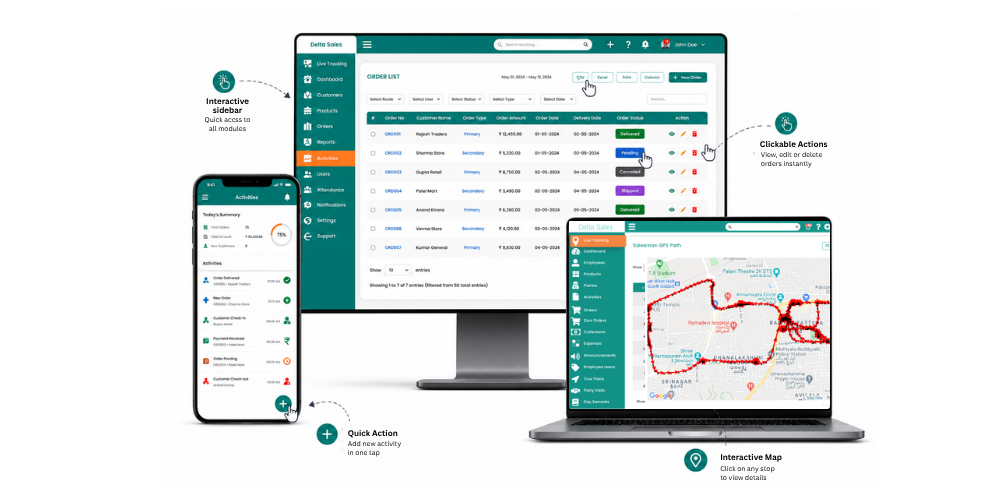
Visit tracking gives managers a direct line into customer coverage and field activity. The system logs the visits and the time spent at each outlet, so managers can see how a rep is actually spending the working day. That's especially useful for weighing territory workload. If one territory keeps eating more travel or visit time than another, managers have real field data behind any decision to rebalance it, not a hunch. For reps, it means they're not constantly reporting their own location or visit status by hand.
-
Auto attendance and expense reporting
Attendance shouldn't be its own separate admin ritual every morning. Automated attendance uses location and field activity to handle check-in and check-out without the rep doing extra work for it. Expense reporting can run the same way, from the phone, as expenses happen, rather than a pile of receipts the rep sorts through at the end of the day trying to remember what each one was for. None of these savings look like much on their own. Add them up over a month, and they're real.
-
One-tap end-of-day reports for managers
Managers want a clear view of the day, and reps shouldn't have to spend half an hour building it for them. Delta Sales App pulls field information together so managers can see daily sales activity, visits, collections, and other execution data straight through reports and dashboards; no manually built DSR is required. That frees up the conversation for what actually matters: performance and exceptions, instead of "Where were you?" and "What did you sell?"
-
Targets and tasks with priorities and deadlines
Workload is a lot easier to manage when a rep already knows what comes first. Targets and tasks let managers set priorities and deadlines in one place and give the rep a structured view of what's actually on their plate, which matters most when several things need doing at the same outlet visit. No more scattered reminders and messages. The tasks just live inside the field sales workflow where the rep already is.
Mistakes managers make when reducing workload
Workload reduction can backfire if managers remove the wrong activities or introduce technology without considering the complete sales process.
-
Removing tracking without replacing visibility
The simplest way to cut reporting workload is to just stop asking for reports. That creates a worse problem, though, because managers still need to know whether the beat got covered, whether the important outlets got a visit, whether orders were booked, and whether collections happened. The fix isn't less visibility. It's less manual work to produce it. Automated location, visit, order, and attendance data gives managers what they need without a rep having to narrate it to them.
-
Adding tools that create more work than they save
More tools doesn't automatically mean less work. One app for attendance, another for CRM, another for expenses, another for route planning, and another for reporting- that's five logins and five places to look, and the tech stack itself becomes the new source of admin pressure. The question isn't whether a tool has a feature. It's whether that feature cuts the total number of steps it takes to get the job done. A connected field sales platform usually beats five disconnected ones for exactly that reason: customer, visit, order, collection, and reporting data all stay in one place instead of five.
-
Treating every rep and territory the same
Standardization helps right up until you treat every territory the same and create a workload that doesn't need to exist. Territories differ in customer density, travel patterns, sales potential, and outlet mix. An urban rep might reasonably cover far more outlets in a day than one working a spread-out rural territory. A territory full of high-value distributors eats more time per customer than one full of small retailers. Workload planning has to account for that. The goal was never equal activity across every territory. It's a workload each rep can actually execute well.
Conclusion
Reducing rep workload is not about doing less. It is about removing unnecessary admin work, inefficient travel, duplicate reporting, and manual processes that take time away from selling. Better beat planning, territory management, account prioritization, and field sales automation can help reps spend more time with customers while managers maintain the visibility they need.
The right approach starts with understanding where rep time is actually going. Managers can then simplify reporting, improve beat and route planning, rebalance territories, prioritize high-value outlets, and automate routine activities such as attendance, visit tracking, expenses, orders, and end-of-day reporting.
Field sales software can make these changes easier by connecting daily sales activities in one workflow. Instead of reducing visibility to reduce workload, managers can use automation to maintain visibility while giving reps fewer manual tasks to complete.
For FMCG companies, distributors, manufacturers, and wholesalers, the result is a more focused field team, better territory coverage, and more productive selling time without sacrificing accountability.
Ready to reduce administrative work and give field reps more time to sell? Book a free demo of Delta Sales App and see how field sales automation can simplify daily operations.