
How to Track Sales Rep Performance in Industrial Distribution

Industrial distribution sales depend on more than the number of orders a rep closes. Reps manage repeat accounts, visit dealers and industrial customers, prepare quotations for technical products, follow up on long buying cycles, and work with inside sales teams to turn opportunities into revenue. A rep might close fewer orders in a given week and still protect several high-value accounts or move a large quotation closer to approval.
Without a structured tracking process, those contributions are hard to measure. Managers see monthly revenue figures but lack what they'd need to explain missed targets, declining account activity, uneven territory coverage, or delayed follow-ups.
Good sales rep performance tracking ties field activity to pipeline progress, customer relationships, and actual sales results. It shows industrial distributors what each rep is really achieving, where opportunities are slipping away, and which actions would improve performance.
This blog explains the metrics to monitor, the steps to build a reliable tracking process, and how field sales tracking software can help industrial distributors manage representatives and territories more effectively.
Why Tracking Sales Rep Performance Is Different in Industrial Distribution
Industrial distribution has a different sales cycle from high-volume consumer sales. Representatives often work with manufacturers, contractors, maintenance teams, procurement departments, dealers, and industrial buyers. Orders may depend on technical specifications, product availability, project schedules, negotiated pricing, and approval from several stakeholders. Performance tracking must account for these conditions instead of relying exclusively on daily order counts or monthly revenue.
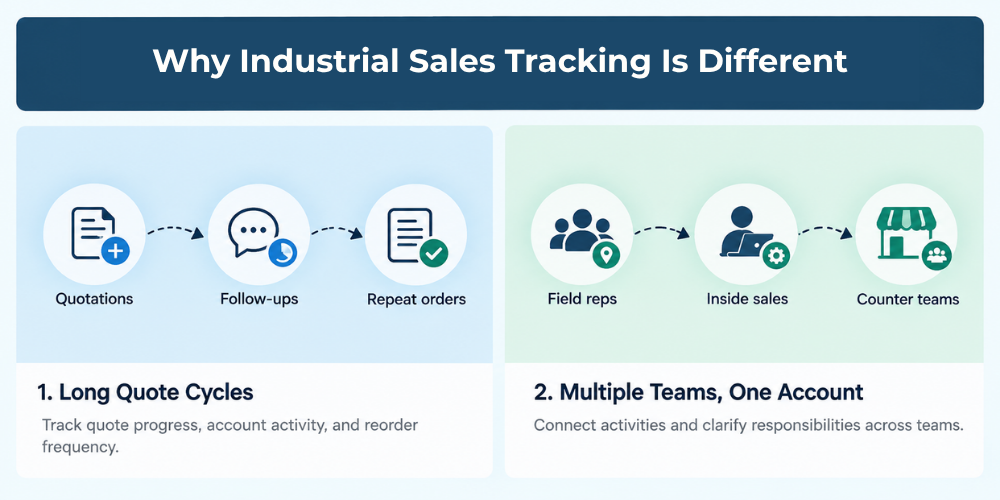
1. Long Quote Cycles and Repeat-Account Revenue
Industrial products such as pumps, bearings, electrical components, and machinery parts often require detailed quotations, technical discussions, and multiple follow-ups before an order is confirmed. Tracking quotation progress and follow-up completion helps managers understand whether opportunities are moving forward. Repeat-account revenue, reorder frequency, and account activity also reveal how effectively representatives maintain existing customer relationships.
2. Field Reps, Inside Sales, and Counter Teams Working One Account
Industrial distribution often has several employees serving the same customer. A field rep spots an opportunity, an inside sales executive prepares the quotation, and a counter team processes an urgent order. Warehouse and procurement teams can also decide whether the transaction actually closes. When each team records its activity separately, managers struggle to tell which actions contributed to the sale.
Performance tracking should define responsibilities clearly. Field reps can be judged on customer visits, account development, and opportunity follow-up. Inside sales teams can be measured on quotation turnaround and follow-up efficiency. Counter teams can be assessed on order processing and customer service. Shared account records let managers see the whole sales process without crediting the same revenue or activity to more than one person.
Which Sales Rep Performance Metrics Should You Track?
The most useful sales rep performance metrics connect daily activities to commercial outcomes. Industrial distributors should choose measures that reflect their sales model, product complexity, account structure, and representative responsibilities.
-
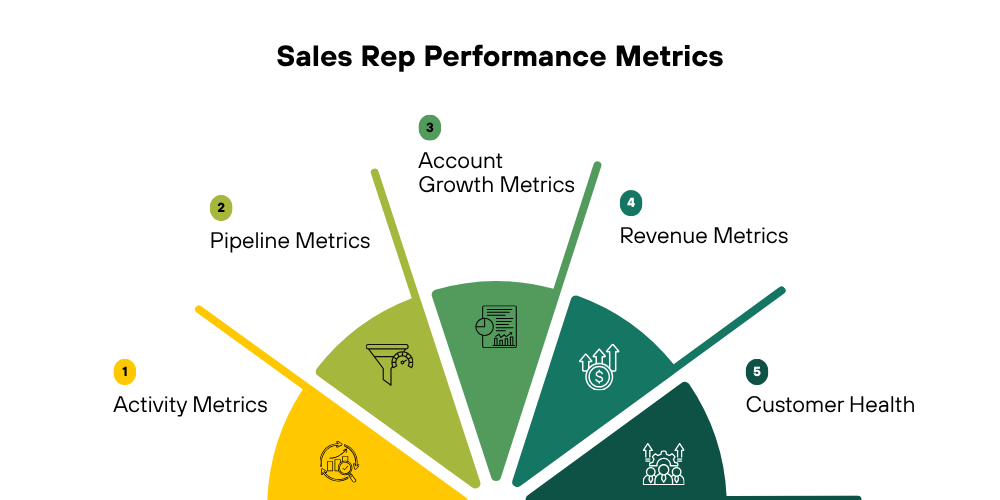
Activity Metrics: Customer Visits, Calls, and Quotes Sent
Activity metrics show whether representatives are completing the work needed to generate sales and maintain customer relationships. Monitor planned versus completed visits, follow-up calls, quotations sent, and overdue customer interactions. Compare these figures with territory potential and account priorities to distinguish productive activity from visits that generate little commercial progress.
-
Pipeline Metrics: Quote-to-Order Rate, Win Rate, and Sales Cycle Length
Pipeline metrics reveal how effectively representatives convert opportunities into orders. The quote-to-order rate measures how many quotations result in sales, while the win rate tracks the proportion of qualified opportunities won. Sales cycle length shows how long opportunities take to close. Reviewing these measures by product category and customer type helps identify conversion problems, delayed decisions, and follow-up gaps.
-
Account Growth Metrics: Wallet Share, Reorder Rate, and Product Line Penetration
Account growth metrics show whether representatives are expanding existing customer relationships. Reorder rate indicates how consistently customers purchase again, while product line penetration measures how many relevant product categories an account buys. Wallet share estimates the portion of a customer's relevant spending captured by the distributor. Together, these indicators help identify cross-selling opportunities and accounts with untapped potential.
-
Revenue Metrics: Quota Attainment, Gross Margin per Rep, and Average Order Value
Quota attainment compares actual sales with assigned targets, while gross margin per rep measures the profitability of sales generated. Average order value indicates the typical value of completed orders. Reviewing these metrics together helps managers identify representatives who generate profitable business and those whose revenue targets may depend on excessive discounts or a small number of large transactions.
-
Customer Health Metrics: New Account Acquisition, Churn, and Reorder Gaps
Customer health metrics help managers identify whether territories are gaining customers or losing existing business. Track newly active accounts, lost customers, and accounts that have missed their usual reorder dates. Investigating these changes early allows representatives to address customer concerns, check product availability, and follow up before declining activity affects long-term revenue.
How to Track Sales Rep Performance Step by Step
A consistent tracking process starts with clear expectations and reliable data. The following steps help industrial distributors turn field activity into actionable performance insights.
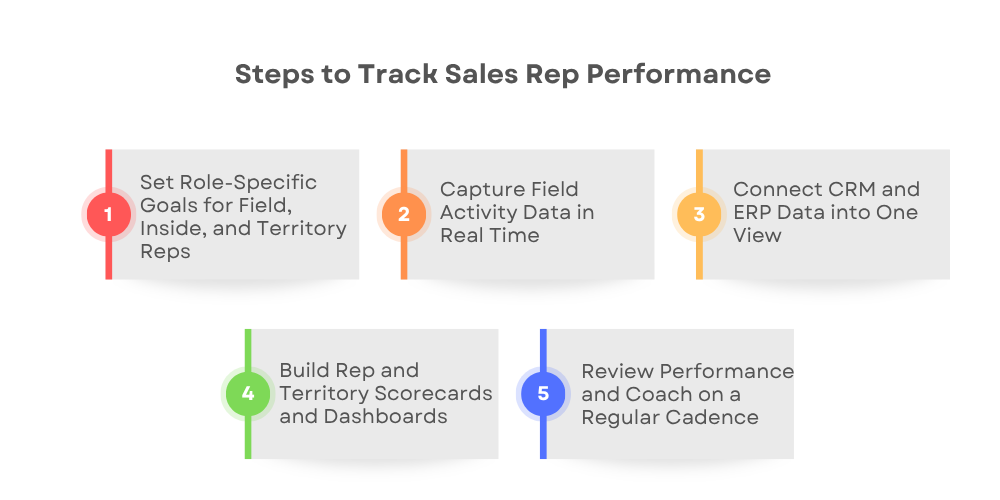
Step 1: Set Role-Specific Goals for Field, Inside, and Territory Reps
Define targets according to each role's responsibilities. Field representatives may focus on customer visits, account development, and territory coverage, while inside sales teams may be measured on quotation turnaround and follow-up completion. Adjust targets for travel distances, account potential, and sales cycle length so performance expectations remain realistic.
Step 2: Capture Field Activity Data in Real Time
Record customer visits, check-in times, visit outcomes, orders, and follow-up commitments through a mobile system. Capturing information immediately reduces forgotten details and gives managers a more accurate view of daily field activity. Offline functionality is especially useful when representatives visit remote industrial customers with unreliable connectivity.
Step 3: Connect CRM and ERP Data into One View
CRM systems typically hold customer interactions and pipeline information, while ERP systems provide order, invoice, and inventory records. Connecting these sources helps managers link representative activity with actual commercial outcomes. Consistent customer IDs, product codes, and reporting periods reduce duplication and make performance comparisons more reliable.
Step 4: Build Rep and Territory Scorecards and Dashboards
Create scorecards that combine sales targets, gross margin, customer visits, quotation conversion, and account activity. Individual dashboards help representatives understand their progress, while territory-level reports highlight missed coverage and declining sales trends. Historical comparisons can reveal problems that current-period revenue figures alone may overlook.
Step 5: Review Performance and Coach on a Regular Cadence
Review field execution daily, pipeline progress weekly, and commercial results monthly. Focus discussions on significant changes, missed opportunities, and obstacles affecting performance rather than reviewing every number individually. Agree on practical next steps and revisit them during the next meeting to measure whether coaching has improved results.
How to Track Field Sales Reps Visiting Customer Sites
For industrial distributors with outside sales teams, field visibility is an important part of performance management. Representatives may visit factories, workshops, dealer outlets, contractor sites, and maintenance facilities throughout the day.
Managers need to understand where planned visits are happening, whether priority accounts are receiving attention, and what commercial outcomes follow those interactions.
-
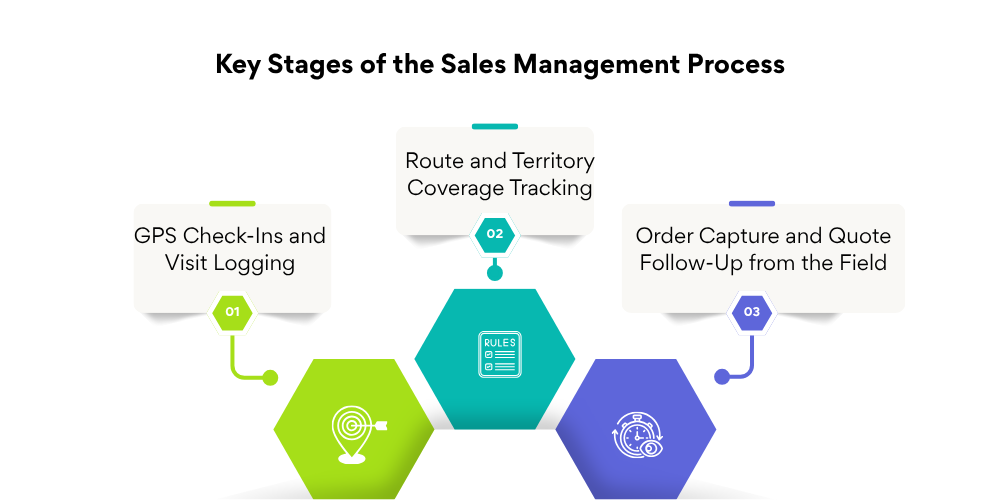
GPS Check-Ins and Visit Logging
GPS check-ins help record when representatives arrive at customer locations, while visit logs capture timing, outcomes, and follow-up requirements. These records help managers compare reported activity with planned visits and identify incomplete records. Combining location information with visit outcomes provides a more useful picture of field performance than location tracking alone.
-
Route and Territory Coverage Tracking
Compare planned routes with completed visits to identify missed accounts, unnecessary travel, and uneven territory coverage. Beat plans organized by geography, customer priority, and visit frequency help representatives allocate their time more effectively. Managers can then adjust routes or account assignments to improve coverage without increasing travel unnecessarily.
-
Order Capture and Quote Follow-Up from the Field
Mobile order capture allows representatives to record customer orders during or immediately after visits, reducing delays in order processing. Structured follow-up records also help managers monitor outstanding quotations and customer commitments. For technical or high-value products, representatives should be able to record requirements and track the next step in the quotation process.
What to Look for in a Sales Performance Tracking Tool
Industrial distributors should evaluate software according to how well it supports their actual field operations, reporting requirements, and existing sales systems.
-
Mobile and Offline Access for Reps in the Field
Representatives need to access customer records, record visits, update follow-ups, and capture orders without depending on a desktop computer. Offline-first functionality is especially helpful when visiting industrial customers or places where mobile connectivity is unreliable. Make sure the system can save records offline and sync them reliably once the connection comes back. The mobile interface should also reduce the need for data entry. A tool that is hard to use during customer visits may lead to lower adoption and lower quality performance reports.
-
ERP and CRM Integration
Find a way to link field activity with customer records, quotation records, order records, and financial records. Check which integrations are available, what data can be synced, how often syncing happens, and which system is the source of truth for each record. If there is no integration, see whether the software allows an export, import, or reporting workflow that works. A good setup cuts down on reconciliation and lets managers see how field activity relates to real business results.
-
Real-Time Reporting and Territory-Level Visibility
Managers should be able to review field activity, sales progress, and territory coverage without waiting for representatives to compile individual spreadsheets. Evaluate whether dashboards support filtering by rep, region, account, date, and relevant performance indicators. Check whether reports distinguish completed visits from planned visits and whether sales figures can be reconciled with the company's source systems. Real-time reporting is most useful when it leads to timely action. Managers should be able to identify overdue follow-ups, missed priority accounts, and declining territory performance before these issues become larger problems.
How Delta Sales App Helps You Track Sales Rep Performance in Industrial Distribution
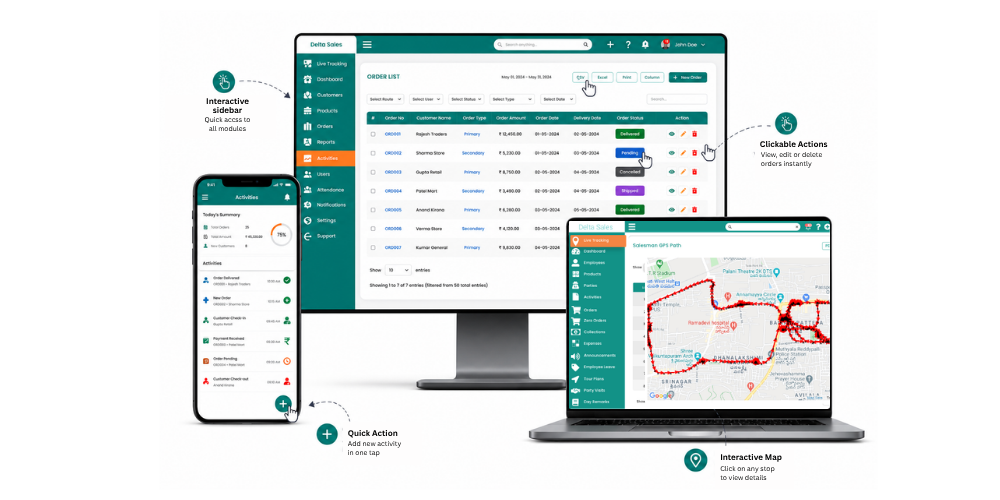
Delta Sales App supports field sales operations through mobile activity tracking, GPS-based employee location tracking, beat planning, order management, attendance management, and sales reporting. These capabilities can help industrial distributors establish more consistent field processes and improve visibility into representative activity. The most suitable setup depends on how the distributor manages quotations, ERP records, customer accounts, and sales targets.
-
Real-Time Visit Logging, GPS Check-Ins, and Route Tracking
Delta Sales App helps managers monitor field employee locations and record field activity through GPS-based tracking and visit management capabilities. These records can provide visibility into customer visits, representative movements, and execution against planned field activities. For industrial distribution teams, this supports more structured territory coverage. Managers can identify missed visits, review activity against beat plans, and determine where route adjustments may improve customer access. Visit records are most useful when combined with customer outcomes and follow-up requirements. This gives managers a more complete view of how field activity contributes to account development.
-
Order and Quote Capture from the Customer Site
Delta Sales App helps representatives to book orders on their phones. Keep track of sales activities right when they happen. For distributors this means less reliance on end‑of‑day spreadsheets and better insight into orders made during customer visits. When connectivity is weak, the offline mode lets representatives still record their work. Quotation preparation and approval might still live inside a CRM, ERP, or pricing system depending on how the distributor is set up. Make sure to check the needed quotation features and the integrations that are available before choosing a configuration.

-
Rep and Territory Dashboards for Managers
Sales reporting and dashboards help managers review representative activity and understand field execution across territories. Instead of relying exclusively on verbal updates, managers can use recorded activity and sales information to identify gaps that need attention. For example, a manager can investigate whether low sales coincide with missed priority visits, incomplete follow-ups, or weak account coverage. Comparing field activity with available order and collection reports can also help reveal where additional analysis is needed. These insights support more focused coaching, better territory planning, and clearer accountability across the field team.
-
ERP and CRM Integration for One View of Rep Performance
Industrial distributors usually keep customer data, inventory details, quotes, and financial records in systems. Putting all this information together helps managers see how sales reps’ work ties into business results. Before using the Delta Sales App check how it fits with your tech setup. Make sure any needed ERP or CRM integrations are available. If direct syncing isn’t possible, you might need to set up a shared reporting process. Having a consistent view of what sales teams are doing, with customer accounts and sales outcomes, helps leaders judge performance more fairly. It also makes it easier to spot areas where things can get better.
Conclusion
Tracking sales rep performance in industrial distribution requires more than monitoring monthly revenue or counting customer visits. Managers need to understand how representatives develop accounts, progress quotations, maintain repeat business, protect gross margins, and cover their assigned territories.
Start with role-specific targets, capture field activity consistently, connect it with reliable sales records, and build scorecards around a manageable number of meaningful metrics. Regular coaching then helps turn those reports into practical improvements. For distributors managing outside sales teams, sales rep performance tracking can bring greater visibility to field execution and help managers identify problems before they affect long-term account growth.
Delta Sales App can support this process through GPS-based employee tracking, visit management, beat planning, mobile order reporting, and sales reporting. Book a personalized demo to explore how Delta Sales App can support field sales operations and territory visibility for an industrial distribution team.