
Do In-Store Promoters Need a Beat Plan, or Are They Fixed to One Store?
In retail execution, clarity is power. There’s a famous saying in operations:
“What you don’t define clearly, you can’t execute consistently.”
And nowhere is this more relevant than in managing in-store promoters. Across FMCG, electronics, and retail brands, one question comes up again and again:
Do in-store promoters need a beat plan like sales representatives, or are they meant to work from a single store every day?
The answer isn’t black and white, but it is logical. Most in-store promoters are fixed to one store, yet certain business models demand movement, planning, and routing. Understanding when a beat plan is necessary and when it isn’t can dramatically improve execution quality, promoter productivity, and return on investment. Let’s break it down clearly.
What Is an In-Store Promoter?
An in-store promoter is a brand-appointed representative who is stationed inside a retail outlet to influence purchasing decisions at the exact moment a customer is ready to buy. Unlike field sales teams, which operate across multiple outlets and focus on distribution expansion, in-store promoters work within the four walls of a store. An in-store promoter is typically deployed inside a retail outlet to:

-
Engage shoppers and demonstrate products
Promoters actively approach customers, learn about their needs, and explain how a product meets those needs. They help customers transition from curiosity to confidence by providing live demonstrations, feature explanations, and hands-on trials.
-
Push ongoing schemes and offers
Retail environments change quickly; prices, discounts, and promotions are frequently rotated weekly or even daily. In-store promoters play an important role in communicating current offers clearly. This real-time communication enables brands to maximize scheme effectiveness, while retailers benefit from faster stock movement and increased basket value.
-
Improve product visibility and shelf presence
Promoters ensure that products are displayed as per brand guidelines, shelves are well-stocked and organized, and POS materials are correctly placed. Promoters serve as the brand's eyes on the shelf, identifying issues such as missing stock, misplaced SKUs, and poor visibility. Strong shelf presence directly correlates with higher pickup rates, particularly in high-traffic stores.
-
Capture consumer feedback
In-store promoters are often the first to hear what customers think. Promoters gather valuable insights such as reasons for purchase or rejection, pricing sensitivity, and feedback on taste, packaging, or features. They also compare competitors. This feedback allows brands to fine-tune messaging, pricing strategies, and future product improvements, making promoters an important source of ground-level market intelligence.
-
Support secondary sales
While promoters do not sell directly to retailers, their efforts have a significant impact on secondary sales made between retailers and end users. Promoters can boost product awareness, availability, and buyer confidence at the point of purchase. Increase product demand, reduce dead stock, and promote faster inventory turnover. Their influence ensures that products don't just sit on shelves but move.
Do In-Store Promoters Have a Beat Plan?
Whether an in-store promoter requires a beat plan is entirely dependent on how their role is structured and where they work. Unlike field sales representatives, who are responsible for territory coverage and outlet visits, promoters are assigned to influence consumer decisions in retail environments. The need for a beat plan varies according to promoter type. Let’s look at the most common models and how beat planning applies to each:
1. Fixed Store Promoters (Most Common Model)
Fixed store promoters are the most common promoter model in the FMCG and modern trade industries. These promoters are assigned to a single retail outlet and work from the same location on a daily or predetermined schedule. Over time, they become acquainted with store personnel, product placement, and typical customer behavior, allowing them to consistently influence sales within that outlet.
Because their work is limited to a single store, no beat plan is required. Attendance is linked directly to the store, and performance is measured using store-level KPIs such as sales uplift, sampling conversions, shelf visibility, and stock availability. This model is commonly seen in large-format modern trade stores, high-footfall outlets, and premium or focus SKU counters—where continuous in-store presence delivers maximum impact.
2. Roving or Multi-Store Promoters
Roving promoters are deployed when brands want to optimize resources across multiple nearby outlets. Instead of being fixed to one store, these promoters cover a cluster of 2 to 5 stores, visiting each location on specific days or within defined time slots. Their role involves balancing consumer engagement with basic visibility checks and store-level reporting.
In this scenario, a light beat plan or route plan is required. The beat plan ensures that promoters visit the right stores at the right times, stay disciplined in their coverage, and submit accurate store-specific reports. This model is frequently used in Tier 2 and Tier 3 cities, pharmacy or cosmetic chains, and pilot launches in which store density is high but full-time deployment per store is not feasible.
3. Weekend or Activation Promoters
Weekend or activation promoters are used for short, high-impact events like weekends, festivals, and special in-store campaigns. Their primary focus is on activities such as product demonstrations, sampling, and communicating limited-time offers in order to maximize consumer engagement during peak traffic periods.

These promoters typically work in one high-traffic store per day, with specific objectives for that location. There is no expectation of multi-store coverage in a single day, so a beat plan is unnecessary. Tracking is best accomplished through store-based attendance and activity reports.
4. Promoter + Merchandiser Hybrid Role
Weekend or activation promoters are used for short, high-impact events like weekends, festivals, and special in-store campaigns. Their primary focus is on activities such as product demonstrations, sampling, and communicating limited-time offers in order to maximize consumer engagement during peak traffic periods.
These promoters typically work in one high-traffic store per day, with specific objectives for that location. There is no expectation of multi-store coverage in a single day, so a beat plan is unnecessary. Tracking is best accomplished through store-based attendance and activity reports.
Summary: Beat Plan vs Fixed Location
|
Promoter Type |
Beat Plan Required |
Store Coverage |
|
Fixed in-store promoter |
No |
Single store |
|
Roving promoter |
Yes |
Multiple stores |
|
Weekend/activation promoter |
No |
Single store |
|
Promoter and merchandiser |
Yes |
Multiple stores |
How Brands Should Track In-Store Promoters
Tracking in-store promoters effectively does not require a one-size-fits-all approach. The key is to tailor the tracking method and technology to each promoter role. Fixed-store promoters, roving promoters, weekend activators, and hybrid promoter-merchandisers all have distinct responsibilities, and expecting them to use the same tracking rules as field sales executives can lead to confusion, poor adoption, and inaccurate data.
To ensure effective execution, brands should:
-
Assign store-level attendance for fixed promoters
Attendance tracking for promoters assigned to a single store should be specific to the location. They must check in and out of the store to ensure accountability and keep accurate work logs. Because fixed promoters do not cover multiple stores, they should prioritize activity quality over route coverage.
-
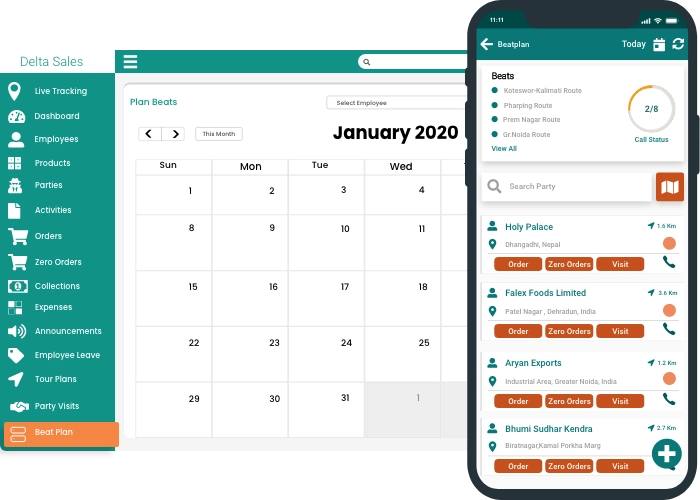
Enable beat plans only for roving promoters
Roving promoters and hybrid promoter-merchants necessitate more structured tracking because they visit multiple stores per day. For them, a light beat plan or daily route plan is essential. The tracking system should record the stores visited, the time spent at each location, and any activities carried out, such as product demonstrations, sampling, or merchandising tasks.
-
Track:
Beyond attendance, brands should focus on key performance metrics that truly reflect promoter impact:
-
Sales Contribution: Track the direct or indirect sales increase caused by promoter activities, such as increased offtake or promotional product movement.
-
Stock Availability: Ensure that shelves are stocked and critical SKUs are not out of stock, which will reduce lost sales opportunities.
-
Shelf Visibility and Photo Compliance: Document visual proof of proper product placement, brand visibility, and in-store activation compliance.
-
Consumer Interactions and Feedback: Analyze shopper engagement, queries, and feedback to improve brand strategy and in-store effectiveness.
Conclusion
In-store promoters are not field sales representatives, and the majority of them do not require a beat plan. Treating them as fixed-location resources improves execution, clarifies KPIs, and increases ROI. Beat plans should only be used when promoters are expected to cover several outlets. In-store promoters make the difference between a product that just sits on the shelf and one that truly sells. Fixed promoters focus on one store, while roving and hybrid roles need a clear plan to ensure no outlet is missed.
Brands looking to track fixed and roving in-store promoters efficiently can use tools like Delta Sales App to assign store-based attendance, enable beat plans, and capture real-time KPIs such as sales contribution, shelf visibility, and consumer interactions. The right combination of planning, role clarity, and technology ensures promoters stay productive, engaged, and accountable, delivering real impact where it matters most.