
10 Leading Sales Force Automation (SFA) Tools for 2026
Managing a field sales team involves far more than tracking monthly revenue. A sales manager may need to know which retailers were visited today, whether representatives followed their assigned beat plan, how many orders were booked, which payments were collected, how much time was spent travelling, and whether important outlets were missed. When this information is collected through spreadsheets, phone calls, WhatsApp messages, and manually prepared Daily Sales Reports, getting a clear picture of field performance becomes difficult.
This is where Sales Force Automation Software becomes useful.
SFA platforms bring routine sales activities into a centralized system. Instead of asking representatives to separately report attendance, customer visits, orders, collections, expenses, and end-of-day activity, businesses can capture these activities through a connected field-sales workflow.
For FMCG companies, distributors, wholesalers, and manufacturers, the requirements are even more specific. A useful SFA platform needs to support beat planning, territory coverage, retailer visits, SKU-level order booking, distributor management, secondary sales, field attendance, GPS tracking, and reporting. It also needs to be simple enough for representatives to use throughout a busy day in the field.
There are many sales automation platforms available in 2026, but they are not all designed for the same operating model. Some are broad CRM platforms, while others focus specifically on field sales and distribution.
This blog looks at 10 leading Sales Force Automation (SFA) tools for 2026, beginning with Delta Sales App and then covering other established platforms.
What Is Sales Force Automation (SFA)?
Sales Force Automation (SFA) refers to software that automates and organizes repetitive sales activities so sales teams can spend less time on administration and more time managing customers and revenue opportunities. For field sales teams, SFA usually covers activities such as:
-
Customer and outlet management
-
Sales order booking
-
Customer visit tracking
-
Beat and territory planning
-
GPS-based field tracking
-
Attendance management
-
Collection tracking
-
Expense management
-
Retail execution
-
Sales reporting
-
Distributor management
-
Sales analytics
For an FMCG organization, this can connect the full field workflow. A sales representative starts the day with a planned beat, visits retailers, checks stock, places orders, records collections, captures relevant outlet information, and submits the day's activity. The sales manager can then review coverage, productivity, orders, collections, and exceptions without waiting for manually prepared reports.
10 Sales Force Automation Tools to Consider in 2026
The right Sales Force Automation platform depends on the size of your field team, the complexity of your sales territories, and how much of your daily sales workflow you want to automate. An FMCG distributor managing hundreds of retailers, for example, may have very different requirements from an enterprise sales organization managing long sales cycles and large customer accounts.
The tools below cover a range of Sales Force Automation and field sales requirements, from CRM-based sales automation to dedicated platforms for field teams and distribution businesses. We have looked at capabilities such as field tracking, beat planning, order management, customer visits, reporting, mobile usability, offline functionality, and sales analytics, with particular attention to the needs of businesses that manage sales representatives outside the office.
1. Delta Sales App
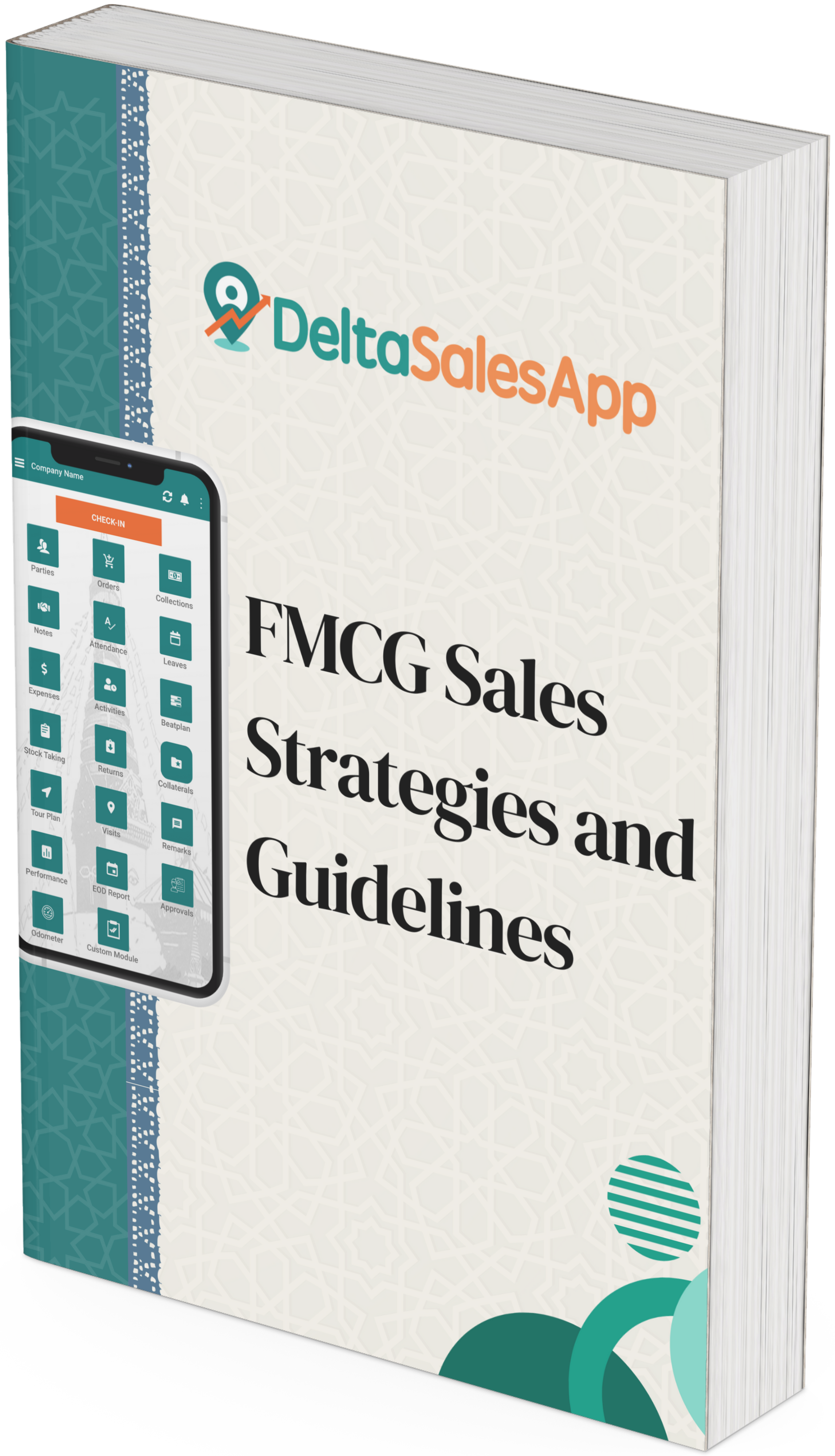
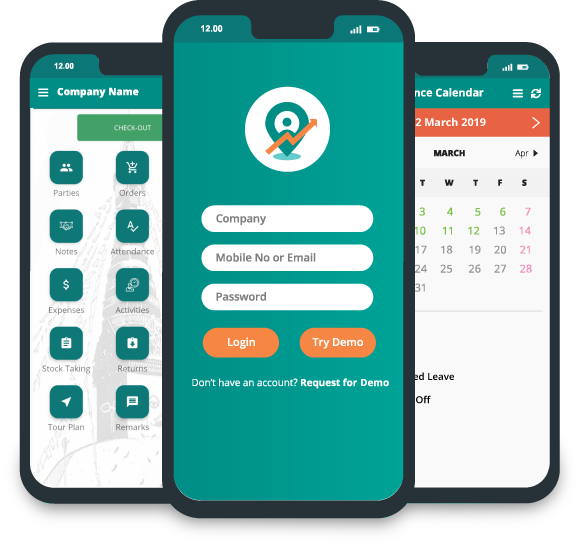
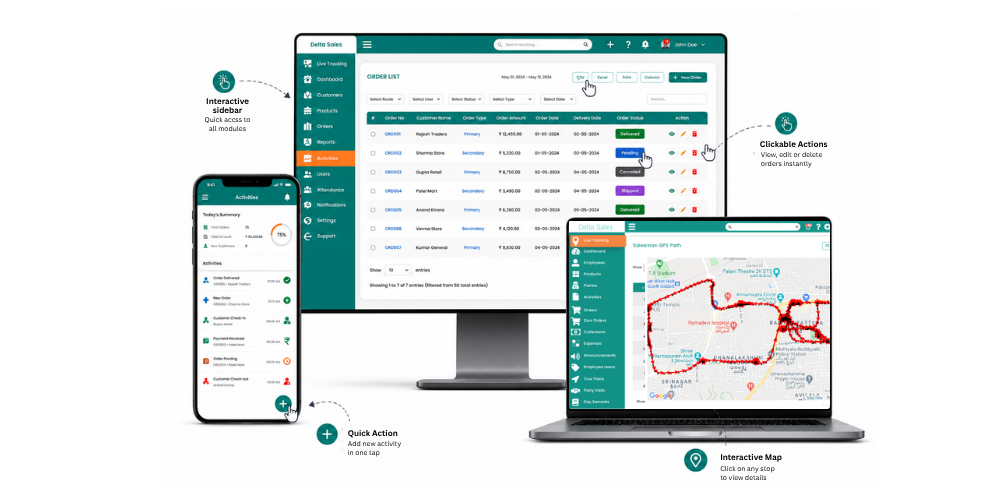
Delta Sales App is a leading field-first sales force automation platform designed for companies that manage sales representatives across territories, distributors, retailers, and other customer locations. For FMCG companies and distribution-led businesses, the important distinction is that field activity is treated as the core workflow rather than an add-on to a conventional CRM. Sales managers can manage beat plans, customer visits, orders, collections, attendance, expenses, routes, and field activity from one platform.
What Delta Sales App offers
The platform brings together several operational areas that field teams typically manage separately:
-
GPS-based employee tracking: Managers can monitor field movement, travel paths, distances, and customer visits instead of relying entirely on self-reported activity.
-
Beat planning: Sales representatives can work from planned beats and territories, helping managers organize outlet coverage and reduce unproductive travel.
-
Order management: Reps can book orders directly from the field, with order information available for management review and reporting.
-
Attendance and leave: GPS and selfie-based attendance can provide managers with greater visibility into when and where field employees start their workday.
-
Customer visit tracking: Field visits can be recorded and verified, giving managers a clearer picture of actual outlet coverage.
-
Collection management: Sales teams can record payment collections alongside customer and order activity.
-
Expense reporting: Field expenses and travel information can be captured digitally instead of being consolidated manually at the end of the month.
-
Retail execution: Teams can collect outlet-level information and execute field activities in a more structured way.
-
Distributor and party management: Distributors, retailers, and other parties can be organized within the sales workflow.
-
Offline functionality: This is particularly relevant for field teams working across rural or connectivity-challenged territories. Reps can continue working when the network is unreliable, with information synchronizing when connectivity returns.
Why it fits FMCG and distribution teams
Take a distributor running 30 reps across hundreds or thousands of retail outlets. The manager doesn't just need to know how much was sold. They need to know which outlets were visited, which planned outlets got missed, how many productive calls actually happened, which SKUs were ordered, where collections are still pending, whether reps are burning too much time traveling, which territories are under-covered, whether the beat plan is being followed, and what actually happened during the day's field activity.
This is where a field-oriented approach like Delta Sales App really makes a difference. GPS tracking, beat planning, order booking, attendance, collections, expense reporting, retail execution, and sales analytics all come together in one view. Instead of dealing with separate reports, you get everything connected. It gives a picture of field operations.
The platform also supports daily work logs and automated reporting, cutting down the manual consolidation work managers would otherwise have to do once the field team's back in for the day. And for businesses working in areas with inconsistent mobile connectivity, offline-first functionality makes adoption a lot easier, since reps don't have to stop working every time the signal drops.
Best suited for
Delta Sales App can be a strong fit for:
-
FMCG companies
-
FMCG distributors
-
Wholesalers
-
Manufacturers with field sales teams
-
Consumer goods businesses
-
Pharma and healthcare sales teams
-
Personal care and cosmetics companies
-
Food and beverage distributors
-
Companies managing large retail networks
If the main challenge is managing what happens in the field, rather than simply managing CRM leads, a field-first SFA platform deserves particular consideration.
2. Salesforce Sales Cloud
Salesforce is one of the most established enterprise CRM platforms and offers extensive sales automation capabilities. Its sales environment covers lead and opportunity management, account management, forecasting, workflow automation, analytics, and broader CRM processes. Salesforce is generally more suitable for organizations looking for a highly configurable enterprise CRM ecosystem. For organizations whose primary requirement is detailed FMCG field execution, however, implementation complexity and customization requirements should be considered alongside its extensive functionality.
Best suited for: Large enterprises with complex CRM and sales processes.
3. Microsoft Dynamics 365 Sales
Microsoft Dynamics 365 Sales brings sales automation with the broader Microsoft business software suite. It offers features for managing accounts and opportunities, forecasting sales, storing customer details, tracking activities, and analyzing performance. The strong integration with Microsoft tools can be a big advantage for companies that are already using Microsoft products across their operations. For businesses where field sales are a major focus, it’s important to look closely at how much extra setup will be needed. This includes setting up workflows for things like planning sales routes, scheduling visits to stores, tracking field staff attendance, and managing sales territories.
Best suited for: Mid-sized and large organizations already using Microsoft business tools.
4. Zoho CRM
Zoho CRM provides sales automation, lead management, workflow automation, analytics, customer management, and integrations. Its broad CRM capabilities make it suitable for businesses looking for a configurable platform without moving immediately into a large enterprise CRM environment. However, companies with highly structured FMCG field operations should examine their field-sales capabilities carefully and determine whether their specific requirements for beat plans, retailer visits, offline order booking, and territory execution are supported natively or require additional applications and configuration.
Best suited for: SMBs and growing businesses looking for configurable CRM and sales automation.

5. SAP Sales Cloud
SAP Sales Cloud is part of SAP's broader customer experience and enterprise software ecosystem. It supports sales processes, including account management, opportunity management, forecasting, customer interactions, and sales analytics. For larger organizations already operating SAP infrastructure, integration can be an important consideration. The trade-off is that businesses with smaller field teams may not need the broader enterprise architecture. Implementation, configuration, and ongoing administration should therefore be considered when evaluating the platform.
Best suited for: Enterprises with complex sales operations and existing SAP environments.
6. Oracle Sales
Oracle offers sales automation capabilities through its broader customer experience and enterprise cloud portfolio. The platform supports account and opportunity management, sales forecasting, analytics, and workflow automation.
Oracle's strength is particularly relevant for organizations that already depend on Oracle's enterprise applications and want their sales processes integrated into a larger technology environment. For an FMCG distributor primarily looking for straightforward field execution, a dedicated field sales platform may require less operational complexity.
Best suited for: Large enterprises with established Oracle ecosystems.
7. LeadSquared
LeadSquared combines CRM, marketing automation, lead management, and sales execution capabilities. Its platform is used across industries where organizations need to manage large volumes of customer interactions and sales activities. It can be relevant for organizations looking for a combination of CRM and sales automation rather than only a field-force management system. For FMCG businesses, buyers should distinguish between lead-oriented sales processes and the operational requirements of distributor sales, outlet coverage, secondary sales, beat execution, and field reporting.
Best suited for: Organizations that want CRM, lead management, and sales automation in one platform.
8. FieldAssist
FieldAssist focuses specifically on field sales and distribution operations. Its functionality is relevant to FMCG and consumer goods organizations managing field representatives, distributors, retailers, orders, and sales execution. The platform's field-sales orientation makes it worth considering for businesses where outlet coverage and distribution execution are central to the sales process. When comparing it with other SFA platforms, businesses should look at the specific workflows they need, particularly around reporting, route planning, integrations, offline operations, and territory management.
Best suited for: FMCG and distribution businesses with structured field operations.
9. BeatRoute
BeatRoute is another platform focused on sales force automation and field execution. It provides capabilities around sales planning, field activity, customer management, sales execution, and analytics. The platform can be relevant for businesses that need to coordinate field representatives across territories and improve visibility into field operations. As with any SFA purchase, the right fit depends on the exact field workflow. Businesses should evaluate how the platform handles their outlet hierarchy, beat structure, order process, reporting requirements, and connectivity conditions.
Best suited for: Organizations looking for field sales automation and structured sales execution.
10. SPOTIO
SPOTIO is a field sales platform that helps outside sales teams. It has features like tracking sales activities, managing territories, handling leads, monitoring performance, and keeping an eye on the field team. SPOTIO is very useful for companies where outside salespeople spend a lot of time moving from one customer or prospect to another. The way SPOTIO is used can be different from how an FMCG distributor works every day. For the FMCG distributor, the sales process might focus more on covering outlets, booking orders at the SKU level, managing distributor stock, handling sales, and planning beats.
Best suited for: Outside sales teams focused on territory-based prospecting and field selling.
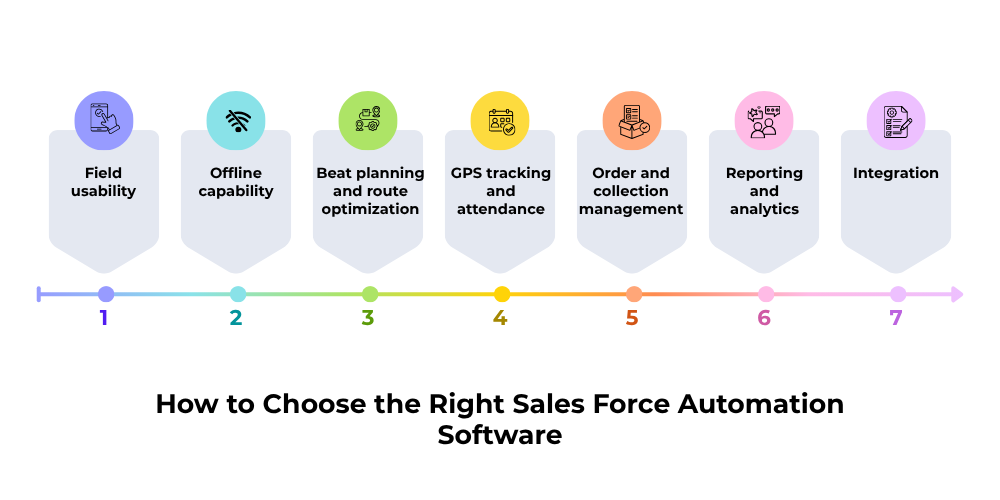
How to Choose the Right Sales Force Automation Software
Choosing an SFA platform should start with the field workflow rather than the feature list. A platform can have dozens of features and still create problems if sales representatives find it difficult to use. Here are the areas worth checking before making a decision.
1. Field usability
Ask your sales representatives to use the application themselves. Can they quickly find an outlet? Can they book an order without several unnecessary steps? Can they record a visit while standing inside a retail shop? A complicated interface often leads to incomplete field data.
2. Offline capability
Network availability should be considered before selecting field sales software. If representatives operate in rural areas, warehouses, highways, or territories with inconsistent mobile coverage, offline functionality becomes an operational requirement rather than a nice-to-have. Check what happens when a rep loses connectivity while creating an order or recording a visit.
3. Beat planning and route optimization
A proper beat plan should help managers answer two questions: Where should the representative go, and did they actually go there? Look for territory planning, route optimization, visit scheduling, and coverage reporting.
4. GPS tracking and attendance
A GPS-based tracking system should provide useful operational information rather than simply displaying a dot on a map. Managers should be able to understand travel paths, distances, customer visits, and field activity. Attendance should also connect logically with field operations.
5. Order and collection management
Order management and collection management for FMCG and distribution businesses must work at the outlet level, not in broad strokes. That means that the system should support SKU-level ordering, customer-specific pricing, and easy access to order history. It should also provide collection tracking and real-time visibility into outstanding amounts. The system must handle distributor workflows smoothly. Generate reports automatically so the system truly reflects how orders and money move in the field, not just how they appear on paper.
6. Reporting and analytics
A good SFA system should reduce reporting work, not create another reporting burden. Managers should be able to monitor metrics such as:
-
Sales by representative
-
Sales by territory
-
Outlet coverage
-
Productive calls
-
Order value
-
Collection value
-
Target achievement
-
Attendance
-
Travel distance
-
Daily sales activity
7. Integration
Consider whether the SFA platform needs to connect with ERP, accounting, inventory, CRM, or distributor systems. Integration becomes particularly important as the sales organization grows.
What Should FMCG Companies Look for in an SFA Platform?
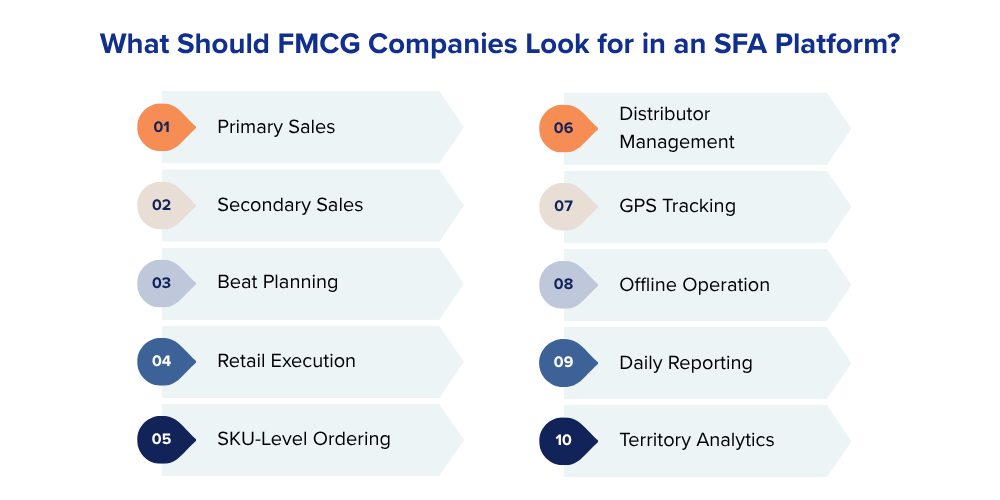
For FMCG organizations, the evaluation criteria should reflect how products actually move through the distribution network. Look for support for:
-
Primary sales: Sales from the company to distributors or other channel partners.
-
Secondary sales: Distributor or wholesaler sales to retailers and other downstream customers.
-
Beat planning: Structured scheduling of outlet visits.
-
Retail execution: Capturing information and completing activities at the outlet.
-
SKU-level ordering: Recording exactly what products and quantities retailers need.
-
Distributor management: Managing channel partners and their sales activities.
-
GPS tracking: Understanding where field representatives are working.
-
Offline operation: Continuing field activity despite unreliable connectivity.
-
Daily reporting: Getting DSR information without manual spreadsheet consolidation.
-
Territory analytics: Identifying under-covered or over-performing areas.
A platform that handles these workflows naturally will generally be easier for a field organization to adopt than one that requires extensive customization.
Final Thoughts
The right Sales Force Automation (SFA) platform depends on how your sales team actually works. Enterprise CRM platforms such as Salesforce, Microsoft Dynamics, SAP, and Oracle can make sense for organizations with complex technology environments and broad CRM requirements. Other platforms focus more directly on sales execution, CRM, or field-force operations. For FMCG companies, distributors, manufacturers, and wholesalers, however, the evaluation should ultimately come back to field execution.
Delta Sales App is built around these field requirements, combining GPS-based tracking, beat planning, customer visits, order management, collections, attendance, expenses, retail execution, offline functionality, and sales analytics in one field-sales platform. For teams that want to move away from disconnected spreadsheets, manual DSR preparation, and limited visibility into field activity, it provides a practical way to bring the sales operation into one workflow. Book a free demo and explore how it can fit your field sales workflow.