
The Operational Difference Between Managed and Unmanaged Field Teams
In the FMCG industry, field sales execution is the backbone of revenue generation. Whether it is retailer engagement, order collection, or product visibility, everything depends on how effectively field teams operate. However, not all organizations manage their field force in the same way. Some companies operate with structured systems, while others rely on loosely controlled field operations.
The difference between managed and unmanaged field teams directly impacts execution quality, sales consistency, and overall business scalability. In today’s competitive environment, companies increasingly rely on the FMCG field force management app to bring discipline and visibility into operations.
What Are Managed Field Teams?
Managed field teams operate under a structured system where every activity is planned, tracked, and analyzed. These teams follow defined workflows, reporting structures, and performance metrics, ensuring that field execution is disciplined and measurable rather than random or assumption-based.
In such setups, managers have clear visibility into field activities, including visits, orders, and retailer interactions. Tools like sales team tracking software ensure that every movement is recorded and aligned with business objectives, improving transparency and control across territories.
Managed teams are typically supported by technology, structured beat plans, and performance dashboards, making execution more predictable and efficient. Beyond this foundation, several additional operational practices strengthen their effectiveness:
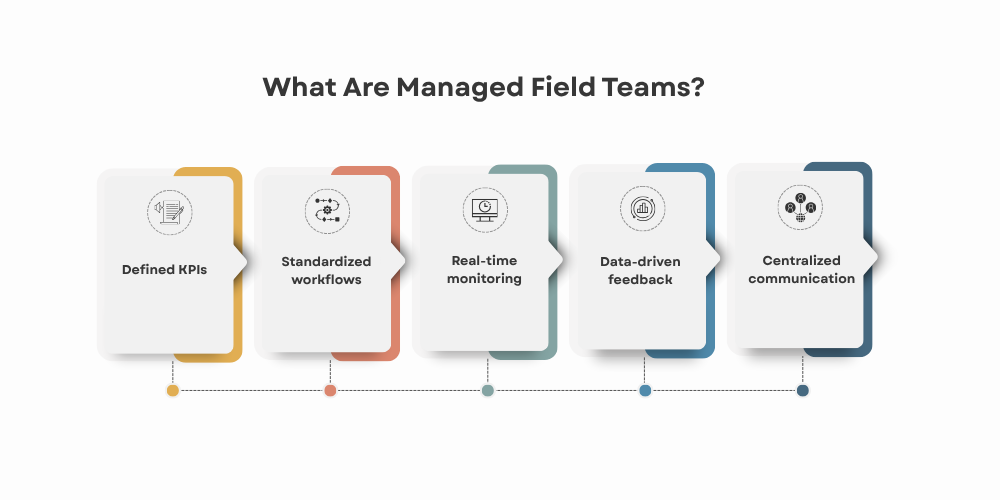
- Defined KPIs: Field performance is measured using structured indicators such as visit frequency, order conversion, and outlet coverage, ensuring objective evaluation.
- Standardized workflows: Sales representatives follow uniform processes for daily visits, order booking, and retailer engagement, reducing inconsistencies in execution.
- Real-time monitoring: Managers receive instant updates on field activities, enabling faster decisions and timely corrective actions when needed.
- Data-driven feedback: Performance reviews are based on analytics rather than assumptions, helping improve coaching and productivity.
- Centralized communication: All field updates and reports flow through a unified system, reducing delays and miscommunication.
These elements collectively make managed field teams more efficient, accountable, and scalable. Many organizations also adopt field force automation systems to further streamline operations and enhance execution consistency across large sales networks.
What Are Unmanaged Field Teams?
Unmanaged field teams operate with minimal structure, limited oversight, and very little standardization in daily field operations. Sales representatives often decide their own routes, reporting methods, and visit schedules without centralized coordination. This creates flexibility at the field level but significantly reduces control and consistency at the organizational level.
Because there is no unified system guiding execution, field activities vary widely across representatives. Some may follow regular retailer visits, while others may skip outlets or delay reporting, leading to uneven performance across territories. Over time, this directly impacts sales predictability and operational discipline.
This results in inconsistent execution, delayed reporting, and poor visibility for managers. Without real-time data flow, leadership teams struggle to understand actual field performance, making it difficult to take timely corrective actions.
Many FMCG companies without systems like field sales tracking apps struggle to maintain control over field operations, especially as team size and distribution complexity increases.
In such environments, decision-making becomes reactive rather than proactive, reducing overall operational efficiency and weakening long-term growth planning.
Beyond these challenges, unmanaged field teams typically show the following patterns:
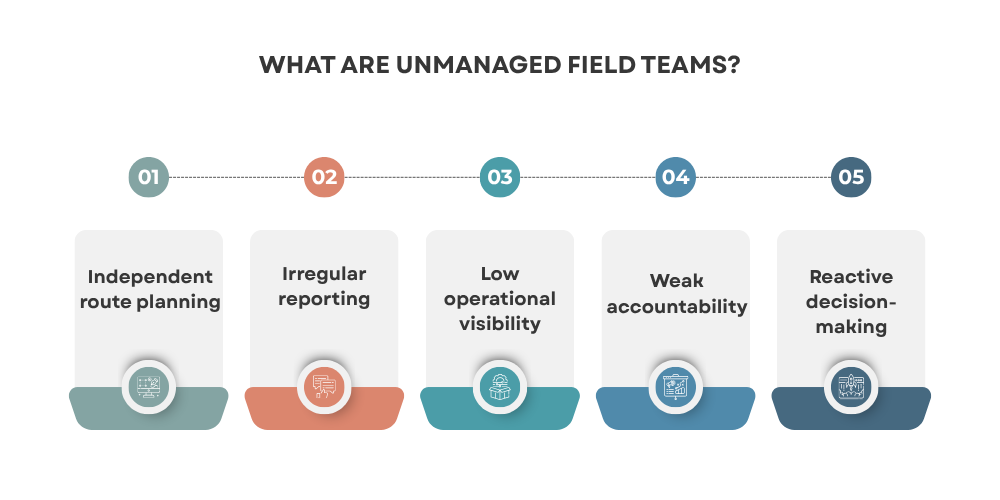
- Independent route planning: Sales representatives decide their own travel paths without structured beat planning or optimization.
- Irregular reporting: Field updates are often delayed, incomplete, or inconsistent across different team members.
- Low operational visibility: Managers lack real-time insights into visits, orders, and retailer engagement.
- Weak accountability: Field activities are difficult to verify, reducing discipline and execution consistency.
- Reactive decision-making: Issues are addressed after they occur instead of being prevented through proactive monitoring.
Overall, unmanaged field teams create operational uncertainty, making it difficult for FMCG businesses to scale efficiently or maintain consistent market performance.
Key Operational Differences Between Managed and Unmanaged Field Teams
The operational gap between managed and unmanaged field teams is not just structural, it fundamentally determines how effectively FMCG sales execution is controlled, measured, and scaled. Managed teams operate within a defined system of workflows, KPIs, and real-time reporting, while unmanaged teams depend largely on individual judgment and informal communication.
In managed environments, every field activity is standardized and monitored. In unmanaged environments, execution varies from one representative to another, creating inconsistencies in performance, visibility, and accountability.
Organizations using real-time sales monitoring tools consistently achieve stronger control over field execution compared to those dependent on manual reporting, where delays and inaccuracies are common.
Visibility and Control
Visibility is the most critical operational differentiator between the two models. Managed field teams provide complete transparency into daily operations, allowing managers to monitor visits, track movement, and assess performance in real time. Every action is digitally recorded, ensuring full clarity of field execution.
Unmanaged teams, on the other hand, operate with limited visibility. Field updates are often delayed, incomplete, or inconsistent, making it difficult for managers to validate actual on-ground activity. This lack of transparency leads to weak control and reactive decision-making.
Companies implementing a GPS based field tracking system gain real-time visibility into field movement, improved visit verification, and stronger accountability across teams.
Impact on Sales Productivity
Sales productivity is significantly higher in managed field teams due to structured workflows and reduced administrative burden. Field representatives spend more time on core selling activities such as retailer engagement, order collection, and market expansion.
In unmanaged teams, productivity is often diluted by unstructured tasks like manual reporting, irregular planning, and ad-hoc coordination. This reduces effective selling time and leads to inconsistent performance across regions.
Businesses using FMCG sales productivity tools are able to streamline field operations, improve time utilization, and enhance revenue contribution per representative.
Retail Execution Differences
Retail execution quality is far more consistent in managed systems. Field teams follow structured visit schedules, merchandising standards, and promotional compliance guidelines, ensuring uniform brand presence across all retail outlets.
This structured approach strengthens shelf visibility, improves product availability, and enhances overall customer experience at the point of sale.
Unmanaged teams lack this consistency. Retail visits may be irregular, execution standards may vary, and key outlets may be missed altogether. This directly impacts brand visibility and reduces sales opportunities.
Companies leveraging retail execution app achieve stronger in-store compliance, better merchandising discipline, and improved retail performance consistency.

Role of Technology in Field Team Management
Technology plays a key role in transforming unmanaged field teams into structured, efficient, and performance-driven operations. In FMCG businesses, manual coordination is no longer enough to manage large sales forces and complex distribution networks.
Digital tools such as mobile apps, dashboards, and automation systems provide real-time visibility into field activities. Managers can track visits, monitor performance, and ensure execution aligns with planned objectives without relying on delayed reports.
Solutions like mobile sales automation platforms help unify field operations by connecting sales teams, managers, and distributors on a single system. This improves reporting accuracy, reduces communication gaps, and ensures timely capture of field data.
Technology also standardizes core field processes and improves overall execution quality:
- Real-time tracking: Enables live monitoring of visits, routes, and field activities, helping managers maintain visibility and control over daily FMCG operations effectively.
- Process standardization: Ensures uniform execution of visit planning, order booking, reporting, and retailer engagement activities across all field teams in every territory.
- Improved communication: Strengthens coordination between sales representatives, managers, and distributors by enabling instant updates, reducing delays, and eliminating communication gaps in operations.
- Better decision-making: Provides real-time analytics and actionable insights that help FMCG managers make faster, more accurate, and data-driven operational and strategic decisions.
Overall, technology strengthens visibility, accountability, and execution consistency across FMCG field operations.
Challenges Faced by Unmanaged Field Teams
Unmanaged field teams face several operational challenges that directly impact FMCG performance, execution quality, and overall business efficiency across territories and distribution networks.
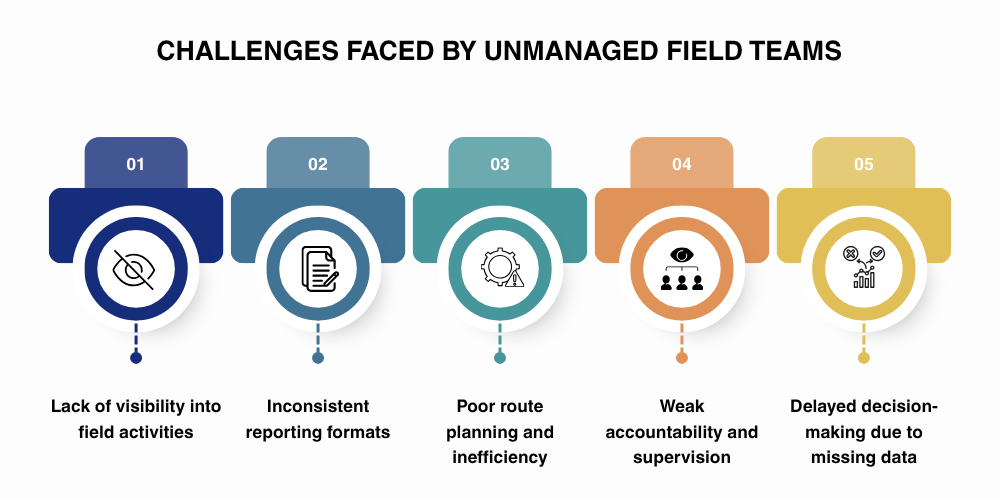
- Lack of visibility into field activities: Managers cannot track real-time visits, orders, or retailer interactions, leading to poor operational control and limited understanding of actual field execution performance.
- Inconsistent reporting formats: Field representatives submit reports in different styles and timelines, creating confusion, data mismatch, and making it difficult to analyze performance accurately across teams.
- Poor route planning and inefficiency: Sales representatives follow unstructured travel routes, increasing fuel costs, reducing outlet coverage, and wasting valuable selling time in daily field operations.
- Weak accountability and supervision: Without proper monitoring systems, it becomes difficult to verify visits and tasks, reducing discipline, responsibility, and consistent performance among field sales teams.
- Delayed decision-making due to missing data: Managers receive late or incomplete information, which slows down corrective actions and reduces responsiveness to market changes and sales opportunities.
Without systems like the FMCG order management system, companies struggle to maintain execution discipline, operational accuracy, and structured coordination across field sales operations.
Benefits of Structured Field Team Management
Structured or managed field teams create a disciplined and performance-driven FMCG environment where every activity is tracked, measured, and aligned with business objectives across territories.
- Better visibility into daily operations: Managers get real-time insights into visits, orders, and field activities, enabling full transparency and stronger control over FMCG sales execution.
- Improved retailer coverage and engagement: Structured scheduling ensures regular retailer visits, better communication, and stronger relationships, leading to improved market penetration and consistent product availability.
- Higher productivity and efficiency: Field teams spend more time selling and less time on manual tasks, improving output, efficiency, and overall contribution to FMCG revenue growth.
- Stronger accountability across teams: Every activity is tracked and verified, ensuring discipline, responsibility, and consistent performance from sales representatives across all assigned territories and outlets.
- Data-driven decision-making: Managers use real-time insights and analytics to make faster, more accurate decisions that improve execution, planning, and overall sales performance outcomes.
Businesses adopting FMCG distributor management software experience smoother coordination, improved operational efficiency, and stronger alignment between field teams, distributors, and management systems.
How Managed Teams Improve Retail Coverage and Beat Discipline
Managed field teams operate with structured beat plans that ensure every retailer is visited at the right frequency and no outlet is missed. This disciplined approach helps FMCG companies achieve consistent market coverage and stronger retailer relationships across all territories.
Because every route is pre-planned and monitored, field representatives follow a predictable schedule. This improves efficiency, reduces duplication of efforts, and ensures wider and more balanced retail coverage across regions.
In contrast, unmanaged teams often follow irregular visit patterns, miss key outlets, or over-visit some locations while ignoring others. This leads to uneven market penetration and weak brand presence in critical retail zones.
Managed systems also improve beat discipline by ensuring accountability at every level of execution. Managers can track whether planned visits are completed and take corrective action when deviations occur.
Using retail coverage optimization strategy, companies can ensure balanced workload distribution, better route efficiency, and improved market penetration across diverse territories.
Cost and Efficiency Comparison
Cost efficiency is one of the most important differences between managed and unmanaged field teams in FMCG operations. Managed teams are designed to minimize operational waste through structured planning, optimized routes, and controlled execution.
With predefined beat plans and real-time tracking, field representatives travel more efficiently, reducing unnecessary movement and fuel consumption. Better planning also ensures higher outlet coverage within the same operational cost, improving overall return on investment.
In contrast, unmanaged teams often generate higher operational expenses due to inefficient routing, repeated visits, and lack of coordination. Unplanned travel and duplication of effort significantly increase fuel costs and reduce productive selling time.
Organizations using the FMCG sales analytics platform can identify cost leakages, monitor expense patterns, and improve financial efficiency by making data-driven decisions.

Real-Time Monitoring and Accountability Gap
Real-time monitoring is one of the most critical differentiators between managed and unmanaged field teams. Managed systems provide instant visibility into field activities such as visits, orders, and productivity metrics.
This live data flow allows managers to track performance continuously, ensuring that field execution remains aligned with business goals. It also improves accountability, as every action is recorded and traceable.
Unmanaged teams, however, rely on delayed or manual reporting, which creates blind spots in operations and reduces the ability to verify actual field activity. This weakens accountability and often leads to performance inconsistencies.
Systems like employee location tracking help bridge this gap by enabling live monitoring, accurate attendance tracking, and real-time verification of field activities, ensuring stronger control and operational discipline.
How FMCG Companies Can Transition from Unmanaged to Managed Teams
Transitioning from unmanaged to managed field teams is a strategic shift that requires careful planning, process redesign, and strong technology adoption. It is not just about implementing tools but also about changing how field operations are executed, monitored, and evaluated across the organization.
Successful transformation ensures better visibility, improved accountability, and standardized execution across all territories, enabling FMCG companies to scale efficiently and sustainably.
Key steps include:
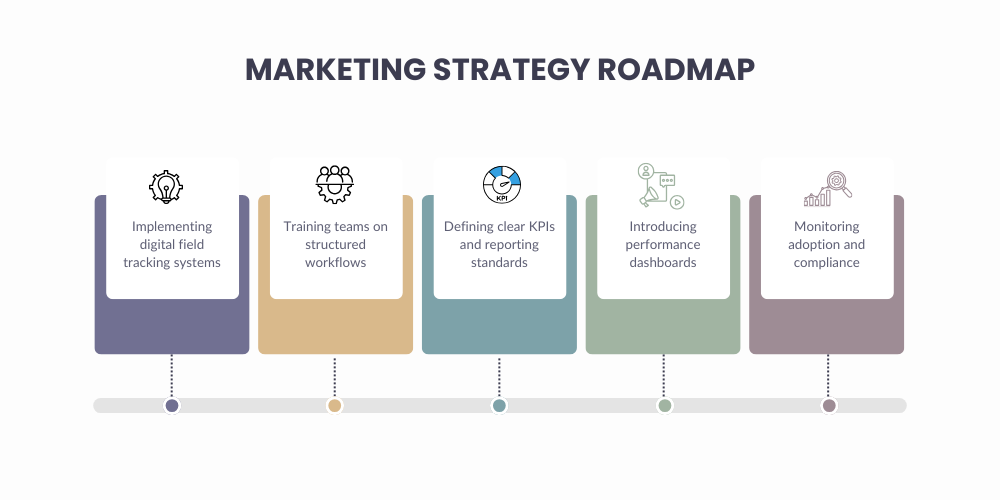
- Implementing digital field tracking systems: Enables real-time monitoring of sales representatives, improves visit verification, and ensures complete visibility into daily field activities across all territories and markets.
- Training teams on structured workflows: Ensures field representatives follow standardized processes for visits, orders, and reporting, improving consistency, efficiency, and reducing operational errors in execution.
- Defining clear KPIs and reporting standards: Establishes measurable performance indicators such as visits, conversions, and coverage, ensuring objective evaluation and aligning individual performance with business goals.
- Introducing performance dashboards: Provides managers with real-time insights into sales performance, helping identify gaps, track productivity, and make faster, data-driven operational decisions across teams.
- Monitoring adoption and compliance: Ensures field teams consistently use the system correctly, improving data accuracy, accountability, and long-term sustainability of managed operations across the organization.
Tools like sales force automation software for FMCG play a crucial role in enabling this transformation by digitizing field operations and ensuring structured, scalable execution.
Final Thoughts
The difference between managed and unmanaged field teams goes beyond daily operations, it directly shapes long-term business performance, scalability, and market competitiveness. Managed teams consistently deliver better visibility, stronger execution discipline, and higher efficiency, while unmanaged teams often struggle with control, coordination, and predictable growth.
In today’s highly competitive FMCG landscape, companies that adopt structured field systems gain a clear advantage in speed, accuracy, and decision-making. Leveraging solutions such as a digital field sales management system enables organizations to standardize operations, improve accountability, and achieve stronger market execution.
Ultimately, sustained success in FMCG field sales depends on how effectively companies monitor, control, and optimize their field operations in real time.
To experience this transformation in action, you can book a demo of Delta Sales App and see how it helps improve visibility, productivity, and overall field performance.