
How Industrial Distributors Can Collect Payments Faster From the Field

Industrial distributors often manage hundreds of customer accounts across dealers, contractors, workshops, and manufacturing units. Reps travel between these accounts to take orders, coordinate deliveries, discuss product requirements, and keep the relationship going. But closing a sale doesn't mean the payment actually arrives on time.
A distributor might supply industrial bearings, electrical components, pumps, tools, lubricants, or machine parts on credit. Once the invoice goes out, responsibility shifts to collecting that payment while still keeping new orders moving. If field reps can't see outstanding balances, or finance only hears about a collection update days later, overdue invoices pile up without anyone following up in time. That shows up as pressure on working capital, delayed supplier payments, and less money available to restock the fast-moving SKUs that actually need it. Even a business with strong sales can hit a cash flow problem once collections fall behind, and the longer an invoice sits unpaid, the harder it gets to manage inventory purchases and day-to-day operating costs.
Improving payment collection takes more than calling customers more often. Effective payment collection management means planning field visits around overdue accounts, giving reps accurate payment information to work with, recording collections the moment they happen, and keeping sales and accounts coordinated instead of operating as two separate teams.
This blog explains why payments get delayed in industrial distribution, how to establish a reliable field collection routine, and how field sales automation can improve collection visibility across territories.
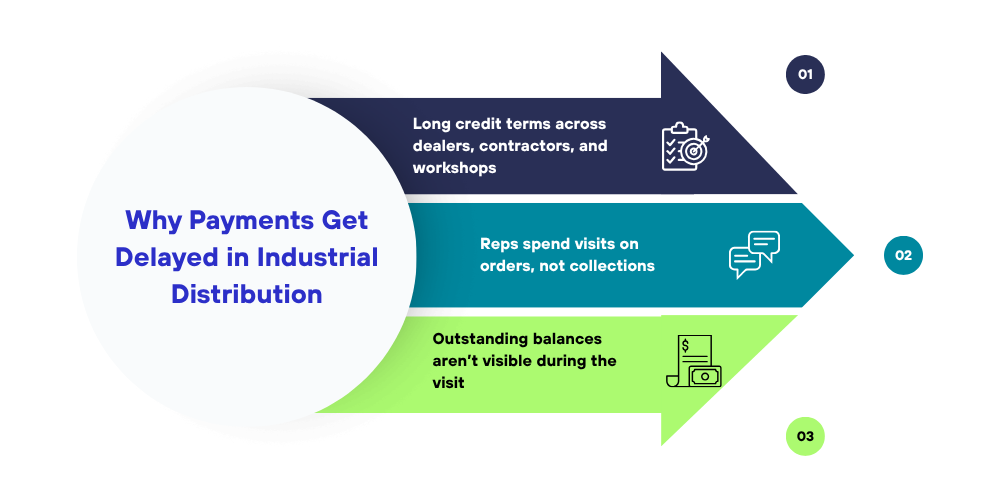
Why Payments Get Delayed in Industrial Distribution
Payment delays come from long credit periods, missed follow-ups, invoice disputes, and poor coordination between sales and finance. Industrial distribution makes this harder still, since customers run on different purchasing cycles and different internal approval processes; nothing moves on the same clock.
Understanding where the delays actually come from is what lets a distributor fix the collection process, rather than just sending more reminders and hoping, or waiting until the overdue balance has already become a real cash flow problem.
-
Long credit terms across dealers, contractors, and workshops
Industrial distribution serves customers with different credit arrangements, period. Established dealers might run 30-day terms, contractors pay after project milestones, and workshops settle several invoices together at month's end. One follow-up schedule can't cover all of that.
Without clear due dates and account-level credit information, a rep can't easily tell a customer who's following their agreed terms apart from one who's already overdue. Distributors need accurate credit terms on file for each account, with clear rules for what happens once a balance goes overdue and when additional credit gets approved.
-
Reps spend visits on orders, not collections
Reps naturally gravitate toward order booking, new opportunities, customer relationships, and the stuff that feels like actual selling. When sales targets emphasize revenue without weighting collections at all, reps keep booking new orders while the previous invoice sits unpaid, and nobody's incentivized to stop and chase it.
This gets worse in territories spread across industrial estates, workshops, and distant dealer locations. Miss a collection during the scheduled visit, and it's another week, or a separate trip; the rep probably won't make it. Putting collection tasks into the daily beat plan is what keeps new sales and payment recovery balanced instead of one eating the other.
-
Outstanding balances aren’t visible during the visit
When outstanding balances only live in office spreadsheets or finance records, a rep can't confidently talk through a pending invoice with the customer standing right there. They end up calling the accounts team mid-visit to confirm payment history, invoice details, and how much is actually still owed.
Delayed updates cause their own mess too: duplicate payment requests and collection opportunities missed entirely. A customer might have already made a partial payment that just hasn't shown up in the rep's records yet, and asking for the full amount again doesn't look good for anyone. Giving the team access to current payment information is what makes these conversations accurate instead of awkward.

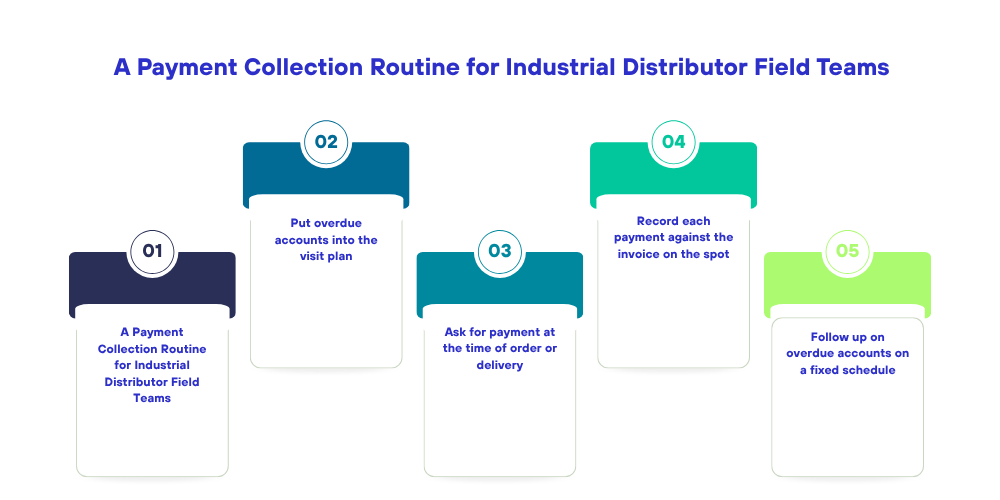
A Payment Collection Routine for Industrial Distributor Field Teams
A consistent collection routine helps reps prepare for the visit, prioritize the overdue accounts, and record payments accurately once they're made. Treating collections as something separate from the rest of the sales day is exactly what breaks down, so folding payment follow-ups into everyday operations is what actually holds it together.
That also gives managers a clearer way to review field performance, catch missed commitments, and coordinate with finance when a payment needs verification instead of guessing at who's covering what.
Check the customer’s outstanding balance before every visit
Before heading out on the route, reps should review outstanding invoices, due dates, previous payment commitments, and recent collection activity. That's what lets them understand where a customer actually stands on payment before walking in to discuss a new order.
An industrial dealer might have three unpaid invoices, and only one of them would actually be overdue. Knowing exactly which one needs attention keeps the rep from putting unnecessary pressure on a customer who's otherwise current and keeps the conversation focused on the invoice that matters. Where possible, this should sit in a mobile sales app the rep can check on the spot, not a separate spreadsheet or a call back to the office.
-
Put overdue accounts into the visit plan
Collection priorities belong in the daily beat plan, not bolted on after. Group overdue customers by territory and location, then build the route so important accounts get timely attention without adding unnecessary travel on top of what's already planned.
Say a rep has eight visits scheduled across an industrial area, two of them dealers with overdue balances. If those dealers already sit near the planned route, the rep handles payment during the same trip instead of scheduling a separate one. High-value overdue accounts, or customers who've already missed a payment commitment, can justify adjusting the route even when it means a bit more travel to reach them.
-
Ask for payment at the time of order or delivery
Order booking and payment collection should work together. When customers place repeat orders or receive deliveries, representatives have an opportunity to review pending invoices, confirm payment dates, and discuss any issues affecting settlement.
For instance, a dealer ordering replacement components may also have an invoice approaching its due date. The representative can confirm whether payment is scheduled and clarify the outstanding amount before finalizing the next steps. This creates a regular collection touchpoint without requiring a separate visit. Representatives should still follow the distributor's credit policy and obtain approval before extending additional credit to accounts with overdue balances.
-
Record each payment against the invoice on the spot
Reps should record the customer, payment amount, date, payment method, and invoice reference the moment a payment comes in. Partial payments need the same treatment, documented right away, so the remaining balance stays clear and nobody asks the customer for the same amount twice.
A customer pays NPR 25,000 against an NPR 70,000 invoice; the collection record should reflect that payment and the remaining NPR 45,000, subject to whatever other adjustments apply. Recording it immediately is what prevents a forgotten transaction, and it's what lets finance reconcile collections without chasing down details later. Distributors should also have clear procedures in place for verifying cash, check, bank transfer, and digital payments, since each one carries its own risk of error.
-
Follow up on overdue accounts on a fixed schedule
Every overdue invoice needs a defined next action and a follow-up date attached to it; nothing should just sit there waiting for someone to remember. Depending on the account, that next step might be a payment reminder, a conversation with purchasing, invoice clarification, or escalation to a sales manager.
Reps should record the outcome of every follow-up, the amount promised, the expected payment date, and the reason for the delay if there is one. A customer promises payment by Friday and misses it; that account gets reviewed again right away, not left to surface at the next routine visit weeks later. A fixed follow-up schedule is what keeps collection responsibilities clear and stops older invoices from quietly getting forgotten.
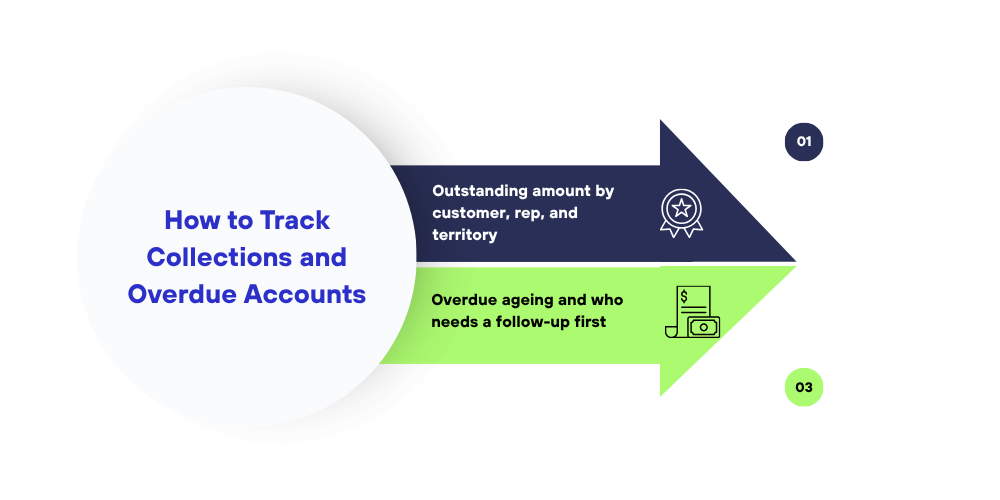
How To Track Collections and Overdue Accounts
Collection reports show how much is actually still outstanding, where the delays are concentrated, and which customers need attention first- information total sales or orders booked alone can't give you. A strong sales number says nothing about whether customers are paying within the agreed credit period.
-
Outstanding amount by customer, rep, and territory
Managers should be able to review outstanding balances by customer, assigned representative, and territory. This reveals which accounts contribute the most unpaid amounts and whether collection problems are concentrated in particular areas or customer segments.
For example, a distributor may have strong sales across three territories, but one territory could contain several customers with consistently delayed payments. Breaking down the data helps managers determine whether the issue requires more frequent visits, customer-level escalation, or a review of credit arrangements. Separate views of total outstanding balances, overdue amounts, and collections received during a reporting period help prevent misleading comparisons.
-
Overdue ageing and who needs a follow-up first
An ageing report groups unpaid invoices by how long they have passed their due dates, such as 1–30, 31–60, 61–90, and more than 90 days. These categories help managers distinguish recently overdue payments from older balances that may require stronger intervention.
A useful report should include the customer name, invoice number, due date, outstanding amount, last collection activity, and next follow-up date. Managers can then prioritize older invoices, assign responsibility, and escalate accounts with repeated delays. Reviewing ageing reports regularly also helps identify customers whose overdue balances are increasing, allowing the business to address collection risks before they place greater pressure on working capital.
How Delta Sales App Helps Field Teams Collect Payments
Industrial distributors need coordination between customer visits, order booking, payment collection, and management reporting, all of it connected instead of living in separate places. When these run on disconnected spreadsheets and office updates that arrive days late, field teams spend less time on customers and less time on timely collections; both suffer at once.
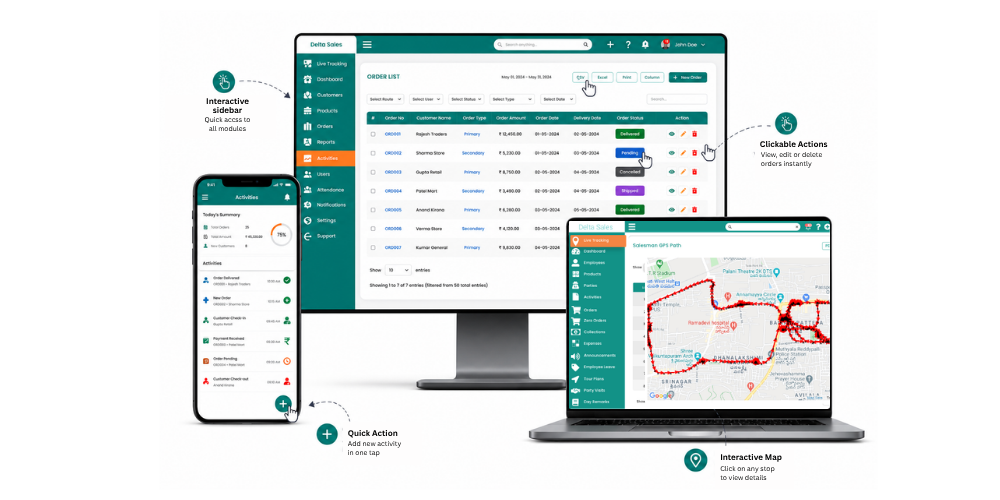
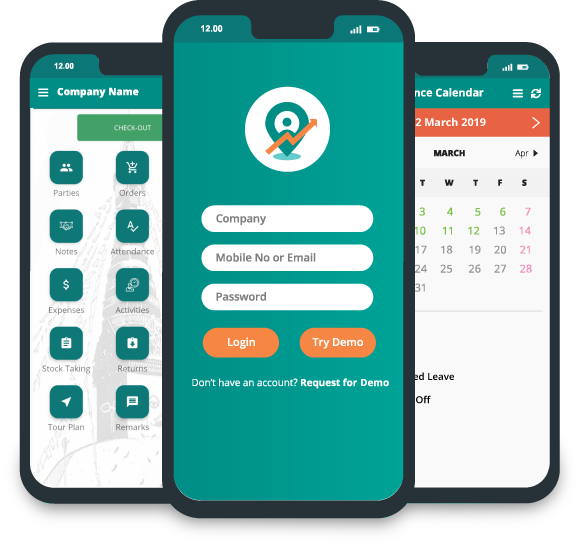
Delta Sales App supports field sales automation and employee tracking, helping businesses organize sales activity and improve visibility into field operations. Its order booking, collection reporting, beat planning, GPS tracking, and reporting capabilities can support a more structured collection workflow, one where payment follow-up isn't an afterthought bolted onto the sales process.
-
Book orders and log collections in the same visit
Delta Sales App supports field order reporting and collection reporting, helping representatives record relevant sales activities during customer visits. Keeping these activities within a structured field-sales workflow reduces reliance on separate manual reports and gives managers a clearer view of what happens in the field.
For example, a representative visiting an industrial components dealer may book a repeat order, discuss an overdue invoice, and record a payment received. The collection information can then be used in the distributor's reporting process, subject to the configured workflow and finance verification.
-
Plan visits around overdue accounts.
Delta Sales App offers beat planning, route optimization, and GPS-based field employee tracking. These capabilities help managers organize territory visits and monitor field activity, supporting collection-focused planning when combined with reliable overdue-account information.
For example, a manager can identify customers requiring payment follow-ups and coordinate those accounts with the representative's planned visits. The route can then be arranged to reduce unnecessary travel while allowing time for collection discussions and regular sales activities. Reviewing planned visits alongside field activity also helps managers identify accounts that repeatedly miss scheduled follow-ups.
-
See outstanding and collection reports by rep and territory
Delta Sales App provides sales reporting and dashboards to support field performance monitoring and collection visibility, depending on the configured reporting capabilities. Managers can review collection activity across representatives and territories to identify follow-up gaps, recognize collection progress, and determine where additional support is needed.
For distributors with multiple field representatives, structured reports make it easier to review collection activity against assigned responsibilities and sales targets. Managers can investigate missed commitments, identify accounts requiring escalation, and coordinate with finance when recorded payments need verification.
Conclusion
Faster payment collection in industrial distribution starts with a consistent process. Representatives need to know which invoices require attention, managers need to include collections in territory planning, and finance teams need accurate records of payments received.
Reviewing outstanding balances before visits, recording payments immediately, and following a fixed schedule can reduce missed follow-ups and improve coordination between field sales and accounts teams. Overdue ageing reports also help distributors identify payment risks early and prioritize customers who need more attention. Field sales automation app supports this process by connecting order booking, collection reporting, beat planning, and field activity visibility. Delta Sales App helps industrial distributors organize field operations and monitor sales and collection activities, giving managers a better foundation for coordinating field teams.
Start by reviewing overdue invoices, assigning responsibility for each account, and incorporating collection priorities into the daily beat plan. A consistent workflow can help make customer visits more productive while improving visibility into receivables and collection performance.
Explore Delta Sales App to see how field sales automation can support your distributor's collection workflow.